


1. Executive Summary
1.1. Global Men’s Underwear Snapshot, 2025 and 2032
1.2. Market Opportunity Assessment, 2025 – 2032, US$ Bn
1.3. Key Market Trends
1.4. Future Market Projections
1.5. Premium Market Insights
1.6. Industry Developments and Key Market Events
1.7. PMR Analysis and Recommendations
2. Market Overview
2.1. Market Scope and Definition
2.2. Market Dynamics
2.2.1. Drivers
2.2.2. Restraints
2.2.3. Opportunity
2.2.4. Challenges
2.2.5. Key Trends
2.3. Macro-Economic Factors
2.3.1. Global Sectorial Outlook
2.3.2. Global GDP Growth Outlook
2.3.3. Other Macro-economic Factors
2.4. COVID-19 Impact Analysis
2.5. Forecast Factors – Relevance and Impact
2.6. Regulatory Landscape
2.7. Value Chain Analysis
2.7.1. List of Raw Materials Suppliers
2.7.2. List of Product Manufacturers
2.7.3. List of Product Distributors
2.7.4. List of End Users
2.8. PESTLE Analysis
2.9. Porter’s Five Force Analysis
3. Price Trend Analysis, 2019 – 2032
3.1. Key Highlights
3.2. Key Factors Impacting Product Prices
3.3. Pricing Analysis, By Fabric
3.4. Regional Prices and Historical and Future Growth Trends
4. Global Men’s Underwear Outlook: Historical (2019 – 2023) and Forecast (2025 – 2032)
4.1. Key Highlights
4.1.1. Market Volume (Unit) Projections
4.1.2. Market Size (US$ Bn) and Volume (Unit) and Y-o-Y Growth
4.1.3. Absolute $ Opportunity
4.2. Market Size (US$ Bn) and Volume (Unit) Analysis and Forecast
4.2.1. Historical Market Size (US$ Bn) and Volume (Unit) Analysis, 2019 – 2023
4.2.2. Current Market Size (US$ Bn) and Volume (Unit) Analysis and Forecast, 2023–2031
4.3. Global Men’s Underwear Outlook: Fabric
4.3.1. Introduction / Key Findings
4.3.2. Historical Market Size (US$ Bn) and Volume (Unit) Analysis, By Fabric, 2019 – 2023
4.3.3. Current Market Size (US$ Bn) and Volume (Unit) Analysis and Forecast, By Fabric, 2025 – 2032
4.3.3.1. Cotton
4.3.3.2. Wool
4.3.3.3. Silk
4.3.3.4. Polyester
4.3.3.5. Rayon
4.3.3.6. Linen
4.3.3.7. Nylon
4.3.3.8. Others
4.4. Market Attractiveness Analysis: Fabric
4.5. Global Men’s Underwear Outlook: Category
4.5.1. Introduction / Key Findings
4.5.2. Historical Market Size (US$ Bn) and Volume (Unit) Analysis, By Category, 2019 – 2023
4.5.3. Current Market Size (US$ Bn) and Volume (Unit) Analysis and Forecast, By Category, 2025 – 2032
4.5.3.1. Regular Brief
4.5.3.2. Boxer Brief
4.5.3.3. Boxer Shorts
4.5.3.4. Trunks
4.5.3.5. Thongs
4.6. Market Attractiveness Analysis: Category
4.7. Global Men’s Underwear Outlook: Size
4.7.1. Introduction / Key Findings
4.7.2. Historical Market Size (US$ Bn) and Volume (Unit) Analysis, By Size, 2019 – 2023
4.7.3. Current Market Size (US$ Bn) and Volume (Unit) Analysis and Forecast, By Size, 2025 – 2032
4.7.3.1. XS
4.7.3.2. S
4.7.3.3. M
4.7.3.4. L
4.7.3.5. XL
4.7.3.6. XXL
4.7.3.7. XXXL
4.8. Market Attractiveness Analysis: Size
4.9. Global Men’s Underwear Outlook: Age Group
4.9.1. Introduction / Key Findings
4.9.2. Historical Market Size (US$ Bn) and Volume (Unit) Analysis, By Age Group, 2019 – 2023
4.9.3. Current Market Size (US$ Bn) and Volume (Unit) Analysis and Forecast, By Age Group, 2025 – 2032
4.9.3.1. 15 to 25
4.9.3.2. 26 to 35
4.9.3.3. 46 to 55
4.9.3.4. 56 to 65
4.9.3.5. 65+
4.10. Market Attractiveness Analysis: Age Group
4.11. Global Men’s Underwear Outlook: Price Range
4.11.1. Introduction / Key Findings
4.11.2. Historical Market Size (US$ Bn) and Volume (Unit) Analysis, By Price Range, 2019 – 2023
4.11.3. Current Market Size (US$ Bn) and Volume (Unit) Analysis and Forecast, By Price Range, 2025 – 2032
4.11.3.1. Below US$ 10
4.11.3.2. US$ 10 to US$ 20
4.11.3.3. US$ 20 to US$ 30
4.11.3.4. US$ 30 and Above
4.12. Market Attractiveness Analysis: Price Range
4.13. Global Men’s Underwear Outlook: Sales Channel
4.13.1. Introduction / Key Findings
4.13.2. Historical Market Size (US$ Bn) and Volume (Unit) Analysis, By Sales Channel, 2019 – 2023
4.13.3. Current Market Size (US$ Bn) and Volume (Unit) Analysis and Forecast, By Sales Channel, 2025 – 2032
4.13.3.1. Wholesalers/ Distributors
4.13.3.2. Hypermarkets/ Supermarkets
4.13.3.3. Specialty Stores
4.13.3.4. Multi-brand Stores
4.13.3.5. Online Retailers
4.13.3.6. Others (Department Stores)
4.14. Market Attractiveness Analysis: Sales Channel
5. Global Men’s Underwear Outlook: Region
5.1. Key Highlights
5.2. Historical Market Size (US$ Bn) and Volume (Unit) Analysis, By Region, 2019 – 2023
5.3. Current Market Size (US$ Bn) and Volume (Unit) Analysis and Forecast, By Region, 2025 – 2032
5.3.1. North America
5.3.2. Europe
5.3.3. East Asia
5.3.4. South Asia and Oceania
5.3.5. Latin America
5.3.6. Middle East & Africa
5.4. Market Attractiveness Analysis: Region
6. North America Men’s Underwear Outlook: Historical (2019 – 2023) and Forecast (2025 – 2032)
6.1. Key Highlights
6.2. Pricing Analysis
6.3. Historical Market Size (US$ Bn) and Volume (Unit) Analysis, By Market, 2019 – 2023
6.3.1. By Country
6.3.2. By Fabric
6.3.3. By Category
6.3.4. By Size
6.3.5. By Age Group
6.3.6. Price Range
6.3.7. Sales Channel
6.4. Current Market Size (US$ Bn) and Volume (Unit) Analysis and Forecast, By Country, 2025 – 2032
6.4.1. U.S.
6.4.2. Canada
6.5. Current Market Size (US$ Bn) and Volume (Unit) Analysis and Forecast, By Fabric, 2025 – 2032
6.5.1. Cotton
6.5.2. Wool
6.5.3. Silk
6.5.4. Polyester
6.5.5. Rayon
6.5.6. Linen
6.5.7. Nylon
6.5.8. Others
6.6. Current Market Size (US$ Bn) and Volume (Unit) Analysis and Forecast, By Category, 2025 – 2032
6.6.1. Regular Brief
6.6.2. Boxer Brief
6.6.3. Boxer Shorts
6.6.4. Trunks
6.6.5. Thongs
6.7. Current Market Size (US$ Bn) and Volume (Unit) Analysis and Forecast, By Size, 2025 – 2032
6.7.1. XS
6.7.2. S
6.7.3. M
6.7.4. L
6.7.5. XL
6.7.6. XXL
6.7.7. XXXL
6.8. Current Market Size (US$ Bn) and Volume (Unit) Analysis and Forecast, By Age Group, 2025 – 2032
6.8.1. 15 to 25
6.8.2. 26 to 35
6.8.3. 46 to 55
6.8.4. 56 to 65
6.8.5. 65+
6.9. Current Market Size (US$ Bn) and Volume (Unit) Analysis and Forecast, By Price Range, 2025 – 2032
6.9.1. Below US$ 10
6.9.2. US$ 10 to US$ 20
6.9.3. US$ 20 to US$ 30
6.9.4. US$ 30 and Above
6.10. Current Market Size (US$ Bn) and Volume (Unit) Analysis and Forecast, By Sales Channel, 2025 – 2032
6.10.1. Wholesalers/ Distributors
6.10.2. Hypermarkets/ Supermarkets
6.10.3. Specialty Stores
6.10.4. Multi-brand Stores
6.10.5. Online Retailers
6.10.6. Others (Department Stores)
6.11. Market Attractiveness Analysis
7. Europe Men’s Underwear Outlook: Historical (2019 – 2023) and Forecast (2025 – 2032)
7.1. Key Highlights
7.2. Pricing Analysis
7.3. Historical Market Size (US$ Bn) and Volume (Unit) Analysis, By Market, 2019 – 2023
7.3.1. By Country
7.3.2. By Fabric
7.3.3. By Category
7.3.4. By Size
7.3.5. By Age Group
7.3.6. Price Range
7.3.7. Sales Channel
7.4. Current Market Size (US$ Bn) and Volume (Unit) Analysis and Forecast, By Country, 2025 – 2032
7.4.1. Germany
7.4.2. France
7.4.3. U.K.
7.4.4. Italy
7.4.5. Spain
7.4.6. Russia
7.4.7. Türkiye
7.4.8. Rest of Europe
7.5. Current Market Size (US$ Bn) and Volume (Unit) Analysis and Forecast, By Fabric, 2025 – 2032
7.5.1. Cotton
7.5.2. Wool
7.5.3. Silk
7.5.4. Polyester
7.5.5. Rayon
7.5.6. Linen
7.5.7. Nylon
7.5.8. Others
7.6. Current Market Size (US$ Bn) and Volume (Unit) Analysis and Forecast, By Category, 2025 – 2032
7.6.1. Regular Brief
7.6.2. Boxer Brief
7.6.3. Boxer Shorts
7.6.4. Trunks
7.6.5. Thongs
7.7. Current Market Size (US$ Bn) and Volume (Unit) Analysis and Forecast, By Size, 2025 – 2032
7.7.1. XS
7.7.2. S
7.7.3. M
7.7.4. L
7.7.5. XL
7.7.6. XXL
7.7.7. XXXL
7.8. Current Market Size (US$ Bn) and Volume (Unit) Analysis and Forecast, By Age Group, 2025 – 2032
7.8.1. 15 to 25
7.8.2. 26 to 35
7.8.3. 46 to 55
7.8.4. 56 to 65
7.8.5. 65+
7.9. Current Market Size (US$ Bn) and Volume (Unit) Analysis and Forecast, By Price Range, 2025 – 2032
7.9.1. Below US$ 10
7.9.2. US$ 10 to US$ 20
7.9.3. US$ 20 to US$ 30
7.9.4. US$ 30 and Above
7.10. Current Market Size (US$ Bn) and Volume (Unit) Analysis and Forecast, By Sales Channel, 2025 – 2032
7.10.1. Wholesalers/ Distributors
7.10.2. Hypermarkets/ Supermarkets
7.10.3. Specialty Stores
7.10.4. Multi-brand Stores
7.10.5. Online Retailers
7.10.6. Others (Department Stores)
7.11. Market Attractiveness Analysis
8. East Asia Men’s Underwear Outlook: Historical (2019 – 2023) and Forecast (2025 – 2032)
8.1. Key Highlights
8.2. Pricing Analysis
8.3. Historical Market Size (US$ Bn) and Volume (Unit) Analysis, By Market, 2019 – 2023
8.3.1. By Country
8.3.2. By Fabric
8.3.3. By Category
8.3.4. By Size
8.3.5. By Age Group
8.3.6. Price Range
8.3.7. Sales Channel
8.4. Current Market Size (US$ Bn) and Volume (Unit) Analysis and Forecast, By Country, 2025 – 2032
8.4.1. China
8.4.2. Japan
8.4.3. South Korea
8.5. Current Market Size (US$ Bn) and Volume (Unit) Analysis and Forecast, By Fabric, 2025 – 2032
8.5.1. Cotton
8.5.2. Wool
8.5.3. Silk
8.5.4. Polyester
8.5.5. Rayon
8.5.6. Linen
8.5.7. Nylon
8.5.8. Others
8.6. Current Market Size (US$ Bn) and Volume (Unit) Analysis and Forecast, By Category, 2025 – 2032
8.6.1. Regular Brief
8.6.2. Boxer Brief
8.6.3. Boxer Shorts
8.6.4. Trunks
8.6.5. Thongs
8.7. Current Market Size (US$ Bn) and Volume (Unit) Analysis and Forecast, By Size, 2025 – 2032
8.7.1. XS
8.7.2. S
8.7.3. M
8.7.4. L
8.7.5. XL
8.7.6. XXL
8.7.7. XXXL
8.8. Current Market Size (US$ Bn) and Volume (Unit) Analysis and Forecast, By Age Group, 2025 – 2032
8.8.1. 15 to 25
8.8.2. 26 to 35
8.8.3. 46 to 55
8.8.4. 56 to 65
8.8.5. 65+
8.9. Current Market Size (US$ Bn) and Volume (Unit) Analysis and Forecast, By Price Range, 2025 – 2032
8.9.1. Below US$ 10
8.9.2. US$ 10 to US$ 20
8.9.3. US$ 20 to US$ 30
8.9.4. US$ 30 and Above
8.10. Current Market Size (US$ Bn) and Volume (Unit) Analysis and Forecast, By Sales Channel, 2025 – 2032
8.10.1. Wholesalers/ Distributors
8.10.2. Hypermarkets/ Supermarkets
8.10.3. Specialty Stores
8.10.4. Multi-brand Stores
8.10.5. Online Retailers
8.10.6. Others (Department Stores)
8.11. Market Attractiveness Analysis
9. South Asia & Oceania Men’s Underwear Outlook: Historical (2019 – 2023) and Forecast (2025 – 2032)
9.1. Key Highlights
9.2. Pricing Analysis
9.3. Historical Market Size (US$ Bn) and Volume (Unit) Analysis, By Market, 2019 – 2023
9.3.1. By Country
9.3.2. By Fabric
9.3.3. By Category
9.3.4. By Size
9.3.5. By Age Group
9.3.6. Price Range
9.3.7. Sales Channel
9.4. Current Market Size (US$ Bn) and Volume (Unit) Analysis and Forecast, By Country, 2025 – 2032
9.4.1. India
9.4.2. Southeast Asia
9.4.3. ANZ
9.4.4. Rest of South Asia & Oceania
9.5. Current Market Size (US$ Bn) and Volume (Unit) Analysis and Forecast, By Fabric, 2025 – 2032
9.5.1. Cotton
9.5.2. Wool
9.5.3. Silk
9.5.4. Polyester
9.5.5. Rayon
9.5.6. Linen
9.5.7. Nylon
9.5.8. Others
9.6. Current Market Size (US$ Bn) and Volume (Unit) Analysis and Forecast, By Category, 2025 – 2032
9.6.1. Regular Brief
9.6.2. Boxer Brief
9.6.3. Boxer Shorts
9.6.4. Trunks
9.6.5. Thongs
9.7. Current Market Size (US$ Bn) and Volume (Unit) Analysis and Forecast, By Size, 2025 – 2032
9.7.1. XS
9.7.2. S
9.7.3. M
9.7.4. L
9.7.5. XL
9.7.6. XXL
9.7.7. XXXL
9.8. Current Market Size (US$ Bn) and Volume (Unit) Analysis and Forecast, By Age Group, 2025 – 2032
9.8.1. 15 to 25
9.8.2. 26 to 35
9.8.3. 46 to 55
9.8.4. 56 to 65
9.8.5. 65+
9.9. Current Market Size (US$ Bn) and Volume (Unit) Analysis and Forecast, By Price Range, 2025 – 2032
9.9.1. Below US$ 10
9.9.2. US$ 10 to US$ 20
9.9.3. US$ 20 to US$ 30
9.9.4. US$ 30 and Above
9.10. Current Market Size (US$ Bn) and Volume (Unit) Analysis and Forecast, By Sales Channel, 2025 – 2032
9.10.1. Wholesalers/ Distributors
9.10.2. Hypermarkets/ Supermarkets
9.10.3. Specialty Stores
9.10.4. Multi-brand Stores
9.10.5. Online Retailers
9.10.6. Others (Department Stores)
9.11. Market Attractiveness Analysis
10. Latin America Men’s Underwear Outlook: Historical (2019 – 2023) and Forecast (2025 – 2032)
10.1. Key Highlights
10.2. Pricing Analysis
10.3. Historical Market Size (US$ Bn) and Volume (Unit) Analysis, By Market, 2019 – 2023
10.3.1. By Country
10.3.2. By Fabric
10.3.3. By Category
10.3.4. By Size
10.3.5. By Age Group
10.3.6. Price Range
10.3.7. Sales Channel
10.4. Current Market Size (US$ Bn) and Volume (Unit) Analysis and Forecast, By Country, 2025 – 2032
10.4.1. Brazil
10.4.2. Mexico
10.4.3. Rest of Latin America
10.5. Current Market Size (US$ Bn) and Volume (Unit) Analysis and Forecast, By Fabric, 2025 – 2032
10.5.1. Cotton
10.5.2. Wool
10.5.3. Silk
10.5.4. Polyester
10.5.5. Rayon
10.5.6. Linen
10.5.7. Nylon
10.5.8. Others
10.6. Current Market Size (US$ Bn) and Volume (Unit) Analysis and Forecast, By Category, 2025 – 2032
10.6.1. Regular Brief
10.6.2. Boxer Brief
10.6.3. Boxer Shorts
10.6.4. Trunks
10.6.5. Thongs
10.7. Current Market Size (US$ Bn) and Volume (Unit) Analysis and Forecast, By Size, 2025 – 2032
10.7.1. XS
10.7.2. S
10.7.3. M
10.7.4. L
10.7.5. XL
10.7.6. XXL
10.7.7. XXXL
10.8. Current Market Size (US$ Bn) and Volume (Unit) Analysis and Forecast, By Age Group, 2025 – 2032
10.8.1. 15 to 25
10.8.2. 26 to 35
10.8.3. 46 to 55
10.8.4. 56 to 65
10.8.5. 65+
10.9. Current Market Size (US$ Bn) and Volume (Unit) Analysis and Forecast, By Price Range, 2025 – 2032
10.9.1. Below US$ 10
10.9.2. US$ 10 to US$ 20
10.9.3. US$ 20 to US$ 30
10.9.4. US$ 30 and Above
10.10. Current Market Size (US$ Bn) and Volume (Unit) Analysis and Forecast, By Sales Channel, 2025 – 2032
10.10.1. Wholesalers/ Distributors
10.10.2. Hypermarkets/ Supermarkets
10.10.3. Specialty Stores
10.10.4. Multi-brand Stores
10.10.5. Online Retailers
10.10.6. Others (Department Stores)
10.11. Market Attractiveness Analysis
11. Middle East & Africa Men’s Underwear Outlook: Historical (2019 – 2023) and Forecast (2025 – 2032)
11.1. Key Highlights
11.2. Pricing Analysis
11.3. Historical Market Size (US$ Bn) and Volume (Unit) Analysis, By Market, 2019 – 2023
11.3.1. By Country
11.3.2. By Fabric
11.3.3. By Category
11.3.4. By Size
11.3.5. By Age Group
11.3.6. Price Range
11.3.7. Sales Channel
11.4. Current Market Size (US$ Bn) and Volume (Unit) Analysis and Forecast, By Country, 2025 – 2032
11.4.1. GCC Countries
11.4.2. Egypt
11.4.3. South Africa
11.4.4. Northern Africa
11.4.5. Rest of Middle East & Africa
11.5. Current Market Size (US$ Bn) and Volume (Unit) Analysis and Forecast, By Fabric, 2025 – 2032
11.5.1. Cotton
11.5.2. Wool
11.5.3. Silk
11.5.4. Polyester
11.5.5. Rayon
11.5.6. Linen
11.5.7. Nylon
11.5.8. Others
11.6. Current Market Size (US$ Bn) and Volume (Unit) Analysis and Forecast, By Category, 2025 – 2032
11.6.1. Regular Brief
11.6.2. Boxer Brief
11.6.3. Boxer Shorts
11.6.4. Trunks
11.6.5. Thongs
11.7. Current Market Size (US$ Bn) and Volume (Unit) Analysis and Forecast, By Size, 2025 – 2032
11.7.1. XS
11.7.2. S
11.7.3. M
11.7.4. L
11.7.5. XL
11.7.6. XXL
11.7.7. XXXL
11.8. Current Market Size (US$ Bn) and Volume (Unit) Analysis and Forecast, By Age Group, 2025 – 2032
11.8.1. 15 to 25
11.8.2. 26 to 35
11.8.3. 46 to 55
11.8.4. 56 to 65
11.8.5. 65+
11.9. Current Market Size (US$ Bn) and Volume (Unit) Analysis and Forecast, By Price Range, 2025 – 2032
11.9.1. Below US$ 10
11.9.2. US$ 10 to US$ 20
11.9.3. US$ 20 to US$ 30
11.9.4. US$ 30 and Above
11.10. Current Market Size (US$ Bn) and Volume (Unit) Analysis and Forecast, By Sales Channel, 2025 – 2032
11.10.1. Wholesalers/ Distributors
11.10.2. Hypermarkets/ Supermarkets
11.10.3. Specialty Stores
11.10.4. Multi-brand Stores
11.10.5. Online Retailers
11.10.6. Others (Department Stores)
11.11. Market Attractiveness Analysis
12. Competition Landscape
12.1. Market Share Analysis, 2023
12.2. Market Structure
12.2.1. Competition Intensity Mapping by Fabric
12.2.2. Competition Dashboard
12.3. Company Profiles (Details – Overview, Financials, Strategy, Recent Developments)
12.3.1. Hanesbrands Inc.
12.3.1.1. Overview
12.3.1.2. Segments and Products
12.3.1.3. Key Financials
12.3.1.4. Market Developments
12.3.1.5. Market Strategy
12.3.2. Philips-Van Heusen Corporation
12.3.3. Ralph Lauren Corporation
12.3.4. Jockey International Inc.
12.3.5. American Eagle Outfitter Inc.
12.3.6. Iconix Brand Group Inc.
12.3.7. J.C. Penny Corporation, Inc.
12.3.8. Berkshire Hathaway Inc.
12.3.9. Other Players
13. Appendix
13.1. Research Methodology
13.2. Research Assumptions
13.3. Acronyms and Abbreviations


- Clothing, Footwear, & Accessories
- Men’s Underwear Market
Men’s Underwear Market Size, Share, and Growth Forecast from 2025 - 2032
Men’s Underwear Market by Fabric (Cotton, Wool, Silk, Polyester, Rayon, Linen, Nylon), Category (Regular Brief, Boxer Brief, Boxer Shorts, Trunks, Thongs), Size, Age Group, Price Range, Sales Channel, and Regional Analysis from 2025 to 2032
Men’s Underwear Market Size and Share Analysis
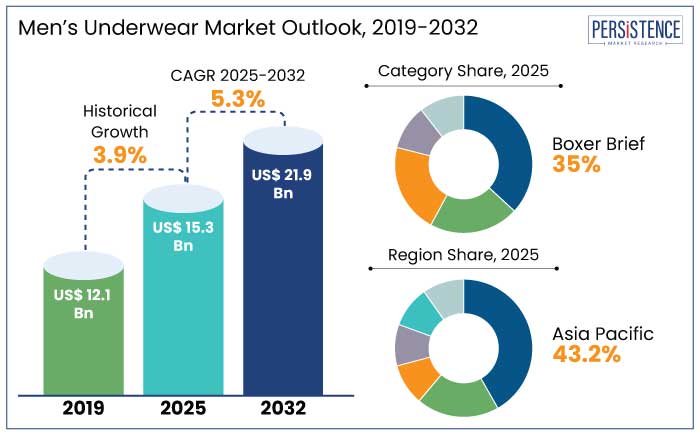
The global men’s underwear market is set to reach a size of US$ 15.3 Bn by 2025. It is anticipated to witness a CAGR of 5.3% during the forecast period to attain a value of US$ 21.9 Bn by 2032.
The market is predicted to witness an increasing demand for activewear-inspired underwear containing athletic and performance-oriented designs. Brands are estimated to focus on breathability, support, and moisture management, particularly for active and on-the-go consumers. By 2028, sports and performance underwear could represent 18% of the total market share, driven by rising trends in fitness and wellness.
Smart underwear with embedded sensors for health monitoring, temperature control, and performance tracking is set to gain popularity during the forecast period. By 2030, the market for smart textiles in underwear could be worth US$ 2 to US$ 3 Bn, driven by the integration of health-monitoring systems such as heart rate and temperature regulation. The advent of biometric-integrated underwear could appeal to health-conscious consumers seeking products that track personal wellness.
Key Highlights of the Industry
- Carbon-neutral manufacturing and the reduction of water waste in production are predicted to become key selling points, especially in Western markets.
- Innovations in fabrics such as antimicrobial, moisture-wicking, and UV-resistant materials will likely continue to be crucial in the development of performance-focused underwear.
- Introduction of clothing recycling programs and resale/second-hand markets are estimated to emerge as key trends with companies like Patagonia and MeUndies leading the way.
- The assessment period is predicted to witness a rising demand for gender-neutral and adaptive underwear that cater to diverse boy types, gender identities, and specific requirements.
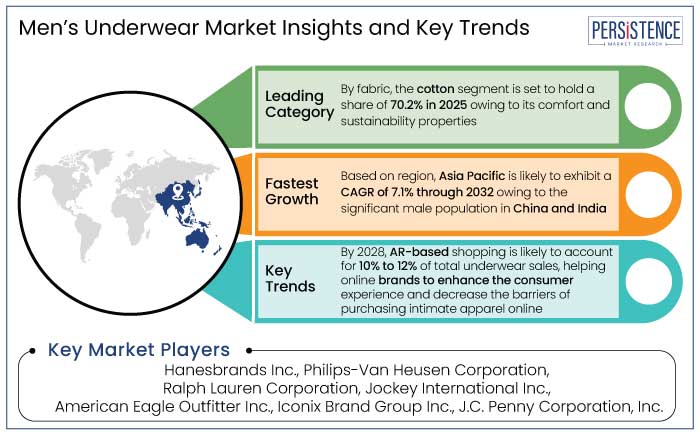
- By 2028, AR-based shopping is set to account for 10% to 12% of total underwear sales, helping online brands enhance the consumer experience and decrease the barriers of purchasing intimate apparel online.
- By 2030, DTC sales in the men’s underwear market could represent 40% to 45% of the total revenue, driven by surging influence of social media, personalized marketing, and subscription-based services.
- By category, the boxer brief segment is anticipated to hold a share of 35% in 2025 owing to their high comfort level.
- Based on fabric, the cotton segment is predicted to hold a share of 70.2% in 2025 owing to its sustainability properties.
- Men’s underwear market in Asia Pacific is set to exhibit a CAGR of 7.1% through 2032 owing to the presence of significant male demographic.
|
Market Attributes |
Key Insights |
|
Men’s Underwear Market Size (2025E) |
US$ 15.3 Bn |
|
Projected Market Value (2032F) |
US$ 21.9 Bn |
|
Global Market Growth Rate (CAGR 2025 to 2032) |
5.3% |
|
Historical Market Growth Rate (CAGR 2019 to 2023) |
3.9% |
DTC Brands in Emerging Countries of Asia Pacific are Fostering Growth
Asia Pacific is set to hold a share of 43.2% in 2025. The region is home to almost 60% of the global population with a significant male demographic in countries like China, India, Indonesia, and Japan, representing a massive potential customer base for the men’s underwear market. Growth in the middle-class population results in increased disposable income and a greater willingness to spend on premium and branded products.
- In India alone, the middle-class population is likely to reach 45% of the total population by 2030, significantly driving demand for higher-quality and branded underwear.
- By 2030, 60% of Asia’s population will live in urban areas.
- Urban dwellers have more exposure to global fashion trends and a preference for branded and comfortable underwear.
Men in urban areas are also more likely to adopt modern lifestyles, which emphasize wellness, personal grooming, and hygiene, increasing demand for premium underwear. Growing fitness and wellness trend in Asia Pacific, with an annual fitness market growth of 8.7%, has driven demand for activewear-inspired underwear with moisture-wicking and performance features.
Emerging DTC brands, such as India’s XYXX and China’s Neiwai, are leveraging digital channels to directly reach younger, tech-savvy consumers. This trend aligns with the increasing demand for personalized and subscription-based services.
Boxer Briefs to Gain Popularity due to High Comfort Level
Boxer brief is projected to generate a share of 35% in 2025. These briefs offer the snug fit and support of briefs, ideal for physical activity, while providing the coverage of boxers, ensuring comfort during daily wear. The added length prevents issues like chafing and riding up, making them suitable for various body types and lifestyles.
- A 2023 survey revealed that 42% of men globally identified boxer briefs as their preferred style.
- The trend is particularly strong among younger demographics, including millennials and Gen Z, who prioritize comfort and versatility.
Sales of performance-oriented boxer briefs with moisture-wicking and odor-resistant features increased by 22% globally from 2020 to 2023, owing to the global fitness boom. Their seamless and ergonomic design ensures comfort during extended wear, making them a go-to choice for men who seek underwear that transitions well from work to leisure activities.
Consumers Worldwide to Choose Cotton Fabric Owing to Sustainability Properties
Cotton is anticipated to generate a share of 70.2% in 2025. Cotton is renowned for its natural softness, making it the most comfortable fabric for sensitive skin and daily wear. This feature is a key reason why 67% of men globally prefer cotton underwear.
Cotton is highly breathable and efficiently absorbs moisture, decreasing sweat buildup and enhancing comfort in warm climates. This is particularly important in tropical regions like Asia Pacific, where demand for breathable fabrics is high. For instance,
- Studies indicate that cotton can hold up to 27 times its weight in water, making it ideal for maintaining freshness throughout the day.
As sustainability becomes a key purchasing factor, consumers are increasingly opting for natural and biodegradable materials like cotton. For example,
- Organic cotton, in particular, has seen a 25% increase in demand globally from 2021 to 2023.
- Several leading brands are committing to sustainable cotton sourcing. For instance, Calvin Klein and Hanes have pledged to use 100% sustainable cotton by 2030.
- Fruit of the Loom launched an organic cotton line in 2022, which contributed to a 15% rise in sales in North America.
- A 2023 survey revealed that 72% of consumers consider the environmental impact of their purchases, with 50% preferring cotton over synthetic fabrics due to its biodegradability.
Market Introduction and Trend Analysis
Potential growth in the global men’s underwear industry is predicted to be driven by advances in technology that result in personalized product offerings, with brands offering custom-fitted underwear based on individual preferences and body types. Personalized shopping experiences are anticipated to increase as brands invest in AI and body measurement technologies.
Performance-focused underwear products are anticipated to drive significant revenue growth, as consumers are willing to pay a premium for comfort, durability, and specialized features. Key innovations will likely include performance fabrics like moisture-wicking, temperature-regulating, and odor-resistant materials, along with eco-friendly options and ergonomic designs that cater to a variety of body types and needs.
Historical Growth and Course Ahead
The men’s underwear market growth was decent at a CAGR of 3.9% during the historical period. The period witnessed high demand for high-quality, comfortable, and functional underwear, thereby boosting the growth of premium brands, especially in developed markets. Premium men’s underwear accounted for 20% to 25% of the total market in 2023. Comfort and performance features, like moisture-wicking fabrics, anti-odor technology, and seamless designs, became key selling points.
- A survey revealed that 50% of consumers in 2023 cited comfort as their top priority when selecting underwear.
- Growth of online shopping and DTC brands like MeUndies, Tommy John, and Saxx contributed to market expansion. These brands capitalized on the rising preference for convenience, personalized shopping experiences, and subscription models.
The forecast period is predicted to witness innovations in functionality of men’s underwear. As consumers become more aware of environmental issues, demand for eco-friendly and sustainable products is anticipated to continue to rise. The share of sustainable men’s underwear is anticipated to rise to 30% of total market sales by 2030.
Market Growth Drivers
Rising Consumer Base Globally to Bolster Demand
Rising population in emerging markets along with a surging appetite for branded and premium products is fostering demand. The rapidly expanding middle-class populations in India and China are key drivers of growth as they are the significant consumer base for affordable yet stylish underwear brands. For instance,
- Millennials and Gen Z accounted for around 60% of global spending on apparel in 2022, including underwear.
- A survey revealed that 65% of Gen Z consumers are willing to pay more for sustainable and ethical products, providing opportunities for eco-conscious underwear brands.
Urban consumers typically seek premium and innovative products, boosting demand for features like moisture-wicking fabrics and ergonomic designs.
Premiumization Trend to Play a Key Role in Augmenting Sales
In 2023, global disposable income per capita increased by 4.3%, creating room for discretionary spending on luxury and high-quality goods. For instance,
- In China, 70% of urban consumers reported an increased willingness to spend on premium clothing and accessories, including underwear.
- A study in 2022 revealed that 78% of men prioritize comfort over cost when purchasing underwear.
Demand for high-performance fabrics like modal, Supima cotton, and microfibers is on the rise. For example,
- The use of sustainable premium fabrics like bamboo and organic cotton is growing, with the sustainable underwear market anticipated to surge by 8.4% annually until 2030.
- Around 40% of consumers in the U.S. stated they are willing to pay a premium for sustainably made clothing.
Brands like Calvin Klein, Tommy John, and Saxx have built a loyal customer base by focusing on innovative designs and high-quality materials. Nearly 68% of premium underwear buyers stick with their preferred brand due to consistent quality and superior experiences.
Market Restraining Factors
Supply Chain Challenges to Remain a Growth Hindering Factor
Uneven supply of raw materials has led to significant disruptions and price volatility. For example,
- Global cotton prices increased by 43% in 2022, owing to weather conditions and disruptions in global supply chains.
It resulted in higher production costs for underwear brands, particularly those relying on cotton-based materials.
Modal and other synthetic fibers, which are crucial for performance fabrics, also experience fluctuating prices, exacerbated by the bottlenecks in the global supply chain. These rising costs often result in higher production prices for underwear manufacturers. For instance,
- According to a survey conducted by the Textile Exchange, 38% of brands cited raw material cost inflation as a significant challenge to profitability.
Market Growth Opportunities
Innovations in Functionality and Design to Create New Growth Prospects
Men are increasingly prioritizing functionality in underwear for diverse activities such as sports, travel, and daily wear. Products with antimicrobial treatments, like those using silver ions or bamboo fibers, have gained immense popularity. Underwear with pouch support and contoured fits address consumer demand for both and aesthetics. For instance,
- Brands like Saxx and Tommy John have seen double-digit sales growth owing to the incorporation of these features.
Brands are also innovating to cater to specific consumer requirements by developing athletic underwear featuring seamless construction, anti-chafing technology, and stretchable materials. They are making travel friendly underwear with quick dying and lightweight option for frequent travelers. Businesses are further innovating climate specific underwear with temperature regulating fabrics like those using Phase-Change Materials (PCM), to cater to consumers in extreme climates.
Emergence of Inclusive and Adaptive Underwear to Create New Opportunities
Traditional ‘one-size-fits-all’ approaches are giving way to extended sizing options, including plus-size and athletic builds.
- A study indicated that 68% of male shoppers want brands to offer better-fitting underwear for all body types.
Brands are hence working toward offering tailored options to suit individual preferences. For instance, companies like Tommy John and Duluth Trading Co. have introduced stretchable and contour-fitting underwear to cater to diverse physiques.
Based on statistics provided by WHO, over 1 billion people worldwide experience some form of disability, making adaptive clothing a critical market segment. Gender-neutral underwear appeals to a broad spectrum of consumers, including LGBTQ+ communities.
- A study revealed that 35% of Gen Z consumers prefer gender-neutral products, highlighting the importance of inclusive designs for younger demographics.
- Brands like TomboyX and MeUndies have introduced unisex collections, focusing on comfortable, minimalist styles that cater to all genders.
Competitive Landscape for the Men’s Underwear Market
Companies in the men’s underwear market are introducing fabrics like moisture-wicking materials, bamboo, and organic cotton for comfort, durability, and sustainability. They are offering ergonomic designs, seamless construction, anti-chafing technology, and pouch-support designs to enhance comfort and functionality.
Brands are also creating niche products like odor-resistant, temperature-regulating, or performance-enhancing underwear for specific needs. They are establishing a distinct brand voice and aesthetic to appeal to target demographics.
Businesses are further highlighting eco-friendly production processes and materials to attract environmentally conscious consumers. They are also partnering with well-known personalities to create buzz and build trust.
Organizations are providing sizing guides, extended size ranges, or even customizable fits to cater to diverse body types. They are offering convenient subscription models for regular replenishments.
Recent Industry Developments
- In September 2024, Skim’s Men’s Shop dropped a new range of underwear, including a stretch kit boxer.
- In August 2024, Diamond Cross Ranch along with Shinesty, released a codesigned collection of Western inspired men’s and women’s underwear.
- In May 2024, SAXX Underwear and Quality Meats introduced a ranchy new campaign for men to reconsider their undies and prioritize comfort.
- In February 2024, STEP ONE, an Aussie underwear brand launched exclusively at John Lewis.
- In February 2024, Adonis Underwear introduced its first ever fitness style for men, the AdonisFit Performance Long Black Boxer Brief.
Companies Covered in Men’s Underwear Market
- Hanesbrands Inc.
- Philips-Van Heusen Corporation
- Ralph Lauren Corporation
- Jockey International Inc.
- American Eagle Outfitter Inc.
- Iconix Brand Group Inc.
- J.C. Penny Corporation, Inc.
- Berkshire Hathaway Inc.
- Others
Frequently Asked Questions
The market is anticipated to reach a value of US$ 21.9 Bn by 2032.
Boxer shorts are the most popular type of men’s underwear.
Asia Pacific is predicted to hold a share of 43.2% in 2025.
Prominent players in the market include Hanesbrands Inc., Philips-Van Heusen Corporation, and Ralph Lauren Corporation.
The market is predicted to witness a CAGR of 5.3% through the forecast period.


