


- Executive Summary
- Global Melamine Tableware Market Snapshot 2025 and 2032
- Market Opportunity Assessment, 2025-2032, US$ Mn
- Key Market Trends
- Industry Developments and Key Market Events
- Demand Side and Supply Side Analysis
- PMR Analysis and Recommendations
- Market Overview
- Market Scope and Definitions
- Value Chain Analysis
- Macro-Economic Factors
- Global GDP Outlook
- Global Tableware & Kitchenware Industry Overview
- Global Hospitality Industry Overview
- Forecast Factors - Relevance and Impact
- COVID-19 Impact Assessment
- PESTLE Analysis
- Porter's Five Forces Analysis
- Geopolitical Tensions: Market Impact
- Regulatory and Technology Landscape
- Market Dynamics
- Drivers
- Restraints
- Opportunities
- Trends
- Price Trend Analysis, 2019 - 2032
- Region-wise Price Analysis
- Price by Segments
- Price Impact Factors
- Global Melamine Tableware Market Outlook: Historical (2019 - 2024) and Forecast (2025 - 2032)
- Key Highlights
- Global Melamine Tableware Market Outlook: Product Type
- Introduction/Key Findings
- Historical Market Size (US$ Mn) and Volume (Units) Analysis by Product Type, 2019-2024
- Current Market Size (US$ Mn) and Volume (Units) Forecast, by Product Type, 2025-2032
- Plates
- Bowls
- Cups
- Trays
- Others
- Market Attractiveness Analysis: Product Type
- Global Melamine Tableware Market Outlook: Application
- Introduction/Key Findings
- Historical Market Size (US$ Mn) and Volume (Units) Analysis by Application, 2019-2024
- Current Market Size (US$ Mn) and Volume (Units) Forecast, by Application, 2025-2032
- Residential
- Commercial
- Market Attractiveness Analysis: Application
- Global Melamine Tableware Market Outlook: Region
- Key Highlights
- Historical Market Size (US$ Mn) and Volume (Units) Analysis by Region, 2019-2024
- Current Market Size (US$ Mn) and Volume (Units) Forecast, by Region, 2025-2032
- North America
- Europe
- East Asia
- South Asia & Oceania
- Latin America
- Middle East & Africa
- Market Attractiveness Analysis: Region
- North America Melamine Tableware Market Outlook: Historical (2019 - 2024) and Forecast (2025 - 2032)
- Key Highlights
- Pricing Analysis
- North America Market Size (US$ Mn) and Volume (Units) Forecast, by Country, 2025-2032
- U.S.
- Canada
- North America Market Size (US$ Mn) and Volume (Units) Forecast, by Product Type, 2025-2032
- Plates
- Bowls
- Cups
- Trays
- Others
- North America Market Size (US$ Mn) and Volume (Units) Forecast, by Application, 2025-2032
- Residential
- Commercial
- Europe Melamine Tableware Market Outlook: Historical (2019 - 2024) and Forecast (2025 - 2032)
- Key Highlights
- Pricing Analysis
- Europe Market Size (US$ Mn) and Volume (Units) Forecast, by Country, 2025-2032
- Germany
- Italy
- France
- U.K.
- Spain
- Russia
- Rest of Europe
- Europe Market Size (US$ Mn) and Volume (Units) Forecast, by Product Type, 2025-2032
- Plates
- Bowls
- Cups
- Trays
- Others
- Europe Market Size (US$ Mn) and Volume (Units) Forecast, by Application, 2025-2032
- Residential
- Commercial
- East Asia Melamine Tableware Market Outlook: Historical (2019 - 2024) and Forecast (2025 - 2032)
- Key Highlights
- Pricing Analysis
- East Asia Market Size (US$ Mn) and Volume (Units) Forecast, by Country, 2025-2032
- China
- Japan
- South Korea
- East Asia Market Size (US$ Mn) and Volume (Units) Forecast, by Product Type, 2025-2032
- Plates
- Bowls
- Cups
- Trays
- Others
- East Asia Market Size (US$ Mn) and Volume (Units) Forecast, by Application, 2025-2032
- Residential
- Commercial
- East Asia Market Size (US$ Mn) and Volume (Units) Forecast, by , 2025-2032
- South Asia & Oceania Melamine Tableware Market Outlook: Historical (2019 - 2024) and Forecast (2025 - 2032)
- Key Highlights
- Pricing Analysis
- South Asia & Oceania Market Size (US$ Mn) and Volume (Units) Forecast, by Country, 2025-2032
- India
- Southeast Asia
- ANZ
- Rest of SAO
- South Asia & Oceania Market Size (US$ Mn) and Volume (Units) Forecast, by Product Type, 2025-2032
- Plates
- Bowls
- Cups
- Trays
- Others
- South Asia & Oceania Market Size (US$ Mn) and Volume (Units) Forecast, by Application, 2025-2032
- Residential
- Commercial
- Latin America Melamine Tableware Market Outlook: Historical (2019 - 2024) and Forecast (2025 - 2032)
- Key Highlights
- Pricing Analysis
- Latin America Market Size (US$ Mn) and Volume (Units) Forecast, by Country, 2025-2032
- Brazil
- Mexico
- Rest of LATAM
- Latin America Market Size (US$ Mn) and Volume (Units) Forecast, by Product Type, 2025-2032
- Plates
- Bowls
- Cups
- Trays
- Others
- Latin America Market Size (US$ Mn) and Volume (Units) Forecast, by Application, 2025-2032
- Residential
- Commercial
- Middle East & Africa Melamine Tableware Market Outlook: Historical (2019 - 2024) and Forecast (2025 - 2032)
- Key Highlights
- Pricing Analysis
- Middle East & Africa Market Size (US$ Mn) and Volume (Units) Forecast, by Country, 2025-2032
- GCC Countries
- South Africa
- Northern Africa
- Rest of MEA
- Middle East & Africa Market Size (US$ Mn) and Volume (Units) Forecast, by Product Type, 2025-2032
- Plates
- Bowls
- Cups
- Trays
- Others
- Middle East & Africa Market Size (US$ Mn) and Volume (Units) Forecast, by Application, 2025-2032
- Residential
- Commercial
- Competition Landscape
- Market Share Analysis, 2024
- Market Structure
- Competition Intensity Mapping
- Competition Dashboard
- Company Profiles
- GET Enterprises
- Company Overview
- Product Portfolio/Offerings
- Key Financials
- SWOT Analysis
- Company Strategy and Key Developments
- Carlisle Foodservice Products
- Elite Global Solutions
- American Metalcraft
- Kip Melamine
- Assheuer + Pott
- Sanshin
- Kokusai-Kako
- Mehar Tableware (Dinewell)
- Dongguan Thousand
- Fujian Sanheng
- Zhejiang Taishun
- Huizhou Wuhe
- Beijing Yameimi
- Huizhou Sungold
- GET Enterprises
- Appendix
- Research Methodology
- Research Assumptions
- Acronyms and Abbreviations


- Advanced Materials
- Melamine Tableware Market
Melamine Tableware Market Size, Trends, Share, and Growth Forecast, 2025 - 2032
Melamine Tableware Market by Product Type (Plates, Bowls, Cups, Trays, Others), Application (Residential, Commercial), and Regional Analysis for 2025 - 2032
Key Industry Highlights:
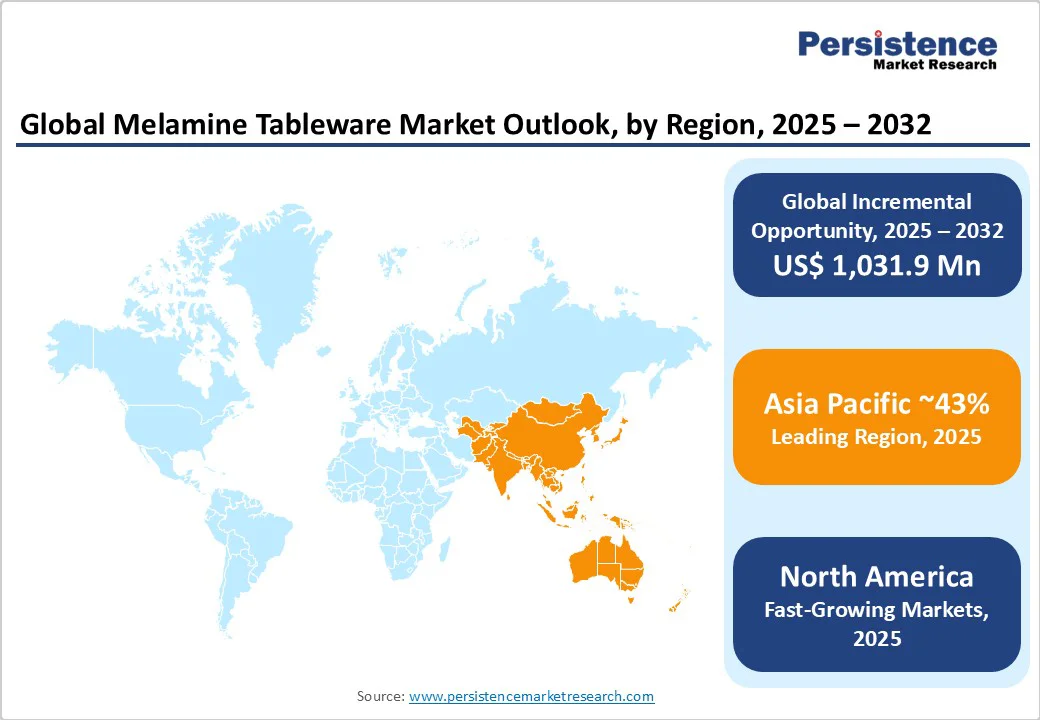
- Leading Region: Asia Pacific leads global market volume and growth, with China and India driving production, domestic demand, and exports.
- Fastest-growing Regional Market: North America is the largest-consuming regional market, supported by hospitality and institutional demand for durable, lightweight, and commercial-grade tableware.
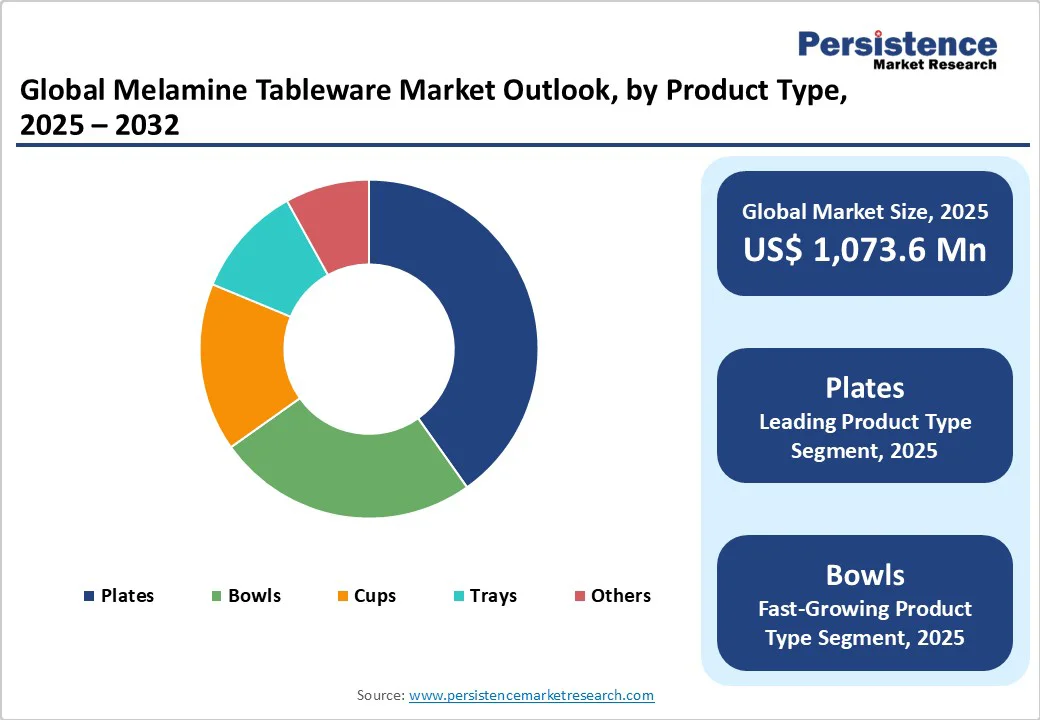
- Leading Product Type: Plates are expected to account for nearly 45% of the melamine tableware market revenue share in 2025, reflecting their essential role in both household and commercial dining applications.
- Leading Application: Commercial use is projected to account for around 60% of demand across the hospitality, institutional, and healthcare sectors, where durability and cost-effectiveness are essential.
- Key Market Opportunity: Heat-resistant and self-healing surface technologies are driving product expansion and creating opportunities for premium and multifunctional melamine tableware.
| Key Insights | Details |
|---|---|
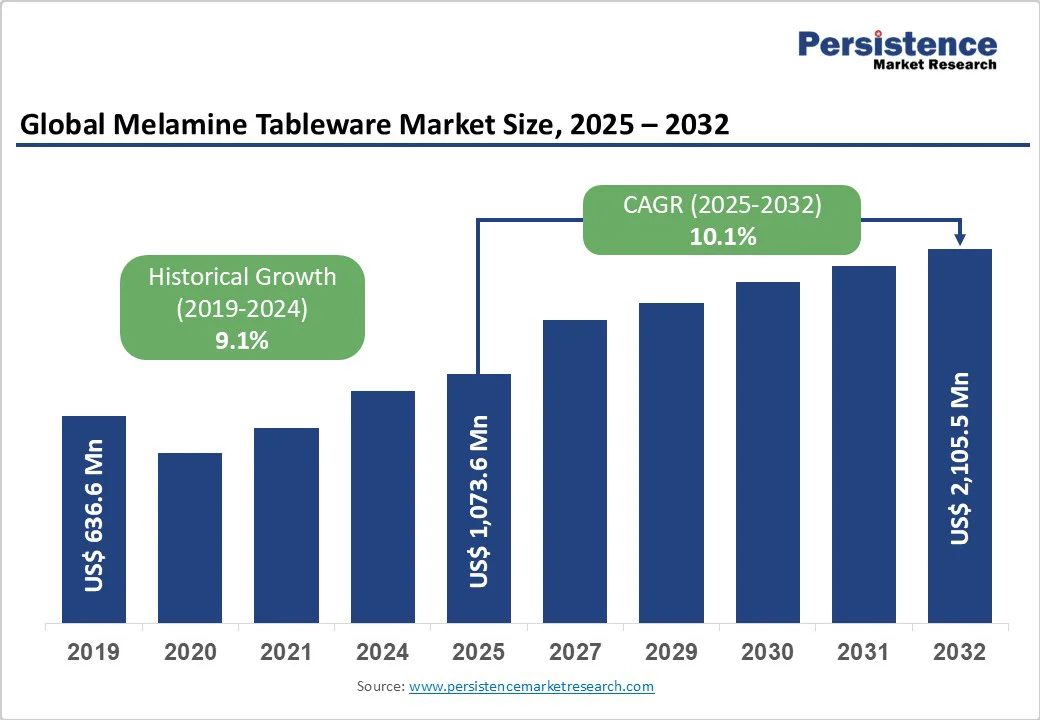
| Melamine Tableware Market Size (2025E) | US$ 1,073.6 Mn |
| Market Value Forecast (2032F) | US$ 2,105.5 Mn |
| Projected Growth CAGR (2025 - 2032) | 10.1% |
| Historical Market Growth (2019-2024) | 9.1% |
Market Factors - Growth, Barriers, and Opportunity Analysis
Rising Hospitality and Foodservice Industry Adoption
The hospitality and foodservice sector is a major catalyst for the melamine tableware market. Restaurants, hotels, and catering services are increasingly opting for melamine products due to their durability, break-resistance, and cost efficiency compared with traditional ceramic or glass alternatives.
In commercial environments, the lightweight nature of melamine reduces staff fatigue during handling and lowers replacement costs. Additionally, the attractive aesthetics of melamine tableware, which mimic traditional materials, make it suitable for upscale dining.
Melamine tableware is also widely popular among urban households, with surveys showing that 65% of city dwellers prefer melamine over ceramics due to its shatterproof properties and vibrant designs. The products’ resistance to temperature and weather variations makes them ideal for patios, poolside areas, and camping activities.
Higher disposable incomes in emerging economies are fueling the demand for stylish, affordable, and multifunctional tableware that complements casual dining and modern lifestyles. As consumers prioritize convenience, safety, and aesthetics in everyday dining, melamine continues to gain traction across domestic, outdoor, and recreational use, further supporting overall market growth.
Health and Safety Regulatory Concerns
Strict regulations, particularly from the U.S. Food and Drug Administration (FDA), limit melamine content in tableware due to concerns about migration into foods, especially acidic or high-temperature dishes. Excessive exposure to melamine has been linked to potential kidney health risks, prompting authorities to enforce stringent safety standards.
Manufacturers must comply with these regulations through rigorous quality control, testing, and certification processes, which increase operational costs and production complexity. Ensuring adherence to safety guidelines is critical to market access, particularly in North America and Europe, where regulatory scrutiny is high. These compliance requirements act as a restraint on small-scale manufacturers and new market entrants.
The melamine tableware market is also facing increasing pressure from environmentally conscious consumers, challenging the reliance on petroleum-based melamine production. Fluctuations in crude oil prices directly affect manufacturing costs and retail pricing, creating operational and strategic challenges.
Furthermore, growing consumer preference for eco-friendly and sustainable alternatives has prompted manufacturers to explore bio-composites, bamboo-filled resins, and other environmentally friendly innovations. While this shift promotes long-term sustainability, it also requires significant R&D investment and production adjustments, which may slow adoption and constrain short-term growth in regions where traditional melamine dominates.
Technological Innovation and Product Development
Advanced manufacturing techniques have enabled the production of ultra-high-heat-resistant melamine, making products suitable for microwave and oven-safe applications. This expansion in functionality opens up new segments in both residential and commercial markets.
The integration of AI-driven quality control has improved production efficiency and significantly reduced defect rates. Innovations such as self-healing surfaces extend product lifecycles, enhance durability, and allow brands to differentiate through premium product lines. These developments create opportunities for higher-margin offerings and stimulate consumer interest in versatile, long-lasting, and aesthetically appealing melamine tableware.
A key market for melamine tableware is the Asia Pacific, led by China, which controls around 38% of the market due to high production capacity, labor availability, and strong domestic consumption. On the other hand, India’s expanding middle class is fueling the demand for attractive and affordable dinnerware, driving higher home improvement spending and contributing to the estimated 12.3% CAGR of the regional market, well above the global average.
Combined with local manufacturing advantages, cost efficiencies, and strong export potential, the Asia Pacific offers significant growth opportunities, both for established players and new entrants seeking to capture expanding residential and commercial demand.
Category-wise Analysis
Product Type Insights
Plates are expected to dominate the melamine tableware market, accounting for approximately 45% of revenue share in 2025, owing to their widespread use in residential and commercial settings. Their durability, resistance to chipping and staining, and broad design range make them ideal for both household dining and professional foodservice applications.
Melamine plates also enhance food presentation with attractive designs, appealing to restaurants, hotels, and catering services. In commercial environments, melamine plates' thermal shock resistance reduces replacement frequency and operational costs, making them a cost-effective, long-lasting, and versatile choice across multiple market segments.
Application Insights
The commercial segment is estimated to account for around 60% of the market in 2025, driven by the extensive use of melamine tableware in restaurants, hotels, schools, and healthcare facilities, where frequent breakage and replacement have created strong demand for durable tableware.
Post-pandemic recovery and the resurgence of dining out have further boosted investment in long-lasting, high-quality melamine products. Institutions also prioritize safety, hygiene, and ease of cleaning, making melamine tableware an attractive choice for high-traffic settings. The material's ability to combine functionality, durability, and aesthetic appeal continues to drive its growth in commercial applications worldwide.
Regional Insights
North America Melamine Tableware Market Trends
North America is a leading market for melamine tableware, supported by high consumer spending, robust supply chains, and strong commercial demand. The U.S. restaurant sector alone is projected to grow 3.3% annually between 2023 and 2028, reflecting sustained demand for durable and stylish tableware.
Consumers increasingly prefer long-lasting products for casual and everyday dining, while commercial establishments value melamine for its lightweight and break-resistant properties. Additionally, strict regulatory frameworks, particularly the FDA’s migration guidelines, drive continuous product innovation focused on enhanced safety, quality, and sustainability, encouraging manufacturers to develop advanced, compliant tableware solutions.
Europe Melamine Tableware Market Trends
Europe is anticipated to account for approximately 18% of the melamine tableware market share in 2025, with Germany as both a leading producer and consumer. The U.K. and France contribute significantly to regional growth, fueled by rising hospitality demand and increasing trends in outdoor and casual dining.
Harmonized safety standards across the European Union (EU) have facilitated cross-border sales, while European consumers show a strong preference for eco-friendly, innovative, and premium-quality products. Manufacturers in the region emphasize sustainability, advanced design, and compliance with health regulations to meet consumer expectations, reinforcing Europe’s stable yet innovation-driven market trajectory.
Asia Pacific Melamine Tableware Market Trends
Asia Pacific is the fastest-growing and largest-volume regional market for melamine tableware, with China dominating both production and consumption due to efficient supply chains, low labor costs, and access to raw materials. India, set to exhibit an approximate 12.3% CAGR through 2032, is emerging as a key market driven by rising disposable incomes and evolving dining culture.
Japan contributes through established foodservice channels and a strong focus on product quality. Combined, these countries make Asia Pacific the powerhouse of the melamine tableware market, offering opportunities for domestic sales, exports, and innovation-driven growth across both commercial and residential segments.
Competitive Landscape
The global melamine tableware market structure is moderately consolidated, featuring a mix of large multinational manufacturers and regional specialists. Competition primarily revolves around product durability, aesthetics, safety, and production efficiency, with companies striving to differentiate through quality and innovation.
Market players are focusing on research and development, adopting advanced manufacturing techniques and sustainable practices to meet evolving consumer preferences and comply with stringent regulatory standards. Strategic investments in design, operational efficiency, and premium product offerings help maintain competitive advantages, enhance brand loyalty, and support expansion across residential, commercial, and institutional segments.
Key Industry Developments
- In July 2025, Target's new 8.5″ Melamine Layering Salad Plate from their Threshold line became a viral hit among shoppers for its coastal aesthetic and budget-friendly price of just US$ 3 per plate. Available in three colorways, these BPA-free, dishwasher-safe melamine plates are durable, perfect for everyday use, and versatile enough for meals, salads, snacks, and appetizers. Customers have praised the plates for their quality, noting they wash well and resist scuffing even after multiple uses.
- In June 2025, Thunder Group launched melamine crockery in calming hues such as Seaside aquamarine and Victoria cream. These new colorways are designed to appeal to the contract catering sector, offering a porcelain-like appearance in durable melamine material, aligning with current trends favoring muted tones in tableware.
- In April 2025, Better Homes & Gardens, in collaboration with Walmart, launched a new line of bamboo melamine dinnerware and glassware. The collection features a vibrant floral pattern in blue, green, and gray, and includes 11-inch dinner plates, bowls, and a four-piece salad serving set with an acacia wood lid and utensils. All products are BPA-free, dishwasher safe, and affordably priced, starting at just US$3.
Companies Covered in Melamine Tableware Market
- GET Enterprises
- Carlisle Foodservice Products
- Elite Global Solutions
- American Metalcraft
- Kip Melamine
- Assheuer + Pott
- Sanshin
- Kokusai-Kako
- Mehar Tableware (Dinewell)
- Dongguan Thousand
- Fujian Sanheng
- Zhejiang Taishun
- Huizhou Wuhe
- Beijing Yameimi
- Huizhou Sungold
Frequently Asked Questions
The global melamine tableware market is projected to reach US$ 1,073.6 million in 2025.
Key market drivers are hospitality sector adoption, outdoor dining trends, exceptional durability, and cost efficiency for commercial clients.
The market is poised to witness a CAGR of 10.1% from 2025 to 2032.
Technological advances in heat resistance, AI-driven quality control, and expanding markets in Asia Pacific underpin future growth.
Some of the key market players include GET Enterprises, Carlisle Foodservice Products, Elite Global Solutions, American Metalcraft, and Kip Melamine.


