




- Hardware & Software IT Services
- Managed File Transfer Market
Managed File Transfer Market Size, Share, and Growth Forecast, 2026 – 2033
Managed File Transfer Market by Offering (Software [System-centric File Transfer, People-centric File Transfer, Extreme File Transfer], Services [Implementation & Integration, Consulting, Maintenance & Support, Others]), Deployment (On-Premises, Cloud-Based / SaaS, Hybrid), Industry and Regional Analysis for 2026 – 2033

Managed File Transfer Market Size and Trends
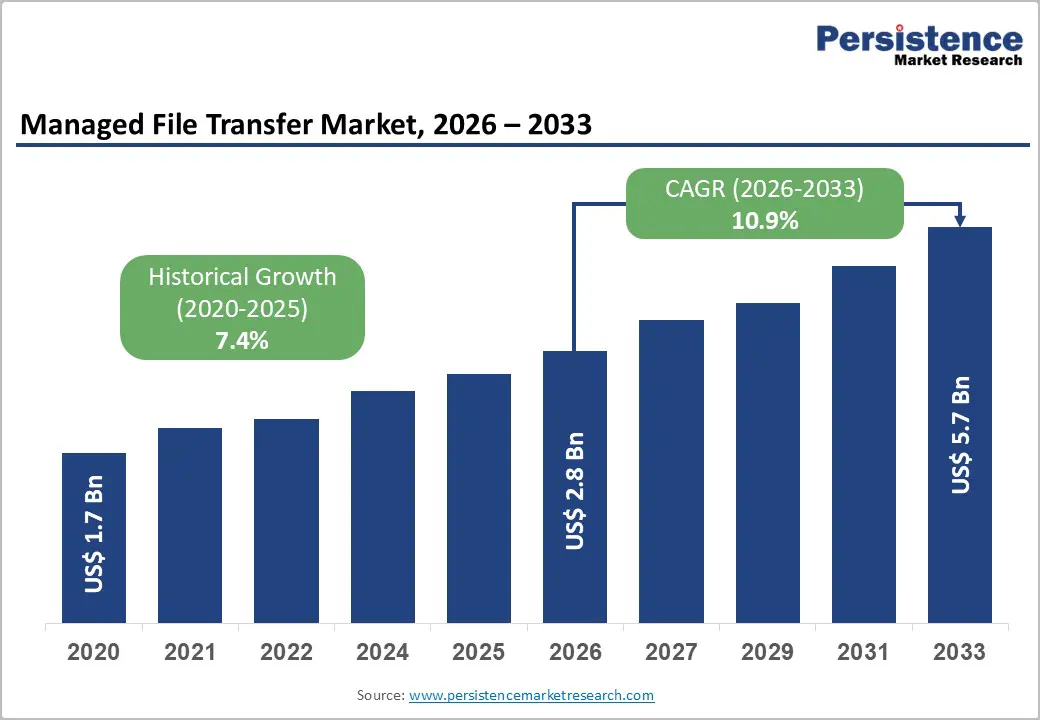
The global Managed File Transfer (MFT) Market size is projected to rise from US$2.8 Bn in 2026 to US$5.7 Bn by 2033. It is anticipated to witness a CAGR of 10.9% during the forecast period from 2026 to 2033, driven by escalating cybersecurity threats, stringent regulatory compliance mandates including GDPR, HIPAA, PCI-DSS, and SOX. Organizations across all sectors are shifting from legacy FTP and SFTP systems to enterprise-grade MFT solutions that provide comprehensive encryption, audit trails, and automated governance capabilities. The rising prevalence of remote work, increased B2B data exchange volumes, and the need for seamless integration across hybrid and multi-cloud environments are further accelerating MFT adoption.
Key Industry Highlights:
- Leading Solution: Software-led MFT solutions dominate the market, with system-centric file transfer capturing over 46% share in 2026, valued at US$ 863 Mn, driven by enterprises’ need for automated, secure, and reliable system-to-system data movement, regulatory compliance, and large-scale data integrity. People-centric file transfer is the fastest-growing segment, fueled by remote work, partner collaboration, ease of use, and reduced IT dependency.
- Leading Deployment: On-premises hold over 40% market share in 2026, valued at more than US$ 1.1 Bn, preferred by BFSI, healthcare, and regulated industries for enhanced control, data security, and compliance. Cloud-based / SaaS is the fastest-growing deployment with a CAGR of 16.3%, driven by scalability, cost efficiency, rapid deployment, and support for global and remote operations.
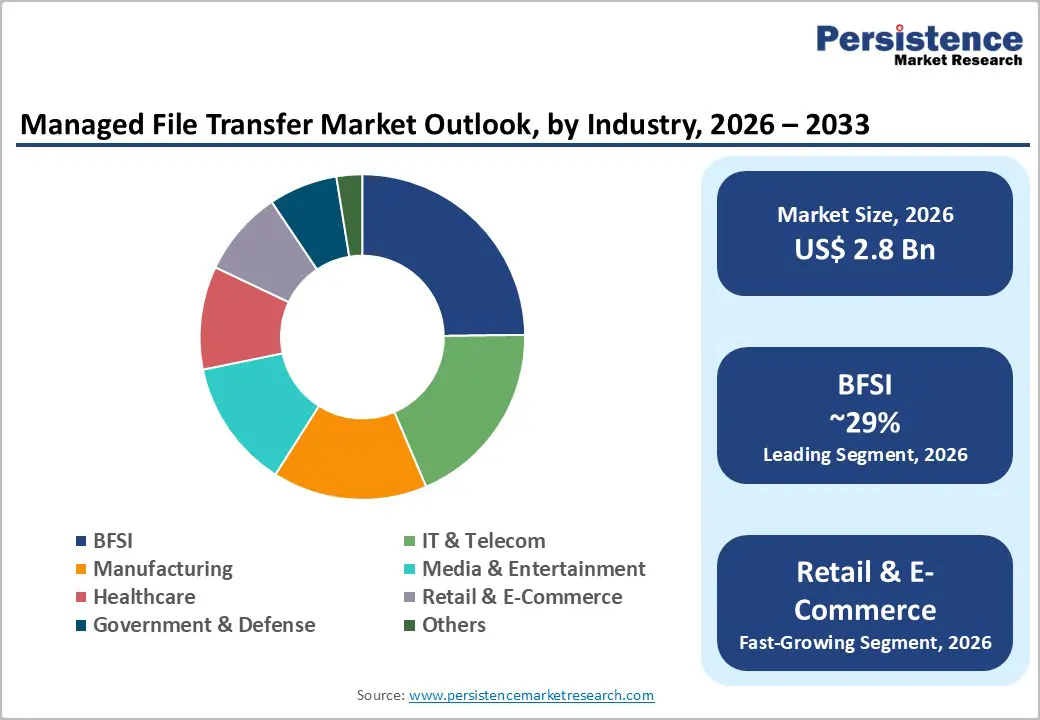
- Leading Industry: BFSI leads with over 29% market share in 2026, valued at US$ 801.6 Mn, due to high volumes of sensitive transactional data, strict regulatory mandates, and the need for real-time, secure inter-organizational data exchange. Retail & E-Commerce is among the fastest-growing industries, supported by omnichannel expansion, real-time inventory and order management, and compliance with data protection regulations.
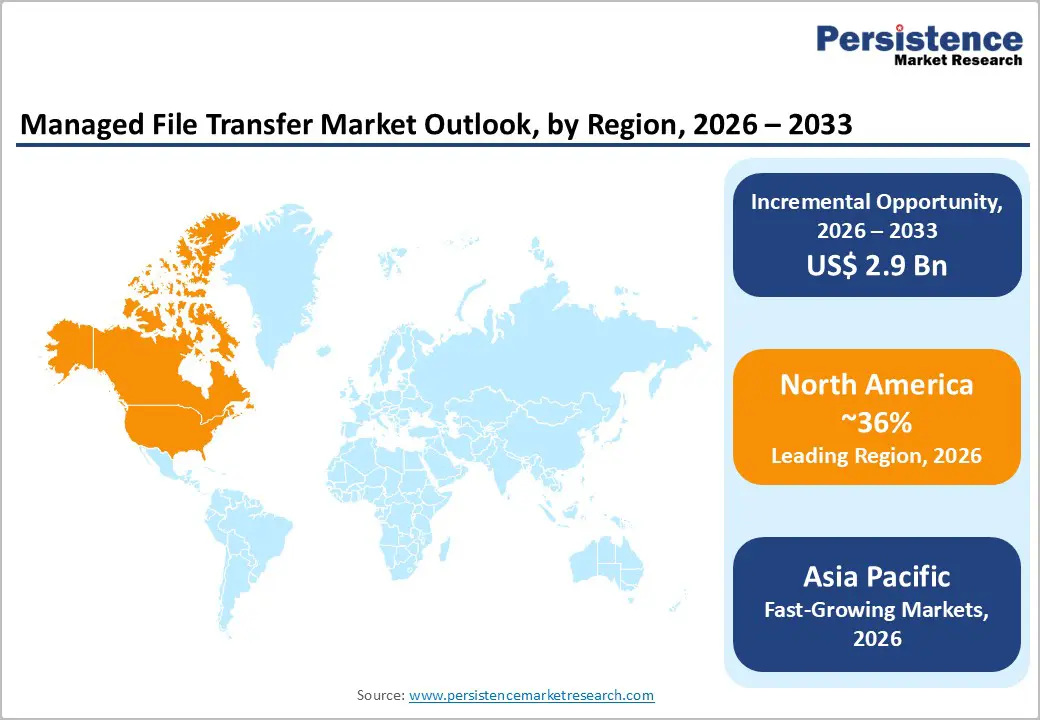
- Leading Region: North America dominates with over 36% market share in 2026, valued at approximately US$ 1.0 Bn, driven by mature IT infrastructure, stringent regulatory requirements, and high enterprise cybersecurity spending. Asia Pacific is the fastest-growing region at a CAGR of 15.9%, supported by rapid digitalization, manufacturing and supply chain expansion, and government-led digital initiatives. Europe holds over 23% share, underpinned by GDPR compliance, data sovereignty concerns, and strong adoption across BFSI and industrial sectors.
| Global Market Attribute | Key Insights |
|---|---|
| Managed File Transfer Market Size (2026E) | US$2.8 Bn |
| Market Value Forecast (2033F) | US$5.7 Bn |
| Projected Growth (CAGR 2026 to 2033) | 10.9% |
| Historical Market Growth (CAGR 2020 to 2025) | 7.4% |
Market Dynamics
Driver
Escalating Cybersecurity Threats and Data Breach Prevention Imperatives
Organizations are facing increasingly sophisticated cybersecurity threats, making secure file transfer a top IT priority. Traditional FTP protocols are being replaced by MFT solutions that offer robust security features such as end-to-end encryption, multi-factor authentication, and detailed audit trails. Integration of AI-powered threat detection and automated response further strengthens security by identifying suspicious activity and enabling rapid mitigation. High-profile data breaches have heightened awareness of file transfer vulnerabilities, prompting enterprises to adopt secure, reliable, and enterprise-grade MFT solutions. These platforms not only protect sensitive data but also enhance operational efficiency and risk management.
Regulatory Compliance Mandates and Governance Requirements
Stringent regulatory frameworks across healthcare, financial services, government, and retail sectors are driving the adoption of secure file transfer solutions. Organizations must comply with mandates such as HIPAA, GDPR, PCI-DSS, and SOX, which require robust data protection, audit trails, and controlled information exchange. Traditional file sharing methods often fail to meet these compliance standards. Managed file transfer solutions offer encryption enforcement, automated reporting, and non-repudiation capabilities, enabling organizations to maintain comprehensive audit records and demonstrate adherence to regulatory requirements. By mitigating risks of non-compliance and associated penalties, MFT has become a critical solution for secure, auditable, and reliable data transfers across industries.
Restraint
High Capital Investment Costs and Deployment Complexity
Implementing enterprise-grade managed file transfer involves significant capital investment and complex deployment, making them less accessible for small and medium-sized enterprises. Deploying MFT across hybrid environments, including on-premises systems, multiple clouds, and legacy infrastructure, requires specialized expertise, often sourced externally, which adds to costs. Organizations must also train IT staff to manage platforms, configure security, and maintain compliance. Transitioning from legacy systems demands careful planning and sometimes parallel operations to prevent disruptions, further increasing implementation complexity. Many smaller organizations view MFT as costly compared to unsecured alternatives, which can slow adoption despite long-term efficiency and security benefits.
Data Sovereignty and Cloud-Residency Concerns
Regulatory requirements often mandate that sensitive data remain within specific geographic boundaries, compelling companies to maintain distributed infrastructure to comply. Fears over government access to cloud-stored data and exposure to foreign legal requests lead some organizations to prefer on-premises MFT solutions, despite their lower scalability and flexibility. The lack of globally harmonized standards for data residency further fragments the regulatory environment, complicating the design and deployment of MFT systems. Organizations must adopt region-specific architecture, which increases operational complexity and costs. These factors collectively restrain the widespread adoption of cloud-based MFT solutions.
Opportunity
AI and Machine Learning Integration for Intelligent Automation and Threat Detection
Vendors are increasingly integrating AI and machine learning to enable intelligent automation, predictive anomaly detection, and advanced threat identification. AI-driven solutions classify files, enforce security controls, and execute complex workflows automatically, reducing manual effort and errors. Machine learning analyzes transfer patterns to detect anomalies, unauthorized access, or operational issues, supporting proactive incident response. Integration with generative AI and large language models allows natural language administration, automated compliance documentation, and intelligent support. This convergence of MFT with AI and automation creates a high-growth opportunity for vendors delivering next-generation platforms that enhance operational efficiency, security, and compliance.
Expansion of IoT and Edge Computing Driving Demand for Multi-Platform and Multi-Protocol Managed File Transfer Solutions
With billions of connected devices generating vast amounts of data at the network edge, enterprises need reliable, secure, and real-time data transfer capabilities across heterogeneous systems. Multi-platform support ensures seamless integration between legacy on-premises systems, cloud environments, and edge devices, while multi-protocol capabilities (SFTP, FTPS, HTTPS, AS2, etc.) enable secure communication across diverse networks. This reduces operational complexity and ensures data consistency, which is critical for IoT analytics, predictive maintenance, and real-time decision-making. Moreover, the growing adoption of Industry 4.0 and smart manufacturing requires high-speed, automated transfers between devices and enterprise applications.
Category-wise Analysis
Software Analysis,
System-centric file transfer dominates capturing more than 46% market share in 2026 with a value exceeding US$ 863 Mn, due to enterprises increasingly need to move large volumes of data reliably and securely between systems and applications. It addresses critical requirements like automation, compliance, encryption, and integration with existing IT infrastructure, reducing manual intervention. Businesses prioritize minimizing downtime and ensuring data integrity, which makes system-to-system transfers essential for operational efficiency and regulatory adherence. This focus on reliability and scalability drives its dominance in the market.
People-centric file transfer demonstrates highest growth due to organizations increasingly need secure, easy-to-use solutions for employees, partners, and clients to share files anytime, anywhere. The shift toward remote work, collaboration across geographies, and demand for intuitive interfaces drives adoption. Businesses are also seeking solutions that reduce IT dependency, ensure compliance, and provide real-time tracking of sensitive data exchanges, making people-centric approaches more critical than traditional system-focused transfers.
Deployment Analysis,
On-premises hold over 40% of the market share in 2026, with a value exceeding US$ 1.1 Bn, as enterprises prioritize data security, compliance, and control over sensitive file transfers. Many industries, especially BFSI and healthcare, require strict regulatory adherence, which on-premises deployments provide. They also support customized integrations with existing IT systems and workflows, meeting complex organizational needs. On-premises solutions offer reliable performance for large-scale transfers, reducing dependency on external networks.
Cloud-Based / SaaS is expected to grow at CAGR of 16.3% due to increasingly need for scalable, flexible, and cost-effective file transfer options without heavy on-premises infrastructure. They support remote workforce and global operations, enabling secure access from anywhere. SaaS models also simplify compliance, updates, and maintenance, reducing IT burden. Businesses demand rapid deployment and integration with cloud applications, which on-premises solutions cannot match.
Industry Analysis,
BFSI command the largest market share at over 29% in 2026 with a value exceeding US$ 801.6 Mn, due to banks, insurance firms, and financial institutions handle massive volumes of sensitive customer and transactional data daily. They require highly secure, reliable, and compliant file transfer solutions to prevent data breaches and meet strict regulatory standards. The need for real-time data exchange between branches, partners, and payment networks drives widespread adoption of MFT solutions in this sector. Robust audit trails, encryption, and automation further make MFT essential for BFSI operations.
Retail & E-Commerce are expected to grow at a significant rate as these sectors handle massive volumes of sensitive customer, payment, and supply chain data daily. They need secure, reliable, and automated file transfers to support real-time order processing, inventory management, and partner integrations. Compliance with data protection regulations (like GDPR) further drives MFT adoption. The rise of omnichannel retail and personalized customer experiences increases the demand for seamless, high-speed data exchange across multiple platforms.
Regional Insights
North America Managed File Transfer Market Trends
North America accounts for over 36% of the Managed File Transfer Market share in 2026, reaching approximately US$ 1.0 Bn, due to its mature IT infrastructure, large enterprises with complex file transfer needs, and strict regulatory environments driving adoption. Organizations across healthcare, finance, and technology sectors view MFT as a strategic priority to manage global data flows, ensure compliance, and mitigate security risks. Cloud and hybrid deployments are increasingly preferred for scalability and operational flexibility. Strong investment in enterprise software and cybersecurity fuels innovation. Large enterprises leverage for secure inter-organizational data exchange, supply chain integration, and reliable regulatory reporting, positioning it as essential infrastructure for modern digital operations.
Asia Pacific Managed File Transfer Market Trends
Asia Pacific is expected to grow at the highest rate with a CAGR of 15.9%, driven by rapid digital transformation, expanding manufacturing and supply chain complexity, and increasing government digitalization initiatives. China’s role as a global manufacturing and supply chain hub is boosting demand for secure supplier collaboration and production data exchanges. India’s growing IT services and financial sectors are driving adoption for secure international data transfers. ASEAN countries like Malaysia and Singapore are seeing increased MFT use due to government digitalization, e-commerce growth, and strict data protection regulations. Singapore’s status as a regional digital hub and Japan’s mature IT infrastructure further support demand for reliable, standards-compliant MFT solutions across multiple industries.
Europe Managed File Transfer Market Trends
Europe is expected to hold more than 23% share by 2026, driven by stringent data protection regulations like GDPR, which compel organizations to implement secure data transfer controls and comprehensive audit capabilities. Enterprises across the region view MFT solutions as essential infrastructure for ensuring regulatory compliance, enabling secure cross-border data transfers, and supporting digital transformation initiatives. Countries with robust IT ecosystems and proactive regulatory frameworks, such as France, Germany, the UK, and Spain, are seeing rapid adoption. Concerns over data residency and sovereignty are creating demand for MFT providers in Europe.
Competitive Landscape
The Managed File Transfer (MFT) market is moderately consolidated, with a mix of global leaders and niche players competing for enterprise clients. Companies are focusing on differentiation through security, compliance, and reliability, offering advanced encryption, automation, and real-time monitoring features. Strategic partnerships with cloud providers and system integrators help expand reach and service offerings. Many also adopt subscription-based pricing and bundled services to enhance customer retention and create recurring revenue streams.
Key Industry Developments
- In October 2025, Progress Software launched Progress Automate MFT, a cloud-native SaaS solution that modernizes secure file transfer automation. The platform reduces reliance on legacy systems and scripting, lowers total cost of ownership, enhances security and compliance, and boosts productivity for enterprises handling large volumes of sensitive data.
- In March 2025, IBM is modernizing Planning Analytics on Cloud (PAoC) by launching a centralized file transfer platform supporting FTPS and SFTP to enhance security and service quality. Existing FTPS services will be discontinued by May 31, 2025, and customers must update URLs, account names, and folder permissions to continue seamless file transfers.
Companies Covered in Managed File Transfer Market
- IBM Corporation
- Oracle Corporation
- Progress Software Corporation
- Axway Inc.
- OpenText Corporation
- Software AG
- Fortra
- GlobalSCAPE
- Wipro Limited
- TIBCO Software Inc.
- Coviant Software
- Seeburger AG
- Others
Frequently Asked Questions
The global market is projected to be valued at US$2.8 Bn in 2026.
The need for secure, compliant, and reliable transfer of large and sensitive data across distributed systems, along with growing automation are key drivers of the market.
The market is expected to witness a CAGR of 10.9% from 2026 to 2033.
Expanding adoption of IoT and big data analytics, cross-border data transfers, and integration with emerging technologies like AI and blockchain for enhanced security and efficiency in file transfers are creating strong market expansion potential.
IBM Corporation, Oracle Corporation, Progress Software Corporation, Axway Inc., OpenText Corporation Software AG, Fortra, GlobalSCAPE are among the leading key players.


