




- Non-food Packaging
- Mailer Packaging Market
Mailer Packaging Market Size, Share, and Growth Forecast, 2026 - 2033
Mailer Packaging Market by Material (Corrugated Cardboard, Kraft Paper/Paper Mailers, Others), Product Type (Padded Mailers/Bubble Mailers, Unpadded Mailers/Non-Cushioned, Others), Insulation, End-user, and Regional Analysis for 2026 - 2033

Mailer Packaging Market Size and Trends Analysis
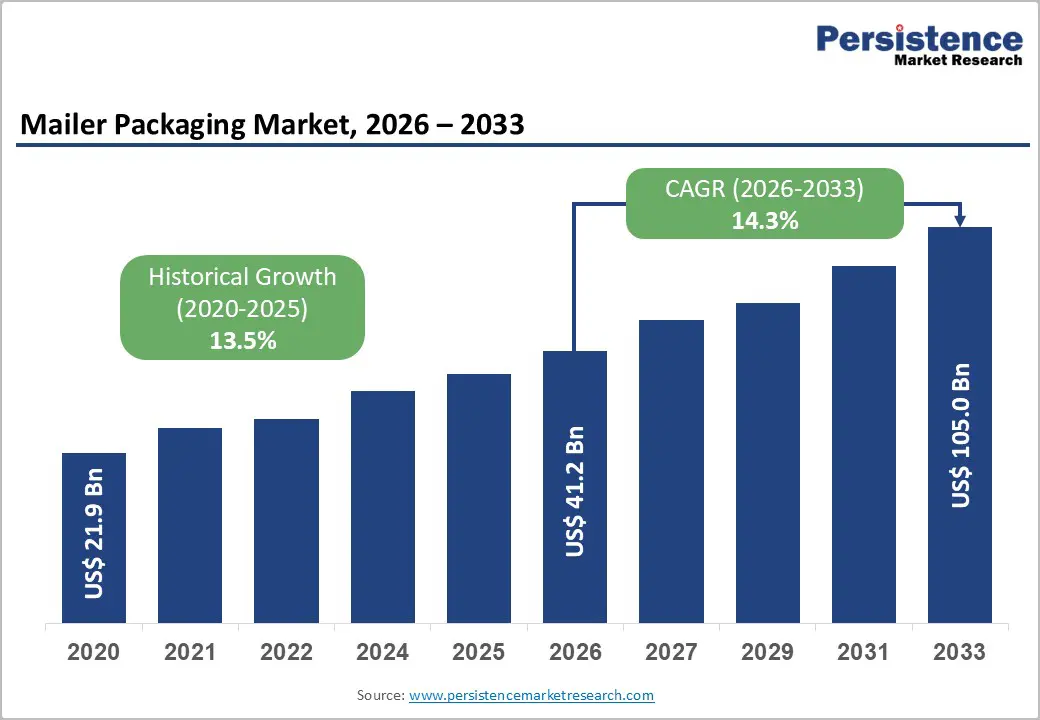
The global mailer packaging market size is likely to be valued at US$ 41.2 billion in 2026 and is expected to reach US$105.0 billion by 2033, growing at a CAGR of 14.3% between 2026 and 2033, driven by sustained expansion in e-commerce, increasing parcel shipment volumes, and the transition toward lightweight and recyclable packaging formats that improve logistics efficiency and reduce costs.
Rising digital commerce penetration across North America, Europe, and Asia Pacific continues to increase demand for mailer packaging formats optimized for last-mile delivery. At the same time, regulatory pressure on plastic usage and waste management is accelerating the adoption of paper-based and recyclable mailers. The market is evolving from volume-driven growth to value-driven innovation, where material efficiency, sustainability compliance, and automation compatibility define competitive advantage.
Key Industry Highlights
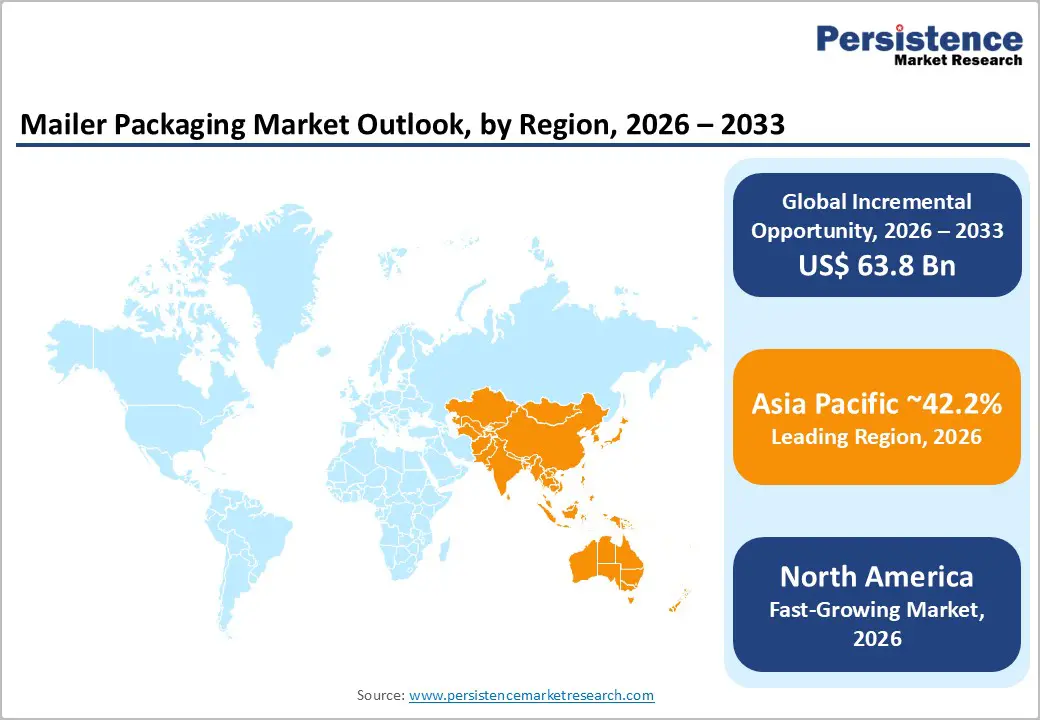
- Leading Region: Asia Pacific is projected to lead the market, accounting for approximately 42.2% share, supported by large-scale e-commerce activity, strong manufacturing capabilities, and high parcel shipment volumes across China, India, and ASEAN countries.
- Fastest-growing Region: North America is the fastest-growing region, driven by advanced fulfillment infrastructure and rising automation adoption, with the U.S. showing strong growth momentum supported by expanding online retail penetration.
- Investment Plans: The market is witnessing increasing investments in sustainable packaging and automation technologies, with companies focusing on recyclable paper mailers, hybrid packaging systems, and fulfillment automation to enhance efficiency and meet regulatory requirements.
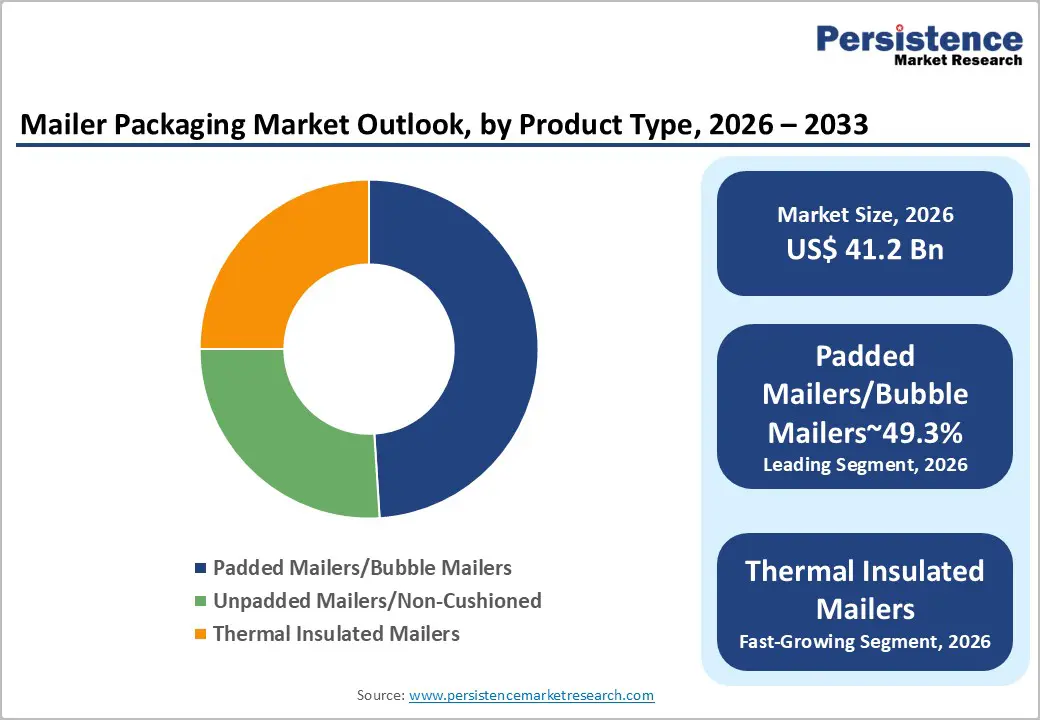
- Dominant Product Type: Padded mailers/bubble mailers are estimated to dominate, accounting for approximately 49.3% share, due to their superior protective capabilities and cost efficiency in shipping fragile and semi-fragile goods.
- Leading Insulation: Non-insulated mailers are estimated to represent approximately 67.8% of the market, driven by their widespread use in general e-commerce shipments that do not require temperature control.
| Key Insights | Details |
|---|---|
|
Mailer Packaging Market Size (2026E) |
US$41.2 Bn |
|
Market Value Forecast (2033F) |
US$105.0 Bn |
|
Projected Growth (CAGR 2026 to 2033) |
14.3% |
|
Historical Market Growth (CAGR 2020 to 2025) |
13.5% |
DRO Analysis
Driver Analysis - Rapid Expansion of Global E-Commerce and Parcel Shipments
The mailer packaging market is directly linked to the growth of e-commerce, which continues to expand across both developed and emerging economies. Online retail penetration has increased significantly, with a growing share of total retail sales conducted through digital channels. This trend has led to a structural rise in small-parcel shipments, which rely heavily on lightweight packaging formats such as mailers. Mailer packaging offers advantages in terms of reduced shipping costs, improved handling efficiency, and lower material usage compared to traditional corrugated boxes. Categories such as apparel, personal care, books, and small electronics increasingly use mailers as a primary packaging format. The continued expansion of omnichannel retail models and direct-to-consumer shipping is expected to sustain strong demand, particularly in high-frequency shipping environments managed by logistics providers and fulfillment centers.
Sustainability Regulations and Shift toward Recyclable Materials
Regulatory frameworks targeting packaging waste reduction are significantly influencing material selection in the mailer packaging market. Governments across Europe and other regions are implementing stricter policies to promote recyclability, reduce plastic usage, and encourage circular economy practices. These policies are prompting manufacturers and retailers to transition toward paper-based and recyclable packaging solutions. In response, packaging companies are investing in innovations such as fully recyclable paper mailers, recycled-content bubble mailers, and biodegradable cushioning materials. Businesses that can demonstrate compliance with environmental standards and offer sustainable alternatives are gaining a competitive edge. This shift is also driven by consumer preferences, as environmentally conscious buyers increasingly favor brands that adopt sustainable packaging practices.
Growth in Fulfillment Automation and Packaging Efficiency
The rise of automated fulfillment systems is transforming packaging requirements across e-commerce and logistics operations. Companies are investing in high-speed packaging lines that require standardized, machine-compatible mailers capable of maintaining throughput without compromising product protection. Automated bagging systems that support both paper and poly mailers are enabling greater operational flexibility. This has increased demand for mailers designed for automation compatibility, including features such as consistent sizing, easy sealing, and optimized material strength. As labor costs rise and delivery expectations shorten, businesses are prioritizing packaging solutions that improve operational efficiency. This trend is increasing the value per shipment and driving the adoption of advanced mailer formats.
Restraint Analysis - Volatility in Raw Material Costs and Supply Chains
Mailer packaging production depends on raw materials such as paper pulp, polyethylene, adhesives, and cushioning substrates. Fluctuations in raw material prices, energy costs, and transportation expenses can significantly impact manufacturing margins. Global trade uncertainties and geopolitical tensions further contribute to supply chain disruptions, affecting availability and pricing stability. Smaller manufacturers are particularly vulnerable due to limited procurement power and reduced ability to hedge against price volatility. In highly competitive segments such as standard poly mailers, pricing pressure can erode profitability, making it challenging for companies to maintain stable margins.
Regulatory Compliance Complexity and Cost Burden
While sustainability regulations support long-term market growth, they also introduce operational challenges. Compliance with evolving packaging standards requires redesigning products, adopting new materials, and undergoing certification processes. These changes involve additional costs related to research, testing, and production adjustments. For companies operating across multiple regions, varying regulatory requirements increase complexity and extend product development timelines. Smaller players may face barriers to entry due to the high cost of compliance, while larger organizations must invest heavily in innovation and supply chain adjustments to meet regulatory expectations.
Opportunity Analysis - Expansion of paper-based and recyclable mailer solutions
The increasing emphasis on sustainability is creating strong opportunities for paper-based and recyclable mailers. These solutions align with regulatory requirements and consumer preferences, making them a preferred choice for retailers seeking to reduce environmental impact. Paper mailers, especially those made from kraft paper and recycled fibers, are gaining traction as alternatives to plastic-based formats. Innovations in material strength and moisture resistance are expanding their application across various product categories. Companies that invest in sustainable material development and scalable production capabilities are well-positioned to capture market share in this segment.
Growth of Insulated Mailers for Temperature-Sensitive Applications
The rising demand for temperature-controlled delivery in food, pharmaceuticals, and healthcare sectors is driving the adoption of insulated mailers. These specialized packaging solutions are designed to maintain product integrity during transit, particularly in last-mile delivery scenarios. As online grocery delivery, meal kits, and pharmaceutical distribution expand, insulated mailers are becoming increasingly important. Although they represent a smaller share of the overall market, they offer higher margins due to their specialized functionality. Continued innovation in lightweight insulation materials and cost-effective designs will further enhance their adoption.
Industry Consolidation and Integrated Packaging Solutions
Mergers, acquisitions, and strategic partnerships are reshaping the competitive landscape of the mailer packaging market. Companies are expanding their capabilities across materials, converting, and distribution to offer integrated solutions to customers. This consolidation enables firms to provide end-to-end packaging solutions, including materials, equipment, and technical support. The shift toward integrated offerings enhances customer retention and creates opportunities for long-term contracts with large e-commerce and logistics providers. Businesses that can deliver comprehensive packaging solutions are likely to gain a competitive advantage in the evolving market.
Category-wise Analysis
Product Type Insights
Padded mailers are expected to remain the leading segment, accounting for an anticipated market share of approximately 49.3% in 2026, driven by their ability to protect fragile and semi-fragile items during transit. These mailers incorporate cushioning materials such as bubble wrap or paper-based padding, which absorb shocks and reduce the risk of damage without significantly increasing packaging weight or shipping costs. They are widely used for shipping electronics accessories, cosmetics, books, jewelry, and small consumer goods. Large e-commerce platforms and third-party sellers frequently standardize padded mailers for mid-value shipments where protection is required but full corrugated boxes are not cost-effective. For example, smartphone accessories, beauty kits, and small home décor items are commonly shipped in bubble mailers to balance protection and cost efficiency. Their compatibility with automated fulfillment systems further strengthens their dominance in high-volume shipping environments.
Thermally insulated mailers are projected to be the fastest-growing segment, supported by rising demand for temperature-sensitive deliveries and an anticipated increase in market share over the forecast period. These mailers are designed with insulating layers such as foam, reflective films, or fiber-based materials to maintain internal temperatures during transit. They are increasingly used in food delivery, meal kits, pharmaceuticals, and specialty healthcare logistics. For instance, online grocery platforms use insulated mailers for perishable items such as dairy, frozen foods, and ready-to-eat meals, while pharmaceutical companies rely on them for temperature-sensitive drugs and vaccines. The expansion of direct-to-consumer healthcare and same-day delivery services is accelerating demand. As material innovations reduce cost and improve thermal efficiency, insulated mailers are expected to gain broader adoption across both premium and mass-market applications.
Insulation Insights
Non-insulated mailers dominate the market with an anticipated share of approximately 67.8% in 2026, as the majority of e-commerce shipments do not require temperature control. These mailers are primarily used for general merchandise, including apparel, documents, books, and low-risk consumer goods. Their low-cost, lightweight structure and ease of storage and handling make them highly suitable for high-volume shipping operations. E-commerce companies often standardize non-insulated poly or paper mailers for categories such as clothing, accessories, and printed materials, where protection requirements are minimal. For example, fashion retailers and online marketplaces frequently use poly mailers for shipping garments due to their flexibility and cost advantages. This widespread applicability ensures the continued dominance of the segment.
Insulated mailers represent the fastest-growing segment, with an anticipated increase in market share driven by expanding cold-chain logistics requirements. These mailers are essential for maintaining product quality in temperature-sensitive shipments, particularly in the food, pharmaceutical, and healthcare sectors. Growth is fueled by the increasing adoption of online grocery delivery, meal subscription services, and pharmaceutical e-commerce. For example, meal kit providers and specialty food brands rely on insulated mailers combined with gel packs to preserve freshness during transit, while healthcare distributors use them for biologics and diagnostic kits. Although insulated mailers currently account for a smaller share compared to non-insulated formats, their higher unit value and critical role in specialized logistics make them a strategically important segment for manufacturers aiming to improve margins and diversify product offerings.
Regional Insights
North America Mailer Packaging Market Trends - E-commerce-Driven Growth and Automation-Ready Mailer Innovation
North America is likely to be the fastest-growing region, driven by strong e-commerce penetration and a highly developed logistics infrastructure. The U.S. leads the market, supported by high online retail volumes, widespread adoption of automated fulfillment systems, and a strong presence of large-scale retailers and third-party logistics providers. Major e-commerce players such as Amazon and Walmart continue to expand their fulfillment networks, increasing demand for standardized and automation-compatible mailer packaging solutions.
The region is also characterized by rapid innovation in packaging materials and technologies. Companies such as Sealed Air have introduced hybrid packaging systems that support both paper and poly mailers, enabling faster throughput in automated warehouses. Similarly, ProAmpac has strengthened its e-commerce packaging portfolio through acquisitions and product innovation, enhancing its ability to serve high-volume retail clients. Sustainability initiatives are gaining traction, with brands increasingly adopting recyclable mailers and reduced-plastic packaging formats. While regulatory frameworks are less centralized than in Europe, state-level policies and corporate sustainability commitments are accelerating the shift toward eco-friendly packaging solutions across the region.
Europe Mailer Packaging Market Trends - Regulation-Driven Shift to Sustainable Paper-Based Mailers
Europe is a mature market with a strong regulatory environment that significantly influences packaging design and material selection. Sustainability regulations are driving the adoption of recyclable and paper-based mailers, positioning the region as a leader in environmentally responsible packaging. The implementation of stricter packaging waste directives has encouraged companies to transition away from single-use plastics toward fiber-based alternatives.
Countries such as Germany, the U.K., France, and Spain play a central role in market development. Germany and the U.K. provide scale and technological advancement, while Spain and other Southern European markets are experiencing faster growth due to rising e-commerce penetration. Companies such as Mondi are actively expanding their paper-based packaging portfolios, including recyclable mailer solutions, to meet regulatory and customer demands. In parallel, Smurfit Westrock continues to invest in sustainable corrugated and paper mailer innovations across Europe. Retailers and logistics providers are also adapting to regulatory changes by redesigning packaging strategies. For example, large European fashion and consumer goods brands are increasingly replacing plastic mailers with kraft paper alternatives to comply with sustainability targets and improve brand perception. These developments are reinforcing Europe’s leadership in sustainable packaging while maintaining steady market growth.
Asia Pacific Mailer Packaging Market Trends - High-Volume E-commerce Expansion and Cost-Efficient Mailer Production
Asia Pacific is projected to dominate the market with a share of approximately 42.2%, driven by large consumer populations, rapid urbanization, and strong growth in digital commerce. China, India, Japan, and ASEAN countries are key contributors, supported by expanding internet penetration and mobile-based shopping ecosystems. China remains the largest market, with major e-commerce platforms such as Alibaba Group and JD.com driving massive parcel volumes that require cost-efficient and scalable packaging solutions.
The region benefits from strong manufacturing capabilities and cost advantages, enabling large-scale production of both paper and plastic mailers. In India, companies such as Flipkart and Reliance Retail are expanding their logistics and delivery networks, increasing demand for mailer packaging in categories such as fashion, electronics, and daily essentials. Japan, with its advanced logistics infrastructure, emphasizes high-quality and compact packaging solutions, supporting innovation in lightweight and protective mailers.
Sustainability is also gaining importance across the region. Several e-commerce platforms are introducing recyclable packaging initiatives and reducing plastic usage in response to regulatory and consumer pressure. At the same time, ASEAN countries are emerging as high-growth markets due to rising cross-border trade and improving logistics infrastructure. These combined factors ensure that Asia Pacific will continue to lead the global market, both in terms of volume and long-term growth potential.
Competitive Landscape
The global mailer packaging market is fragmented to moderately consolidated, with a mix of global packaging companies and regional players. Competition is driven by product innovation, sustainability, pricing, and customer-specific solutions. Companies with integrated capabilities across materials, manufacturing, and distribution hold a competitive advantage.
Key strategies include sustainability-driven innovation, automation integration, cost optimization, and geographic expansion. Companies are focusing on recyclable materials, advanced packaging technologies, and strategic acquisitions to strengthen their market position and meet evolving customer requirements.
Key Industry Developments:
- In August 2025, ProAmpac announced the acquisition of PAC Worldwide, aiming to expand its global footprint and strengthen vertically integrated capabilities across recycled paper, film, and e-commerce mailer solutions, enhancing its ability to deliver sustainable packaging innovations.
- In September 2025, PAC Worldwide introduced new sustainable packaging innovations at PACK EXPO, including a post-consumer recycled bubble roll and an enhanced wicketed paper mailer with a fixed release liner, designed to improve fulfillment efficiency and reduce plastic usage in e-commerce packaging.
Companies Covered in Mailer Packaging Market
- Sealed Air
- ProAmpac
- Amcor
- Mondi
- Smurfit Westrock
- Pregis
- Storopack
- Packaging Corporation of America
- Graphic Packaging
- Huhtamaki
- PAC Worldwide
- EcoEnclose
- Intertape Polymer Group
- Novolex
- DS Smith
- WestRock
Frequently Asked Questions
The global mailer packaging market is estimated to be valued at US$ 41.2 billion in 2026.
The mailer packaging market is projected to reach US$ 105.0 billion by 2033.
Key trends include the shift toward sustainable and recyclable materials, increasing adoption of paper-based mailers, growing use of automation-compatible packaging, and rising demand for insulated mailers in food and pharmaceutical delivery.
Padded mailers/bubble mailers are the leading segment, accounting for approximately 49.3% share, driven by their protective capabilities and cost efficiency.
The mailer packaging market is expected to grow at a CAGR of 14.3% from 2026 to 2033.
Some of the major players include Sealed Air, ProAmpac, Amcor, Mondi, and Smurfit Westrock.


