




- Biotechnology
- Liquid Chromatography-mass Spectroscopy Market
Liquid Chromatography-mass Spectroscopy Market Size, Share, Growth, and Regional Forecast, 2026 - 2033
Liquid Chromatography-mass Spectroscopy Market by Technology (Single Quadrupole LC‑MS, Triple Quadrupole LC‑MS (QqQ), Quadrupole‑Time‑of‑Flight (Q‑TOF) LC‑MS, Time‑of‑Flight (TOF) LC‑MS, Others), Application (Drug Discovery and Development, Clinical Testing, Others), End-user (Pharmaceutical & Biotechnology Companies, Contract Research Organizations (CROs), Academic & Government Research Laboratories, Clinical Diagnostic Laboratories & Hospitals, Others), and Regional Analysis from 2026 - 2033

Liquid Chromatography Mass Spectroscopy Market Share and Trends Analysis
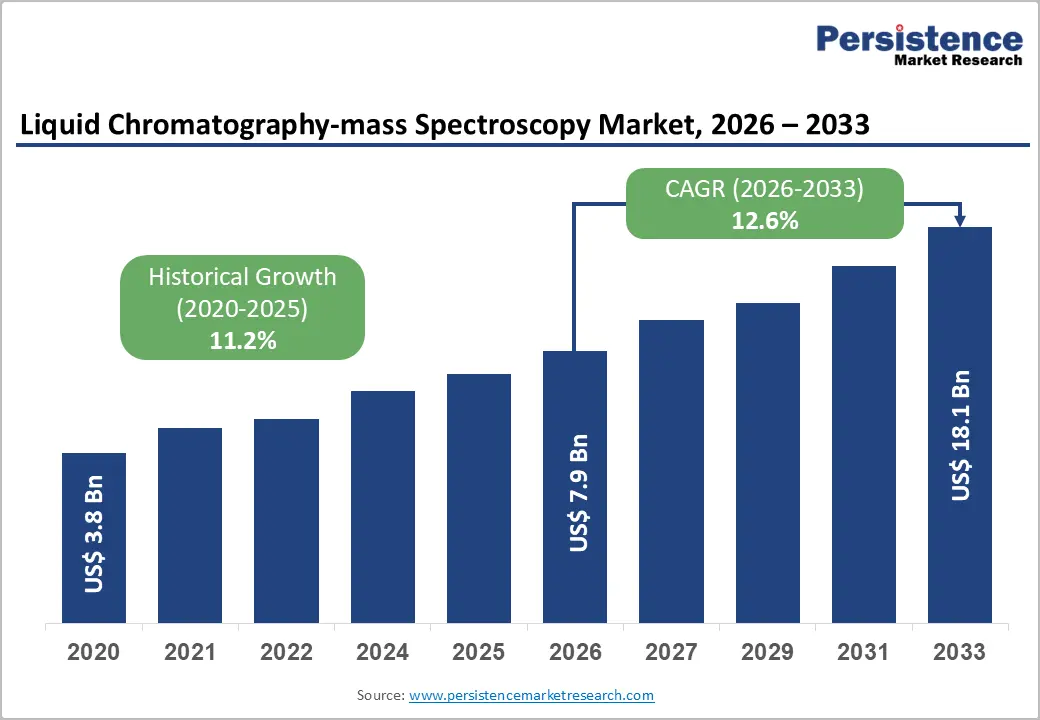
The global liquid chromatography mass spectroscopy market size is likely to be valued at US$ 7.9 billion in 2026 and US$ 18.1 billion by 2033, growing at a CAGR of 12.6% during the forecast period from 2026 to 2033.
The global market is growing steadily, driven by rising demand for advanced analytical techniques, increasing pharmaceutical and biotech R&D, and expanding applications in clinical diagnostics and food safety. North America leads due to established infrastructure and early technology adoption, while Asia Pacific shows the fastest growth, supported by expanding laboratories, government initiatives, and rising industrial investments.
Key Industry Highlights:
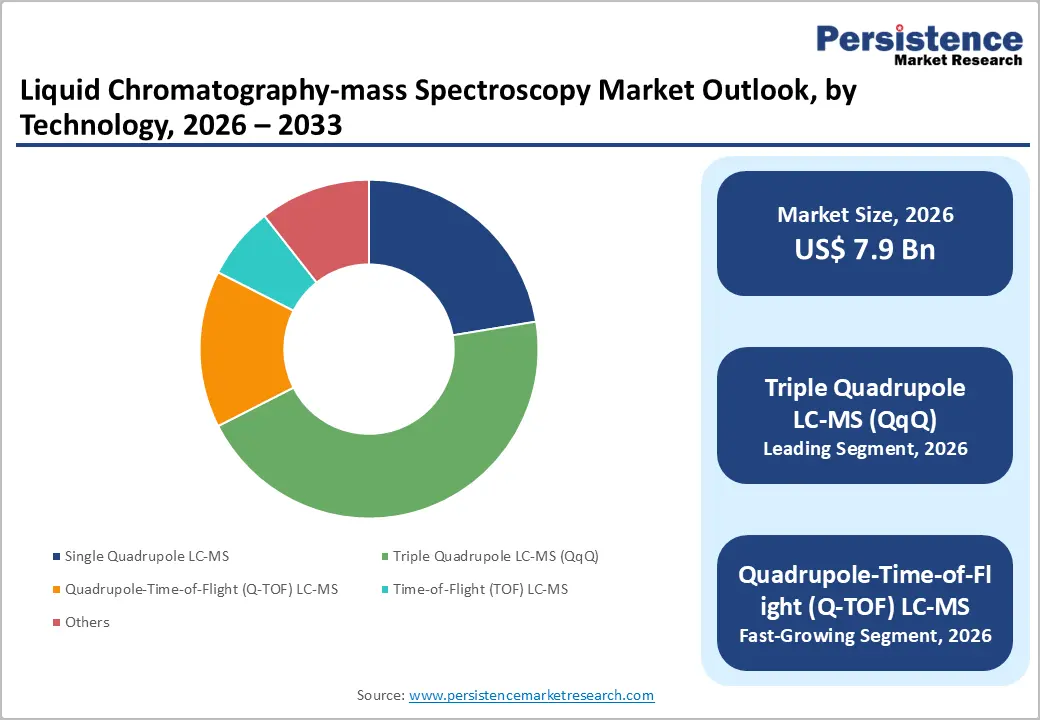
- Dominant Segment: Triple Quadrupole (QqQ) LC-MS dominates the technology segment with an estimated 45.1% share in 2025, driven by its high sensitivity, selectivity, and reproducibility, making it the preferred choice for quantitative analysis in pharmaceutical, clinical, food safety, and environmental testing applications.
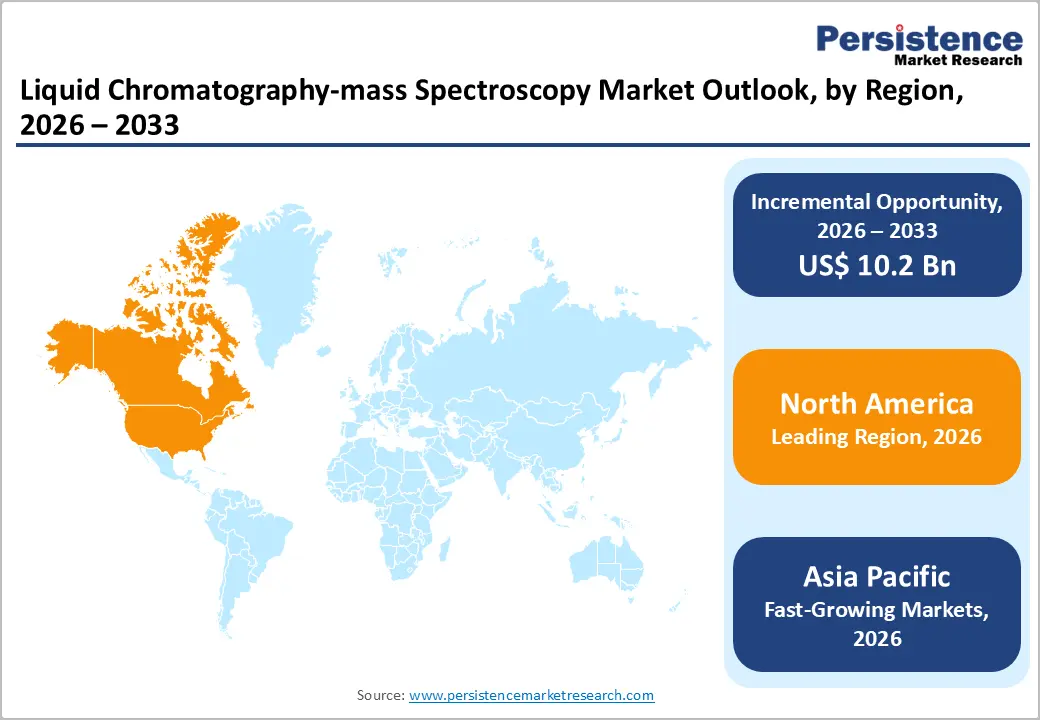
- Dominant Region: North America leads in 2025 with 39.1% share, supported by established R&D infrastructure, early adoption of advanced LC-MS technologies, and strong regulatory compliance. Asia Pacific is the fastest-growing region due to expanding laboratories, government initiatives, and rising industrial and clinical applications.
- Market Drivers: Growth is driven by rising pharmaceutical and biotech R&D, demand for accurate clinical diagnostics, growing food safety concerns, and expanding applications in environmental and chemical analysis.
- Market Opportunity: Key opportunities include the development of high-throughput and miniaturized LC-MS systems, integration with automation and AI, novel ionization techniques, enhanced sensitivity instruments, and market expansion in emerging economies with growing research infrastructure.
| Key Insights | Details |
|---|---|
|
Liquid Chromatography-Mass Spectroscopy Market Size (2026E) |
US$ 7.9 Bn |
|
Market Value Forecast (2033F) |
US$ 18.1 Bn |
|
Projected Growth (CAGR 2026 to 2033) |
12.6% |
|
Historical Market Growth (CAGR 2020 to 2025) |
11.2% |
Market Dynamics
Driver - Rising Demand for Accurate and High-Throughput Analytical Techniques in Pharmaceuticals and Biotechnology
The rising demand for accurate, high-throughput analytical techniques such as LC-MS is closely tied to expanding pharmaceutical and biotechnology R&D activity. Governments and industry groups report substantial and growing investment in drug R&D; for example, the pharmaceutical industry spent approximately USD 129 billion in R&D in 2021, with sustained increases over the past decade, particularly in OECD countries and emerging markets such as China, where R&D expenditure grew markedly from 2010 to 2022. This intense R&D focus reflects the need for precise analytical tools capable of detecting trace impurities, characterizing complex molecules, and supporting regulatory compliance throughout drug discovery and development pathways.
Liquid Chromatography–Mass Spectrometry (LC-MS) has become a cornerstone technique within these sectors due to its high sensitivity, specificity, and throughput. Industry data indicate that around 70% of drug development pipelines now incorporate LC-MS for tasks such as pharmacokinetics, biomarker research, and compound verification, reflecting its critical role in modern analytical workflows. Additionally, LC-MS adoption extends across laboratories focused on quality control and regulatory testing, underscoring how precise analytical performance directly supports pharmaceutical and biotech innovation. As R&D budgets and complexity grow, so does reliance on LC-MS systems for accurate, reproducible analysis.
Restraints - High Cost of LC-MS Instruments and Maintenance
A key restraint on the liquid chromatography–mass spectroscopy market is the high cost of instruments and maintenance, which limits adoption in cost-sensitive settings. Advanced LC-MS systems often range from several hundred thousand to over a million dollars for high-end configurations, reflecting substantial capital investment requirements for laboratories and research institutions. Academic facilities and shared instrumentation centers frequently charge per-sample analysis fees or hourly rates to offset these costs, underscoring the significant expenditure associated with owning and operating LC-MS equipment rather than relying on external services. These high acquisition and usage costs deter smaller organizations from deploying LC-MS technology broadly.
Beyond initial purchase, ongoing maintenance, consumables, and specialized staffing further compound the financial burden of LC-MS deployment. Annual service agreements and routine calibration are significant recurring expenses, while consumables such as solvents, columns, and gases add continuous operational costs that laboratories must budget for. Additionally, effective LC-MS use requires trained personnel proficient in instrument operation and complex data analysis, often necessitating investment in training programs. These cumulative costs make LC-MS systems less accessible to smaller clinical or environmental laboratories, thereby restraining broader market penetration, particularly in developing regions or institutions with limited funding.
Opportunity - Development of Miniaturized, Portable, and High-Throughput LC-MS Systems
The development of miniaturized, portable, and high-throughput LC-MS systems presents a significant opportunity for liquid chromatography.Mass Spectroscopy market by enabling analysis outside traditional laboratories and supporting rapid decision-making. Research has demonstrated the feasibility of compact LC-MS configurations, such as a briefcase-sized capillary LC interfaced with a portable mass spectrometer capable of detecting trace compounds at low parts-per-billion levels and achieving robust reproducibility, facilitating near real-time on-site pharmaceutical and chemical analysis. This transition toward miniaturization enhances accessibility for fieldwork, process monitoring, and decentralized testing, where conventional benchtop systems are impractical.
Miniaturized and portable LC-MS platforms also support high-throughput workflows by reducing sample and solvent requirements through micro or nanoscale chromatographic components, delivering enhanced sensitivity and faster analysis times. Research reviews indicate that smaller-footprint systems can maintain analytical performance comparable to conventional instruments, while microfluidic integration and reduced flow rates improve efficiency and reduce operational barriers. These advancements not only expand LC-MS applications into environmental monitoring, food safety, and clinical settings, but also lower entry barriers for smaller laboratories and emerging markets by offering greater flexibility and site-specific analytical capabilities
Category-wise Analysis
By Technology, Triple Quadrupole LC-MS (QqQ) Dominates the Liquid Chromatography-Mass Spectroscopy Market
Triple Quadrupole L-MS (QqQ) dominates with a 45.1% share of the global market in 2025 because it is widely regarded as the gold standard for targeted quantitative analysis, offering exceptional sensitivity, selectivity, and reproducibility compared with single-quadrupole and other high-resolution systems.
In QqQ instruments, ions are filtered in the first quadrupole, fragmented in a collision cell, and then analyzed again in the third quadrupole, enabling multiple reaction monitoring (MRM) with very low limits of detection and high signal-to-noise ratios for known analytes in complex matrices such as plasma, environmental samples, or food extracts. This makes QqQ especially essential in pharmaceutical bioanalysis, therapeutic drug monitoring, and regulatory compliance testing, where precise quantification is critical. Notably, biomedical research and clinical applications using QqQ systems have increased two to threefold over the past decade, underscoring their entrenched role in routine high-throughput analysis.
By Application, Drug discovery leads the LC-MS market by enabling precise, high-throughput compound analysis in pharmaceutical R&D
Drug discovery and development applications dominate the segment because they provide unparalleled analytical precision and versatility essential throughout the pharmaceutical pipeline. LC-MS enables accurate identification, quantification, and structural characterization of small molecules, metabolites, and biologics in complex biological matrices, supporting key activities such as lead compound screening, pharmacokinetics (PK), drug metabolism studies, and impurity profiling.
Its high sensitivity and specificity allow detection of trace-level compounds that conventional methods cannot reliably quantify, which is critical for early-stage discovery and regulatory compliance in later stages. LC-MS also accelerates high-throughput analysis in metabolic profiling and proteomics, enhancing efficiency in iterative drug design and optimization. Consequently, LC-MS has become a cornerstone analytical tool in modern pharmaceutical research and development.
Regional Insights
North America Liquid Chromatography-mass Spectroscopy Market Trends
North America dominates the liquid chromatography-mass spectroscopy market with 39.1% share in 2025, due to its well-established research infrastructure, strong regulatory frameworks, and high investment in life sciences and analytical technologies. The region has a dense network of pharmaceutical, biotechnology, and clinical laboratories that require advanced analytical tools for drug discovery, therapeutic monitoring, and quality control. According to the National Science Foundation, the United States alone accounted for over $800 billion in total R&D expenditure in 2022, supporting both public and private sector research.
Additionally, federal funding from agencies such as the NIH fuels extensive biomedical research, increasing the need for precise analytical instrumentation. Combined with early adoption of advanced technologies, skilled personnel availability, and stringent regulatory standards, these factors make North America the leading LC-MS market globally.
Europe Liquid Chromatography-Mass Spectroscopy Market Trends
Europe is an important region in the liquid chromatography–mass spectroscopy market due to its substantial research and development ecosystem, stringent regulatory standards, and strong life sciences infrastructure. In 2023, the European Union spent €381.4 billion on R&D, reflecting long-term investment growth and the development of scientific capacity across member states. This funding supports analytical technologies, including LC-MS, in pharmaceutical research, environmental testing, and food safety compliance.
Furthermore, Europe accounts for a significant share of global mass spectrometry demand, with Germany, the United Kingdom, and France leading the adoption of advanced laboratories, driven by robust pharmaceutical industries and regulatory emphasis on quality and safety. These factors together make Europe a key regional market for LC-MS systems and services.
Asia Pacific Liquid Chromatography-Mass Spectroscopy Market Trends
Asia Pacific is the fastest-growing region in the liquid chromatography–mass spectroscopy market due to rapid expansion of research infrastructure, increasing pharmaceutical and biotechnology activities, and rising demand in clinical diagnostics, environmental monitoring, and food safety testing. Governments in countries such as China, India, and Japan are heavily investing in scientific research and modern laboratory facilities, with China reporting R&D expenditure exceeding 3.6 trillion yuan in 2024, reflecting consistent growth and strong support for innovation.
The region also benefits from an expanding pool of skilled researchers, growing university and private laboratories, and policies that promote advanced analytical technologies. These factors collectively drive wider LC-MS adoption, making the Asia Pacific the fastest-growing market globally.
Competitive Landscape:
Leading LC-MS providers focus on developing high-sensitivity instruments, automated workflows, and user-friendly software. By enhancing analytical accuracy, throughput, and reproducibility, they support pharmaceutical, clinical, and environmental applications, streamline research and quality control, and enable regulatory compliance, driving adoption across laboratories, facilitating advanced R&D, and fueling growth in the global liquid chromatography–mass spectroscopy market.
Key Industry Developments:
- In June 2025, Thermo Fisher Scientific launched two new mass spectrometers at the American Society for Mass Spectrometry (ASMS) conference. The instruments were introduced to enhance analytical performance, offering higher sensitivity, faster processing, and improved accuracy for pharmaceutical, clinical, and environmental applications.
- In June 2025, Thermo Fisher Scientific unveiled a new Liquid Chromatography–Mass Spectrometry (LC-MS) system designed specifically for forensic toxicology applications. The system was introduced to provide highly sensitive and accurate detection of drugs, poisons, and other toxic substances in biological samples.
Companies Covered in Liquid Chromatography-mass Spectroscopy Market
- Thermo Fisher Scientific
- Waters Corporation
- Agilent Technologies
- Shimadzu Corporation
- SCIEX
- Bruker
- JASCO Corporation
- Analytik Jena GmbH+Co. KG
- LECO Corporation
- JEOL Ltd.
- KNAUER Wissenschaftliche Geräte GmbH
- PerkinElmer
- C.P.S. Instruments
- Others
Frequently Asked Questions
The global liquid chromatography-mass spectroscopy market is projected to be valued at US$ 7.9 Bn in 2026.
Rising pharmaceutical R&D, demand for precise analytics, expanding clinical and environmental testing, technological advancements, and regulatory compliance drive LC‑MS market growth.
The global liquid chromatography-mass spectroscopy market is poised to witness a CAGR of 12.6% between 2026 and 2033.
Opportunities include miniaturized LC‑MS systems, high-throughput automation, AI integration, emerging market expansion, advanced ionization techniques, and specialized applications.
Thermo Fisher Scientific, Waters Corporation, Agilent Technologies, Shimadzu Corporation, SCIEX, Bruker.


