




- Automotive & Transportation
- Intralogistics Automation Market
Intralogistics Automation Market Size, Share, and Growth Forecast, 2026 - 2033
Intralogistics Automation Market by Equipment Type (Automated Storage and Retrieval Systems (AS/RS), Robotic Systems, Others), Technology (Warehouse Management Systems (WMS), Others), End-use Industry, and Regional Analysis for 2026 - 2033

Intralogistics Automation Market Size and Trends Analysis
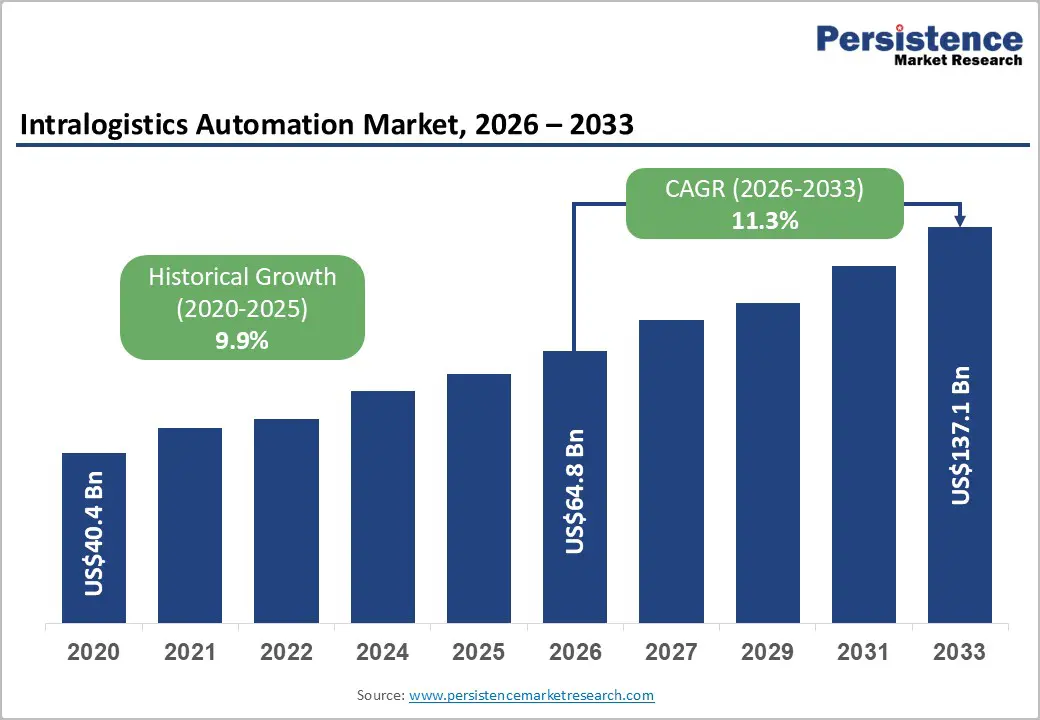
The global intralogistics automation market size is likely to be valued at US$64.8 billion in 2026 and is expected to reach US$137.1 billion by 2033, growing at a CAGR of 11.3% during the forecast period from 2026 to 2033, driven by rising e-commerce volumes, increasing labor shortages, and the need for enhanced inventory visibility, order accuracy, and fulfillment efficiency. Modern intralogistics strategies are increasingly centered on cloud-based warehouse execution systems, intelligent robotics orchestration, and brownfield facility modernization, indicating a shift from purely infrastructure-based investments toward integrated automation ecosystems.
Key Industry Highlights:
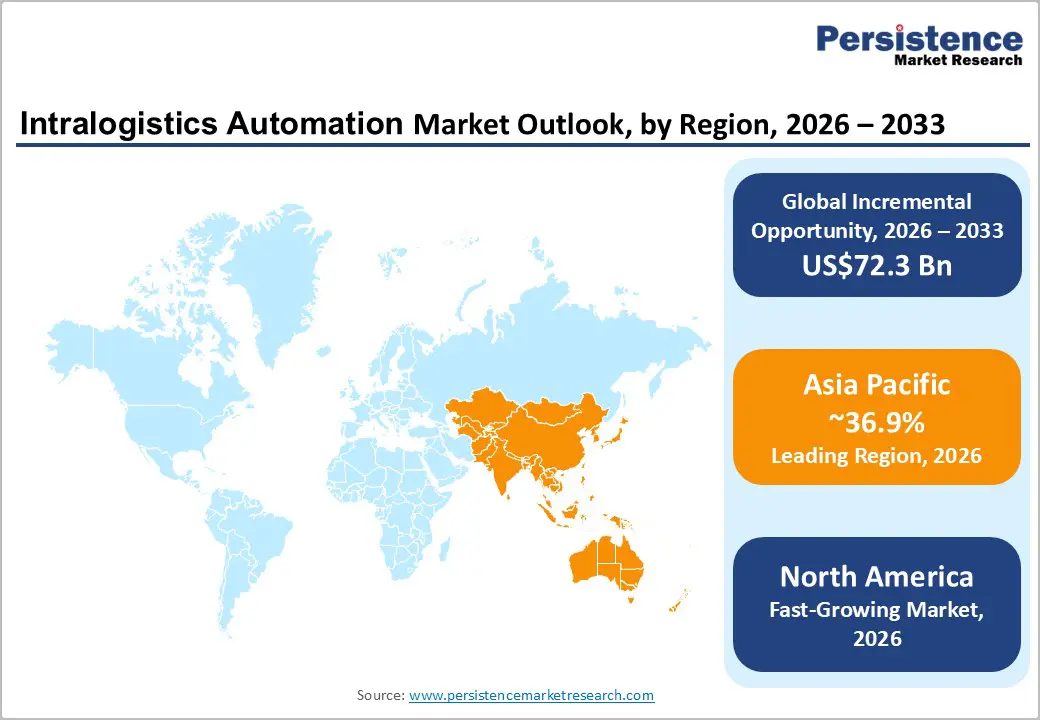
- Leading Region: Asia Pacific is projected to account for 36.9% market share in 2026, driven by large-scale manufacturing activity, expanding e-commerce operations, and rapid warehouse automation adoption across China, Japan, India, and Southeast Asia.
- Fastest-growing Region: North America is projected to record the highest growth rate through 2033, supported by increasing investments in warehouse modernization, robotics deployment, and AI-powered fulfillment infrastructure.
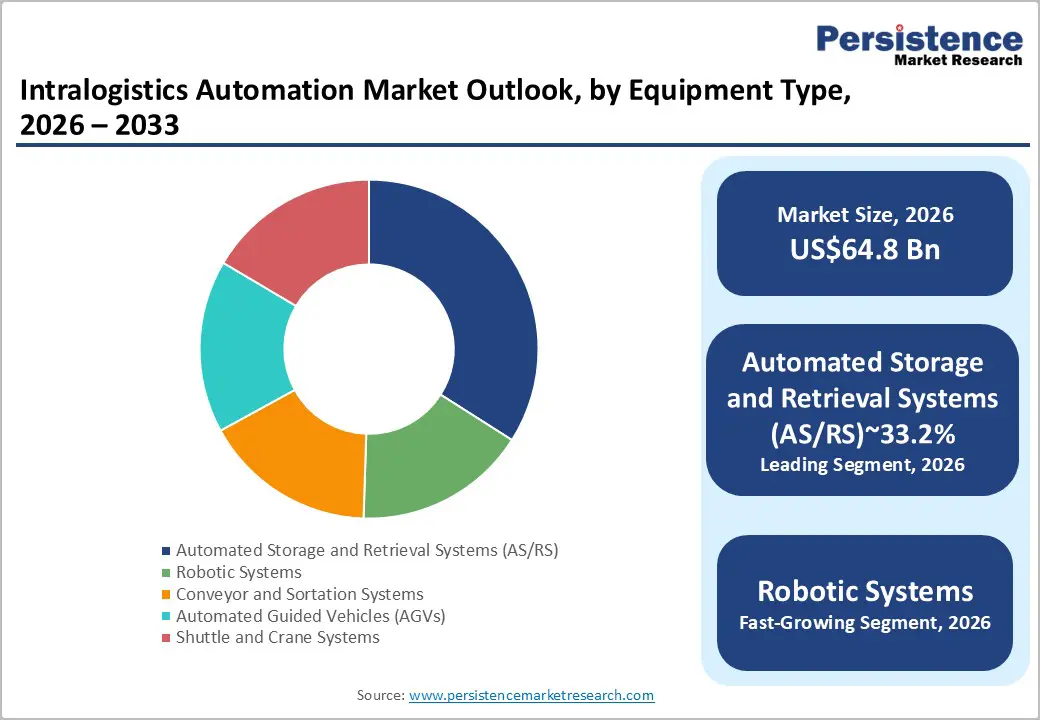
- Dominant Equipment Type: Automated Storage and Retrieval Systems (AS/RS) are estimated to hold a 33.2% market share in 2026, supported by increasing demand for high-density storage, inventory accuracy, and labor-efficient warehouse operations.
- Leading Technology: Warehouse Management Systems (WMS) is anticipated to account for a 30.1% market share in 2026, driven by growing requirements for real-time inventory visibility, automated workflow management, and integration with advanced warehouse technologies.
DRO Analysis
Driver - Growing Labor Shortages and Rising Productivity Requirements
Persistent labor shortages across manufacturing, logistics, and warehousing sectors are accelerating the adoption of intralogistics automation solutions. Aging workforces, changing labor market dynamics, and increasing competition for skilled employees have made workforce availability a significant operational challenge. Warehouses and distribution centers are also under pressure to process larger order volumes while maintaining high service levels and operational consistency. Automated storage systems, robotic picking solutions, autonomous mobile robots, and intelligent warehouse software help organizations reduce dependence on manual labor while improving throughput and operational accuracy.
Expansion of E-commerce and Increasing Fulfillment Complexity
The rapid growth of e-commerce continues to reshape warehouse operations worldwide. Online retail generates significantly higher order volumes, greater SKU diversity, frequent returns, and increased demand for same-day or next-day delivery services. These factors require distribution centers to process orders more efficiently while maintaining inventory accuracy and customer satisfaction. Modern intralogistics systems enable real-time inventory management, automated order fulfillment, and optimized material flow across warehouse networks. The emergence of cloud-based warehouse execution platforms further strengthens operational efficiency by synchronizing labor, inventory, and automated equipment.
Restraint - High Capital Investment and Integration Complexity
Despite strong growth prospects, the market continues to face challenges related to high implementation costs and integration complexity. Deploying intralogistics automation typically requires substantial investments in automated storage systems, robotics, conveyor infrastructure, warehouse management software, control systems, and workforce training. Integration challenges become particularly significant in existing facilities where automation solutions must be incorporated without disrupting ongoing operations. Organizations often face project delays, customization requirements, and compatibility issues when integrating multiple technologies from different vendors. For small and medium-sized enterprises, lengthy return-on-investment periods may further limit adoption.
Opportunity - Brownfield Warehouse Modernization
Brownfield modernization represents one of the most significant opportunities within the intralogistics automation market. A large portion of global warehouse infrastructure was designed for manual or semi-automated operations and now requires modernization to meet evolving fulfillment requirements. Organizations increasingly prefer upgrading existing facilities rather than constructing entirely new warehouses, creating demand for modular and scalable automation technologies. Advances in warehouse execution software, digital twins, simulation tools, and adaptive robotics enable operators to implement automation while maintaining operational continuity. This approach reduces implementation risk and capital expenditure while improving throughput, inventory accuracy, and labor productivity.
Emerging Markets and Integrated Software Ecosystems
Emerging economies across Asia, Latin America, and the Middle East are creating substantial growth opportunities for automation providers. Rapid industrialization, manufacturing expansion, and increasing e-commerce penetration are driving demand for modern warehouse infrastructure. Businesses are also moving away from standalone automation equipment toward integrated platforms that combine warehouse management systems, machine vision, artificial intelligence, and robotics. Vendors capable of delivering end-to-end automation ecosystems supported by lifecycle services and advanced analytics are expected to gain a competitive advantage.
Category-wise Analysis
Equipment Type Insights
Automated Storage and Retrieval Systems (AS/RS) are anticipated to account for 33.2% of the market share in 2026, making them the leading equipment segment. Their ability to maximize storage density, improve inventory accuracy, and reduce labor dependence has driven widespread adoption across e-commerce, pharmaceuticals, food and beverage, and manufacturing facilities. Major automated warehouses operated by companies such as Amazon and Walmart increasingly utilize AS/RS technologies to support high-volume fulfillment operations. As organizations prioritize warehouse efficiency and space optimization, AS/RS remains a cornerstone of modern intralogistics infrastructure.
Robotic systems represent the fastest-growing equipment category. Growth is fueled by rising deployment of autonomous mobile robots (AMRs), robotic picking systems, and collaborative robots in fulfillment centers and distribution hubs. For example, Amazon Robotics and DHL’s robotic warehouse initiatives demonstrate how automation enhances productivity and operational flexibility. Advances in artificial intelligence, machine vision, and navigation technologies continue to improve robot capabilities, supporting broader adoption across warehouse and logistics operations.
Technology Insights
Warehouse Management Systems (WMS) are anticipated to capture 30.1% of the market share in 2026, establishing them as the leading technology segment. WMS platforms coordinate inventory tracking, order fulfillment, workforce management, and automated equipment operations from a centralized interface. Solutions from providers such as SAP, Oracle, and Manhattan Associates are widely used to improve warehouse visibility and operational control. Growing adoption of cloud-based platforms and real-time analytics continues to strengthen demand for advanced WMS solutions across industries.
AI and machine learning technologies are expected to be the fastest-growing technology segment, driven by increasing demand for predictive and autonomous warehouse operations. These technologies support applications such as demand forecasting, route optimization, predictive maintenance, and intelligent inventory management. Companies, including Ocado and GXO Logistics, are leveraging AI-powered automation to improve fulfillment accuracy and operational efficiency. As warehouses become increasingly connected and data-driven, AI and machine learning are emerging as critical enablers of next-generation intralogistics systems.
Regional Insights
North America Intralogistics Automation Market Trends
North America is projected to be the fastest-growing regional market throughout the forecast period, supported by rapid adoption of warehouse automation technologies, strong investments in supply chain modernization, and increasing demand for efficient fulfillment operations. The region benefits from a mature technology ecosystem that encourages deployment of robotics, artificial intelligence, autonomous material handling equipment, and cloud-based warehouse management platforms.
U.S. Intralogistics Automation Market Trends
The U.S. serves as the primary growth engine for the North America market. Large-scale investments by e-commerce companies, retailers, manufacturers, and third-party logistics providers are accelerating automation deployment across distribution centers and fulfillment facilities. Rising labor costs, workforce shortages, and growing consumer expectations for same-day and next-day delivery continue to drive demand for advanced intralogistics solutions. The country's strong innovation ecosystem further supports the adoption of autonomous mobile robots, robotic picking systems, and AI-powered warehouse management technologies.
Canada Intralogistics Automation Market Trends
Canada is witnessing steady growth in warehouse automation adoption, particularly within the retail, e-commerce, and logistics sectors. Investments in modern distribution infrastructure and increasing cross-border trade activities are encouraging businesses to implement automated storage systems and intelligent warehouse technologies. The country's focus on operational efficiency and supply chain resilience is expected to support long-term market expansion.
North America's favorable regulatory environment, combined with ongoing investments in warehouse modernization and digital transformation initiatives, is expected to sustain strong market growth throughout the forecast period.
Europe Intralogistics Automation Market Trends
Europe remains a strategically important market for intralogistics automation, supported by its strong manufacturing base, advanced logistics infrastructure, and widespread adoption of automation technologies. The region benefits from harmonized regulatory standards that encourage automation deployment while maintaining operational safety and efficiency.
Germany Intralogistics Automation Market Trends
Germany leads the Europe market due to its highly developed manufacturing sector and leadership in Industry 4.0 initiatives. Automotive, industrial machinery, and engineering companies continue investing in automated warehouses, robotic systems, and intelligent material handling solutions. Strong demand for smart factory technologies supports ongoing market expansion.
U.K. Intralogistics Automation Market Trends
The U.K. is a major contributor to regional growth, driven by the rapid expansion of e-commerce fulfillment operations and increasing investments in warehouse modernization. Retailers and logistics providers are deploying automated storage systems, robotics, and AI-driven warehouse management platforms to improve efficiency and meet evolving consumer expectations.
France Intralogistics Automation Market Trends
France continues to strengthen its position through investments in logistics infrastructure, digital supply chains, and industrial automation. Companies are increasingly adopting intelligent warehouse technologies to improve inventory visibility, reduce operational costs, and enhance fulfillment performance.
Spain Intralogistics Automation Market Trends
Spain is emerging as an attractive market for intralogistics automation due to growing e-commerce activity, expanding logistics networks, and increasing demand for efficient distribution operations. Investments in modern warehousing facilities are supporting the adoption of automated handling and storage technologies.
Europe's emphasis on sustainability, digital transformation, and industrial modernization is expected to support steady market growth throughout the forecast period.
Asia Pacific Intralogistics Automation Market Trends
Asia Pacific is expected to lead the market and is anticipated to account for approximately 36.9% of market revenue in 2026. The region's dominance is supported by extensive manufacturing activity, rapid expansion of logistics infrastructure, and strong growth in e-commerce and industrial automation.
China Intralogistics Automation Market Trends
China is expected to dominate the Asia Pacific market, representing approximately 61% of regional demand in 2026. The country benefits from the world's largest manufacturing ecosystem, extensive warehouse development, and significant investments in automation technologies. Rapid growth in e-commerce, coupled with increasing adoption of robotics and AI-powered logistics systems, continues to drive market expansion.
Japan Intralogistics Automation Market Trends
Japan remains a key contributor due to its advanced automation capabilities and technological leadership. Labor shortages and high operational efficiency requirements are encouraging widespread adoption of robotic systems, automated storage solutions, and intelligent warehouse management platforms across manufacturing and logistics sectors.
India Intralogistics Automation Market Trends
India is estimated to account for approximately 8% of the regional market in 2026 and represents one of the fastest-growing opportunities. Expanding e-commerce activity, increasing investments in modern warehousing infrastructure, and government initiatives supporting domestic manufacturing are accelerating automation adoption. Rising demand for organized logistics and supply chain optimization is further strengthening market growth.
South Korea Intralogistics Automation Market Trends
South Korea continues to invest heavily in robotics, smart factories, and automated logistics systems. The country's advanced technology infrastructure and strong electronics and manufacturing sectors create favorable conditions for intralogistics automation deployment.
With its combination of manufacturing scale, industrial growth, technological advancement, and expanding logistics infrastructure, Asia Pacific is expected to maintain its leadership position in the global intralogistics automation market throughout the forecast period.
Competitive Landscape
The global intralogistics automation market is moderately fragmented, characterized by the presence of global steel manufacturers, specialty steel producers, and integrated bearing-material suppliers. Competition is primarily based on product quality, metallurgical expertise, production efficiency, customer relationships, and technological capabilities.
Leading market participants are focusing on product innovation, sustainability, manufacturing efficiency, and geographic expansion. Investments in cleaner steel production, advanced metallurgy, localized supply chains, and application-specific bearing materials are becoming key competitive differentiators. Companies are also increasingly emphasizing lifecycle value, predictive maintenance support, and long-term customer partnerships to strengthen market positioning.
Key Industry Developments:
- In March 2025, Geekplus introduced three next-generation warehouse automation solutions at LogiMAT 2025, including the PopPick v2 Shelf-to-Person system, RoboShuttle v4 Tote-to-Person solution, and SkyCube v2 Pallet-to-Person platform.
- In March 2025, Honeywell International Inc. partnered with Corvus Robotics to integrate its SwiftDecoder™ software into autonomous inventory drones, allowing warehouses to automate barcode scanning and inventory tracking with greater accuracy and real-time visibility. The collaboration expands the use of AI-driven automation in warehouse operations.
Companies Covered in Intralogistics Automation Market
- Daifuku Corporation
- Dematic (KION Group)
- Honeywell Intelligrated
- Vanderlande Industries
- SSI SCHAEFER Group
- Swisslog Holding AG
- KNAPP AG
- AutoStore Holdings Ltd.
- Toyota Industries Corporation
- Murata Machinery, Ltd. (Muratec)
- BEUMER Group
- Mecalux, S.A.
- Geekplus Technology Co., Ltd.
- Locus Robotics Corp.
- Ocado Intelligent Automation (Ocado Group)
- TGW Logistics Group GmbH


