




- Beauty & Personal Care
- Hypnea musciformis Extract Market
Hypnea musciformis Extract Market Size, Share, and Growth Forecast, 2026 - 2033
Hypnea Musciformis Extract Market by Formulation Type (Liquid Extracts, Powdered Extracts, Capsules and Tablets, Topical Ointments and Creams), Application (Food and Beverages, Others), and Regional Analysis for 2026 - 2033

Hypnea Musciformis Extract Market Size and Trends Analysis
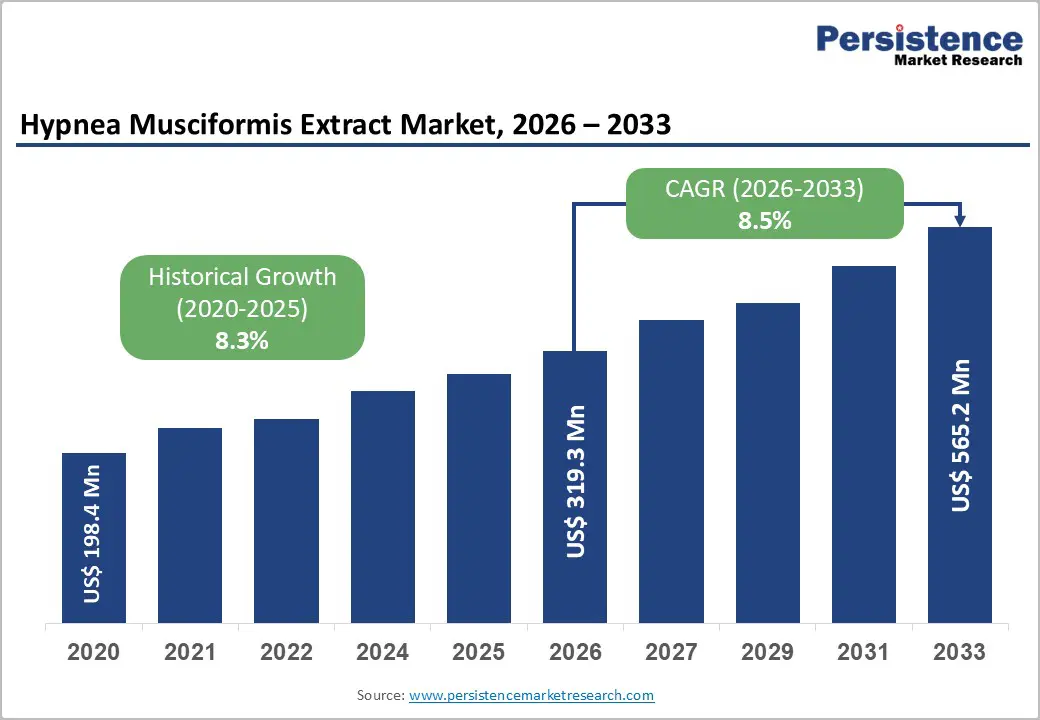
The global Hypnea musciformis extract market size is likely to be valued at US$319.3 million in 2026 and is expected to reach US$565.2 million by 2033, growing at a CAGR of 8.5% during the forecast period from 2026 to 2033, driven by the rising adoption of natural, marine-derived ingredients across cosmetics, personal care, nutraceuticals, and functional food applications, supported by increasing consumer awareness of clean-label and sustainably sourced products.
Hypnea musciformis extract contains high levels of kappa-carrageenan and other bioactive polysaccharides, making it a valuable natural ingredient for thickening, stabilizing, emulsifying, and skin-conditioning. Rising demand from the cosmetics and personal care industry, especially for moisturizing, calming, and anti-aging products, continues to drive market growth. Increasing adoption of nutraceuticals and functional foods, driven by their antioxidant properties and digestive health benefits, is further fueling expansion.
Key Industry Highlights:
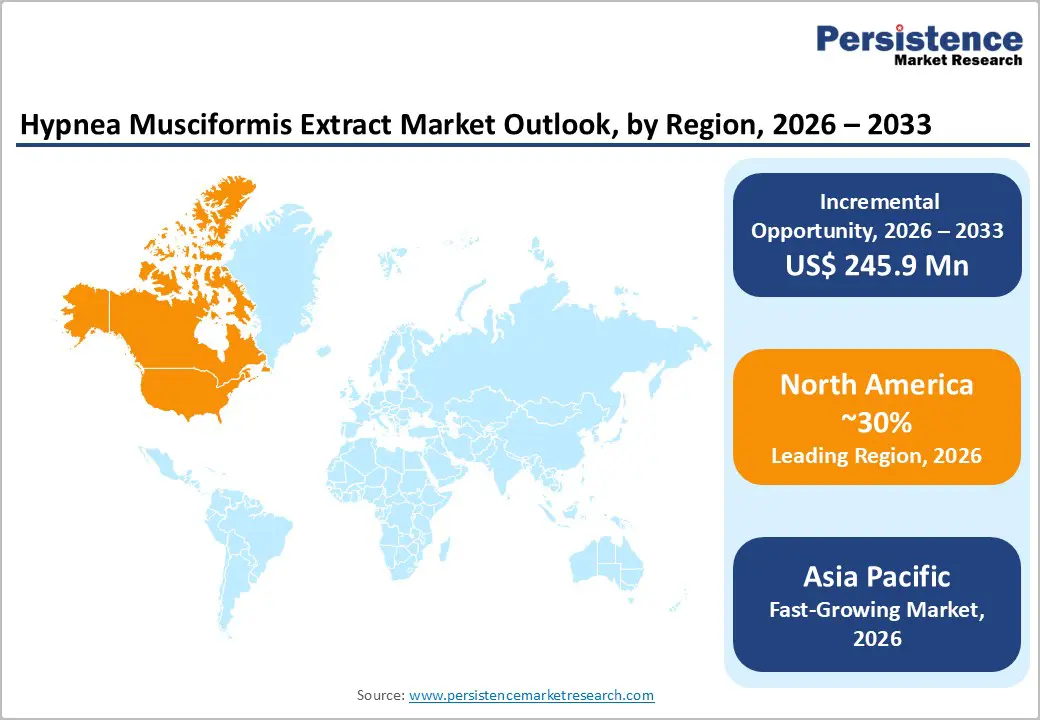
- Leading Region: North America is anticipated to be the leading region, accounting for a market share of 30% in 2026, driven by strong U.S. demand for natural cosmetics, nutraceuticals, and regulated marine bioactive innovation.
- Fastest-growing Region: Asia Pacific is likely to be the fastest-growing region, supported by abundant seaweed resources, large-scale cultivation, export-oriented manufacturing, and strong domestic demand across China, India, Japan, and ASEAN countries.
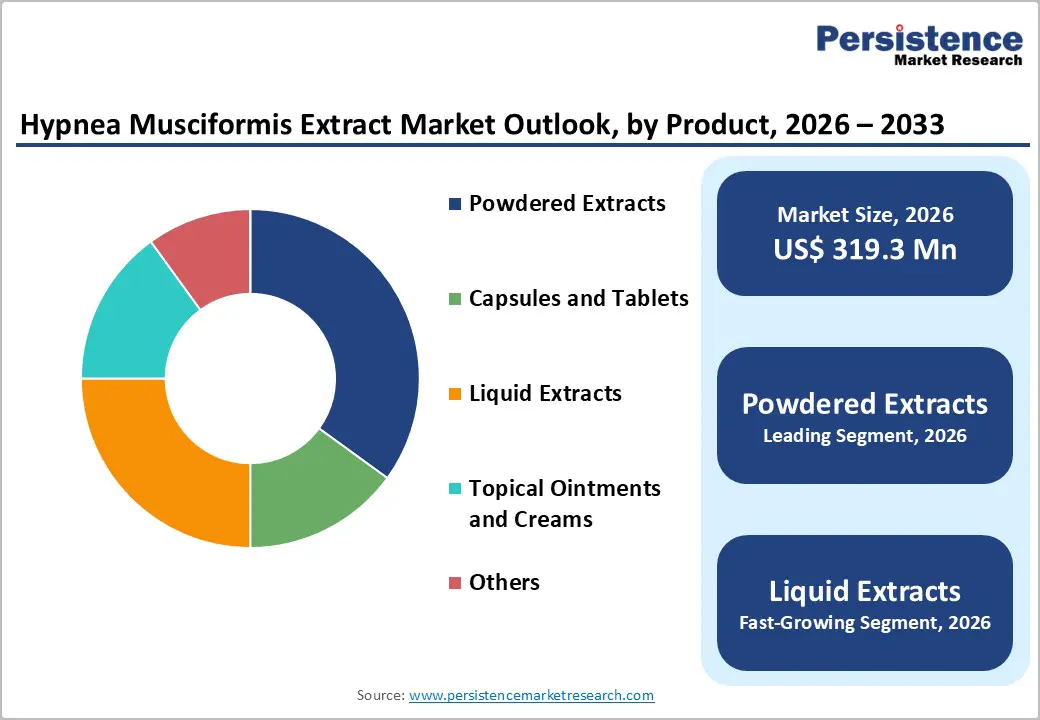
- Leading Formulation Type: The powdered extracts segment is projected to lead in 2026, accounting for 45% of revenue share, due to superior stability and ease of use in nutraceutical and cosmetic formulations.
- Leading Application: The cosmetics and personal care segment is anticipated to be the leading application, accounting for over 50% of revenue in 2026, supported by strong demand for natural, skin-soothing, and moisturizing ingredients.
| Key Insights | Details |
|---|---|
|
Hypnea Musciformis Extract Market Size (2026E) |
US$319.3 Mn |
|
Market Value Forecast (2033F) |
US$565.2 Mn |
|
Projected Growth (CAGR 2026 to 2033) |
8.5% |
|
Historical Market Growth (CAGR 2020 to 2025) |
8.3% |
Market Factors - Growth, Barriers, and Opportunity Analysis
Rising Demand for Natural Ingredients in Cosmetics and Personal Care
Consumers across global markets are increasingly favoring clean-label, plant- and marine-derived products, driven by growing concerns about synthetic ingredients, skin sensitivity, and long-term health effects. As a red algae-based ingredient, Hypnea musciformis extract fits well with this trend due to its natural source and versatile functionality. Abundant in kappa-carrageenan and bioactive polysaccharides, it delivers strong moisturizing, film-forming, and soothing properties, making it well-suited for use in creams, lotions, serums, masks, and haircare formulations. Cosmetic brands are leveraging this extract to improve texture, stability, and sensory performance while preserving a natural product positioning. Its antioxidant and anti-inflammatory benefits support skin-protection and anti-aging claims, driving greater adoption in premium and dermocosmetic products.
Increasing regulatory scrutiny and corporate sustainability initiatives are driving a shift toward naturally-derived cosmetic ingredients, boosting demand for Hypnea musciformis extract. Authorities across North America, Europe, and parts of Asia are emphasizing transparency in formulations and consumer safety, encouraging manufacturers to replace synthetic thickeners and stabilizers with marine-based alternatives. The extract’s biodegradable profile and suitability for eco-friendly and vegan formulations align well with the preferences of environmentally aware consumers. Brands are highlighting their sustainable sourcing credentials, as red algae cultivation typically has a lower environmental impact than many land-based raw materials.
Supply Chain Constraints and Seasonal Variability
Hypnea musciformis is primarily sourced from coastal areas where its growth is highly dependent on seasonal patterns, water temperature, salinity, and weather conditions. Events such as monsoons, storms, and broader climate variability can disrupt harvesting activities, leading to inconsistent raw material supply and price volatility. Unlike synthetic alternatives, year-round, large-scale cultivation of this red algae is still limited in many regions, leading to supply constraints when demand increases from the cosmetics, nutraceutical, and food sectors. The geographic concentration of harvesting locations heightens exposure to regional risks, including stricter environmental regulations, coastal ecosystem degradation, and concerns over overharvesting.
Supply-side challenges are further compounded by logistical and processing constraints within the Hypnea musciformis extract market. Preserving carrageenan levels and bioactive compounds requires careful post-harvest handling, including controlled drying, storage, and extraction, which increases reliance on specialized infrastructure near coastal regions. In developing markets, limited access to cold-chain logistics and advanced processing facilities can cause quality inconsistencies, reducing product performance and limiting acceptance by high-end cosmetic and pharmaceutical manufacturers. Seasonal availability also complicates long-term sourcing agreements, prompting manufacturers to hold larger inventories or turn to substitute ingredients, thereby increasing operational costs. While investments in seaweed aquaculture and controlled cultivation systems are gradually enhancing supply reliability, widespread scaling of these solutions remains capital-intensive and time-consuming.
Technological Convergence for Bioactive Innovations
Advances in processing technologies, including enzyme-assisted extraction, membrane filtration, and the use of green solvents, are enabling improved recovery of kappa-carrageenan and other bioactive compounds while maintaining their antioxidant and anti-inflammatory properties. These innovations enhance the purity, performance, and consistency of extracts, increasing the appeal of Hypnea musciformis for high-value applications in cosmetics, nutraceuticals, and pharmaceuticals. The integration of marine biotechnology with analytical approaches such as metabolomics and bioassays allows manufacturers to better identify active constituents and substantiate efficacy claims, supporting premium product positioning. As brands increasingly demand standardized, high-performing natural ingredients, technologically advanced extracts are better able to meet regulatory expectations and functional needs, driving wider adoption in innovation-led product segments.
The convergence of digital technologies with marine bioactives is also opening new commercialization opportunities for Hypnea musciformis extract. Data-driven formulation tools, AI-enabled ingredient optimization, and predictive stability testing help manufacturers fine-tune extract concentrations to achieve specific skin, health, and functional benefits. This supports the creation of next-generation offerings, including targeted anti-aging skincare, condition-focused nutraceuticals, and functional foods with improved bioavailability. In parallel, progress in controlled seaweed aquaculture, enhanced by automation and real-time monitoring, is improving raw material quality, consistency, and traceability, reinforcing alignment with clean-label and sustainability goals.
Category-wise Analysis
Formulation Type Insights
Powdered extracts are expected to lead, accounting for approximately 45% of revenue in 2026, driven by their superior stability, ease of storage, and compatibility with a wide range of end-user applications. These extracts are highly valued for their concentrated kappa-carrageenan content, which delivers consistent thickening, binding, and stabilizing performance in dry formulations. Manufacturers in nutraceuticals, cosmetics, and functional foods prefer powdered formats because they integrate seamlessly into capsules, tablets, sachets, face masks, and powdered cosmetic blends without compromising shelf life. For example, Cargill personal care ingredient suppliers offer powdered red algae extracts to indie and premium skincare brands seeking natural texturizers with marine-derived claims.
Liquid extracts are likely to represent the fastest-growing segment in 2026, supported by increasing demand from topical cosmetics and functional beverages. Their rapid growth is supported by superior solubility, faster bioavailability, and ease of incorporation into ready-to-use formulations such as serums, lotions, toners, shampoos, and wellness drinks. Cosmetic formulators favor liquid Hypnea musciformis extracts for their smooth sensory profile and ability to deliver immediate hydration and film-forming effects without additional processing steps. In the beauty sector, marine-infused serums and calming skincare products increasingly feature liquid red algae extracts to support anti-aging and barrier-repair claims. For example, premium skincare brands incorporate liquid seaweed extracts into hydrating serums and post-treatment soothing solutions, where uniform dispersion and bioactive integrity are critical.
Application Insights
The cosmetics and personal care segment is projected to lead the market, capturing around 50% of the revenue share in 2026, supported by rising demand for natural, marine-based skincare and haircare ingredients. The extracts' moisturizing, soothing, film-forming, and texture-enhancing properties make it highly attractive for creams, lotions, masks, sunscreens, and anti-aging products. Hypnea musciformis extract also functions as a natural alternative to synthetic thickeners, helping brands reformulate products to meet regulatory and consumer expectations. Its compatibility with sensitive skin and dermatological products strengthens adoption. For example, the growing use of marine algae extracts by skincare brands in anti-aging creams and hydrating masks, where seaweed-derived actives are marketed for their ocean-based purity and skin-calming benefits.
Nutraceuticals are likely to be the fastest-growing application in 2026, driven by increasing consumer focus on preventive health, immunity support, and natural wellness solutions. The extract’s antioxidant, mineral-rich, and bioactive polysaccharide profile supports its use in dietary supplements, functional powders, and wellness blends aimed at digestive health, immune balance, and overall vitality. Rising awareness of marine-sourced nutrition and the shift toward plant- and algae-based supplements are accelerating adoption, particularly among health-conscious and aging populations. Nutraceutical manufacturers value Hypnea musciformis extract for its clean-label appeal, natural origin, and compatibility with capsules, tablets, and powdered drink mixes. For example, supplement brands are introducing seaweed-based antioxidant formulations and marine mineral complexes that feature red algae extracts as key functional ingredients.
Regional Insights
North America Hypnea Musciformis Extract Market Trends
North America is anticipated to be the leading region, accounting for a market share of 30% in 2026, driven by increasing consumer demand for natural and sustainable ingredients in cosmetics, nutraceuticals, and functional food applications. Consumers continue to prioritize clean-label products that combine efficacy with ethical sourcing, prompting manufacturers to reformulate existing lines and launch new product innovations featuring marine-derived extracts. In cosmetics and personal care, Hypnea musciformis extract is valued for its hydrating, soothing, and film-forming properties, which align with trends toward gentle, multi-benefit formulations tailored for sensitive and aging skin. Regulatory frameworks, particularly stringent safety and labeling standards enforced by the U.S. Food and Drug Administration (FDA) and Health Canada, further boost market confidence by ensuring ingredient transparency and product integrity.
Within this expanding landscape, industry players are actively integrating Hypnea musciformis extract into differentiated product portfolios, leveraging its functional benefits and marketing appeal. For example, DuPont Nutrition & Biosciences has been notable for its investments in marine bioactive ingredients, exploring applications of seaweed extracts in both personal care and nutritional segments as part of its broader portfolio expansion. Such strategic moves reflect a broader trend of ingredient houses and formulators partnering with seaweed producers to secure supply, optimize extraction efficiency, and co-develop high-performance actives tailored to North American consumer preferences. The functional food and beverage sector is also exploring opportunities to incorporate marine extracts into products positioned for digestive well-being and natural fortification.
Europe Hypnea Musciformis Extract Market Trends
Europe is likely to be a significant market for Hypnea musciformis extract in 2026, due to stringent regional regulations and well-established consumer preferences for clean-label products. European consumers increasingly favor marine-derived extracts for their multifunctional benefits, such as hydration, anti-aging, and natural thickening, which aligns with the rising adoption of eco-certified and organic formulations across premium beauty and wellness portfolios. Regulatory frameworks within the European Union encourage the use of natural additives while restricting synthetic chemicals, reinforcing the shift toward marine bioactives in certified clean beauty and health supplements. Market players are focusing on product differentiation through sustainable sourcing, traceability, and certifications that resonate with European consumer preferences for ethically produced extracts.
European ingredient suppliers and formulators are leveraging strategic collaborations and innovation to expand applications of Hypnea musciformis extract, particularly in high-growth segments such as functional nutraceuticals and premium skincare. For example, Gelymar, a company actively introducing high-purity marine extracts tailored for both cosmetic and nutraceutical applications in European markets, highlights the region’s inclination toward performance-driven natural ingredients and specialized formulations. These product developments are driven by consumer demand for health-enhancing benefits, such as antioxidants for immune support and marine polysaccharides for skin repair, which are becoming increasingly mainstream in European dietary supplements and beauty care offerings.
Asia Pacific Hypnea Musciformis Extract Market Trends
The Asia Pacific region is likely to be the fastest-growing region in the Hypnea musciformis extract market, driven by abundant coastal resources, well-established seaweed cultivation traditions, and rising domestic demand for natural and marine-derived ingredients across cosmetics, nutraceuticals, and food & beverage sectors. Countries such as China, Japan, South Korea, and India serve as key production and consumption hubs, benefiting from favorable climates, low production costs, and strong research and development in marine biotechnology that enhance extraction efficiency and product quality. The region’s dominance is also reinforced by progressive government initiatives that support marine agriculture expansion and sustainable harvesting practices, helping to stabilize raw material supply and meet the increasing industrial demand for clean-label extracts.
Within this dynamic landscape, key ingredient and formulation companies are leveraging regional strengths to expand product portfolios and capture growing opportunities in high-value applications. For example, Qingdao Gather Great Ocean Algae Industry Group, a major China-based seaweed extract producer that supplies a broad range of marine-derived actives, including carrageenan and polysaccharide-rich extracts, to cosmetic, nutraceutical, and functional food manufacturers across Asia Pacific. By focusing on high-quality, sustainably sourced seaweed biomass and investing in advanced extraction and processing technologies, the company exemplifies how local players are enhancing regional competitiveness while meeting stringent quality standards set by buyers.
Competitive Landscape
The global hypnea musciformis extract market exhibits a moderately fragmented structure, driven by a mix of established ingredient suppliers, marine biotech firms, and regional specialty producers competing to meet the rising demand for natural, clean-label extracts across cosmetics, nutraceuticals, food & beverage, and pharmaceutical applications. Market players are increasingly focusing on sustainable sourcing, advanced extraction technologies, and product standardization to differentiate their offerings and enhance functional performance. Innovation in green solvent extraction, enzyme-assisted processing, and bioavailability optimization is a key area of investment as companies seek to offer high-purity extracts with consistent bioactive profiles that appeal to eco-conscious and performance-oriented buyers.
With key leaders including DuPont de Nemours, Inc., CP Kelco (J.M. Huber Corporation), Cargill, Incorporated, and Gelymar S.A., the competitive landscape is defined by both product innovation and sustainability commitments that resonate with evolving consumer expectations. These players compete through continuous R&D investments, distribution expansion, and portfolio diversification to capture share in high-growth segments such as marine-based cosmetics and health supplements. Companies such as CP Kelco focus on sustainable production practices and eco-friendly extraction techniques to align with the regulatory trends and environmental standards.
Key Industry Developments:
- In December 2025, Silab introduced Deglysome (INCI: Hypnea Musciformis Extract), a seaweed-derived ingredient designed to combat skin aging caused by glycation and Advanced Glycation End Products (AGEs). The extract, rich in sulfated galactans, protects fibroblasts and dermal tissue by preserving cytoskeleton integrity, stimulating collagen and fibrillin network formation, and maintaining skin elasticity. Clinical testing demonstrated that at a 0.25% concentration, Deglysome reduced AGE formation in glycated human fibroblasts by 54%, preserved the organization of vimentin fibers, and enhanced the collagen I network by 100%.
- In May 2025, YASHAM announced a strategic partnership with Nutrileads B.V., a Netherlands-based leader in clinically proven health ingredients, to introduce Benicaros®, a plant-based precision prebiotic, to the Indian market. Derived from upcycled carrot pomace, Benicaros® is sustainable and designed to support gut health and immune resilience through low-dose, clinically validated efficacy. Benicaros® works by feeding beneficial gut microbes across diverse microbiomes and training the innate immune system to respond faster and more effectively. The ingredient is formulation-friendly, offering a neutral taste, low dose, and versatile application across nutraceutical and functional food products.
Companies Covered in Hypnea musciformis Extract Market
- SILAB
- Parchem
- ASSESSA
- Yasham
- Catalina
- Essentials
- Seppic
- RITA Corporation
Frequently Asked Questions
The global Hypnea musciformis extract market is projected to reach US$319.3 million in 2026.
The rising demand for natural, marine-derived ingredients in cosmetics, nutraceuticals, and functional foods.
The Hypnea musciformis extract market is expected to grow at a CAGR of 8.5% from 2026 to 2033.
Expansion in cosmetics and personal care, growth in nutraceuticals and functional foods, development of high-performance marine bioactives, and innovations in sustainable and standardized extraction technologies.
SILAB, Parchem, ASSESSA, Yasham, Catalina, Essentials, Seppic, and RITA Corporation are the leading players.


