




- Medical Devices
- Hybrid Infant Incubators Market
Hybrid Infant Incubators Market Size, Share, and Growth Forecast 2026 - 2033
Hybrid Infant Incubators Market by Product Type (Open Care System, Closed Incubator, Transport Incubator), Application (Neonatal ICU, Premature Infant Care), End-user (Hospitals, Specialty Clinics), and Regional Analysis, 2026 - 2033

Hybrid Infant Incubators Market Size and Trends Analysis
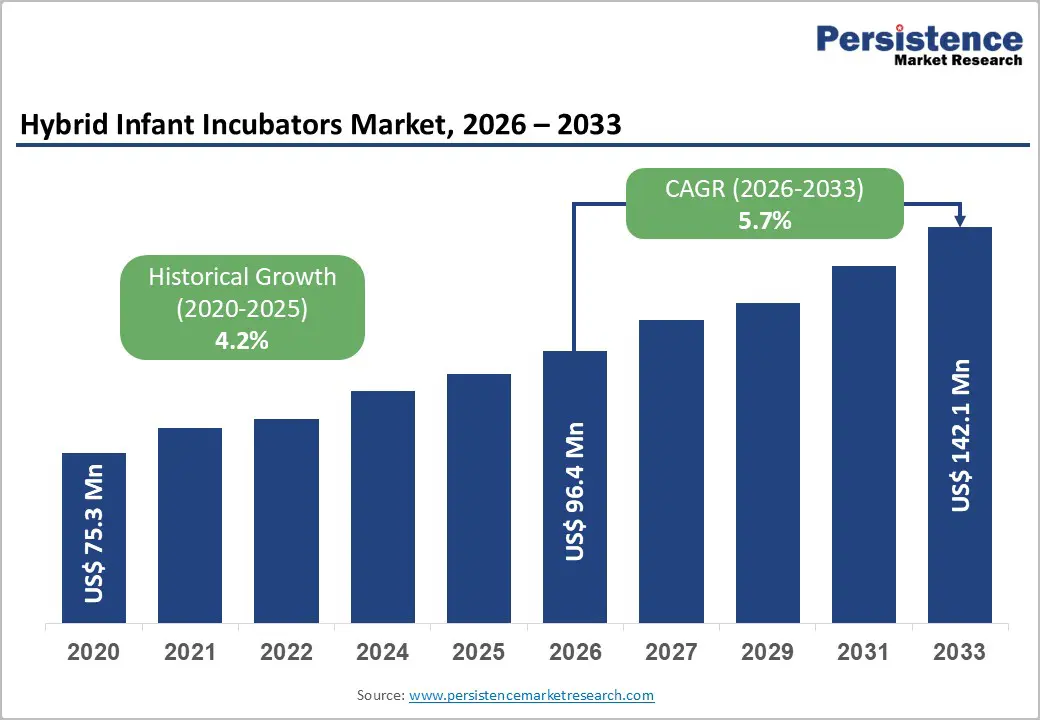
The global hybrid infant incubators market size is likely to be valued at US$96.4 million in 2026 and is expected to reach US$142.1 million by 2033, growing at a CAGR of 5.7% during the forecast period from 2026 to 2033, driven by rising preterm birth cases that require continuous thermal and respiratory support.
Increasing NICU upgrades toward integrated and single-device care systems is also expected to boost growth.
Key Industry Highlights:
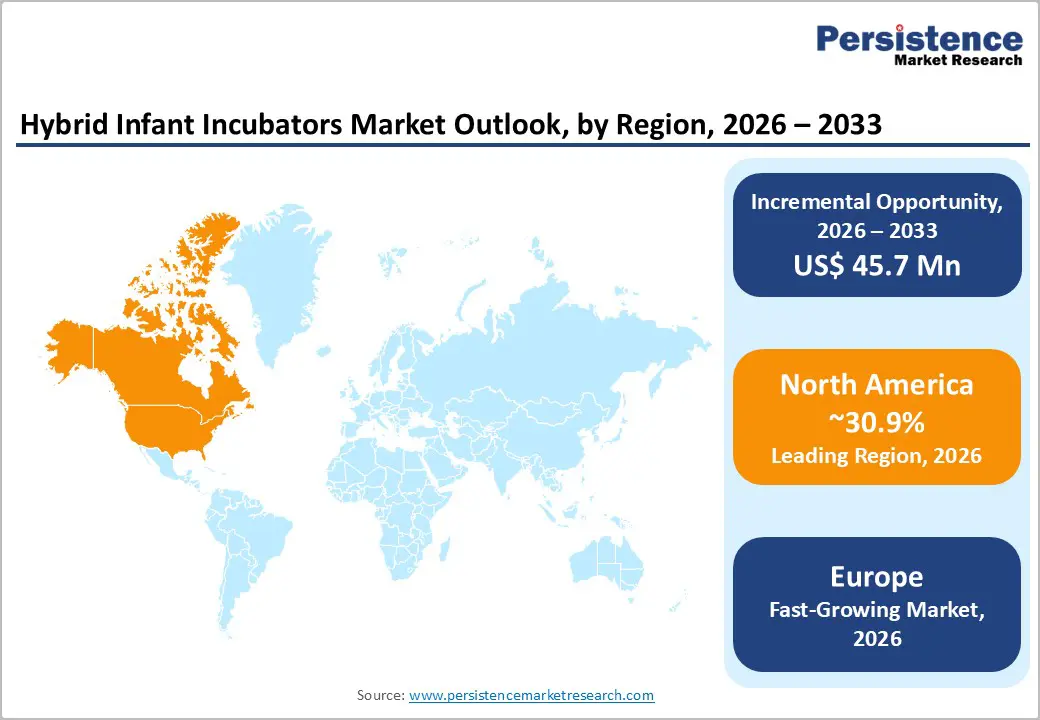
- Leading Region: North America, with about 30.9% share in 2026, backed by a well-established NICU infrastructure and rising neonatal respiratory distress cases.
- Fast-growing Region: Europe, as hospitals are upgrading neonatal intensive care units with novel respiratory support technologies.
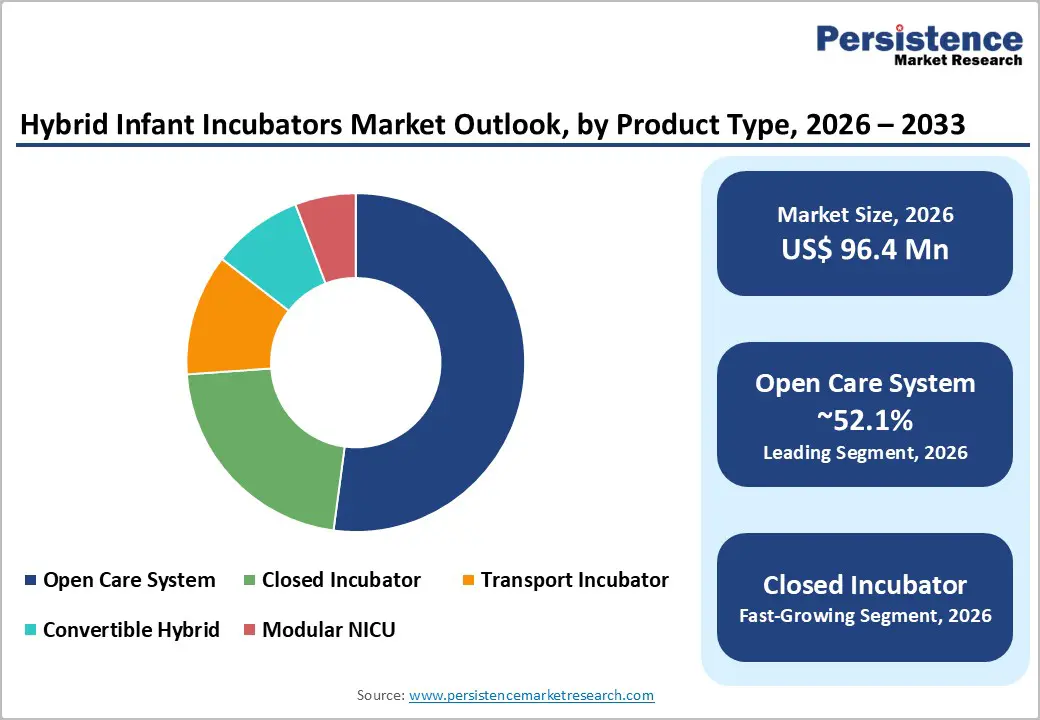
- Leading Product Type: Open care systems, approximately 52.1% share in 2026, as they provide quick and unrestricted access to newborns during emergency procedures.
- Dominant Application: Premature infant care, nearly 38.5% in 2026, as nearly 1 in 10 babies worldwide are born preterm and require controlled temperature immediately after birth.
- New Product: In April 2025, SynCubator, a multifunctional hybrid neonatal incubator developed at the Indian Institute of Technology (IIT) Mandi, was selected for the prestigious Stanford Biodesign Innovators Garage program.
DRO Analysis
Driver - Surging Preterm Birth Rates Worldwide
Preterm birth remains one of the most pressing challenges in neonatal health. According to the World Health Organization (WHO), an estimated 13.4 million babies were born preterm in 2020, which was more than 1 in 10 babies globally. A joint WHO/UNICEF/March of Dimes report found that preterm birth rates have not improved in any region over the past decade, with 152 million vulnerable babies born too soon between 2010 and 2020. Conflict, climate change, and rising living costs are only adding to the risk.
In the U.S. alone, 373,902 preterm births occurred in 2023, accounting for 10.4% of all live births. These infants require intensive thermal and respiratory support from day one, making hybrid incubators important tools in modern NICUs. As preterm rates persist at high levels globally, hospitals are investing in more advanced incubation systems that can handle the complex requirements of these fragile newborns.
Rising Demand for Single-Device Flexibility in Neonatal Critical Care
Moving a critically ill newborn between a closed incubator and a separate open warmer creates dangerous temperature instability. Hybrid incubators eliminate this by switching between both modes in one unit. GE HealthCare's Giraffe OmniBed Carestation, for instance, functions as both a full-featured incubator and a radiant warmer, allowing the microenvironment to be maintained during clinical procedures.
A study published in the Journal of Perinatology evaluated a hybrid warming device called the Versalet and found it provided similar thermal and cardiovascular stability to using separate devices, but without the need to physically move the infant between units during mode transitions. For procedures such as intubation or umbilical catheter insertion, this single-platform approach protects the baby while giving clinicians unobstructed access. Hence, it is considered a clear clinical and workflow advantage.
Restraint - Thermal and Humidity Loss during Access
Even the most advanced hybrid incubators face a persistent problem. Every time a caregiver opens the unit, the controlled microenvironment is disrupted. Research shows that a 1°C drop in body temperature on NICU admission is associated with a 28% increase in mortality and an 11% rise in late-onset sepsis risk for extremely low-birthweight neonates. A 2024 study in the World Journal of Pediatrics confirmed that for extremely low-birthweight infants in the first week of life, better thermoregulation was achieved by minimizing the opening of incubator side panels and using portholes instead of lifting the canopy.
Clinical guidelines from the Royal Children's Hospital recommend minimizing the time main doors are open and avoiding raising the incubator canopy. It suggested relying mainly on features such as air curtain mode to reduce heat loss during porthole access. These limitations affect care efficiency and pose real safety risks, especially during urgent or frequent procedures.
Opportunity - Sensory Features to Strengthen Parent-Infant Bonding inside the NICU
New hybrid incubators are moving beyond clinical function to support emotional development, too. Built-in speakers and display screens are helping bridge the gap between parents and their isolated newborns. A study published in the Proceedings of the National Academy of Sciences (PNAS) found that playing maternal voice and heartbeat recordings inside incubators triggered measurable auditory plasticity in the developing brain before full gestation.
Research published in Frontiers in Pediatrics further supports integrating controlled sound environments into incubators. It found that algorithms that filter out machine noise while preserving the mother's voice and therapeutic sounds can promote neural development and reduce infant distress. These features are transforming the incubator from a purely medical device into one that supports family-centered care. This is a growing priority in NICU design and an area where manufacturers can meaningfully differentiate their products.
AI and Smart Sensors to Enable Personalized and Automated Neonatal Environments
The integration of AI and novel sensors into hybrid incubators is opening the door to truly individualized care. A 2024 study published in a peer-reviewed engineering journal found that machine learning models can automatically adjust incubator settings such as temperature and humidity based on variables, including gestational age, weight, and current health status, and can even forecast health outcomes from past data.
IoT-enabled systems have demonstrated temperature regulation precision of ±0.2°C and humidity consistency within ±3% variance, keeping conditions within the therapeutic range for premature infants. A 2024 PubMed-indexed study further validated continuous real-time tracking of temperature, humidity, and gas values from incubator environments, with automated alerts triggered when parameters deviate. As these capabilities mature, they reduce the cognitive burden on NICU staff and minimize human error. It further helps in making AI-integrated hybrid incubators a compelling next step for neonatal care facilities worldwide.
Category-wise Analysis
Product Type Insights
The open care system segment is predicted to dominate with a share of approximately 52.1% in 2026. This is attributed to its easy accessibility during emergency procedures, resuscitation, ventilation support, and continuous monitoring. Hospitals prefer open care systems because clinicians can quickly access neonates without opening enclosed chambers, which is important during intensive interventions. Their low cost and compatibility with multiple monitoring devices also support wide adoption across public hospitals and developing healthcare systems.
The closed incubator segment is estimated to remain in the second position in 2026. It is highly preferred in advanced neonatal intensive care settings where infection prevention, humidity control, and long-term thermal stability are priorities. Demand is also increasing at a fast pace as hospitals are focusing more on reducing neonatal infections and improving survival rates of extremely low-birth-weight infants. Modern closed incubators now include servo-controlled humidity, oxygen regulation, double-wall insulation, and reduced-noise environments for developmental care.
Application Insights
The premature infant care segment is expected to lead with nearly 38.5% of the share in 2026. This is because preterm babies require continuous thermal support, humidity regulation, respiratory monitoring, and minimal physical disturbance during the first few weeks of life. Extremely premature infants often cannot regulate body temperature on their own, which increases the risk of respiratory distress, dehydration, and organ complications. Hybrid incubators are widely preferred as they combine incubator and radiant warmer functions in a single system.
The infection control segment is anticipated to be the fastest-growing over the forecast period, as NICU infants are highly vulnerable to hospital-acquired infections. Premature babies have underdeveloped immune systems, and prolonged NICU stays increase exposure to bacterial contamination. Governments and healthcare agencies are hence tightening neonatal infection prevention standards. The Centers for Disease Control and Prevention (CDC), for instance, has issued dedicated NICU recommendations for preventing Staphylococcus aureus infections in neonatal intensive care units.
Regional Insights
North America Hybrid Infant Incubators Market Trends
In 2026, North America is expected to lead with a share of nearly 30.9%, backed by its well-established NICU infrastructure, high healthcare spending, superior reimbursement systems, and early adoption of connected neonatal technologies. The region also has a high concentration of Level III and Level IV NICUs equipped with novel neonatal monitoring systems.
The U.S., in particular, benefits from increasing investments in maternal-fetal medicine and pediatric critical care. Key companies such as GE HealthCare and Dräger have extensive neonatal installations across North America’s hospitals. Another important factor is the rising focus on reducing healthcare-associated infections. The CDC reported that around one in 31 hospital patients acquires at least one healthcare-associated infection on any given day in the U.S. healthcare system.
U.S. Hybrid Infant Incubators Market Trends
The U.S. growth outlook remains positive as hospitals are replacing conventional incubators with integrated hybrid systems that support digital monitoring and workflow efficiency. Demand is also increasing from children’s hospitals and academic medical centers upgrading NICUs with AI-assisted thermoregulation and remote monitoring functions. Several U.S.-based hospitals are investing in single-family NICU rooms and developmental care environments, which favor quieter and more adaptive hybrid incubator systems. Rising maternal age and increasing rates of high-risk pregnancies continue to support neonatal intensive care demand.
Europe Hybrid Infant Incubators Market Trends
Europe is seeing exponential growth as governments are modernizing neonatal infrastructure and implementing strict infection-control standards. The region has a strong focus on reducing neonatal mortality and improving developmental care outcomes. Local hospitals mainly prefer hybrid incubators that reduce noise, stabilize humidity, and minimize infant movement during treatment. Regulatory pressure under the European Medical Device Regulation (MDR) is also pushing hospitals toward new compliant systems with improved safety and monitoring capabilities. Infection prevention has become very important across neonatal units after multiple reports of resistant bacterial outbreaks in hospitals.
Germany Hybrid Infant Incubators Market Trends
Germany has a superior growth outlook as it has one of the most advanced neonatal care infrastructures in Europe. The country maintains a high number of specialized perinatal centers and neonatal intensive care units. Local hospitals are also early adopters of precision neonatal technologies and integrated patient monitoring systems. Companies such as Dräger play a key role in domestic adoption due to their strong local manufacturing presence and close collaboration with hospitals. Germany’s emphasis on engineering quality, infection prevention, and energy-efficient medical systems further supports replacement demand for advanced hybrid incubators.
U.K. Hybrid Infant Incubators Market Trends
The U.K. is witnessing decent growth due to rising attention toward neonatal mortality reduction and infection prevention. Government agencies have increased monitoring of bloodstream infections and neonatal critical care safety practices. The National Health Service (NHS) is also investing in neonatal network expansion and upgraded NICU infrastructure. Recent government guidance on incubator cleaning and humidifier management has increased awareness regarding the importance of modern neonatal equipment with improved contamination control. Hospitals are also adopting family-centered neonatal care models, which support the use of less disruptive hybrid incubator systems.
Asia Pacific Hybrid Infant Incubators Market Trends
Asia Pacific is witnessing steady growth owing to increasing birth volumes, improving neonatal survival programs, and expanding healthcare infrastructure. Governments across China, India, Indonesia, and Southeast Asia are investing heavily in maternal and child healthcare facilities. Demand is very high in urban hospitals where NICU modernization is accelerating. Another important factor is the rising awareness of neonatal hypothermia prevention in premature infants. Several countries are also increasing local manufacturing of neonatal equipment to improve affordability and reduce import dependency.
India Hybrid Infant Incubators Market Trends
India is emerging as a highly lucrative market owing to its large preterm birth population, expanding NICU capacity, and increasing government focus on neonatal survival. The country records one of the highest numbers of preterm births globally, creating booming long-term demand for neonatal care equipment. Public health initiatives such as Special Newborn Care Units (SNCUs) and facility-based newborn care programs have extended neonatal infrastructure across district hospitals.
Private hospital chains are also constantly investing in novel NICUs in Tier I and Tier II cities. Domestic manufacturers are helping improve affordability, while international companies are targeting India through partnerships and localized distribution networks. Rising institutional deliveries, improving insurance coverage, and surging awareness of neonatal critical care make India one of the most promising future markets for hybrid infant incubators.
China Hybrid Infant Incubators Market Trends
China is experiencing stable market expansion due to ongoing hospital modernization and increasing investments in neonatal intensive care units. The country has significantly broadened its maternal and infant healthcare infrastructure over the past decade. Large urban hospitals are now adopting smart neonatal systems integrated with hospital information platforms. Domestic manufacturers are also becoming more competitive by producing low-cost hybrid incubators with unique monitoring functions. Government healthcare reforms and the expansion of tertiary hospitals are further strengthening adoption across provincial healthcare systems.
Competitive Landscape
The global hybrid infant incubators market is moderately consolidated, with a small group of multinational companies controlling a key share of hospital installations. Companies such as GE HealthCare, Drägerwerk AG & Co. KGaA, Atom Medical Corporation, and Fanem Ltda. dominate due to their extensive distribution networks, integrated neonatal platforms, and long-standing relationships with hospitals as well as maternity centers.
Competition is centered on multifunctionality rather than basic thermal support. Hospitals now prefer hybrid systems that combine incubator and radiant warmer functions in a single unit to reduce neonatal handling and improve workflow efficiency in NICUs. This has pushed manufacturers to compete on features such as servo-controlled humidity, AI-assisted temperature regulation, touchscreen monitoring, wireless connectivity, and family-centered care designs.
Key Industry Developments:
- In June 2025, Paras Health Srinagar inaugurated a dedicated Mother and Baby Care Unit, including a fully operational 24×7 Level III NICU, described as one of the most advanced in the Kashmir Valley.
- In February 2025, a neonatal ICU ambulance, the first of its kind in the Rayalaseema region of Andhra Pradesh, India, was inaugurated to enable the safe transport of critically ill newborns from remote locations to advanced care facilities.
- In January 2025, Atom Medical Corp. participated in Arab Health 2025 in Dubai to showcase its hybrid infant incubator portfolio. In a separate global expansion move, Atom Medical also announced the establishment of Atom Medical Europe S.R.L.
Companies Covered in Hybrid Infant Incubators Market
- GE HealthCare
- Drägerwerk AG
- Atom Medical
- Natus Medical
- Fanem
- Phoenix Medical
- AVI Healthcare
- Cobams
- Bistos
- Medicor
- Neokraft Medical
- Heinen + Löwenstein
- Olidef Medical
- Löwenstein Medical
- Weyer GmbH
- Others
Frequently Asked Questions
The global hybrid infant incubators market is projected to be valued at US$96.4 million in 2026.
The hybrid infant incubators market is expected to reach US$142.1 million by 2033.
Key market trends include the integration of AI-assisted temperature regulation and the launch of smart monitoring systems.
Open care systems are expected to lead with nearly 52.1% of the share in 2026, as these reduce the requirement for repeated infant transfers between warming and treatment devices.
The hybrid infant incubators market is expected to grow at a CAGR of 5.7% from 2026 to 2033.
GE HealthCare, Drägerwerk AG, Atom Medical, Natus Medical, and Fanem are a few key market players.


