Hiker Socks and Yoga Socks Market Size, Share, and Growth Forecast for 2025 - 2032

Hiker and Yoga Socks Market Size, Share and Growth Forecast by Product Type (No-show Socks, Ankle Socks, Crew Socks, Knee-high Socks), by Material ( Cotton, Polyester, Wool, Nylon, Spandex), by Size(Small, Medium, Large), Consumer Orientation, Cushion Level, Sales Channel and Regional Analysis

ID: PMRREP32296
Calendar

April 2025

300 Pages

Author : Swapnil Chavan

Hiker Socks and Yoga Socks Demand Analysis (2019 to 2024) Vs. Market Projections (2025 to 2032)

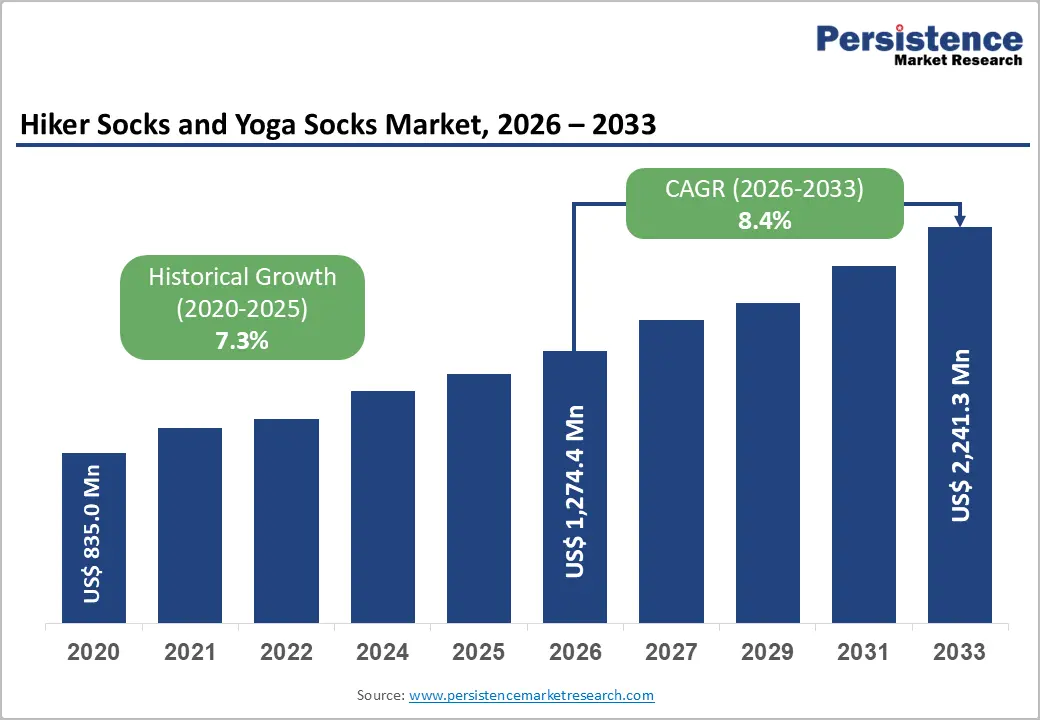
From 2019 to 2024, the hiker and yoga socks market grew at a CAGR of 4.6%, and the outlook for this industry is positive going forward. Since these socks offer the compression and grip required for physical activities like hiking and yoga, their use is predicted to grow. Manufacturers are working to create socks that are as comfortable as possible for customers.

Additionally, it is anticipated that the multipurpose character of these socks will fuel sales development in the upcoming years. In addition to yoga and hiking, these socks can be worn for a variety of sports, dancing, etc.

Over the forecast period 2025-2032, the hiking and yoga socks market is anticipated to expand at a CAGR of 5.7% in terms of value.

Will the Popularity of Outdoor Sports Lead to a Greater Uptake of Hiking and Yoga Socks?

The use and significance of hiker socks and yoga socks during adventure activities have been widely publicized due to adventure lovers. Popular adventurers and influencers like Mike Horn, Jimmy Chin, and Bear Grylls have used social media platforms and television programs to demonstrate how they use these technologies for their audience. This has motivated those who enjoy outdoor adventures to choose these tools.

How Is Customization and Premiumization Gaining Traction?

Customization has gained prominence as a crucial business strategy in recent years due to its ability to boost client happiness, which in turn encourages repeat business and increases revenues. Manufacturers in the sector are supplying customized hiking and yoga socks after realizing that the future rests in offering personalized and customized solutions.

The ability to tailor socks in terms of size, pattern, style, height, material, etc. is rarely offered by manufacturers. In addition to customization, manufacturers are also involved in making some ideas and suggestions. All of these programs have aided firms in gaining a competitive edge over other players in this market.

What are the Positive Claims Manufacturers Attach to Yoga and Hiking Socks?

In an effort to capitalize on a product's USP, and establish a significant market presence, various manufacturers, and brand owners have made numerous assertions about the effectiveness of their products. Consonants like "non-slip socks," "grip socks," "compression socks," etc. are frequently employed to catch the attention of customers.

Another well-known promise that is becoming more significant in the market is Eco Made. This description is applied to socks constructed of recycled materials. The utilization of such implications and assertions in connection with product performance and features has significantly contributed to grabbing more consumer attention.

How Increase in Spending on Health and Fitness Among Adults Fueling the Demand for Hiker and Yoga Socks Market?

The adult generations are highly concerned about their health and fitness so they are active about the latest trends in the products like hiker and yoga socks. This generation is active on social media, mostly prefer buying online products, and branded products so the spending on health and fitness products are high in demand.

Will the Rise in Importance for Eco-Friendly Socks Increasing Demand for Socks in the Market?

With the growing number of eco-conscious consumers, eco-friendly companies are effortlessly positioning their products as sustainable to achieve a brand image in the market. Providing sustainable socks is grabbing the attention of the targeted audience.

For instance, Patagonia Inc. is the eco-friendliest seller and commits about 1% of its revenue to environmental groups by saying as one percent to our planet. The company even carries out the campaigns like Global Climate Strike. This grabs the attention of those consumers who are eco-conscious.

Country-wise Insights

Will the U.S.'s Rising Sports Injuries Encourage Consumers to Adopt New Products?

The adoption of socks that give better comfort and protection is anticipated to be significantly influenced by the rising incidence of injuries resulting from sports and other recreational activities. Exercise was one of the main contributors to accidents during sports and recreational activities in 2019, according to figures from the National Safety Council. As a result, American consumers are now more worried about their safety when participating in sports and other leisure activities.

The regional sales of hiker socks and yoga socks with built-in cushions that ensure maximum protection are projected to benefit from growing awareness of health safety during such sports and leisure activities.

How is the Premiumization Trend Changing the Range of Products Available in the UK?

One of the significant current developments that has changed the market's product offers is premiumization. The demand for good and premium anti-grip socks in the United Kingdom is expected to rise as consumer spending grows. Due to the current fashion, local manufacturers are eager to provide hiker socks that ensure bacterial and odor control, an anti-blistering function, and maximum comfort. This is how regional players are being encouraged to modify their services by the current premium trend.

Is Brazil's Demand for Sports and Recreational Activities Being Driven by Growing Millennial Interest?

Millennials are constantly on the cutting edge of health and fitness trends. The millennial generation is known as the "outdoor natives" because, despite leading a busy lifestyle, they have considerably increased interest in outdoor and recreational activities over the past several years.

During the projection period, it is anticipated that millennials' growing interest in outdoor and recreational activities would be a major factor in boosting the regional uptake of hiking and yoga socks. Additionally, it is expected that the swift growth of recreational and outdoor groups in the nation would encourage an increase in hiking activities over the next years, favorably affecting regional sales of hiker and yoga socks.

Category-wise Insights

Which Category of Hiking and Yoga Socks Commands the Market?

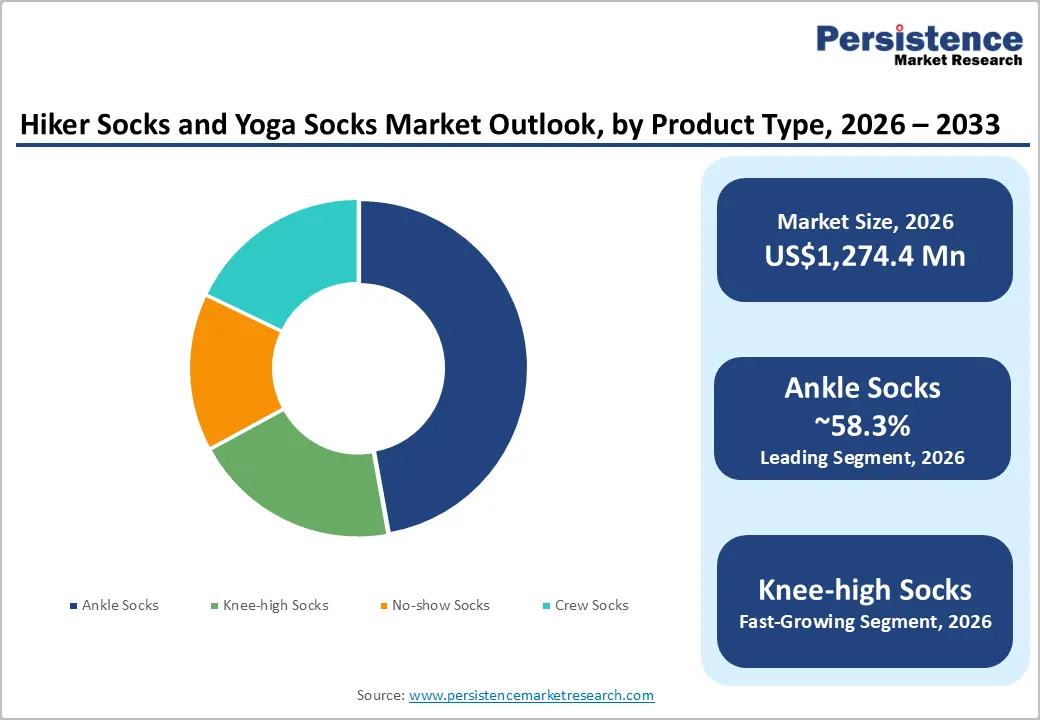
Crew socks, among the products, currently have a sizable share of the market with a volume of 46.5%. Crew socks are thought of as the traditional height since they are somewhat taller than ankle socks and offer the best protection against abrasion when worn with boots. This is one of the main explanations for why crew socks are more commonly worn than other types of socks.

Which Sock Material is anticipated to be in Demand the Most?

The most common socks material, in terms of composition, is wool. According to the analysis, the sector had a sizable proportion of 31.6% in 2022. The best material for shoes is wool since it regulates temperature and offers the right amount of cushioning.

Additionally, the material has inherent anti-microbial qualities, which means it retains less odor than other fibers. Wool has become a popular material for yoga socks and hiking socks because of all these features. Over the forecast period, the wool material category is anticipated to experience a high CAGR of over 8%.

Will Online Retail Take the Lead in Sales of Yoga and Hiker Socks?

Our analysis predicts that online sales will grow at a CAGR of more than 8% during the projection period. Numerous local and regional firms compete in the hiker and yoga socks market, which is largely categorized as a fragmented industry. Manufacturers are extending their online presence in an industry where brick-and-mortar shopping is still a major player to boost sales and profitability.

Hiker Socks and Yoga Socks Market Competition Landscape

Manufacturers are currently concentrating on expanding their product portfolios and market reach in response to the growing number of consumers by choosing strategic alliances and partnerships. Currently, producers are focusing on both the mass and luxury categories of markets.

For instance:

  • In 2020, Adidas announced that in 2021, Adidas will use more than 60 percent recycled polyester in its products & from 2024 onward, Adidas is committed to using only recycled polyester.
  • In 2020, the company announced that it had collaborated with a London-based skateboard shop and clothing brand named PALACE Skateboards. They committed to manufacture classic sportswear apparel and footwear for a new and modern audience reimagining the oldest sporting traditions.

Segmentation of Hiker Socks and Yoga Socks Industry Research

Product Type:

  • No-show Socks
  • Ankle Socks
  • Crew Socks
  • Knee-high Socks

Material:

  • Cotton
  • Polyester
  • Wool
  • Nylon
  • Spandex

Size:

  • Small
  • Medium
  • Large

Consumer Orientation:

  • Men
  • Women
  • Kids
  • Unisex

Cushion Level:

  • Ultralight
  • Light/Medium
  • Heavy

Sales Channel:

  • Supermarkets/Hypermarkets
  • Convenience Stores
  • Specialty Stores
  • Online Retailers
  • Wholesalers/Distributors
  • Other Sales Channels

Region:

  • North America
  • Latin America
  • Europe
  • East Asia
  • South Asia
  • Oceania
  • Middle East & Africa (MEA)

Companies Covered in Hiker Socks and Yoga Socks Market

  • ADIDAS Group
  • Nike, Inc.
  • PUMA SE
  • VF Corporation
  • Darn Tough
  • Farm to Feet
  • Patagonia, Inc.
  • Icebreaker
  • Wrightso
  • Elicit Brands, LLC
  • Implus, LLC
  • Injinji, Inc.
  • ToeSox, Inc
  • Feetures
  • Others
Frequently Asked Questions

The global hiker socks and yoga socks market was valued at US$ 1,189.60 Mn as of 2024.

Demand for hiker socks and yoga socks market is projected to increase at 6.4% CAGR and be valued at US$ 1,834.2 Mn by 2032-end.

ADIDAS Group, Nike, Inc., PUMA SE, VF Corporation, Darn Tough, Farm to Feet, Patagonia, Inc., Icebreaker, Wrightsock, Elicit Brands, LLC, Implus, LLC, Injinji, Inc., ToeSox, Inc., Feetures, Others are key market players.

The top three hiker socks and yoga socks market providers accounted for close to 25% market share in 2024.

Hiker Socks and Yoga Socks Industry Report Scope

Attribute

Details

Forecast Period

2025-2032

Historical Data Available for

2019-2024

Market Analysis Units Value: US$ Bn/Mn, Volume: As applicable

Key Regions Covered

  • North America
  • Latin America
  • Europe
  • East Asia
  • South Asia
  • Oceania
  • MEA

Key Countries Covered

  • United States
  • Canada
  • Brazil
  • Mexico
  • Germany
  • U.K.
  • France
  • Spain
  • Italy
  • Russia
  • South Africa
  • Northern Africa
  • GCC Countries
  • China
  • Japan
  • South Korea
  • India
  • Thailand
  • Malaysia
  • Indonesia
  • Australia
  • New Zealand

Key Market Segments Covered

  • Product
  • Material
  • Size
  • Consumer Orientation
  • Cushion Level
  • Sales Channel
  • Region

Key Companies Profiled

  • ADIDAS Group
  • Nike, Inc.
  • PUMA SE
  • VF Corporation
  • Darn Tough
  • Farm to Feet
  • Patagonia, Inc.
  • Icebreaker
  • Wrightsock
  • Elicit Brands, LLC
  • Implus, LLC
  • Injinji, Inc.
  • ToeSox, Inc
  • Feetures
  • Others
Report Highlights
  • Market Forecast and Trends
  • Competitive Intelligence & Share Analysis
  • Growth Factors and Challenges
  • Strategic Growth Initiatives
  • Pricing Analysis & Technology Roadmap
  • Future Opportunities and Revenue Pockets
  • Industry Market Analysis Tools

Customization & Pricing

Available upon Request

Related Reports

1. Executive Summary

    1.1. Global Market Overview

    1.2. Summary of Key Statistics

    1.3. Summary of Key Findings

    1.4. Product Evolution Analysis

    1.5. PMR Analysis and Recommendations

2. Market Overview

    2.1. Market Coverage/Taxonomy

    2.2. Market Definition/Scope/Limitations

3. Key Market Trends

    3.1. Key Trends Impacting the Market

    3.2. Future Prospects of Hiker Socks and Yoga Socks Market

        3.2.1. Factors Fuelling Growth

        3.2.2. Influx of Brands

        3.2.3. Innovative Distribution & Marketing Strategies

4. Global Hiker Socks and Yoga Socks Market Demand Analysis 2019-2032

    4.1. Historical Market Volume ('000 Units) Analysis, 2019-2023

    4.2. Current and Future Market Volume ('000 Units) Projections, 2024-2032

    4.3. Y-o-Y Growth Trend Analysis

5. Global Hiker Socks and Yoga Socks Market - Pricing Analysis

    5.1. Pricing Analysis By Product Type

    5.2. Global Average Pricing Analysis Benchmark

6. Global Hiker Socks and Yoga Socks Market Demand (in Value or Sales Channel in US$ Mn) Analysis 2019-2032

    6.1. Historical Market Value (US$ Mn) Analysis, 2019-2023

    6.2. Current and Future Market Value (US$ Mn) Projections, 2024-2032

        6.2.1. Y-o-Y Growth Trend Analysis

        6.2.2. Absolute $ Opportunity Analysis

7. Market Background

    7.1. Macro-Economic Factors

        7.1.1. GDP Growth Outlook

        7.1.2. Consumer Spending Outlook

        7.1.3. GDP Growth Rate Analysis

        7.1.4. Internet Penetration Rate Outlook

        7.1.5. Income Group Population Overview

        7.1.6. Per Capita Disposable Income

    7.2. Forecast Factors - Relevance & Impact

        7.2.1. Top Companies Historical Growth

        7.2.2. Urbanization Growth Outlook

        7.2.3. Others

    7.3. PESTLE Analysis of Global Hiker Socks and Yoga Socks Market

    7.4. Investment Feasibility Matrix of Hiker Socks and Yoga Socks Market

    7.5. Porter’s Five Forces Analysis of Global Hiker Socks and Yoga Socks Market

    7.6. Market Dynamics

        7.6.1. Drivers

        7.6.2. Restraints

        7.6.3. Opportunity Analysis

8. Global Hiker Socks and Yoga Socks Market Analysis 2019-2032, By Product Type

    8.1. Introduction / Key Findings

    8.2. Historical Market Size (US$ Mn) and Volume (‘000 Units) Analysis by Product Type, 2019-2023

    8.3. Current and Future Market Size (US$ Mn) and Volume (‘000 Units) Analysis and Forecast by Product Type, 2024-2032

        8.3.1. No-show Socks

        8.3.2. Ankle Socks

        8.3.3. Crew Socks

        8.3.4. Knee-high Socks

    8.4. Market Attractiveness Analysis by Product Type

9. Global Hiker Socks and Yoga Socks Market Analysis 2019-2032, by Material

    9.1. Introduction / Key Findings

    9.2. Historical Market Size (US$ Mn) and Volume (‘000 Units) Analysis by Material, 2019-2023

    9.3. Current and Future Market Size (US$ Mn) and Volume (‘000 Units) Analysis and Forecast by Material, 2024-2032

        9.3.1. Cotton

        9.3.2. Polyester

        9.3.3. Wool

        9.3.4. Nylon

        9.3.5. Spandex

    9.4. Market Attractiveness Analysis by Flavor

10. Global Hiker Socks and Yoga Socks Market Analysis 2019-2032, by Size

    10.1. Introduction / Key Findings

    10.2. Historical Market Size (US$ Mn) and Volume (‘000 Units) Analysis by Size, 2019-2023

    10.3. Current and Future Market Size (US$ Mn) and Volume (‘000 Units) Analysis and Forecast by Size, 2024-2032

        10.3.1. Below US$ 100

        10.3.2. US$ 100- US$ 200

        10.3.3. US$ 200- US$ 300

        10.3.4. US$ 300 and Above

    10.4. Market Attractiveness Analysis by Size

11. Global Hiker Socks and Yoga Socks Market Analysis 2019-2032, by Size

    11.1. Introduction / Key Findings

    11.2. Historical Market Size (US$ Mn) and Volume (‘000 Units) Analysis by Size, 2019-2023

    11.3. Current and Future Market Size (US$ Mn) and Volume (‘000 Units) Analysis and Forecast by Size, 2024-2032

        11.3.1. Small

        11.3.2. Medium

        11.3.3. Large

    11.4. Market Attractiveness Analysis by Size

12. Global Hiker Socks and Yoga Socks Market Analysis 2019-2032, by Consumer Orientation

    12.1. Introduction / Key Findings

    12.2. Historical Market Size (US$ Mn) and Volume (‘000 Units) Analysis by Consumer Orientation, 2019-2023

    12.3. Current and Future Market Size (US$ Mn) and Volume (‘000 Units) Analysis and Forecast by Consumer Orientation, 2024-2032

        12.3.1. Men

        12.3.2. Women

        12.3.3. Kids

        12.3.4. Unisex

    12.4. Market Attractiveness Analysis by Consumer Orientation

13. Global Hiker Socks and Yoga Socks Market Analysis 2019-2032, by Cushion Level

    13.1. Introduction / Key Findings

    13.2. Historical Market Size (US$ Mn) and Volume (‘000 Units) Analysis by Cushion Level, 2019-2023

    13.3. Current and Future Market Size (US$ Mn) and Volume (‘000 Units) Analysis and Forecast by Cushion Level, 2024-2032

        13.3.1. Ultralight

        13.3.2. Light/Medium

        13.3.3. Heavy

    13.4. Market Attractiveness Analysis by Cushion Level

14. Global Hiker Socks and Yoga Socks Market Analysis 2019-2032, by Sales Channel

    14.1. Introduction / Key Findings

    14.2. Historical Market Size (US$ Mn) and Volume (‘000 Units) Analysis by Sales Channel, 2019-2023

    14.3. Current and Future Market Size (US$ Mn) and Volume (‘000 Units) Analysis and Forecast by Sales Channel, 2024-2032

        14.3.1. Supermarkets/Hypermarkets

        14.3.2. Convenience Stores

        14.3.3. Specialty Stores

        14.3.4. Online Retailers

        14.3.5. Wholesalers/Distributors

        14.3.6. Other Sales Channels

    14.4. Market Attractiveness Analysis by Sales Channel

15. Global Hiker Socks and Yoga Socks Market Analysis 2019-2032, by Region

    15.1. Introduction

    15.2. Historical Market Size (US$ Mn) and Volume (‘000 Units) Analysis by Region, 2019-2023

    15.3. Current Market Size (US$ Mn) and Volume (‘000 Units) Analysis and Forecast by Region, 2024-2032

        15.3.1. North America

        15.3.2. Latin America

        15.3.3. Europe

        15.3.4. East Asia

        15.3.5. South Asia

        15.3.6. Oceania

        15.3.7. Middle East and Africa (MEA)

    15.4. Market Attractiveness Analysis by Region

16. North America Hiker Socks and Yoga Socks Market Analysis 2019-2032

    16.1. Introduction

    16.2. Pricing Analysis

    16.3. Historical Market Size (US$ Mn) and Volume Trend Analysis By Market Taxonomy, 2019-2023

    16.4. Market Size (US$ Mn) and Volume Forecast By Market Taxonomy, 2024-2032

        16.4.1. By Country

            16.4.1.1. U.S.

            16.4.1.2. Canada

        16.4.2. By Product Type

        16.4.3. By Material

        16.4.4. By Size

        16.4.5. By Sales Channel

    16.5. Market Attractiveness Analysis

        16.5.1. By Country

        16.5.2. By Product Type

        16.5.3. By Material

        16.5.4. By Size

        16.5.5. Consumer Orientation

        16.5.6. Cushion Level

        16.5.7. By Sales Channel

17. Latin America Hiker Socks and Yoga Socks Market Analysis 2019-2032

    17.1. Introduction

    17.2. Pricing Analysis

    17.3. Historical Market Size (US$ Mn) and Volume Trend Analysis By Market Taxonomy, 2019-2023

    17.4. Market Size (US$ Mn) and Volume Forecast By Market Taxonomy, 2024-2032

        17.4.1. By Country

            17.4.1.1. Brazil

            17.4.1.2. Mexico

            17.4.1.3. Rest of Latin America

        17.4.2. By Product Type

        17.4.3. By Material

        17.4.4. By Size

        17.4.5. Consumer Orientation

        17.4.6. Cushion Level

        17.4.7. By Sales Channel

    17.5. Market Attractiveness Analysis

        17.5.1. By Country

        17.5.2. By Product Type

        17.5.3. By Material

        17.5.4. By Size

        17.5.5. Consumer Orientation

        17.5.6. Cushion Level

        17.5.7. By Sales Channel

18. Europe Hiker Socks and Yoga Socks Market Analysis 2019-2032

    18.1. Introduction

    18.2. Pricing Analysis

    18.3. Historical Market Size (US$ Mn) and Volume Trend Analysis By Market Taxonomy, 2019-2023

    18.4. Market Size (US$ Mn) and Volume Forecast By Market Taxonomy, 2024-2032

        18.4.1. By Country

            18.4.1.1. Germany

            18.4.1.2. Italy

            18.4.1.3. France

            18.4.1.4. U.K.

            18.4.1.5. Spain

            18.4.1.6. Rest of Europe

        18.4.2. By Product Type

        18.4.3. By Material

        18.4.4. By Size

        18.4.5. Consumer Orientation

        18.4.6. Cushion Level

        18.4.7. By Sales Channel

    18.5. Market Attractiveness Analysis

        18.5.1. By Country

        18.5.2. By Product Type

        18.5.3. By Material

        18.5.4. By Size

        18.5.5. Consumer Orientation

        18.5.6. Cushion Level

        18.5.7. By Sales Channel

19. South Asia Hiker Socks and Yoga Socks Market Analysis 2019-2032

    19.1. Introduction

    19.2. Pricing Analysis

    19.3. Historical Market Size (US$ Mn) and Volume Trend Analysis By Market Taxonomy, 2019-2023

    19.4. Market Size (US$ Mn) and Volume Forecast By Market Taxonomy, 2024-2032

        19.4.1. By Country

            19.4.1.1. India

            19.4.1.2. Thailand

            19.4.1.3. Indonesia

            19.4.1.4. Malaysia

            19.4.1.5. Rest of South Asia

        19.4.2. By Product Type

        19.4.3. By Material

        19.4.4. By Size

        19.4.5. Consumer Orientation

        19.4.6. Cushion Level

        19.4.7. By Sales Channel

    19.5. Market Attractiveness Analysis

        19.5.1. By Country

        19.5.2. By Product Type

        19.5.3. By Material

        19.5.4. By Size

        19.5.5. Consumer Orientation

        19.5.6. Cushion Level

        19.5.7. By Sales Channel

20. East Asia Hiker Socks and Yoga Socks Market Analysis 2019-2032

    20.1. Introduction

    20.2. Pricing Analysis

    20.3. Historical Market Size (US$ Mn) and Volume Trend Analysis By Market Taxonomy, 2019-2023

    20.4. Market Size (US$ Mn) and Volume Forecast By Market Taxonomy, 2024-2032

        20.4.1. By Country

            20.4.1.1. China

            20.4.1.2. Japan

            20.4.1.3. South Korea

        20.4.2. By Product Type

        20.4.3. By Material

        20.4.4. By Size

        20.4.5. Consumer Orientation

        20.4.6. Cushion Level

        20.4.7. By Sales Channel

    20.5. Market Attractiveness Analysis

        20.5.1. By Country

        20.5.2. By Product Type

        20.5.3. By Material

        20.5.4. By Size

        20.5.5. Consumer Orientation

        20.5.6. Cushion Level

        20.5.7. By Sales Channel

21. Oceania Hiker Socks and Yoga Socks Market Analysis 2019-2032

    21.1. Introduction

    21.2. Pricing Analysis

    21.3. Historical Market Size (US$ Mn) and Volume Trend Analysis By Market Taxonomy, 2019-2023

    21.4. Market Size (US$ Mn) and Volume Forecast By Market Taxonomy, 2024-2032

        21.4.1. By Country

            21.4.1.1. Australia

            21.4.1.2. New Zealand

        21.4.2. By Product Type

        21.4.3. By Material

        21.4.4. By Size

        21.4.5. Consumer Orientation

        21.4.6. Cushion Level

        21.4.7. By Sales Channel

    21.5. Market Attractiveness Analysis

        21.5.1. By Country

        21.5.2. By Product Type

        21.5.3. By Material

        21.5.4. By Size

        21.5.5. Consumer Orientation

        21.5.6. Cushion Level

        21.5.7. By Sales Channel

22. Middle East and Africa Hiker Socks and Yoga Socks Market Analysis 2019-2032

    22.1. Introduction

    22.2. Pricing Analysis

    22.3. Historical Market Size (US$ Mn) and Volume Trend Analysis By Market Taxonomy, 2019-2023

    22.4. Market Size (US$ Mn) and Volume Forecast By Market Taxonomy, 2024-2032

        22.4.1. By Country

            22.4.1.1. GCC Countries

            22.4.1.2. Northern Africa

            22.4.1.3. South Africa

            22.4.1.4. Rest of Middle East and Africa

        22.4.2. By Product Type

        22.4.3. By Material

        22.4.4. By Size

        22.4.5. Consumer Orientation

        22.4.6. Cushion Level

        22.4.7. By Sales Channel

    22.5. Market Attractiveness Analysis

        22.5.1. By Country

        22.5.2. By Product Type

        22.5.3. By Material

        22.5.4. By Size

        22.5.5. Consumer Orientation

        22.5.6. Cushion Level

        22.5.7. By Sales Channel

23. Key Countries’ Hiker Socks and Yoga Socks Market Analysis 2024-2032

    23.1. Introduction

        23.1.1. Market Value Proportion Analysis, By Key Countries

        23.1.2. Global Vs. Country Growth Comparison

    23.2. U.S. Hiker Socks and Yoga Socks Market Analysis

        23.2.1. By Product Type

        23.2.2. By Material

        23.2.3. By Size

        23.2.4. Consumer Orientation

        23.2.5. Cushion Level

        23.2.6. By Sales Channel

    23.3. Canada Hiker Socks and Yoga Socks Market Analysis

        23.3.1. By Product Type

        23.3.2. By Material

        23.3.3. By Size

        23.3.4. Consumer Orientation

        23.3.5. Cushion Level

        23.3.6. By Sales Channel

    23.4. Mexico Hiker Socks and Yoga Socks Market Analysis

        23.4.1. By Product Type

        23.4.2. By Material

        23.4.3. By Size

        23.4.4. Consumer Orientation

        23.4.5. Cushion Level

        23.4.6. By Sales Channel

    23.5. Brazil Hiker Socks and Yoga Socks Market Analysis

        23.5.1. By Product Type

        23.5.2. By Material

        23.5.3. By Size

        23.5.4. Consumer Orientation

        23.5.5. Cushion Level

        23.5.6. By Sales Channel

    23.6. Germany Hiker Socks and Yoga Socks Market Analysis

        23.6.1. By Product Type

        23.6.2. By Material

        23.6.3. By Size

        23.6.4. Consumer Orientation

        23.6.5. Cushion Level

        23.6.6. By Sales Channel

    23.7. Italy Hiker Socks and Yoga Socks Market Analysis

        23.7.1. By Product Type

        23.7.2. By Material

        23.7.3. By Size

        23.7.4. Consumer Orientation

        23.7.5. Cushion Level

        23.7.6. By Sales Channel

    23.8. U.K. Hiker Socks and Yoga Socks Market Analysis

        23.8.1. By Product Type

        23.8.2. By Material

        23.8.3. By Size

        23.8.4. Consumer Orientation

        23.8.5. Cushion Level

        23.8.6. By Sales Channel

    23.9. China Hiker Socks and Yoga Socks Market Analysis

        23.9.1. By Product Type

        23.9.2. By Material

        23.9.3. By Size

        23.9.4. Consumer Orientation

        23.9.5. Cushion Level

        23.9.6. By Sales Channel

    23.10. Japan Hiker Socks and Yoga Socks Market Analysis

        23.10.1. By Product Type

        23.10.2. By Material

        23.10.3. By Size

        23.10.4. Consumer Orientation

        23.10.5. Cushion Level

        23.10.6. By Sales Channel

    23.11. S. Korea Hiker Socks and Yoga Socks Market Analysis

        23.11.1. By Product Type

        23.11.2. By Material

        23.11.3. By Size

        23.11.4. Consumer Orientation

        23.11.5. Cushion Level

        23.11.6. By Sales Channel

    23.12. India Hiker Socks and Yoga Socks Market Analysis

        23.12.1. By Product Type

        23.12.2. By Material

        23.12.3. By Size

        23.12.4. Consumer Orientation

        23.12.5. Cushion Level

        23.12.6. By Sales Channel

    23.13. Australia and New Zealand Hiker Socks and Yoga Socks Market Analysis

        23.13.1. By Product Type

        23.13.2. By Material

        23.13.3. By Size

        23.13.4. Consumer Orientation

        23.13.5. Cushion Level

        23.13.6. By Sales Channel

    23.14. South Africa Hiker Socks and Yoga Socks Market Analysis

        23.14.1. By Product Type

        23.14.2. By Material

        23.14.3. By Size

        23.14.4. Consumer Orientation

        23.14.5. Cushion Level

        23.14.6. By Sales Channel

24. Market Structure Analysis

    24.1. Market Analysis by Tier of Companies

    24.2. Market Concentration

    24.3. Market Share Analysis of Top Players

    24.4. Market Presence Analysis

        24.4.1. By Regional footprint of Players

        24.4.2. Product foot print by Players

        24.4.3. Channel Foot Print by Players

25. Competition Analysis

    25.1. Competition Dashboard

    25.2. Pricing Analysis by Competition

    25.3. Competition Benchmarking

    25.4. Competition Deep Dive

        25.4.1. ADIDAS Group

            25.4.1.1. Overview

            25.4.1.2. Product Portfolio

            25.4.1.3. Profitability by Market Segments (Product/Channel/Region)

            25.4.1.4. Sales Footprint

            25.4.1.5. Strategy Overview

                25.4.1.5.1. Marketing Strategy

                25.4.1.5.2. Product Strategy

                25.4.1.5.3. Channel Strategy

        25.4.2. Nike, Inc.

            25.4.2.1. Overview

            25.4.2.2. Product Portfolio

            25.4.2.3. Profitability by Market Segments (Product/Channel/Region)

            25.4.2.4. Sales Footprint

            25.4.2.5. Strategy Overview

                25.4.2.5.1. Marketing Strategy

                25.4.2.5.2. Product Strategy

                25.4.2.5.3. Channel Strategy

        25.4.3. PUMA SE

            25.4.3.1. Overview

            25.4.3.2. Product Portfolio

            25.4.3.3. Profitability by Market Segments (Product/Channel/Region)

            25.4.3.4. Sales Footprint

            25.4.3.5. Strategy Overview

                25.4.3.5.1. Marketing Strategy

                25.4.3.5.2. Product Strategy

                25.4.3.5.3. Channel Strategy

        25.4.4. VF Corporation

            25.4.4.1. Overview

            25.4.4.2. Product Portfolio

            25.4.4.3. Profitability by Market Segments (Product/Channel/Region)

            25.4.4.4. Sales Footprint

            25.4.4.5. Strategy Overview

                25.4.4.5.1. Marketing Strategy

                25.4.4.5.2. Product Strategy

                25.4.4.5.3. Channel Strategy

        25.4.5. Darn Tough

            25.4.5.1. Overview

            25.4.5.2. Product Portfolio

            25.4.5.3. Profitability by Market Segments (Product/Channel/Region)

            25.4.5.4. Sales Footprint

            25.4.5.5. Strategy Overview

                25.4.5.5.1. Marketing Strategy

                25.4.5.5.2. Product Strategy

                25.4.5.5.3. Channel Strategy

        25.4.6. Farm to Feet

            25.4.6.1. Overview

            25.4.6.2. Product Portfolio

            25.4.6.3. Profitability by Market Segments (Product/Channel/Region)

            25.4.6.4. Sales Footprint

            25.4.6.5. Strategy Overview

                25.4.6.5.1. Marketing Strategy

                25.4.6.5.2. Product Strategy

                25.4.6.5.3. Channel Strategy

        25.4.7. Patagonia, Inc.

            25.4.7.1. Overview

            25.4.7.2. Product Portfolio

            25.4.7.3. Profitability by Market Segments (Product/Channel/Region)

            25.4.7.4. Sales Footprint

            25.4.7.5. Strategy Overview

                25.4.7.5.1. Marketing Strategy

                25.4.7.5.2. Product Strategy

                25.4.7.5.3. Channel Strategy

        25.4.8. Icebreaker

            25.4.8.1. Overview

            25.4.8.2. Product Portfolio

            25.4.8.3. Profitability by Market Segments (Product/Channel/Region)

            25.4.8.4. Sales Footprint

            25.4.8.5. Strategy Overview

                25.4.8.5.1. Marketing Strategy

                25.4.8.5.2. Product Strategy

                25.4.8.5.3. Channel Strategy

        25.4.9. Wrightsock

            25.4.9.1. Overview

            25.4.9.2. Product Portfolio

            25.4.9.3. Profitability by Market Segments (Product/Channel/Region)

            25.4.9.4. Sales Footprint

            25.4.9.5. Strategy Overview

                25.4.9.5.1. Marketing Strategy

                25.4.9.5.2. Product Strategy

                25.4.9.5.3. Channel Strategy

        25.4.10. Elicit Brands, LLC

            25.4.10.1. Overview

            25.4.10.2. Product Portfolio

            25.4.10.3. Profitability by Market Segments (Product/Channel/Region)

            25.4.10.4. Sales Footprint

            25.4.10.5. Strategy Overview

                25.4.10.5.1. Marketing Strategy

                25.4.10.5.2. Product Strategy

                25.4.10.5.3. Channel Strategy

        25.4.11. Implus, LLC

            25.4.11.1. Overview

            25.4.11.2. Product Portfolio

            25.4.11.3. Profitability by Market Segments (Product/Channel/Region)

            25.4.11.4. Sales Footprint

            25.4.11.5. Strategy Overview

                25.4.11.5.1. Marketing Strategy

                25.4.11.5.2. Product Strategy

                25.4.11.5.3. Channel Strategy

        25.4.12. Injinji, Inc.

            25.4.12.1. Overview

            25.4.12.2. Product Portfolio

            25.4.12.3. Profitability by Market Segments (Product/Channel/Region)

            25.4.12.4. Sales Footprint

            25.4.12.5. Strategy Overview

                25.4.12.5.1. Marketing Strategy

                25.4.12.5.2. Product Strategy

                25.4.12.5.3. Channel Strategy

        25.4.13. ToeSox, Inc

            25.4.13.1. Overview

            25.4.13.2. Product Portfolio

            25.4.13.3. Profitability by Market Segments (Product/Channel/Region)

            25.4.13.4. Sales Footprint

            25.4.13.5. Strategy Overview

                25.4.13.5.1. Marketing Strategy

                25.4.13.5.2. Product Strategy

                25.4.13.5.3. Channel Strategy

        25.4.14. Feetures

            25.4.14.1. Overview

            25.4.14.2. Product Portfolio

            25.4.14.3. Profitability by Market Segments (Product/Channel/Region)

            25.4.14.4. Sales Footprint

            25.4.14.5. Strategy Overview

                25.4.14.5.1. Marketing Strategy

                25.4.14.5.2. Product Strategy

                25.4.14.5.3. Channel Strategy

        25.4.15. Others

            25.4.15.1. Overview

            25.4.15.2. Product Portfolio

            25.4.15.3. Profitability by Market Segments (Product/Channel/Region)

            25.4.15.4. Sales Footprint

            25.4.15.5. Strategy Overview

                25.4.15.5.1. Marketing Strategy

                25.4.15.5.2. Product Strategy

                25.4.15.5.3. Channel Strategy

26. Assumptions and Acronyms Used

27. Research Methodology

Research Methodology Framework for Market Research Excellence

At Persistence Market Research, we implement a comprehensive, validated, and multi-dimensional approachto market analysis that delivers actionable insights across complex market landscapes. Our methodology combines the analytical rigor of leading consulting firms with innovative research techniques, ensuring robust market assessments that guide strategic decision-making with confidence.

Core Research Philosophy

Our methodology is built on four foundational pillars:

Research Philosophy Image

At Persistence Market Research, our methodology is designed to transcend conventional market studies by combining analytical rigor, multi-source validation, and future-focused insights.

We integrate advanced research frameworks, robust data collection strategies, cutting-edge analytics, and innovative technologies to deliver a 360-degree view of complex markets.

We integrate advanced research frameworks, robust data collection strategies, cutting-edge analytics, and innovative technologies to deliver a 360-degree view of complex markets.

Each stage spanning from strategic scoping and hypothesis-building to competitive intelligence, quality validation, and actionable recommendations is engineered to provide clients with unmatched clarity, precision, and confidence in decision-making.

By embedding innovation and technology at the core, our approach ensures that insights are not only comprehensive but also predictive, empowering businesses to seize opportunities, mitigate risks, and achieve sustainable growth

Research Philosophy Image

Capturing Key Information and Events

During this phase, key research objectives focus on essential information and data points for assessing the market, including:

Research Philosophy Image

TAM-SAM-SOM Framework Implementation

We employ both top-down and bottom-up approaches to ensure accurate market sizing.

Top-Down Market SizingBottom-Up Market Sizing
Universe Definition: Total global/regional market identificationUnit Economics: Average transaction values, purchase frequencies, customer lifecycle
Segmentation Filters: Geographic, demographic, and behavioral constraintsCustomer Segmentation: Detailed buyer persona development and sizing
Market Share Analysis: Competitive landscape assessment and share allocationPenetration Analysis: Market penetration rates by segment and geography
Growth Rate Application: Historical trends and forward-looking growth assumptionsScaling Methodology: Extrapolation techniques with confidence intervals

Validation & Cross-Verification

  • Triangulation: Comparing top-down and bottom-up results for consistency
  • Sensitivity Analysis: Testing key assumptions and parameter variations
  • Peer Benchmarking: Comparison with analogous markets and industry benchmarks
  • Expert Review: External validation through industry specialist consultation

Research Philosophy Image

Forecasting & Projection Modeling

Our proprietary forecasting models incorporate multiple variables and scenarios.

Forecasting Components

  • Historical Trend Analysis: 10-year historical growth patterns and cyclical variations
  • Driver-Based Modeling: Economic indicators, demographic shifts, technology adoption
  • Scenario Planning: Base case, optimistic, and conservative projections
  • Monte Carlo Simulations: Probability-weighted outcomes and risk assessments

Model Validation

  • Back-Testing: Historical accuracy assessment over 3–5-year periods
  • Cross-Validation: Multiple modeling approaches for result comparison
  • External Benchmarking: Comparison with established market forecasts
  • Continuous Calibration: Quarterly model updates based on new data

Comprehensive Data Collection Strategy

Our secondary research phase establishes a robust knowledge base utilizing diverse, credible sources.

Secondary Data Sourcess

  • Industry Publications & Reports
  • Government & Regulatory Data
  • Financial Intelligence (filings & reports)
  • Academic Research & Digital Intelligence

Quality Assurance Protocol

  • Source credibility assessment and publication date validation
  • Data consistency checks across multiple sources
  • Bias identification and neutralization techniques
  • Information gap tracking for primary research prioritization

Research Philosophy Image

Primary Research Excellence

Our primary research methodology employs best-in-class techniques to capture unique market insights.

Quantitative Research Methods

  • Large-Scale Surveys: Statistically representative samples with 95% confidence intervals
  • Survey Methodology: Multi-channel deployment (online, telephone, in-person)
  • Question Architecture and Response Optimization

Qualitative Research Methods

  • Executive Interviews
  • Focus Groups
  • Expert Consultations

Quality Assurance & Validation Framework

Multi-Stage Validation Process

  • Source Verification and Consistency Testing
  • Outlier Detection and Bias Assessment
  • Peer Review Process and External Validation
  • Sensitivity Analysis and Confidence Intervals

Research Philosophy Image

Methodology Validation & Credibility

Our research methodology has been extensively validated through:

  • Academic Partnerships: Collaborations with top-tier business schools and research institutions
  • Client Success Stories: Documented case studies demonstrating research impact and ROI
  • Continuous Benchmarking: Performance comparison with leading global research firms

This comprehensive methodology framework positions Persistence Market Research at the forefront of market intelligence, combining the analytical sophistication of top-tier consulting firms with innovative research techniques. Our approach ensures that every market assessment delivers precise, actionable, and strategically valuable insights that drive business success in competitive market environments.

Ready to unlock your market potential? Contact our research experts to discuss how our validated methodology can transform your strategic decision-making with data-driven market intelligence.

Copyright © 2026 Persistence Market Research. All Rights Reserved

Connect With Us -
Hiker Socks and Yoga Socks Market Size & Future Growth, 2032