




- Home Appliances
- Food Blenders and Mixers Market
Food Blenders and Mixers Market Size, Share, and Growth Forecast 2026 - 2033
Food Blenders and Mixers Market by Product Type (Blenders, Mixers, Food Processors), Application (Residential, Commercial, Industrial), Operation Mode (Manual, Electric, Battery-Operated), Material Type (Plastic, Stainless Steel, Glass), and Regional Analysis, 2026 - 2033

Food Blenders and Mixers Market Size and Trend Analysis
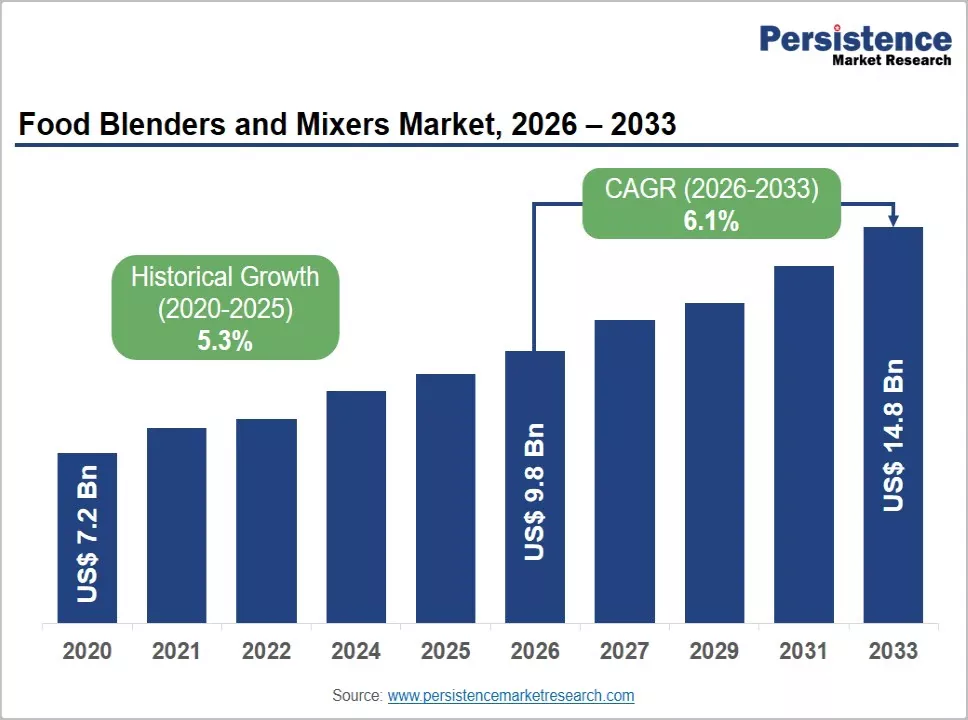
The global food blenders and mixers market size is likely to be valued at US$ 9.8 billion in 2026, and is estimated to reach US$ 14.8 billion by 2033, growing at a CAGR of 6.1% during the forecast period 2026 - 2033. Growth is underpinned by rising health and wellness awareness, increasing home cooking and baking, and the expansion of quick-service and institutional foodservice that depend on efficient preparation equipment.
The market recorded a CAGR of 5.3% during 2020–2025, as component shortages, freight costs, and post-pandemic normalization of home cooking tempered demand. However, the forecast period anticipates firmer acceleration as multifunctional and portable appliances gain acceptance, smart features spread, premiumization continues, and kitchen labor shortages push commercial operators towards automated prep equipment.
Key Industry Highlights
- Dominant Product Type: Blenders are set to command around 39% of the revenue share in 2026, while multifunctional appliances are likely to grow the fastest at 7.4% CAGR through 2033, as consumers favour compact, space-saving kitchen systems.
- Leading Application: Residential is expected to lead with 63% in 2026, while commercial applications are likely to be the fastest-growing at about 6.9% CAGR during 2026–2033, reflecting foodservice labor pressures and smoothie and beverage menu expansion.
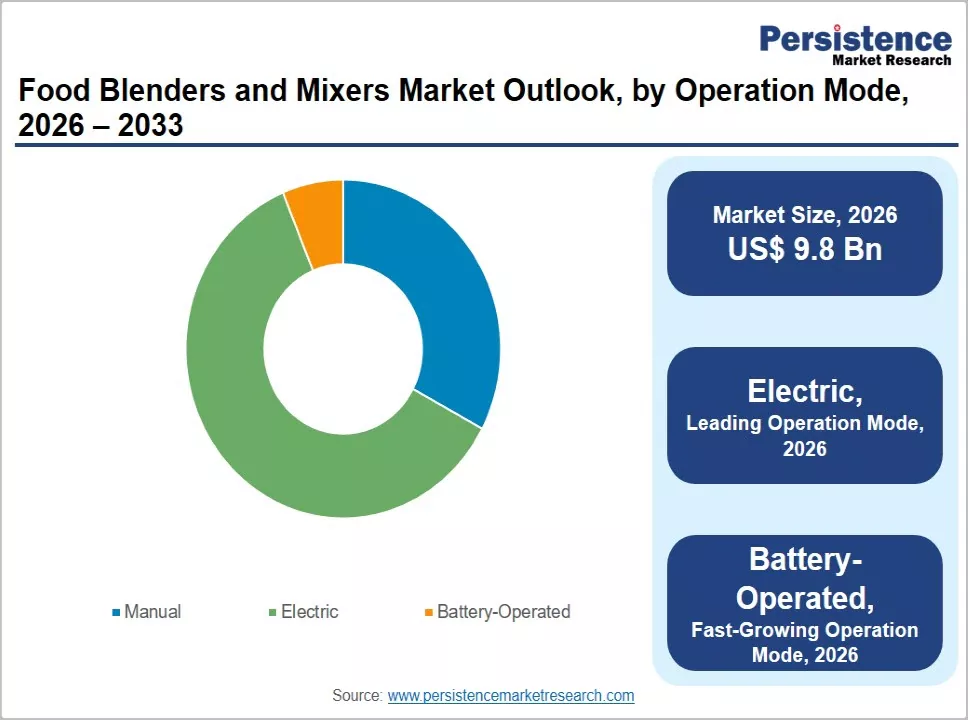
- Dominant Operation Mode: Electric appliances are anticipated to lead with an estimated 82% share in 2026, while battery-operated models are slated to represent the fastest-growing segment at 8.6% CAGR from 2026 to 2033.
- Leading Material Type: Plastic is projected to hold about 48% of the market in 2026, while stainless steel is expected to grow the fastest at 6.7% CAGR through 2033, driven by hygiene and durability preferences.
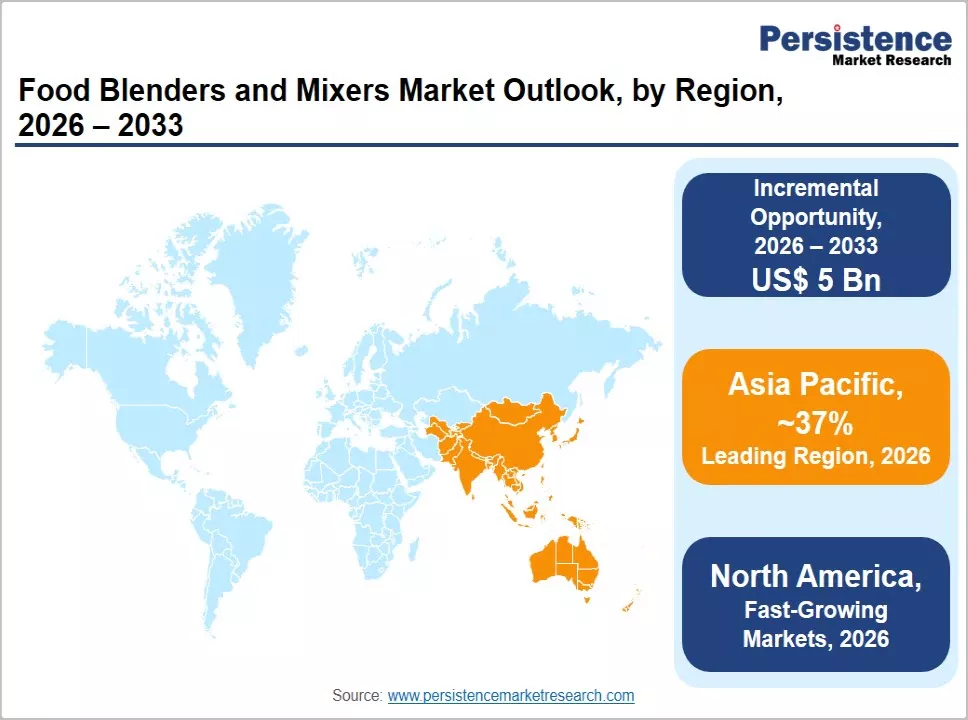
- Regional Leadership: Asia Pacific is poised to dominate with an estimated 37% share in 2026 and register a 7% CAGR through 2033, led by China, India, and Southeast Asia.
DRO Analysis
Drivers: Health and Wellness Trends and Home Cooking as Primary Growth Catalyst
Health-conscious eating is the leading force driving the food blenders and mixers market growth, as consumers prepare smoothies, soups, nut butters, baby food, and protein shakes at home to control ingredients and reduce processed food intake. Social media cooking content, meal prep culture, and interest in plant-based diets reinforce appliance purchases, while rising disposable incomes in Asia and Latin America are expanding the base of first-time buyers.
Manufacturers are responding with higher-power motors, quieter operation, self-cleaning programmes, and preset functions that simplify use. Entry-level products from premium brands are also widening access, as seen in the February 2026 launch of the Vitamix VX1, positioned as an entry-level blender for first-time buyers. Combined with replacement demand and gifting, these factors sustain steady volume and value growth.
Smart Features and Multifunctional Design
Connectivity, sensors, and automatic programs are being added to blenders and mixers to guide texture and timing, while multifunctional appliances combine blending, chopping, kneading, and cooking in one base. Compact multi-use systems appeal to urban households with limited kitchen space and are lifting average selling prices. Sustainability is another differentiator, with brands highlighting recyclable packaging, longer warranties, replacement parts, and energy-efficient motors to appeal to environmentally conscious buyers.
Restraints: Price Competition and Raw Material and Tariff Pressures
Intense price competition is a major challenge for the food blenders and mixers market. Low-cost manufacturers and private-label brands offer feature-rich appliances at lower prices, particularly through online marketplaces, which compresses margins for established brands.
Costs of motors, copper, plastics, stainless steel, and electronic components fluctuate, while freight costs and trade policy changes can affect landed prices and delay product launches. Retailer-driven promotions during major sales events also encourage deep discounting, which can erode brand equity and reduce profitability for premium-positioned products.
Product Longevity and Safety Considerations
Blenders and mixers have long replacement cycles, and many households already own at least one appliance, limiting repeat purchases in mature markets. Safety concerns around blade injuries, motor overheating, and plastic jar materials require continuous quality and compliance investment. Regulatory expectations on repairability, energy efficiency, and chemical content in food-contact materials add design and testing costs, particularly for smaller manufacturers.
Opportunities: Portable Appliances, Commercial Kitchen Automation, and Premiumization
Portable, rechargeable blenders for travel, gyms, and offices are broadening usage occasions and attracting younger consumers, with premium brands entering the segment alongside established personal blender makers. In commercial kitchens, labor shortages and the need for consistency are boosting demand for back-of-house systems.
In April 2026, Vitamix Commercial introduced the Power-Prep to help professional kitchens streamline preparation and ease labor strain. Collaborations with recipe platforms, nutrition apps, and meal-kit providers are also helping brands deepen engagement and drive accessory sales.
Material Innovation and Emerging Market Penetration
Stainless steel and glass containers are gaining attention for hygiene and durability, as illustrated by the Vitamix Ascent X5, introduced in January 2026 with a stainless steel container. Emerging markets in South Asia, Southeast Asia, Africa, and Latin America offer long-term potential as electrification and income growth increase appliance ownership, and local brands are tailoring products to regional cooking styles, such as mixer-grinders for wet and dry grinding. Rental, refurbishment, and certified reconditioned programs are also emerging as ways to reach cost-sensitive buyers while supporting circular economy goals.
Category-wise Insights
Product Type Analysis
Why Do Blenders Lead the Food Blenders and Mixers Market?
Blenders are the leading product type segment, expected to hold about 39% of the food blenders and mixers market revenue share in 2026. Countertop, personal, and immersion models serve smoothies, soups, sauces, and frozen beverages, and are widely available at price points from entry-level to premium. High-performance models with powerful motors and self-cleaning programs attract health-focused consumers, while personal blenders appeal to single-serve convenience. Frequent promotions and strong brand loyalty support volumes, though price competition from low-cost entrants remains intense. Smaller households and rental accommodation are also increasing preference for compact appliances that store easily and perform several tasks.
Multifunctional appliances are likely to grow the fastest through 2033, at an estimated 7.4% CAGR. These systems combine blending, food processing, dough mixing, and sometimes cooking in one base with interchangeable attachments, saving space and cost. Products such as the Ninja CrushBOSS, which merges a blender, food processor, and to-go tumbler, illustrate the trend. Demand is particularly strong among urban households and renters. Mixers, including stand and hand models, remain central to baking, supported by social media baking culture, while food processors serve chopping, slicing, and shredding tasks.
Application Analysis
Why Does Residential Lead Food Blenders and Mixers Applications?
Residential is the leading application segment, anticipated to account for about 63% of the market revenue share in 2026. Households buy blenders, mixers, and processors for daily meal preparation, baking, and beverages, and often own multiple appliances. Growth in nuclear households, rising incomes, and renewed interest in home cooking support unit sales, while gifting and seasonal promotions provide demand peaks. Brands compete through design, power, ease of cleaning, and ecosystems of attachments and accessories.
Commercial applications represent the fastest-growing segment, expected to register about 6.9% CAGR during 2026–2033. Restaurants, cafes, juice bars, hotels, and institutional kitchens require durable, high-capacity equipment that delivers consistent results and reduces prep time. Labor shortages and rising wages are encouraging adoption of automated blending and processing systems, and smoothie and frozen beverage menus continue to expand. Industrial applications, including food manufacturing and bakeries, use heavy-duty mixers and blenders and grow steadily with packaged food production.
Operation Mode Analysis
Why Does Electric Operation Lead Food Blenders and Mixers?
Electric appliances are poised to lead with an estimated 82% share in 2026, offering consistent power, speed control, and capacity for heavy tasks such as crushing ice, kneading dough, and grinding. Corded models dominate residential and commercial use because they run continuously and support a wide array of attachments. Efficient motors, safety interlocks, and low noise designs improve user experience, while energy standards influence product development.
Battery-operated models are the fastest-growing segment, anticipated to achieve about 8.6% CAGR through 2033. Rechargeable portable blenders serve smoothies on the go, travel, outdoor activities, and office use, and advances in lithium-ion batteries and USB-C charging make them more practical. Premium brands, including Vitamix with its first portable blender, are entering the category, which validates demand. Manual devices persist in price-sensitive and off-grid markets, valued for simplicity and low cost.
Material Type Analysis
Why Does Plastic Lead Food Blenders and Mixers Materials?
Plastic is the leading material type segment, projected to capture about 48% of the market in 2026. Copolyester and polycarbonate-alternative jars are lightweight, shatter-resistant, and inexpensive, which suits mass-market blenders and mixers. BPA-free materials and improved clarity address safety and design preferences, and manufacturers are exploring recycled-content plastics to meet sustainability goals. Dishwasher-safe, scratch-resistant finishes are further extending product life and consumer satisfaction.
Stainless steel is the fastest-growing material type, expected to register about 6.7% CAGR through 2033. Metal containers offer durability, hygiene, resistance to staining and odors, and a premium look, making them attractive in commercial kitchens and upper-tier home appliances. Glass jars are valued for neutrality and scratch resistance but are heavier and costlier, retaining a niche among consumers concerned about plastics.
Regional Insights
North America Food Blenders and Mixers Market Trends and Insights
North America is anticipated to account for an estimated 28% of the global food blenders and mixers market in 2026. The region’s market is likely to benefit from high household appliance ownership, strong premium brands, and a large foodservice sector. Innovation from leading manufacturers, including new entry-level, portable, and multifunctional products, is expected to sustain replacement and upgrade cycles. Labor challenges in restaurants are also anticipated to support demand for commercial prep systems through 2033.
U.S. Food Blenders and Mixers Market Size
The U.S. is estimated to account for approximately 84% of the North America food blenders and mixers market in 2026. Market growth is likely to be supported by smoothie and wellness culture, strong online retail, and frequent product launches by Vitamix, SharkNinja, and other brands. Rising interest in portable blenders and kitchen systems that replace several appliances is expected to lift average selling prices. Commercial operators are also expected to invest in efficiency-enhancing equipment as labor costs rise.
Canada Food Blenders and Mixers Market Size
Canada is projected to represent approximately 9% of the North America food blenders and mixers market in 2026. Market expansion is expected to be driven by health-conscious consumers, growing interest in home baking, and cross-border brand availability. Online retail and major home goods chains are anticipated to remain key channels, while the foodservice sector is likely to adopt compact commercial blenders for cafes and juice bars. Demand for durable, energy-efficient appliances is expected to support steady consumption through 2033.
Europe Food Blenders and Mixers Market Trends and Insights
Europe is estimated to account for approximately 14% of the global food blenders and mixers market in 2026. The region’s market is expected to benefit from strong home-cooking traditions, premium small appliance brands, and sustainability-focused policies. The EU ecodesign framework is likely to encourage repairability, durability, and energy efficiency, favouring established brands with spare-part availability. Demand for multifunctional kitchen machines and quiet, high-performance blenders is expected to remain solid, although consumer price sensitivity influences purchasing.
Germany Food Blenders and Mixers Market Size
Germany is anticipated to account for approximately 26% of the Europe food blenders and mixers market in 2026. Demand is expected to be supported by strong consumer interest in quality and durability and the popularity of multifunctional kitchen machines such as Vorwerk’s Thermomix. German consumers also value energy efficiency, safety certifications, and repair support, which benefits established brands. Growth in healthy cooking, baking, and online appliance sales is projected to support market expansion through 2033.
Why Is Asia Pacific Expected to Lead the Food Blenders and Mixers Market?
Asia Pacific is projected to account for approximately 37% of the global food blenders and mixers market in 2026, making it the largest regional market. The region is also anticipated to register the fastest growth, expanding at an estimated CAGR of 7% through 2033. Market expansion is likely to be driven by rising incomes, urbanization, growing e-commerce, and strong local manufacturing. China and India are expected to remain the primary demand centres, while Japan, South Korea, and Southeast Asian countries are also likely to see rising adoption of premium and multifunctional appliances.
China Food Blenders and Mixers Market Size
China is estimated to represent approximately 40% of the Asia Pacific food blenders and mixers market in 2026. The country’s market is expected to benefit from the world’s largest small appliance manufacturing base, strong domestic brands such as Midea, Joyoung, and Supor, and rapid growth of online retail. Consumers favour soy milk makers, wall-breaking blenders, and smart kitchen devices, and manufacturers are adding app connectivity and automated recipes. Export production also supports scale and cost advantages, sustaining China’s regional leadership through 2033.
India Food Blenders and Mixers Market Size
India is projected to account for approximately 18% of the Asia Pacific food blenders and mixers market in 2026. The market is expected to witness strong expansion, supported by rising household incomes, urbanization, and a long-standing preference for mixer-grinders suited to wet and dry grinding in everyday cooking. Domestic brands such as Preethi, Bajaj, and Prestige compete with global players across price tiers, while online marketplaces are widening reach into smaller cities. Growth in quick-service restaurants and cloud kitchens is also expected to increase demand for commercial blenders and mixers.
Competitive Landscape
The global food blenders and mixers market structure is moderately fragmented, with the top vendors, including Vitamix, SharkNinja, Philips, BSH, and Groupe SEB, controlling a significant share of the revenue. These established players have been leveraging strong brands, global distribution, and sustained product innovation. They are also known to invest heavily in R&D to maintain leadership in motor technology, smart features, and multifunctional designs. Product launches and ecosystem building around attachments, accessories, and recipe content help these firms increase customer lifetime value.
Regional and niche competitors such as Breville, Hamilton Beach, Midea, and De’Longhi are focusing on specialized segments and geographic strongholds. Barriers such as brand loyalty, retail relationships, and safety certification limit entry into premium tiers, while online marketplaces enable low-cost entrants in the value segment. Market consolidation is expected to continue gradually as larger groups acquire niche brands to broaden portfolios, while manufacturers expand into adjacent categories such as juicers, personal blenders, and commercial prep equipment. Partnerships with retailers on exclusive colors and limited editions also help brands differentiate in crowded online marketplaces.
Key Market Developments
- In August 2026, Ninja launched the CrushBOSS, a 3-in-1 kitchen system that combines a blender, food processor, and to-go tumbler on a shared base, targeting households with limited kitchen space.
- In April 2026, Vitamix Commercial introduced the Power-Prep, a back-of-house blending system designed to streamline food preparation and ease labor and efficiency pressures in professional kitchens.
- In February 2026, Vitamix announced the launch of the VX1, a new entry-level blender in its premium blending line-up aimed at first-time Vitamix buyers.
Companies Covered in Food Blenders and Mixers Market
- Vita-Mix Corporation
- SharkNinja, Inc.
- Breville Group Limited
- Koninklijke Philips N.V.
- BSH Hausgeräte GmbH
- Panasonic Holdings Corporation
- Whirlpool Corporation
- Hamilton Beach Brands Holding Company
- Groupe SEB
- Midea Group Co., Ltd.
- De’Longhi S.p.A.
Frequently Asked Questions
The global food blenders and mixers market is valued at US$ 9.8 billion in 2026 and is projected to reach US$ 14.8 billion by 2033, expanding at a CAGR of 6.1% during 2026 - 2033.
Rising health and wellness awareness, increasing home cooking and baking, growth of foodservice, and innovation in multifunctional and portable appliances are driving the market.
The leading segments in 2026 are blenders by product type (about 39% share), residential by application (about 63% share), electric by operation mode (about 82% share), and plastic by material type (about 48% share).
Asia Pacific dominates the market with an estimated 37% share in 2026 and is projected to register a 7% CAGR through 2033, led by China, India, and Southeast Asian economies.
Portable battery-operated blenders, commercial kitchen automation, premium and stainless steel designs, and appliance penetration in emerging markets are key market opportunities.
The market is moderately fragmented, with Vitamix, SharkNinja, Philips, BSH, and Groupe SEB controlling a significant share of the revenue.


