




- Medical Devices
- Endodontic Files Market
Endodontic Files Market Size, Trends, Share, Growth, and Regional Forecast, 2026 to 2033
Endodontic Files Market by File Type (Nickel Titanium, Stainless Steel), Treatment (Manual, Rotary), End-user (Hospitals, Dental Clinics, Academics and Research Institutes, Others), and Regional Analysis, from 2026 to 2033

Endodontic Files Market Share and Trends Analysis
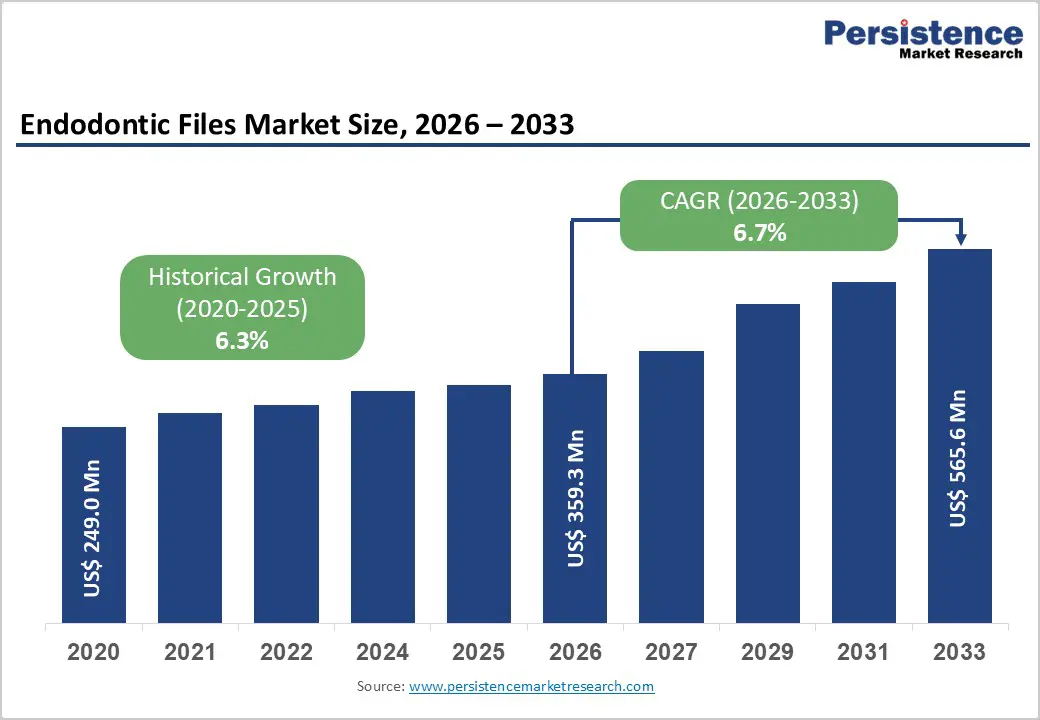
The global endodontic files market is expected to reach US$ 359.3 million in 2026 and is projected to reach US$ 565.6 million by 2033. The market is projected to grow at a CAGR of 6.7% from 2026 to 2033.
Increased awareness of oral health and the growing incidence of dental diseases are projected to drive a 10-year increase in demand for endodontic files. Manufacturers are introducing innovative products with improved materials that enhance strength, flexibility, and resistance to cyclic fatigue. The need for efficient endodontic methods is increasing owing to the trend toward minimally invasive dental procedures.
Key Industry Highlights:
- The rising number of dental clinics and healthcare facilities in developing countries is projected to fuel the endodontic files market.
- The increasing adoption of advanced endodontic techniques, such as rotary systems, is likely to drive sales of specialized files.
- Key endodontic file manufacturers are focusing on enhancing their online presence to reach a large consumer base and engage with dental professionals.
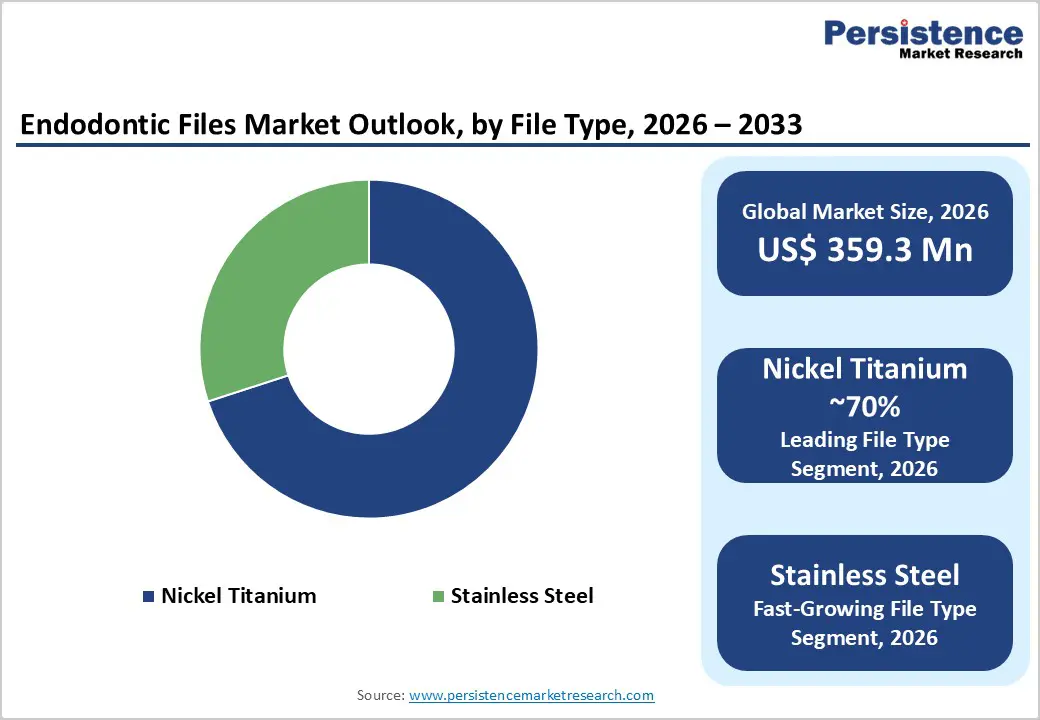
- In terms of file type, the nickel titanium segment is anticipated to witness a CAGR of 5.8% through 2033 due to its superior performance in complex root canal anatomies.
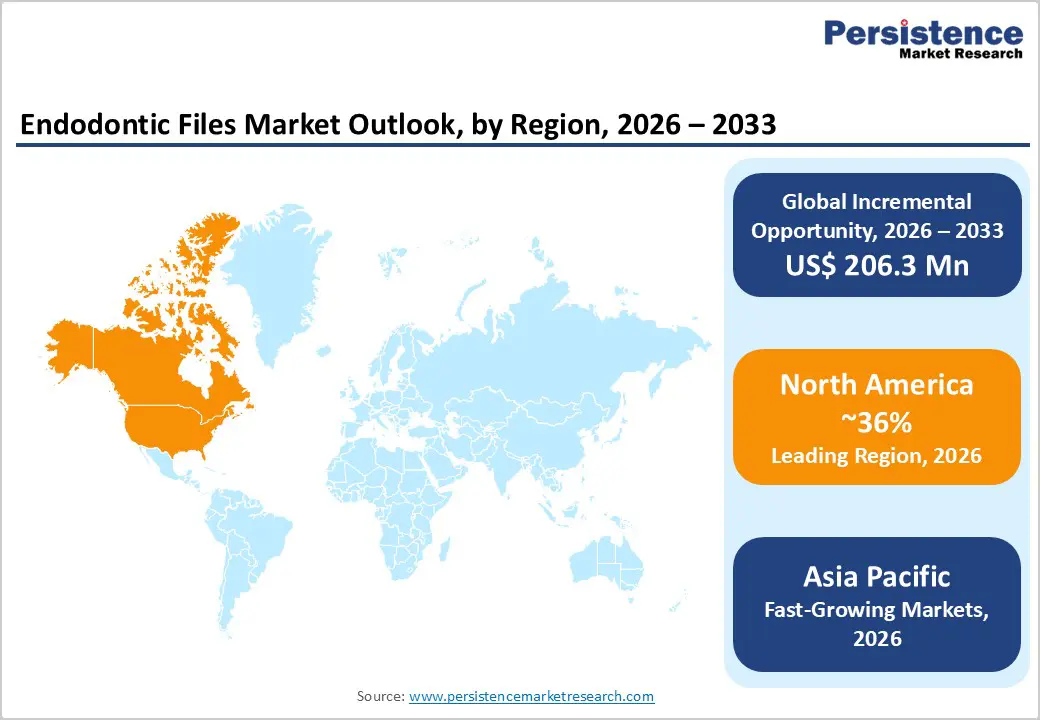
- North America is expected to witness a CAGR of 6.2% through 2033 as millennials shift toward online sales channels.
| Key Insights | Details |
|---|---|
| Endodontic Files Market Size (2026E) | US$ 359.3 Bn |
| Market Value Forecast (2033F) | US$ 565.6 Bn |
| Projected Growth (CAGR 2026 to 2033) | 6.7% |
| Historical Market Growth (CAGR 2020 to 2024) | 6.3% |
Market Dynamics
Driver - Increasing Prevalence of Pulpitis and Dental Caries to Boost Demand
The rising prevalence of dental diseases worldwide is a key factor fueling demand in the endodontic files market. Conditions such as dental caries, pulpitis, and other periodontal issues are on the rise due to factors like poor oral hygiene, unhealthy dietary habits, and limited access to preventive care. According to the World Health Organization (WHO), oral diseases affect approximately 3.5 million people globally. This underscores an urgent need for effective endodontic treatments, including advanced endodontic file systems.
As awareness of oral health increases, more individuals are seeking professional dental care, resulting in a surge in demand for root canal treatments. This trend is particularly pronounced among older adults, who are more susceptible to dental problems. Consequently, dental professionals are investing in cutting-edge endodontic file technologies to enhance the efficiency and quality of root canal procedures. This shift toward advanced endodontic solutions is driving market growth while significantly improving patient outcomes in dental care.
Innovations in Root Canal Therapy to Augment Growth
The market for endodontic files is being driven by ongoing advancements in endodontic technologies. Root canal therapy is now safer and more successful due to advances in materials and file design, particularly the development of rotary and reciprocating systems. Improved nickel-titanium technology provides greater flexibility and resistance to cyclic fatigue, making it easier for dentists to navigate intricate root canal anatomy.
The developments make these instruments highly attractive to dentists, as they not only enhance treatment outcomes but also reduce the risk of complications. As a result, dentists are spending more on these advanced endodontic files, thereby bolstering market expansion. This pattern underscores the importance of innovation in addressing the evolving demands of contemporary dentistry.
Restraints - Premium Price of High-end Instruments to Hamper Sales
Rising adoption is hampered by the high cost of sophisticated endodontic files, particularly in markets where consumers are price-sensitive. It is particularly prevalent in files composed of resilient nickel-titanium, which offers improved flexibility and fatigue resistance. Purchasing these high-end instruments may be challenging for small-scale clinics and those in developing countries due to their often tight budgets. For instance, Nickel-titanium files can be significantly more expensive than stainless steel counterparts. Hence, many small dental practices in Southeast Asia prioritize affordable alternatives.
The quality of treatment and procedural efficiency are impacted by this cost barrier, which limits access to new endodontic technology. Despite the clinical advantages, exorbitant costs preclude some clinics from incorporating these advanced files into their practices, thereby restricting market expansion.
Opportunity - Shift toward Rotary and Reciprocating File Systems to Create Opportunities
Increasing use of rotary and reciprocating file systems is anticipated to create novel growth opportunities in future. These cutting-edge devices offer substantial advantages over manual files, including greater accuracy, adaptability, and efficiency in root canal treatment. They can handle intricate canal architecture, reduce treatment time, and improve patient outcomes. Because they reduce hazards such as file breakage, rotary and reciprocating systems are especially prized.
Innovations in nickel-titanium technology are also driving demand as these materials offer excellent flexibility and strong resistance to cyclic fatigue, enabling safe treatment in complex situations. Manufacturers are well positioned to benefit from the growing trend of dental clinics adopting these systems, given their reliability and effectiveness. This is anticipated to present significant prospects for market expansion.
Development of Robust Dental Infrastructure to Open the Door to Success
Endodontic file suppliers are set to gain a significant opportunity as dental infrastructure broadens in emerging regions, particularly in the Asia Pacific and Latin America. The demand for sophisticated root canal therapy and endodontic technology is increasing as dental care becomes more widely available and oral health awareness rises.
High-quality dental instruments, such as cutting-edge endodontic files, are in high demand in India. Government programs like the National Oral Health Program in India seek to improve dental services and accessibility. To meet growing patient expectations, leading dental chains expanding into countries such as Brazil are also making significant investments in advanced equipment. A strong market for endodontic files is produced by this expansion of dental infrastructure. It will likely provide providers with access to a new and rapidly expanding clientele in these areas.
Category-wise Analysis
By File Type Insights
Nickel-titanium (NiTi) files are increasingly preferred over stainless steel files in modern endodontic practice, driving strong growth in this segment through 2033. The superior flexibility and resistance to cyclic fatigue offered by NiTi materials allow clinicians to navigate complex and curved root canal anatomies with greater precision and reduced risk of file separation. This flexibility minimizes canal transportation and procedural errors, improving treatment outcomes and enhancing patient comfort. As endodontic techniques shift toward minimally invasive approaches, NiTi files support conservative dentin removal while maintaining effective canal shaping. Although stainless steel files remain cost-effective and are still used in simpler cases, their limited flexibility restricts use in anatomically challenging canals. The growing emphasis on efficiency, safety, and patient experience is accelerating the adoption of NiTi systems. These clinical advantages, combined with continuous product innovations, are positioning nickel-titanium files as the material of choice for contemporary endodontic procedures worldwide.
By End-user Insights
Dental clinics are expected to remain the dominant end-user segment in the endodontic files market, supported by a projected CAGR of approximately 5.4% over the forecast period. The growing number of dental clinics, particularly in urban and semi-urban areas, is expanding access to advanced dental treatments, including root canal procedures. Clinics are actively investing in modern equipment and high-performance endodontic tools to enhance procedural efficiency, treatment accuracy, and patient satisfaction. The growing focus on preventive dentistry and minimally invasive techniques has further increased the demand for advanced endodontic files within clinical settings.
Additionally, professional training initiatives introduced by dental supply companies in early 2024 have strengthened clinicians’ familiarity with innovative file systems, encouraging wider adoption. These programs aim to streamline root canal procedures, reduce chair time, and improve clinical outcomes. Collectively, technological adoption, clinician training, and rising patient demand are making dental clinics the primary drivers of endodontic file utilization.
Regional Insights
North America Endodontic Files Market Trends
North America is expected to remain a leading region in the global endodontic files market. The U.S. plays a central role due to its well-established dental care infrastructure and high volume of root canal procedures performed annually. A dense network of dental clinics, distributors, and retail pharmacies ensures wide availability of endodontic files across multiple brands and pricing ranges. This accessibility allows practitioners to select products based on clinical requirements and cost considerations.
The growing use of digital and e-commerce platforms has further transformed purchasing behavior, enabling dentists to compare product specifications, performance reviews, and pricing before procurement. Enhanced logistics and distribution capabilities have shortened delivery timelines, improving access to advanced endodontic technologies. Additionally, strong emphasis on patient-centered care and adoption of modern dental tools continue to support consistent demand, positioning North America as a key revenue-generating region for endodontic files.
Asia Pacific Endodontic Files Market Trends
Asia Pacific endodontic files market is experiencing steady expansion, driven by improving dental care access and rising awareness of oral health across emerging economies. Countries such as China, India, Japan, and South Korea are witnessing an increase in dental clinics and specialized endodontic practices, supported by growing urban populations and rising disposable incomes. Demand for root canal treatments is increasing as patients seek to preserve natural teeth rather than opt for extractions.
Local manufacturing and cost-effective product offerings are improving affordability, encouraging wider adoption of advanced endodontic files. Educational initiatives and professional training programs also strengthen clinical skills and familiarity with modern file systems among dental practitioners. Government-led oral health programs and private sector investments are contributing to infrastructure development in both urban and semi-urban areas. In addition, gradual adoption of digital procurement platforms is improving product access and distribution efficiency.
Competitive Landscape
The global endodontic files industry is highly competitive, with large- and small-scale companies developing unique technologies to meet varying dental care needs. Key brands are focusing on innovations in file materials, such as nickel-titanium, to enhance durability and reduce procedural risks.
Local manufacturers are increasing their market presence by utilizing online platforms and attending specialized dental industry events. New start-ups specializing in endodontic solutions are also set to emerge. They are likely to be supported by funding and exposure from dental-focused platforms like Dental Innovation Alliance. Such platforms provide crucial networking opportunities, funding resources, and visibility across the dental community. They are set to help start-ups bring cutting-edge endodontic products to the market efficiently.
Key Developments:
- In January 2026, Septodont, a global leader in dental solutions, is proud to announce the launch of GenENDO, * a range of endodontic files designed to support easy and successful shaping of the root canal.
- In September 2025, J. MORITA USA, a global leader in imaging technology, announced the launch of RootFlex Endodontic Files. RootFlex is a single-file shaping system compatible with both continuous rotary and reciprocating motors. The system incorporates a proprietary heat-treatment process that enhances cyclic fatigue and torsional resistance while preserving cutting sharpness, resulting in a nickel-titanium file that delivers cutting performance comparable to stainless steel.
- In October 2024, U.S.-based Kerr Dental announced the launch of ZenFlex™ CM, a groundbreaking advancement in endodontic file technology. Engineered with innovative features and proprietary heat-treatment processes, ZenFlex CM has superior strength and flexibility. It would empower dental professionals to tackle even the most challenging root canal anatomies.
- In August 2024, Dentsply Sirona, headquartered in the U.S., extended its endodontic offerings in the country with the launch of the X-Smart Pro+ endodontic motor. It features an integrated apex locator and the Reciproc Blue file. The motor delivers genuine reciprocating motion specifically tailored to the Reciproc Blue file. It was designed to simplify root canal shaping without an initial glidepath in most cases.
Companies Covered in Endodontic Files Market
- Dentsply Sirona
- Envista Holdings Corporation (Kerr Corporation)
- Brasseler USA
- Ultradent Products, Inc.
- FKG Dentaire SA
- EdgeEndo
- Kerr Corporation
- Zhermack SpA
- Others
Frequently Asked Questions
The global endodontic files market is projected to be valued at US$ 359.3 Bn in 2026.
Rising prevalence of dental caries, growing root canal procedures, technological advances in NiTi files, and increasing dental care awareness.
The global market is expected to witness a CAGR of 6.7% between 2026 and 2033.
Expanding dental clinics in emerging markets, adoption of rotary NiTi systems, minimally invasive dentistry, and growing cosmetic dentistry demand.
North America is the leading region in the global endodontic files market.


