


1. Executive Summary
1.1. Global Demi-fine Jewelry Market Snapshot, 2025 and 2032
1.2. Market Opportunity Assessment, 2025 - 2032, US$ Bn
1.3. Key Market Trends
1.4. Future Market Projections
1.5. Premium Market Insights
1.6. Industry Developments and Key Market Events
1.7. PMR Analysis and Recommendations
2. Market Overview
2.1. Market Scope and Definition
2.2. Market Dynamics
2.2.1. Drivers
2.2.2. Restraints
2.2.3. Opportunity
2.2.4. Challenges
2.2.5. Key Trends
2.3. Macro-Economic Factors
2.3.1. Global Sectorial Outlook
2.3.2. Global GDP Growth Outlook
2.3.3. Other Macro-economic Factors
2.4. COVID-19 Impact Analysis
2.5. Forecast Factors - Relevance and Impact
2.6. Regulatory Landscape
2.7. Supply Chain Analysis
2.8. PESTLE Analysis
2.9. Porter’s Five Force Analysis
3. Price Trend Analysis, 2019 - 2031
3.1. Key Highlights
3.2. Key Factors Impacting Product Prices
3.3. Pricing Analysis, By Price Range
3.4. Regional Prices and Historical and Future Growth Trends
4. Global Demi-fine Jewelry Market Outlook: Historical (2019 - 2023) and Forecast (2025 - 2032)
4.1. Key Highlights
4.2. Market Size (US$ Bn) Analysis and Forecast
4.2.1. Historical Market Size (US$ Bn) Analysis, 2019-2023
4.2.2. Current Market Size (US$ Bn) Analysis and Forecast, 2024-2031
4.3. Global Demi-fine Jewelry Market Outlook: Price Range
4.3.1. Introduction / Key Findings
4.3.2. Historical Market Size (US$ Bn) Analysis, By Price Range, 2019-2023
4.3.3. Current Market Size (US$ Bn) Analysis and Forecast, By Price Range, 2025 - 2032
4.3.3.1. Below 150 USD
4.3.3.2. 151-300 USD
4.3.3.3. 301-500 USD
4.4. Market Attractiveness Analysis: Price Range
4.5. Global Demi-fine Jewelry Market Outlook: Application
4.5.1. Introduction / Key Findings
4.5.2. Historical Market Size (US$ Bn) Analysis, By Application, 2019-2023
4.5.3. Current Market Size (US$ Bn) Analysis and Forecast, By Application, 2025 - 2032
4.5.3.1. Women
4.5.3.2. Men
4.6. Market Attractiveness Analysis: Application
4.7. Global Demi-fine Jewelry Market Outlook: Distribution Channel
4.7.1. Introduction / Key Findings
4.7.2. Historical Market Size (US$ Bn) Analysis, By Distribution Channel, 2019-2023
4.7.3. Current Market Size (US$ Bn) Analysis and Forecast, By Distribution Channel, 2025 - 2032
4.7.3.1. Offline
4.7.3.2. Online
4.8. Market Attractiveness Analysis: Distribution Channel
5. Global Demi-fine Jewelry Market Outlook: Region
5.1. Key Highlights
5.2. Historical Market Size (US$ Bn) Analysis, By Region, 2019-2023
5.3. Current Market Size (US$ Bn) Analysis and Forecast, By Region, 2025 - 2032
5.3.1. North America
5.3.2. Europe
5.3.3. East Asia
5.3.4. South Asia and Oceania
5.3.5. Latin America
5.3.6. Middle East & Africa
5.4. Market Attractiveness Analysis: Region
6. North America Demi-fine Jewelry Market Outlook: Historical (2019 - 2023) and Forecast (2025 - 2032)
6.1. Key Highlights
6.2. Pricing Analysis
6.3. Historical Market Size (US$ Bn) Analysis, By Market, 2019-2023
6.3.1. By Country
6.3.2. By Price Range
6.3.3. By Application
6.3.4. By Distribution Channel
6.4. Current Market Size (US$ Bn) Analysis and Forecast, By Country, 2025 - 2032
6.4.1. U.S.
6.4.2. Canada
6.5. Current Market Size (US$ Bn) Analysis and Forecast, By Price Range, 2025 - 2032
6.5.1. Below 150 USD
6.5.2. 151-300 USD
6.5.3. 301-500 USD
6.6. Current Market Size (US$ Bn) Analysis and Forecast, By Application, 2025 - 2032
6.6.1. Women
6.6.2. Men
6.7. Current Market Size (US$ Bn) Analysis and Forecast, By Distribution Channel, 2025 - 2032
6.7.1. Offline
6.7.2. Online
6.8. Market Attractiveness Analysis
7. Europe Demi-fine Jewelry Market Outlook: Historical (2019 - 2023) and Forecast (2025 - 2032)
7.1. Key Highlights
7.2. Pricing Analysis
7.3. Historical Market Size (US$ Bn) Analysis, By Market, 2019-2023
7.3.1. By Country
7.3.2. By Price Range
7.3.3. By Application
7.3.4. By Distribution Channel
7.4. Current Market Size (US$ Bn) Analysis and Forecast, By Country, 2025 - 2032
7.4.1. Germany
7.4.2. France
7.4.3. U.K.
7.4.4. Italy
7.4.5. Spain
7.4.6. Russia
7.4.7. Türkiye
7.4.8. Rest of Europe
7.5. Current Market Size (US$ Bn) Analysis and Forecast, By Price Range, 2025 - 2032
7.5.1. Below 150 USD
7.5.2. 151-300 USD
7.5.3. 301-500 USD
7.6. Current Market Size (US$ Bn) Analysis and Forecast, By Application, 2025 - 2032
7.6.1. Women
7.6.2. Men
7.7. Current Market Size (US$ Bn) Analysis and Forecast, By Distribution Channel, 2025 - 2032
7.7.1. Offline
7.7.2. Online
7.8. Market Attractiveness Analysis
8. East Asia Demi-fine Jewelry Market Outlook: Historical (2019 - 2023) and Forecast (2025 - 2032)
8.1. Key Highlights
8.2. Pricing Analysis
8.3. Historical Market Size (US$ Bn) Analysis, By Market, 2019-2023
8.3.1. By Country
8.3.2. By Price Range
8.3.3. By Application
8.3.4. By Distribution Channel
8.4. Current Market Size (US$ Bn) Analysis and Forecast, By Country, 2025 - 2032
8.4.1. China
8.4.2. Japan
8.4.3. South Korea
8.5. Current Market Size (US$ Bn) Analysis and Forecast, By Price Range, 2025 - 2032
8.5.1. Below 150 USD
8.5.2. 151-300 USD
8.5.3. 301-500 USD
8.6. Current Market Size (US$ Bn) Analysis and Forecast, By Application, 2025 - 2032
8.6.1. Women
8.6.2. Men
8.7. Current Market Size (US$ Bn) Analysis and Forecast, By Distribution Channel, 2025 - 2032
8.7.1. Offline
8.7.2. Online
8.8. Market Attractiveness Analysis
9. South Asia & Oceania Demi-fine Jewelry Market Outlook: Historical (2019 - 2023) and Forecast (2025 - 2032)
9.1. Key Highlights
9.2. Pricing Analysis
9.3. Historical Market Size (US$ Bn) Analysis, By Market, 2019-2023
9.3.1. By Country
9.3.2. By Price Range
9.3.3. By Application
9.3.4. By Distribution Channel
9.4. Current Market Size (US$ Bn) Analysis and Forecast, By Country, 2025 - 2032
9.4.1. India
9.4.2. Southeast Asia
9.4.3. ANZ
9.4.4. Rest of South Asia & Oceania
9.5. Current Market Size (US$ Bn) Analysis and Forecast, By Price Range, 2025 - 2032
9.5.1. Below 150 USD
9.5.2. 151-300 USD
9.5.3. 301-500 USD
9.6. Current Market Size (US$ Bn) Analysis and Forecast, By Application, 2025 - 2032
9.6.1. Women
9.6.2. Men
9.7. Current Market Size (US$ Bn) Analysis and Forecast, By Distribution Channel, 2025 - 2032
9.7.1. Offline
9.7.2. Online
9.8. Market Attractiveness Analysis
10. Latin America Demi-fine Jewelry Market Outlook: Historical (2019 - 2023) and Forecast (2025 - 2032)
10.1. Key Highlights
10.2. Pricing Analysis
10.3. Historical Market Size (US$ Bn) Analysis, By Market, 2019-2023
10.3.1. By Country
10.3.2. By Price Range
10.3.3. By Application
10.3.4. By Distribution Channel
10.4. Current Market Size (US$ Bn) Analysis and Forecast, By Country, 2025 - 2032
10.4.1. Brazil
10.4.2. Mexico
10.4.3. Rest of Latin America
10.5. Current Market Size (US$ Bn) Analysis and Forecast, By Price Range, 2025 - 2032
10.5.1. Below 150 USD
10.5.2. 151-300 USD
10.5.3. 301-500 USD
10.6. Current Market Size (US$ Bn) Analysis and Forecast, By Application, 2025 - 2032
10.6.1. Women
10.6.2. Men
10.7. Current Market Size (US$ Bn) Analysis and Forecast, By Distribution Channel, 2025 - 2032
10.7.1. Offline
10.7.2. Online
10.8. Market Attractiveness Analysis
11. Middle East & Africa Demi-fine Jewelry Market Outlook: Historical (2019 - 2023) and Forecast (2025 - 2032)
11.1. Key Highlights
11.2. Pricing Analysis
11.3. Historical Market Size (US$ Bn) Analysis, By Market, 2019-2023
11.3.1. By Country
11.3.2. By Price Range
11.3.3. By Application
11.3.4. By Distribution Channel
11.4. Current Market Size (US$ Bn) Analysis and Forecast, By Country, 2025 - 2032
11.4.1. GCC Countries
11.4.2. Egypt
11.4.3. South Africa
11.4.4. Northern Africa
11.4.5. Rest of the Middle East & Africa
11.5. Current Market Size (US$ Bn) Analysis and Forecast, By Price Range, 2025 - 2032
11.5.1. Below 150 USD
11.5.2. 151-300 USD
11.5.3. 301-500 USD
11.6. Current Market Size (US$ Bn) Analysis and Forecast, By Application, 2025 - 2032
11.6.1. Women
11.6.2. Men
11.7. Current Market Size (US$ Bn) Analysis and Forecast, By Distribution Channel, 2025 - 2032
11.7.1. Offline
11.7.2. Online
11.8. Market Attractiveness Analysis
12. Competition Landscape
12.1. Market Share Analysis, 2024
12.2. Market Structure
12.2.1. Competition Intensity Mapping By Market
12.2.2. Competition Dashboard
12.3. Company Profiles (Details - Overview, Financials, Strategy, Recent Developments)
12.3.1. Otiumberg Limited
12.3.1.1. Overview
12.3.1.2. Segments and Products
12.3.1.3. Key Financials
12.3.1.4. Market Developments
12.3.1.5. Market Strategy
12.3.2. Missoma Limited
12.3.3. Edge of Ember
12.3.4. Catbird
12.3.5. Astley Clarke Limited
12.3.6. WWAKE, Inc.
12.3.7. Loren Stewart
12.3.8. Monica Vinader Ltd.
12.3.9. Natasha Schweitzer
12.3.10. Sarah & Sebastian Pty Ltd.
13. Appendix
13.1. Research Methodology
13.2. Research Assumptions
13.3. Acronyms and Abbreviations


- Clothing, Footwear, & Accessories
- Demi-fine Jewelry Market
Demi-fine Jewelry Market Size, Share, and Growth Forecast from 2025 - 2032
Demi-fine Jewelry Market by Price Range (Below 150 USD, 151 to 300 USD, 301 to 500 USD), Application (Women, Men), Distribution Channel (Offline, Online), and Regional Analysis from 2025 to 2032
151 to 300 USD Provides a Balance Between Quality and Price
151 to 300 USD price range is predicted to hold a share of 42.2% in 2024. Consumers are increasingly seeking “affordable luxury” options, where they can experience high-quality materials and craftsmanship without the premium price tag of fine jewelry.
A survey revealed that 58% of Millennial and Gen Z consumers prefer purchasing jewelry within this price range due to its perceived value for money and the ability to wear pieces that feel luxurious without the high cost.
151 to 300 USD price range enables consumers to access high-quality materials such as sterling silver, gold vermeil, and semi-precious stones. This balance of quality and price is highly appealing to younger buyers who may not yet have the disposable income for fine jewelry but still want products that offer durability and sophistication. Brands like Mejuri and Missoma, which predominantly price their products between 150 and 300 USD, have seen 20% to 25% year-over-year sales growth.
Accessibility of Demi-fine Jewelry Appeals to Women of All Ages
Women application is estimated to hold a share of 64.5% in 2024. Jewelry has become a powerful tool for women to express their personality, individuality, and creativity. The demand for customizable and versatile pieces aligns with women’s increasing desire for self-expression.
Around 70% of women in the U.S. report wearing jewelry as a form of self-expression. According to 2023 survey, 58% of female consumers said they purchase jewelry to reflect their personal identity, with 35% opting for demi-fine jewelry. because of its customizable features. Women are increasingly seeking jewelry that blends luxury with affordability.
Demi-fine jewelry offers high-quality materials at an accessible price point compared to fine jewelry. This accessibility appeals to women of all ages who want to invest in beautiful, durable pieces without the premium prices of high-end fine jewelry. In 2023, 55% of women aged 25 to 40 reported that they prefer demi-fine jewelry due to its balance of affordability and perceived luxury.
According to a study, 80% of women in the U.S. report that they are influenced by social media when making jewelry purchases, and 70% follow influencers or celebrities who frequently wear demi-fine jewelry. Women are gravitating toward minimalist and timeless jewelry designs that are versatile enough to wear daily and complement a variety of outfits. Demi-fine jewelry's ability to offer stylish, classic pieces that cater to this preference, making it highly appealing to women.
Offline Distribution Channel Continues to Dominate with Tactile Nature of Jewelry Shopping
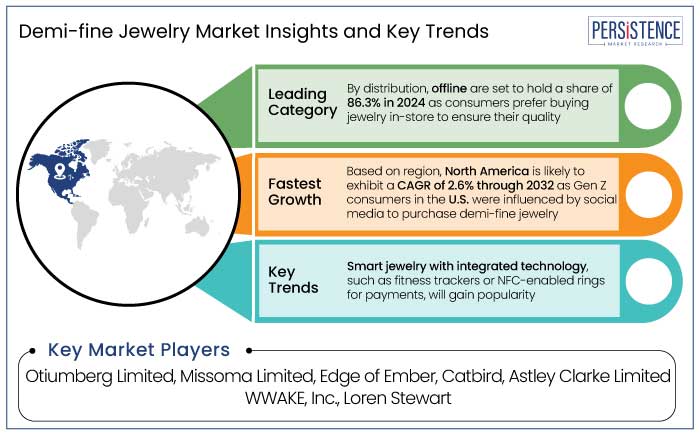
Offline is estimated to emerge as the dominating distribution channel with a share of 86.3% in 2024. Jewelry is a tactile product, and many consumers prefer to touch, feel, and try on jewelry before making a purchase. The ability to physically inspect the quality, weight, and fit of a piece is crucial in the buying decision process for jewelry.
A 2023 survey revealed that 55% of consumers prefer buying jewelry in-store to ensure the quality and authenticity of the product. A study conducted in 2023 indicated that 65% of jewelry sales still occur in physical stores, highlighting the continuing dominance of offline retail in the jewelry sector, including demi-fine jewelry.
Jewelry consumers often seek personalized experiences, whether it's advice on matching pieces, customization of designs, or finding the perfect gift. In-store shopping offers immediate interaction with knowledgeable salespeople who can provide tailored guidance and help in creating personalized experiences.
In the U.S., over 60% of jewelry buyers reported that personalized service during in-store shopping is a key reason they prefer buying in-store rather than online. Nearly, 45% of female consumers stated that they enjoy an opportunity to discuss their needs with sales associates and get suggestions on styling or customization in physical stores.
Market Introduction and Trend Analysis
The global demi-fine jewelry market is predicted to be driven by consumers’ interest in unique, and personalized pieces. Brands are progressively advanced technologies like AI for custom designs. By 2025, the market is anticipated to occupy a substantial share of the global jewelry industry, bridging the gap between mass-market affordability and premium exclusivity.
Increasing demand for eco-friendly and ethically sourced products are likely to drive brands to innovate in materials and production processes. For instance, recycled metals and lab-grown gemstones may dominate the material mix. According to a survey, 75% of global consumers are likely to prioritize brands with clear sustainability practices by 2030.
Historical Growth and Course Ahead
The demi-fine jewelry market growth was robust at a CAGR of 2.9% during the period from 2019 to 2023. Millennials and Gen Z, who prioritize affordable luxury and personal style, were the primary drivers of demand during the period. According to a survey, 60% of demi-fine jewelry purchases in 2023 were made by consumers aged 25 to 40.
E-commerce platforms enabled brands to reach global audiences, with online sales accounting for 35% of demi-fine jewelry purchases in 2023, up from 20% in 2019. Collaborations with celebrities and influencers significantly boosted market awareness. For instance, Mejuri’s influencer-driven campaigns contributed to a 25% year-over-year increase in sales during this period.
While the pandemic initially disrupted supply chains, it accelerated the adoption of e-commerce. In 2020, reportedly 60% of consumers shifted to online jewelry shopping, leading to a spike in sales for direct-to-consumer demi-fine brands.
Rising consumer demand for sustainable practices is estimated to push brands to use recycled metals and ethically sourced gemstones during the forecast period. According to a survey, 73% of Gen Z prefer purchasing from environmentally conscious brands. Men’s demi-fine jewery is an emerging segment which is predicted to undergo exponential growth as societal norms around men’s jewelry witness evolution.
Market Growth Drivers
Younger Demographic Appeal Remains a Key Driver
Based on a study, 70% of Millennials and Gen Z consumers prioritize purchasing affordable luxury items over high-end, traditional luxury. They value quality and design but are price-sensitive, making demi-fine jewelry, particularly appealing, owing to its balance of quality and cost.
A 2023 report revealed that 73% of Millennials and 62% of Gen Z are willing to pay more for sustainable products. These groups actively seek brands that align with their values, such as eco-consciousness and ethical practices, influencing their purchase decisions in the jewelry sector.
A survey found that 54% of Gen Z and 42% of Millennials discover new brands via social media platforms like Instagram and TikTok. Visual platforms mainly influence their purchasing decisions, as they use them to explore trends and engage with brands.
Millennials and Gen Z demand high-quality materials but at accessible prices. A research report revealed that 63% of Millennials are inclined toward brands that offer luxury experiences within a moderate price range. Younger buyers value self-expression, with 56% of Gen Z stating that customizable products enhance their brand loyalty.
Affordable Luxury Positioning Fuels Sales
Affordable luxury positioning is a cornerstone of the demi-fine jewelry market, as it caters to consumers seeking high-quality pieces without the exorbitant price tags of fine jewelry. Consumers are drawn to jewelry that combines durable with appealing price points.
A report highlighted that affordable luxury goods grew by 9% annually from 2019 to 2023 owing to demand for accessible indulgence. Affordable luxury appeals to buyers who desire status symbols but lack the budget for ultra-luxury items.
In 2023, 76% of Millennials and 64% of Gen Z reported that they were willing to invest in brands that offered luxury experiences at moderate prices. The concept of "everyday luxury" resonates strongly with younger demographics, who seek high-quality items they can use regularly, not just on special occasions. Over 68% of Millennials prefer luxury goods that fit seamlessly into their daily lives.
A survey found that 75% of Millennials and 63% of Gen Z consider jewelry as an investment-worthy category when it is reasonably priced. These groups are noted to allocate 20% of their disposable income toward affordable luxury items.
Market Restraining Factors
Limited Longevity Perception Remains a Key Barrier
Demi-fine jewelry often uses high-quality yet cost-effective materials like gold vermeil and semi-precious stones. However, consumers sometimes perceive these materials as less durable or valuable compared to fine jewelry, which uses solid gold, platinum, or diamonds.
Gold vermeil can wear off over time, especially with daily use or exposure to harsh chemicals, unlike solid gold, which retains its finish indefinitely. A 2023 survey revealed that 32% of consumers view gold vermeil as inferior in terms of durability compared to solid gold.
Semi-precious stones like quartz or topaz are more prone to scratches and chips than diamonds or sapphires, thereby decreasing their perceived lifespan. Demi-fine jewelry lacks the resale value associated with fine jewelry. A 2023 study found that 24% of consumers avoid demi-fine pieces because they do not perceive them as long-term investments.
Regular wear can lead to tarnishing, discoloration, or damage, particularly with gold-plated or vermeil items. According to a survey, 28% of demi-fine jewelry owners reported visible signs of wear within two years of purchase.
Consumers looking for durable, heirloom-quality pieces may bypass demi-fine jewelry and instead opt for fine jewelry. 45% of Millennials in a 2023 survey indicated they were unlikely to purchase demi-fine jewelry due to doubts about its longevity.
Market Growth Opportunities
Men’s Preference toward Purchasing Demi Fine Jewelry
Jewelry is no longer perceived solely as a women’s accessory. A 2023 study revealed that 27% of men aged 18 to 45 have purchased jewelry in the past year, with 18% opting for demi-fine pieces due to their affordability and style. Men view it as a medium for self-expression and personal style.
A research report revealed that men’s jewelry sales grew by 22% annually between 2020 and 2023, outpacing the women’s segment. Men typically prefer bold yet minimalist designs crafted from durable materials like sterling silver, stainless steel, or gold vermeil.
High-profile male celebrities, such as Harry Styles, Timothée Chalamet, and BTS members, have normalized jewelry for men, thereby driving widespread acceptance and demand. According to a report by GQ, 63% of men aged 18 to 35 consider celebrity-inspired jewelry as trendy and desirable.
A survey revealed that 45% of men aged 25 to 40 prioritize affordable luxury when purchasing jewelry. Online platforms have made it easy for men to explore and purchase jewelry. A 2023 report revealed that 38% of male jewelry buyers prefer online shopping, citing ease of access and variety. Brands emphasizing durable materials and versatile designs resonate strongly with male buyers.
Brands emphasizing durable materials and versatile designs resonate strongly with male buyers. Several men value functionality in their jewelry, such as magnetic closures, multipurpose designs, or dual-use accessories.
Cross-Sector Collaborations
A 2023 survey revealed that 52% of Millennials and 46% of Gen Z actively look for products from collaborations, as they perceive them as trendy and exclusive. Collaborations amplify brand exposure by leveraging the partner’s audience. Co-branded or exclusive collections attract attention by offering something unique and time-limited.
A study revealed that 45% of Gen Z and 39% of Millennials are likely to purchase limited-edition items because of their exclusivity. Jewelry brands often collaborate with high-end fashion houses or emerging fashion designers to align with their style and reach. For instance, demi-fine brand Missoma collaborated with fashion label Lucy Williams to produce a capsule collection that drove a 30% increase in sales during its launch month.
According to Influencer Marketing Hub, 61% of consumers trust recommendations from influencers over traditional ads, especially in fashion and jewelry partnering with influencers or celebrities, therefore boosts credibility and creates buzz.
Collaborations with artists or architects help create bold, innovative designs that appeal to collectors and design enthusiasts. For instance, Tiffany & Co. partnered with artist Daniel Arsham for a limited-edition collection that blended art and jewelry, generating high engagement on social media.
Competitive Landscape for the Demi-fine Jewelry Market
Companies in the demi-fine jewelry market are crafting a compelling brand story that resonates with their customers. They are progressively highlighting values like sustainability, ethical sourcing, and craftsmanship.
Businesses are using influencer collaboration to improv brand visibility and credibility. They are designing affordable luxury pieces that cater to younger audiences. Brands are emphasizing on personalization and customization options. They are leveraging social media platforms like Instagram, Pinterest, and TikTok for marketing.
Organizations are progressively using recycled or ethically sourced materials to appeal to environmentally conscious consumers. They are also partnering with organizations that certify ethical practices in the jewelry supply chain.
Recent Industry Developments
- In September 2024, British jewelry brands Astley Clarke and Edge of Ember launched a new collection of meticulously crafted demi-fine jewelry, highlighting modern elegance and sustainability.
- In May 2024, actor Shraddha Kapoor joined demi fine jewellery brand Palmonas as Co-founder.
- In December 2023, Tanzire, launched Missoma, a U.K.-based demi fine jewelry brand, to target the Indian audience.
- In December 2023, Demi-fine jewelry brand, Flourish by Gunjan Jain opened its first retail store in Mumbai named House of Flourish, at Bandra’s Waterfield Road.
- In August 2023, Sarah & Sebastian launched their new men’s collection called TRACTION. To mark the debut, they hosted a private launch event at their Strand Arcade store in Sydney.
- In May 2023, Little Liffner, announced to launch its first collection of demi fine jewelry. According to the company, the new collection is made from baroque pearls and cool natural stones.
- In February 2023, Dior, launched Dioramour, its new demi-fine jewelry collection. The latest collection featured bracelets, rings, and necklaces.
Companies Covered in Demi-fine Jewelry Market
- Otiumberg Limited
- Missoma Limited
- Edge of Ember
- Catbird
- Astley Clarke Limited
- WWAKE, Inc.
- Loren Stewart
- Monica Vinader Ltd.
- Natasha Schweitzer
- Sarah & Sebastian Pty Ltd.
Frequently Asked Questions
The market is anticipated to reach a value of US$ 2.6 Bn by 2032.
It usually lasts longer than fashion jewelry owing to higher quality but is less expensive compared to fine jewelry.
Demi fine jewelry is a step below fine jewelry but still uses high-quality and genuine materials to give you extensive wear.
Prominent players in the market include Otiumberg Limited, Missoma Limited, and Edge of Ember.
The market is predicted to witness a CAGR of 3.3% through the forecast period.


