




- Technology
- Critical Infrastructure Protection Market
Critical Infrastructure Protection Market Size, Share, and Growth Forecast, 2026 - 2033
Critical Infrastructure Protection Market by Component (Hardware, Software, Services), Security Type (Physical Security & Cybersecurity), Enterprise Size (Large Enterprises, Small & Medium Enterprises), Industry (BFSI, IT and Telecom, Government and Defense, Energy and Power, Manufacturing, Transport and Logistics, Oil and Gas, Healthcare, Others), and Regional Analysis for 2026 - 2033

Critical Infrastructure Protection Market Size and Trends Analysis
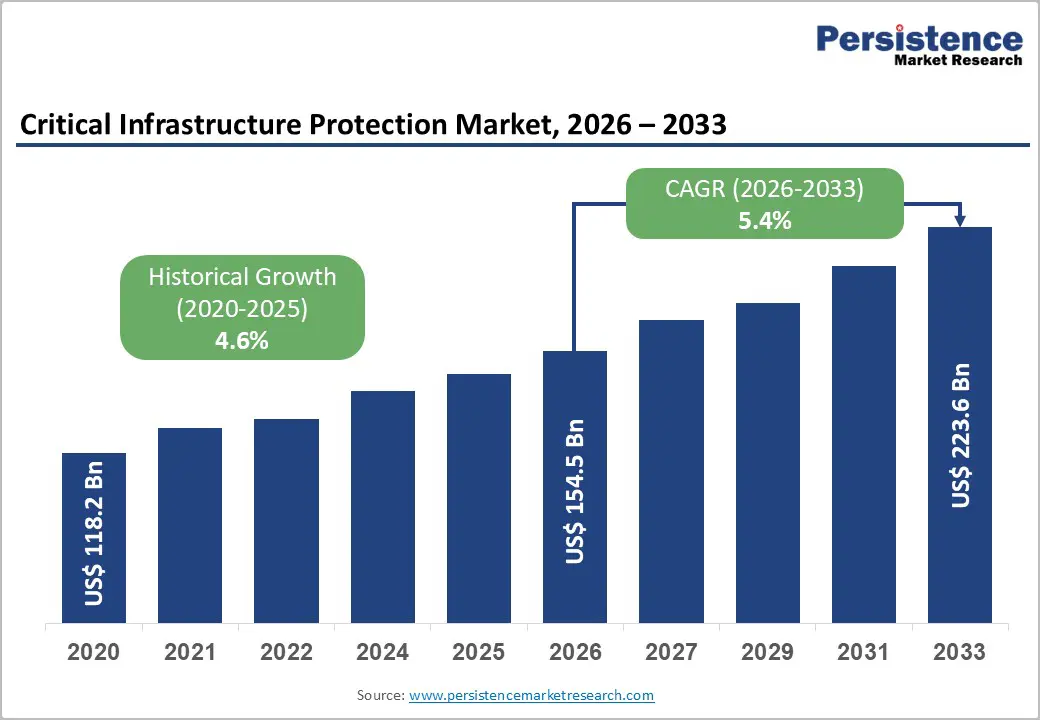
The global Critical Infrastructure Protection (CIP) Market size is projected to rise from US$154.5 billion in 2026 to US$223.6 billion by 2033. It is anticipated to witness a CAGR of 5.4% during the forecast period from 2026 to 2033.
Rising frequency and sophistication of cyber–physical attacks on essential services, combined with aging infrastructure and digitalization, are compelling governments and operators to invest in integrated physical security and cybersecurity solutions. Regulatory frameworks such as the EU NIS2 Directive, U.S. programs led by CISA and DHS, and national cyber strategies in markets like the U.K. are tightening compliance obligations, driving steady, policy-anchored demand.
Key Industry Highlights:
- Leading Component: Hardware leads the market with over 46% share in 2026, valued at more than US$ 71 Bn, driven by the need for robust on-site security infrastructure, secure gateways, firewalls, and ruggedized edge devices to protect mission-critical assets. Software is the fastest-growing segment at 8.9% CAGR, supported by rising demand for AI-driven threat detection, predictive analytics, centralized risk visibility, and automated incident response across converged IT–OT environments.
- Leading Security Type: Surveillance & monitoring dominate physical security with over 35% share in 2026, fueled by the need for real-time threat detection, rapid response, and continuous asset visibility across high-risk facilities. Cloud security is the fastest-growing segment, propelled by accelerating migration of critical workloads to cloud platforms, increasing reliance on scalable digital infrastructure, and the need to secure distributed, hybrid environments.
- Leading Enterprise Size: Large enterprises account for more than 64% share in 2026, exceeding US$ 99 Bn, due to complex, geographically dispersed operations, higher exposure to nation-state and ransomware threats, and strong regulatory compliance mandates. SMEs represent the fastest-growing, driven by increasing cyber targeting, expanding cloud and IoT adoption, supply chain compliance pressures, and growing access to affordable managed security services.
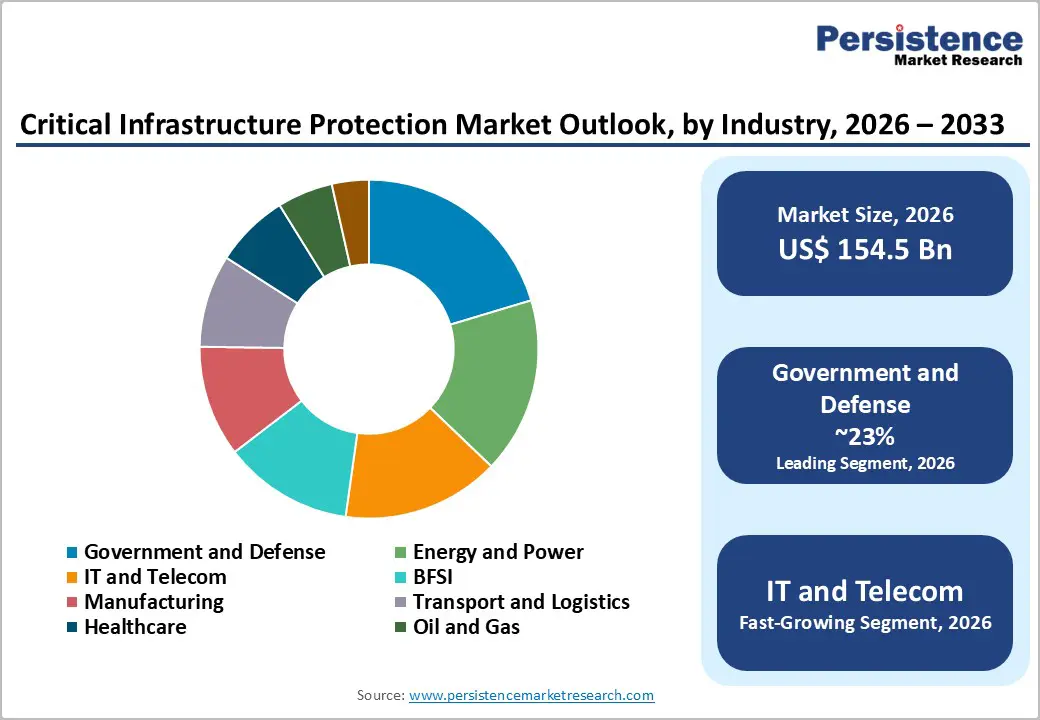
- Leading Industry: Government & defense hold the largest share at over 23% in 2026, valued at over US$36 Bn, supported by continuous investments in safeguarding national security, military networks, intelligence systems, and sovereign assets against hybrid and cyber warfare threats. IT & telecommunications are the fastest-growing industry at a 7.8% CAGR, fueled by expanding 5G, cloud, data center, and edge ecosystems requiring secure, low-latency, and always-on connectivity.
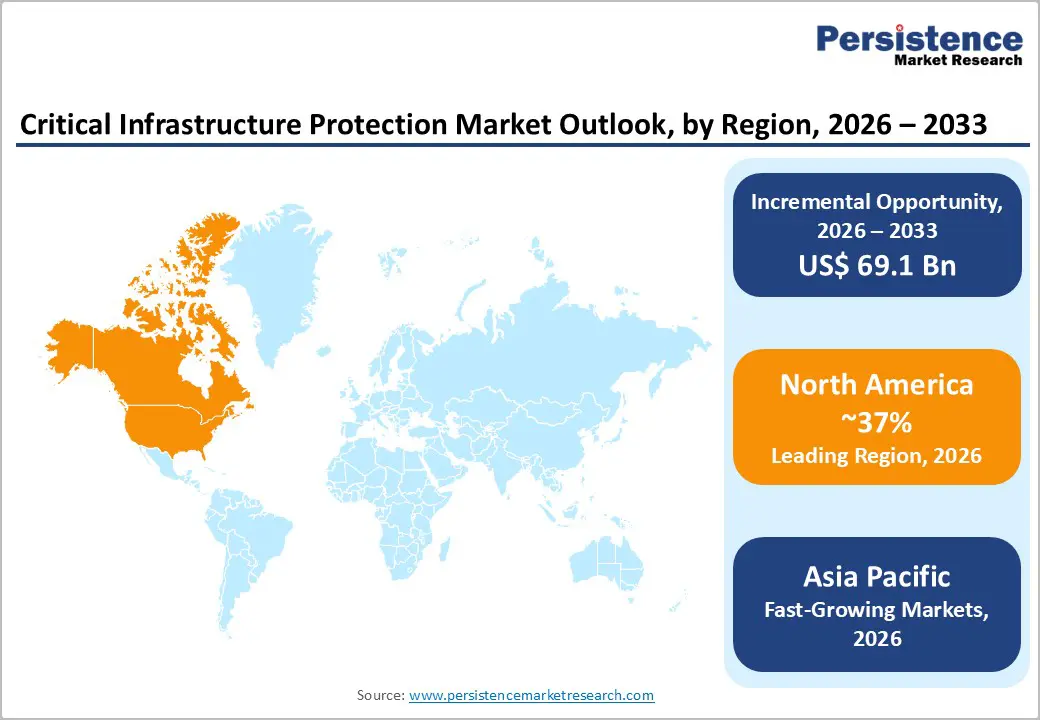
- Leading Region: North America leads the market with over 37% share in 2026, driven by advanced digital infrastructure, high exposure to sophisticated ransomware and nation-state campaigns, and strong regulatory enforcement across energy, transport, and financial systems. Asia Pacific is the fastest-growing region at an 8.3% CAGR, supported by rapid urbanization, infrastructure modernization, digital transformation programs, and expanding regulatory frameworks.
| Key Insights | Details |
|---|---|
|
Critical Infrastructure Protection Market Size (2026E) |
US$154.5 Bn |
|
Market Value Forecast (2033F) |
US$223.6 Bn |
|
Projected Growth (CAGR 2026 to 2033) |
5.4% |
|
Historical Market Growth (CAGR 2020 to 2025) |
4.6% |
Market Dynamics
Driver - Rise in Cyber–Physical Threats to Essential Services
Rapid digitalization and interconnectivity have made essential services prime targets for cybercriminals, hacktivists, and state-sponsored actors, with impacts extending beyond financial losses to public safety and national security. Ransomware incidents such as Play reported by the Federal Bureau of Investigation to have affected ~900 entities globally by May 2025 and Interlock, flagged by the Cybersecurity and Infrastructure Security Agency across multiple critical sectors, highlight the growing scale of disruption.
The European Union Agency for Cybersecurity Threat Landscape 2025 identifies Public Administration (38.2%), Transport (7.5%), and Digital Infrastructure & Services (4.8%) as the most targeted sectors, reflecting intensified hacktivist and state-aligned activity. In the UK, the UK Government Cyber Security Breaches Survey 2024 recorded ~7.78 million cybercrimes, while the Internet Crime Complaint Center reported $1.571 billion in U.S. losses in 2024, including 4,878 complaints from critical infrastructure organizations. These escalating threats are accelerating investments in 24×7 monitoring, incident response, network segmentation, and secure-by-design strategies, driving strong demand for advanced protection solutions.
Shift Toward Integrated Security Platforms and Edge-Capable Solutions
The rapid shift from siloed point solutions to integrated security platforms is a key driver for the market, as operators demand unified visibility across IT, OT, physical security, identity, and incident response. The rise in nationally significant cyber incidents in 2024, highlighted by the National Cyber Security Centre, is accelerating the adoption of coordinated and auditable security frameworks across critical sectors. Growing IT–OT convergence and expansion of edge computing are widening the attack surface, increasing the need for edge-capable protection such as secure boot, remote attestation, and OT-aware XDR. Regulatory push from the National Institute of Standards and Technology (ZTA and CSF updates), the NIS2 Directive, and guidance from the European Union Agency for Cybersecurity is converting compliance mandates into procurement demand. The need for low-latency, real-time protection in utilities and smart transportation further reinforces investment in integrated, resilient security platforms.
Restraint - Skilled Workforce Shortages and Rising Costs
Increasing reliance on digital and networked technologies exposes infrastructure to cyberattacks, yet a global shortage of skilled cybersecurity professionals limits the ability to detect, respond, and mitigate threats effectively. For example, the U.S. Department of Defense reported a shortage of over 20,000 cyber professionals department-wide in mid-2025, while the UK’s Department for Science, Innovation and Technology (DSIT) found that roughly 30% of cyber firms reported a technical skills gap in 2024. These shortages allow prolonged attacks, lateral movement, and unpatched vulnerabilities, directly undermining infrastructure integrity.
Limited skilled personnel also drive up operational costs and slow market growth. Governments and public-sector reviews in 2024–25 note that many agencies cannot perform routine monitoring, incident response, forensic analysis, or patching. Australia’s 2025 APS Data, Digital & Cyber Workforce Plan reported that over 50% of agencies experienced critical cyber skills shortages in 2023–24, leaving gaps that CIP systems alone cannot fill. Rising compensation for scarce professionals forces infrastructure operators, especially public-sector and municipal entities, to allocate larger budgets, often delaying investments in tools, redundancy, or upgrades, which particularly restricts adoption among smaller operators and developing economies.
Opportunity - AI Threats and Infrastructure Modernization Programs
Increased public-sector funding and government initiatives are creating opportunities in the critical infrastructure protection (CIP) market. In the United States, the Department of Homeland Security’s Cybersecurity and Infrastructure Security Agency (CISA) received a FY2025 budget request of approximately $3.0 billion, reflecting multi-billion-dollar public spending that fuels demand for CIP tools, services, and systems integration. This increased funding generates numerous RFPs, grants, and procurement opportunities for vendors, integrators, and managed service providers.
Public-private partnerships (PPPs) and infrastructure modernization programs are creating additional avenues for market expansion. In January 2025, the U.S. Executive Branch launched PPPs focused on AI-driven cyber-defense for critical energy infrastructure, enabling vendors to commercialize AI detection, vulnerability discovery, and automated reporting solutions. U.S. programs under the Infrastructure Investment and Jobs Act (IIJA) and the EU’s Horizon civil-security work programmes provide funding for modernizing energy, transport, and telecom systems. Rising AI-enabled criminal techniques, highlighted by Europol’s EU-SOCTA 2025, are also increasing demand for counter-AI capabilities such as deepfake detection, attribution, and content analysis, presenting specialized opportunities for CIP vendors.
Expansion of Managed Security and Resilience Services for Critical Infrastructure
Growing demand for managed and professional services presents a significant opportunity as infrastructure operators seek compliance, resilience, and 24×7 protection without developing extensive internal capabilities. With tightening regulations and increasingly sophisticated cyber threats, SMEs, regional utilities, and municipal operators are outsourcing functions such as continuous monitoring, vulnerability management, incident response, and crisis simulations to specialized providers. Government-backed initiatives that integrate multiple agencies into vulnerability-disclosure platforms and centralized asset-visibility programs further strengthen the case for shared security services. Providers that combine sector-specific expertise, such as BFSI or transport and logistics, with advanced threat intelligence, simulation tools, and recovery planning build strong recurring revenue streams. This model supports multi-jurisdictional regulatory compliance while enhancing operational continuity and overall infrastructure resilience.
Category-wise Analysis
Component Insights
Hardware dominates the market, capturing more than 46% market share in 2026 with a value exceeding US$ 71 Bn, as protecting critical assets requires tangible, on-site security infrastructure that physically prevents unauthorized access, theft, and sabotage. The increasing integration of operational and digital systems also demands upgraded firewalls, secure gateways, and ruggedized devices deployed at edge locations. Modernization of aging facilities and the need for continuous, real-time monitoring make durable and resilient hardware the foundational layer upon which software and services depend.
Software demonstrates a significant rate at 8.9% CAGR due to the rising need for real-time threat detection, predictive analytics, and centralized risk visibility across distributed assets. Critical sectors such as energy, utilities, transportation, and BFSI increasingly rely on AI-driven monitoring platforms and automated incident response to combat ransomware, supply chain attacks, and nation-state cyber threats. The convergence of IT and OT environments requires advanced security software to ensure seamless integration, scalability, and remote infrastructure management.
Security Type Insights
Among physical security, surveillance & monitoring are expected to account for more than 35% share in 2026 due to the rising need for real-time threat detection and rapid response to both physical and cyber risks. Increasing incidents of intrusions, sabotage, and system disruptions demand continuous observation and intelligence-driven security. The ability to prevent, predict, and mitigate potential disruptions drives its widespread adoption across critical assets.
Cloud security is expected to grow at the highest rate due to the widespread migration of sensitive data and critical operations to cloud platforms. It offers scalability and cost-efficiency, enabling organizations to maintain uninterrupted operations and safeguard data integrity. Advanced cloud security solutions are becoming essential to protect critical digital assets, ensure operational resilience, and strengthen the overall critical infrastructure protection (CIP) framework.
Enterprise Size Insights
Large enterprises are expected to account for more than 64% share in 2026, with a value exceeding US$ 99 Bn as they operate complex, geographically distributed assets. These organizations face higher exposure to sophisticated cyberattacks, ransomware, and nation-state threats, making advanced security integration essential. Stringent regulatory compliance mandates further increase security investments. Large enterprises have greater budgets to deploy zero-trust architectures, AI-driven monitoring, and managed security services to ensure operational resilience and business continuity.
The Small & Medium Enterprises (SMEs) segment is expected to grow at a significant rate, as they are increasingly targeted by cyberattacks due to comparatively weaker security frameworks. As SMEs adopt cloud computing, IoT devices, and remote operations, their exposure to cyber and physical threats rises significantly. Regulatory compliance requirements and supply chain security mandates from larger enterprises are also pushing SMEs to strengthen protection measures. Affordable, scalable security solutions and managed services now make advanced protection technologies more accessible to SMEs, accelerating adoption.
Industry Insights
Government and defense are expected to account for more than 23% share in 2026, with a value exceeding US$ 36 Bn, due to its responsibility for safeguarding national security, public safety, and sovereign assets. Rising geopolitical tensions, cyber warfare, terrorism, and hybrid threats require continuous protection of military networks, intelligence systems, border controls, satellites, and classified data. Governments must secure both physical infrastructure and operational technology (OT) systems against ransomware, espionage, and nation-state attacks. Increasing adoption of AI-driven threat detection and secure communication systems further drives spending.
IT and telecommunications are expected to grow at a CAGR of 7.8% as they form the backbone of digital economies and connect all other essential sectors through cloud, data centers, fiber networks, and 5G infrastructure. The rapid expansion of remote work, IoT devices, edge computing, and real-time data exchange increases exposure to cyberattacks, service disruptions, and data breaches. These sectors require continuous uptime, low latency, and secure data transmission, making advanced threat detection, zero-trust frameworks, and network monitoring essential.
Regional Insights
North America Critical Infrastructure Protection Market Trends
North America is expected to account for a share of more than 37% in 2026, driven by increasingly sophisticated cyber threats targeting energy, transportation, and financial systems. Rising ransomware, supply chain attacks, and nation-state campaigns from countries such as China, Russia, and Iran have accelerated the adoption of zero-trust security and multi-factor authentication. In 2025, the U.S. Department of Homeland Security (DHS) warned of persistent threats to critical infrastructure, highlighted by the Volt Typhoon group’s prolonged infiltration of U.S. aviation, rail, and maritime networks.
The North American Electric Reliability Corporation (NERC) has warned of critical reliability challenges facing the electricity grid due to rising demand from artificial intelligence (AI), coupled with coal plant closures and renewable project delays. Canada’s Communications Security Establishment (CSE) also reported 2,561 cybersecurity incidents in 2024–2025, including 1,406 incidents affecting critical infrastructure partners, while the Cyber Centre issued 336 pre-ransomware alerts across healthcare and energy sectors. The integration of advanced technologies like AI and IoT into smart grids and transportation systems improves efficiency but also creates new vulnerabilities, requiring stronger cybersecurity measures, updated regulations, and closer U.S. & Canada collaboration.
Asia Pacific Critical Infrastructure Protection Market Trends
Asia Pacific is expected to grow at the highest rate with a CAGR of 8.3%, due to rapid urbanization, industrial growth, and digitalization. China is at the forefront, with its extensive energy and transport networks, the Cybersecurity Law, and data security regulations reinforcing infrastructure protection. The Belt and Road Initiative has expanded the need for securing cross-border corridors, while the National Industrial Information Security Development Research Center projects China’s data elements market revenue to reach 198.9 billion yuan ($27.3 billion) by 2025, underlining large-scale investments in security governance.
Taiwan’s focus on green energy and territorial protection, Japan’s roadmap linking IoT/AI adoption to SBOMs, protective DNS, and resilience exercises, and India’s surge in demand from Digital India and Smart Cities Mission highlight the region’s diverse focus. India faces growing cyber incidents, with 99% of IoT exploitation attempts in 2024 leveraging known vulnerabilities, exposing gaps in digital and physical resilience. Australia and New Zealand are pushing CIP demand through regulatory frameworks such as the updated Critical Infrastructure Security Act and Australia’s Cyber Security Bill 2024, which mandate ransomware reporting, IoT standards, and expanded SOCI Act obligations, ensuring advanced monitoring, SOC services, and resilience planning.
Europe Critical Infrastructure Protection Market Trends
The European Union’s Critical Entities Resilience (CER) Directive, effective October 18, 2024, requires member states to adopt national strategies aimed at strengthening the resilience of critical entities. This initiative is reducing vulnerabilities to both natural and man-made disruptions while fostering the adoption of advanced technologies like quantum key distribution (QKD) and artificial intelligence (AI). For example, QKD enhances network integrity by preventing eavesdropping and sabotage, while collaborations such as the G7 cybersecurity working group promote international information-sharing on threats to critical infrastructure.
In Germany, the KRITIS law obliges operators in energy, transport, finance, health, and water to secure facilities, reflecting heightened threats after Russia’s 2022 invasion of Ukraine. The UK is focusing on financial sector resilience, with UK Finance’s Annual Fraud Report 2025 revealing £1.17 billion stolen in 2024, 70% of which came from online authorized push payment (APP) fraud. Spain recorded over 100,000 cyberattacks in 2024, including a serious case every three days, leading to stronger defensive measures. EU’s Energy Highways initiative tackles grid bottlenecks and rising energy prices, while the transport sector expands cybersecurity to safeguard critical networks.
Competitive Landscape
The CIP market is moderately consolidated, with global defense contractors, industrial automation leaders, and cybersecurity specialists competing across segments. Companies differentiate themselves through integrated platforms that combine physical and cyber capabilities. Strategic acquisitions, AI-driven analytics, and the expansion of managed services are widely adopted growth strategies. Partnerships with governments and utilities strengthen long-term contracts. R&D investments focus on zero-trust architectures, OT security integration, and predictive analytics.
Key Developments:
- In February 2026, Schneider Electric and ETAP unveiled a new physics-based digital twin solution at DTECH to help utilities and critical infrastructure operators enhance grid resilience and accelerate time-to-power. Integrated with Schneider’s One Digital Grid Platform and EcoStruxure ArcFM Web, the solution combines real-time operations, GIS, and engineering-grade simulation to enable predictive insights, validate protection schemes, and improve safety across utilities and mission-critical sectors.
- In June 2025, Honeywell introduced Cyber Proactive Defense and the OT Security Operations Center to enhance industrial cybersecurity using AI, behavioral analytics, and deception technology, offering 24/7 vendor-agnostic monitoring and on-site support. It also expanded the Digital Prime ecosystem, integrating SESP, Enabled Services, and Assurance 360 for project simulation, real-time performance tracking, and operational optimization, enhancing resilience and reducing dependence on scarce skilled personnel.
Companies Covered in Critical Infrastructure Protection Market
- Siemens AG
- Honeywell International Inc.
- Schneider Electric
- Lockheed Martin
- Boeing
- Cisco Systems, Inc.
- Raytheon Technologies
- Northrop Grumman
- General Electric (GE)
- Dell Technologies
- Fortinet, Inc.
- Palo Alto Networks
- IBM Corporation
- FireEye, Inc.
- ABB Ltd.
- Others
Frequently Asked Questions
The global critical infrastructure protection market is projected to be valued at US$154.5 Bn in 2026.
Rising threats from cyberattacks, physical security breaches, and the need to ensure resilience and continuity are key drivers of the market.
The critical infrastructure protection market is poised to witness a CAGR of 5.4% from 2026 to 2033.
Growing adoption of IoT and smart grid technologies, along with increased investment in resilient transportation, energy, and water systems, is creating strong growth opportunities.
Siemens AG, Honeywell International Inc., Schneider Electric, Lockheed Martin, Cisco Systems, Inc. IBM Corporation, Palo Alto Networks are among the key leading players.


