Brine Concentration Minerals Market Size, Share, and Growth Forecast 2026 - 2033

Brine Concentration Minerals Market by Product Type (Sodium Derivatives, Potassium Derivatives, Calcium Derivatives, Magnesium Derivatives, Others), Application (Metallurgical, Pharmaceutical and Food & Beverages, Water Treatment, Tilting, Fertilizers, Construction, Others), Technology (Solar Evaporation, NF-RO-MF, Osmotically Assisted RO (OARO), Others), and Regional Analysis, 2026 - 2033

ID: PMRREP35119
Calendar

February 2026

188 Pages

Author : Swapnil Chavan

Brine Concentration Minerals Market Size and Trend Analysis

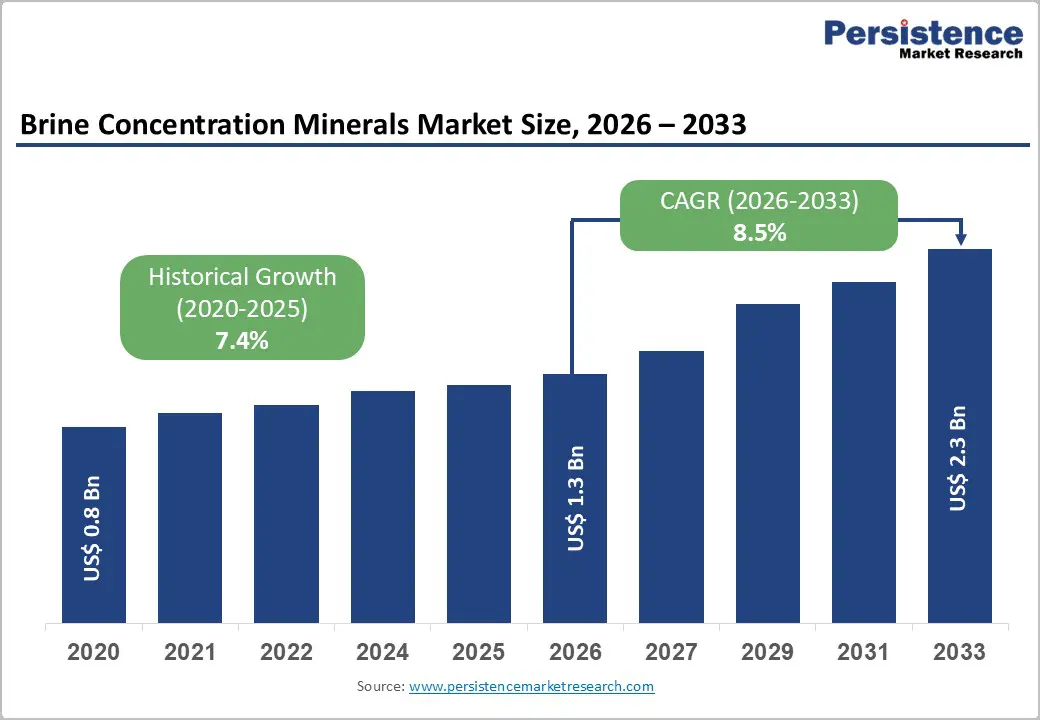
The global brine concentration minerals market size is expected to be valued at US$ 1.3 billion in 2026 and projected to reach US$ 2.3 billion by 2033, growing at a CAGR of 8.5% between 2026 and 2033.

Rising demand for critical minerals used in renewable energy systems and advanced water treatment processes is accelerating market expansion. Increasing extraction of lithium and magnesium from brine resources supports battery manufacturing and grid-scale storage deployment. The International Energy Agency reports strong lithium demand growth through 2030, while the United Nations Environment Programme notes significant desalination brine volumes globally, strengthening mineral recovery opportunities.

Key Industry Highlights:

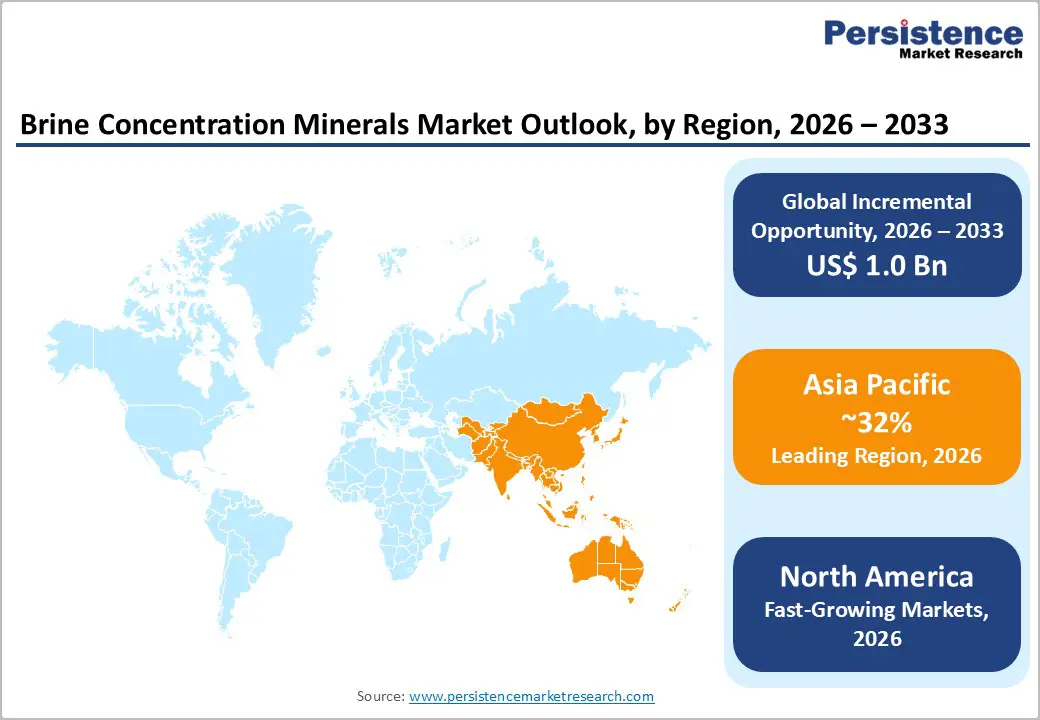
  • Leading Region - Asia Pacific accounts for 32% share in 2025, driven by strong salt lake resources, desalination expansion, and growing mineral recovery investments.
  • Fastest Growing Region - Europe is projected to expand at a CAGR of 7.8% during the forecast period, supported by circular economy policies and zero-liquid discharge regulations.
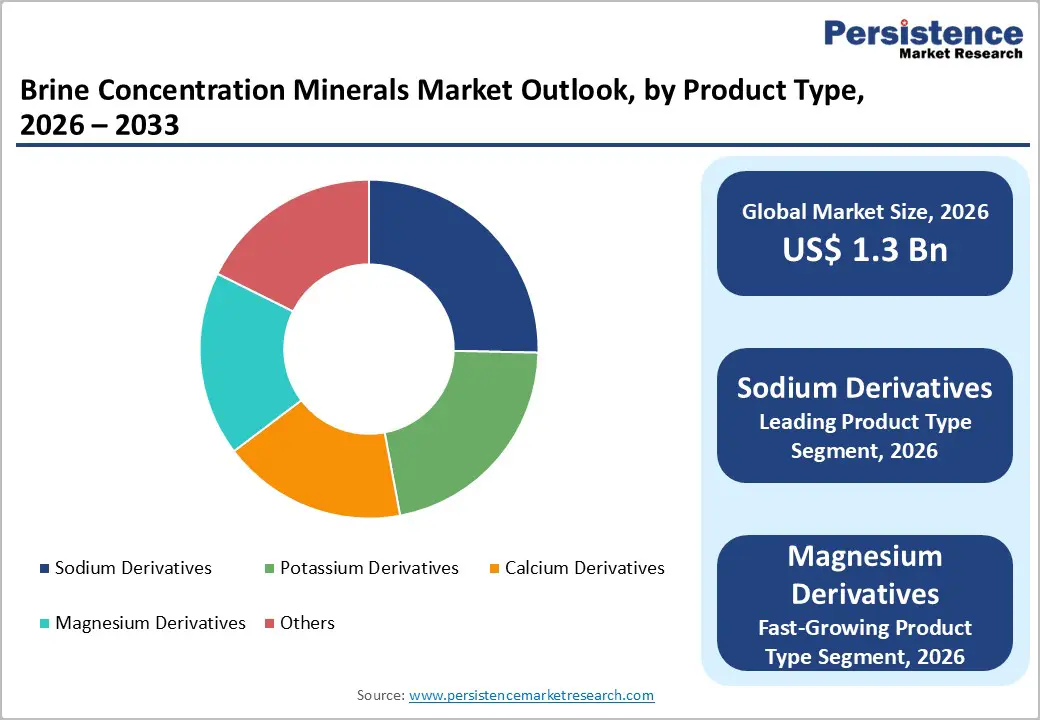
  • Leading Product Category - Sodium derivatives hold 35% share in 2025 due to high demand in water treatment and construction applications.
  • Leading Technology - Solar evaporation captures 42% share in 2025, favored for its cost efficiency and scalability in arid regions.
  • Key Market Opportunity - Fertilizers represent 28% share in 2025, creating strong growth potential in potassium recovery from desalination and industrial brines.
Key Insights Details
Brine Concentration Minerals Market Size (2026E) US$ 1.3 billion
Market Value Forecast (2033F) US$ 2.3 billion
Projected Growth CAGR (2026 - 2033) 8.5%
Historical Market Growth (2020 - 2025) 7.4%

Market Dynamics

Drivers - Rising Demand for Critical Minerals in Clean Energy

The accelerating transition toward clean energy is significantly driving demand for lithium, potassium, and magnesium extracted through brine concentration processes. According to the International Energy Agency, global lithium demand is projected to rise sharply by 2030 due to rapid electric vehicle adoption and expanding battery storage infrastructure.

Brine-based extraction methods offer operational advantages, including reduced freshwater consumption compared to conventional mining, as noted by the United States Geological Survey. This efficiency, combined with geopolitical pressures on mineral supply chains, is accelerating investments in advanced brine concentration technologies to enhance sustainability and long-term resource security.

Expansion of Desalination and Water Reuse Initiatives

The rapid growth of desalination and water reuse projects worldwide is generating substantial volumes of mineral-rich brine, creating strong recovery opportunities. The International Desalination Association reports thousands of desalination facilities globally, producing significant brine outputs suitable for mineral extraction and commercial reuse.

Regulatory frameworks such as the EU Water Framework Directive are encouraging zero-liquid discharge systems, prompting utilities to adopt advanced concentration technologies. These systems enable high-efficiency mineral recovery while minimizing environmental discharge, improving operational economics and supporting broader sustainability objectives.

Restraints - High Capital Intensity and Technological Barriers

The adoption of advanced brine concentration technologies such as Osmotically Assisted Reverse Osmosis (OARO) is constrained by high initial capital requirements. The World Bank highlights that brine-based projects often incur significantly higher capital expenditure than conventional mining due to specialized infrastructure and membrane systems.

Operational complexities, including membrane fouling and limited scalability in remote salt lake regions, further restrict widespread deployment. These technical barriers raise maintenance costs and project risks, discouraging smaller operators from entering the market despite the long-term efficiency and sustainability benefits offered by advanced concentration systems.

Environmental and Regulatory Compliance Challenges

Strict environmental regulations governing brine discharge and mineral recovery operations present another key restraint. The United States Environmental Protection Agency enforces stringent limits on total dissolved solids and wastewater discharge, with substantial penalties for non-compliance, increasing operational risk for producers.

Moreover, volatility in mineral pricing adds financial uncertainty. The United States Geological Survey has reported fluctuations in key minerals such as potassium, impacting revenue predictability. Combined with evolving environmental standards, these factors constrain investment decisions and delay large-scale deployment of advanced brine concentration technologies.

Opportunity - Advancements in Membrane Technologies for High-Value Recovery

Technological innovation in membrane-based systems, including NF-RO-MF hybrids and Osmotically Assisted Reverse Osmosis (OARO), is unlocking high-value mineral recovery from desalination brines. Projects supported by the U.S. Department of Energy demonstrate strong recovery efficiencies for lithium and magnesium, strengthening commercial viability across energy and specialty chemical applications.

In parallel, pilot programs by the National Renewable Energy Laboratory indicate substantial energy savings through advanced OARO systems. Such efficiency gains attract utilities in water-stressed regions and create expansion opportunities in fertilizer and industrial mineral applications, positioning membrane innovators to benefit from rising demand for sustainable resource recovery solutions.

Policy Support for Circular Economy in Mining

Government initiatives promoting circular economy practices in mining and water management are creating favorable conditions for brine valorization. Policies introduced by the Ministry of Mining of Chile encourage increased brine reuse, accelerating adoption of advanced concentration technologies in lithium-rich regions.

Similarly, India’s National Critical Minerals Mission supports investments in mineral recovery technologies to strengthen domestic supply chains. These policy frameworks, aligned with global sustainability goals, enable companies to monetize waste brine streams, expand into water treatment segments, and enhance long-term revenue stability through resource-efficient production models.

Category-wise Analysis

Product Type Insights

Sodium derivatives accounted for 35% of the market share in 2025, driven by strong demand from water treatment and construction industries. According to the United States Geological Survey, global soda ash production from brine sources remains substantial, supported by cost-efficient solar evaporation in natural salt lakes. Large-scale production in China, reported by the Ministry of Natural Resources of the People's Republic of China, further reinforces segment leadership.

Magnesium derivatives are emerging as the fastest-growing category, supported by rising demand in lightweight alloys, specialty chemicals, and energy storage applications. Expanding desalination activities and advanced recovery technologies are improving extraction efficiency, positioning magnesium compounds as increasingly important in industrial and renewable energy value chains.

Application Insights

Fertilizers held 28% share in 2025, supported by robust demand for potassium derivatives essential to crop productivity. The Food and Agriculture Organization reports sustained global potash demand, with a significant portion sourced from brine operations. Production from facilities such as ICL Group Ltd. in the Dead Sea region strengthens supply reliability and reinforces segment dominance.

Water treatment is emerging as the fastest-growing application, driven by expanding desalination infrastructure and tightening wastewater discharge regulations. Increasing emphasis on mineral recovery from brine streams, combined with sustainability initiatives, is accelerating adoption across municipal and industrial utilities worldwide.

Technology Insights

Solar evaporation dominated the market with a 42% share in 2025 due to its cost-effectiveness in arid environments. The International Desalination Association notes its widespread use in processing global brine volumes, while the United States Geological Survey highlights its economic advantage over membrane-based systems. Large-scale operations in the Salar de Atacama further validate its scalability.

Osmotically Assisted Reverse Osmosis (OARO) is the fastest-growing technology, driven by improved energy efficiency and higher mineral recovery potential. Increasing regulatory pressure for zero-liquid discharge and advancements in membrane durability are accelerating adoption, particularly in regions facing water scarcity and environmental constraints.
Regional Insights

North America Brine Concentration Minerals Market Trends and Insights

North America accounted for 27% of the global market share in 2025, supported by technological innovation and strong regulatory enforcement. The U.S. Department of Energy has funded brine mining and advanced membrane projects, accelerating commercialization of Osmotically Assisted Reverse Osmosis technologies across the United States.

Regulatory measures such as the Clean Water Act encourage mineral recovery from desalination and industrial brine streams. Pilot initiatives in California demonstrate high-efficiency magnesium recovery, strengthening domestic supply chains for electric vehicle batteries and specialty chemicals while reducing environmental discharge risks.

Europe Brine Concentration Minerals Market Trends and Insights

Europe is projected to achieve a CAGR of 7.8% during the forecast period, driven by strong environmental compliance frameworks and circular economy initiatives. Funding under Horizon 2020 has supported zero-liquid discharge and mineral recovery technologies across Germany and France, accelerating innovation in brine concentration systems.

The United Kingdom is advancing potassium recovery for fertilizer applications, supported by assessments from the British Geological Survey. Spain leverages desalination infrastructure for sodium derivative production, while EU-wide regulatory alignment under REACH strengthens sustainable mineral valorization and regional competitiveness.

Asia Pacific Brine Concentration Minerals Market Trends and Insights

Asia Pacific led the global market with a 32% share in 2025 and is also the fastest-growing region through the forecast period. China remains the primary contributor, with significant brine-based sodium production reported by the National Bureau of Statistics of China. Expanding fertilizer demand and large-scale salt-lake operations strengthen the region’s leadership position.

Growth is further supported by India’s solar pond projects in Rajasthan and rising investments in mineral recovery technologies. Japan is advancing NF-RO systems for water treatment, while Southeast Asian manufacturing hubs improve cost competitiveness. Strong policy backing, expanding desalination capacity, and increasing battery material demand continue to accelerate regional expansion.
Competitive Landscape

The brine concentration minerals market is moderately consolidated, characterized by established participants investing heavily in research and development to strengthen technological capabilities. Companies are focusing on advanced membrane platforms, including Osmotically Assisted Reverse Osmosis systems, to improve mineral recovery efficiency and reduce overall energy consumption. Strategic acquisitions and technology partnerships are being used to expand portfolios and secure long-term supply agreements.

Competitive positioning increasingly centers on regional expansion, particularly through joint ventures in high-growth Asian markets. Additionally, service-based business models are emerging, where providers offer integrated mineral recovery solutions to utilities, enhancing recurring revenue streams while addressing fragmentation in traditional solar evaporation operations.

Key Developments:

  • In June 2025, EnergySource Minerals launched a commercial Osmotically Assisted Reverse Osmosis (OARO) plant in California, enabling large-scale lithium recovery from geothermal brines and strengthening domestic supply chains for battery-grade critical minerals.
  • In March 2024, Lilac Solutions partnered with Sumitomo Corporation to deploy advanced NF-RO technology in Japan, significantly enhancing magnesium extraction efficiency from desalination brines.
  • In October 2023, TCLP Solutions secured a US$ 30 million grant from the U.S. Department of Energy to establish a brine valorization hub in Nevada focused on advanced mineral recovery.

Companies Covered in Brine Concentration Minerals Market

  • Albemarle Corporation
  • Sociedad Química y Minera de Chile (SQM)
  • Ganfeng Lithium Group
  • AICL Group Ltd.
  • Nutrien Ltd.
  • K+S AG
  • The Mosaic Company
  • Compass Minerals International, Inc.
  • Livent Corporation
  • Arcadium Lithium
  • Allkem Limited
  • China Minmetals Corporation
  • Tianqi Lithium Corporation
  • Dead Sea Works
  • Sinofert Holdings Limited
Frequently Asked Questions

The global Brine Concentration Minerals Market is projected to reach US$ 1.3 billion in 2026 and grow to US$ 2.3 billion by 2033 at a CAGR of 8.5%.

Surging need for critical minerals like lithium and magnesium in EVs and renewables, with IEA forecasting 40% annual lithium demand growth through 2030.

Asia Pacific leads with 32% market share in 2025, supported by strong salt lake resources and expanding mineral recovery infrastructure.

Advancements in OARO technology for high-recovery from desalination brines, backed by DOE incentives and circular economy policies.

Leading firms include Albemarle Corporation, Sociedad Química y Minera de Chile (SQM), Ganfeng Lithium Group, AICL Group Ltd., and Nutrien Ltd.

Global Brine Concentration Minerals Market Report Scope
Report Attribute Details
Historical Data/Actuals 2020 - 2025
Forecast Period 2026 - 2033
Market Analysis Units Value: US$ Bn, Volume: As Applicable
Geographical Coverage
  • North America
  • Europe
  • East Asia
  • South Asia and Oceania
  • Latin America
  • Middle East and Africa
Segmental Coverage
  • Product Type
  • Application
  • Technology
  • Region
Competitive Analysis
  • Albemarle Corporation
  • Sociedad Química y Minera de Chile (SQM)
  • Ganfeng Lithium Group
  • AICL Group Ltd.
  • Nutrien Ltd.
  • K+S AG
  • The Mosaic Company
  • Compass Minerals International, Inc.
  • Livent Corporation
  • Arcadium Lithium
  • Allkem Limited
  • China Minmetals Corporation
  • Tianqi Lithium Corporation
  • Dead Sea Works
  • Sinofert Holdings Limited
Report Highlights
  • Market Forecast and Trends
  • Competitive Intelligence & Share Analysis
  • Growth Factors and Challenges
  • Strategic Growth Initiatives
  • Pricing Analysis
  • Future Opportunities and Revenue Pockets
  • Market Analysis Tools
Market Segmentation

By Product Type

  • Sodium Derivatives
  • Potassium Derivatives
  • Calcium Derivatives
  • Magnesium Derivatives
  • Others

By Application

  • Metallurgical
  • Pharmaceutical and Food & Beverages
  • Water Treatment
  • Tilting
  • Fertilizers
  • Construction
  • Others

By Technology

  • Solar Evaporation
  • NF-RO-MF
  • Osmotically Assisted RO (OARO)
  • Others

By Region

  • North America
  • Europe
  • East Asia
  • South Asia & Oceania
  • Latin America
  • Middle East & Africa

Related Reports

  1. Executive Summary
    1. Global Brine Concentration Minerals Market Snapshot 2026 and 2033
    2. Market Opportunity Assessment, 2026-2033, US$ Bn
    3. Key Market Trends
    4. Industry Developments and Key Market Events
    5. Demand Side and Supply Side Analysis
    6. PMR Analysis and Recommendations
  2. Market Overview
    1. Market Scope and Definitions
    2. Market Dynamics
      1. Driver
      2. Restraint
      3. Opportunities
      4. Trends
    3. Macro-Economic Factors
      1. Global GDP Outlook
      2. Global Prison Growth Outlook
      3. Global Crime Rates by Country
      4. Global Prison Population by Country
      5. Global Private Prison Market Growth Outlook
      6. Other Macro-economic Factors
    4. Forecast Factors - Relevance and Impact
    5. COVID-19 Impact Assessment
  3. Value Added Insights
    1. Value Chain analysis
    2. Key Market Players
    3. Product Adoption Analysis
    4. Key Promotional Strategies by key players
    5. PESTLE Analysis
    6. Porter's Five Forces Analysis
    7. Regulatory and Technology Landscape
  4. Price Trend Analysis, 2025
    1. Region-wise Price Analysis
    2. Price by Segments
    3. Price Impact Factors
  5. Global Brine Concentration Minerals Market Outlook: Historical (2020 - 2025) and Forecast (2026 - 2033)
    1. Key Highlights
    2. Global Brine Concentration Minerals Market Outlook: Product Type
      1. Introduction/Key Findings
      2. Historical Market Size (US$ Bn) and Volume (Units) Analysis by Product Type, 2020-2025
      3. Current Market Size (US$ Bn) and Volume (Units) Forecast, by Product Type, 2026-2033
        1. Sodium Derivatives
        2. Potassium Derivatives
        3. Calcium Derivatives
        4. Magnesium Derivatives
        5. Others
      4. Market Attractiveness Analysis: Product Type
    3. Global Brine Concentration Minerals Market Outlook: Application
      1. Introduction/Key Findings
      2. Historical Market Size (US$ Bn) and Volume (Units) Analysis by Application , 2020-2025
      3. Current Market Size (US$ Bn) and Volume (Units) Forecast, by Application , 2026-2033
        1. Metallurgical
        2. Pharmaceutical and Food & Beverages
        3. Water Treatment
        4. Tilting
        5. Fertilizers
        6. Construction
        7. Others
      4. Market Attractiveness Analysis: Application
    4. Global Brine Concentration Minerals Market Outlook: Technology
      1. Introduction/Key Findings
      2. Historical Market Size (US$ Bn) and Volume (Units) Analysis by Technology, 2020-2025
      3. Current Market Size (US$ Bn) and Volume (Units) Forecast, by Technology, 2026-2033
        1. Solar Evaporation
        2. NF-RO-MF
        3. Osmotically Assisted RO (OARO)
        4. Others
      4. Market Attractiveness Analysis: Technology
  6. Global Brine Concentration Minerals Market Outlook: Region
    1. Key Highlights
    2. Historical Market Size (US$ Bn) and Volume (Units) Analysis by Region, 2020-2025
    3. Current Market Size (US$ Bn) and Volume (Units) Forecast, by Region, 2026-2033
      1. North America
      2. Europe
      3. East Asia
      4. South Asia & Oceania
      5. Latin America
      6. Middle East & Africa
    4. Market Attractiveness Analysis: Region
  7. North America Brine Concentration Minerals Market Outlook: Historical (2020 - 2025) and Forecast (2026 - 2033)
    1. Key Highlights
    2. Pricing Analysis
    3. North America Market Size (US$ Bn) and Volume (Units) Forecast, by Country, 2026-2033
      1. U.S.
      2. Canada
    4. North America Market Size (US$ Bn) and Volume (Units) Forecast, by Product Type, 2026-2033
      1. Sodium Derivatives
      2. Potassium Derivatives
      3. Calcium Derivatives
      4. Magnesium Derivatives
      5. Others
    5. North America Market Size (US$ Bn) and Volume (Units) Forecast, by Application , 2026-2033
      1. Metallurgical
      2. Pharmaceutical and Food & Beverages
      3. Water Treatment
      4. Tilting
      5. Fertilizers
      6. Construction
      7. Others
    6. North America Market Size (US$ Bn) and Volume (Units) Forecast, by Technology, 2026-2033
      1. Solar Evaporation
      2. NF-RO-MF
      3. Osmotically Assisted RO (OARO)
      4. Others
  8. Europe Brine Concentration Minerals Market Outlook: Historical (2020 - 2025) and Forecast (2026 - 2033)
    1. Key Highlights
    2. Pricing Analysis
    3. Europe Market Size (US$ Bn) and Volume (Units) Forecast, by Country, 2026-2033
      1. Germany
      2. Italy
      3. France
      4. U.K.
      5. Spain
      6. Russia
      7. Rest of Europe
    4. Europe Market Size (US$ Bn) and Volume (Units) Forecast, by Product Type, 2026-2033
      1. Sodium Derivatives
      2. Potassium Derivatives
      3. Calcium Derivatives
      4. Magnesium Derivatives
      5. Others
    5. Europe Market Size (US$ Bn) and Volume (Units) Forecast, by Application , 2026-2033
      1. Metallurgical
      2. Pharmaceutical and Food & Beverages
      3. Water Treatment
      4. Tilting
      5. Fertilizers
      6. Construction
      7. Others
    6. Europe Market Size (US$ Bn) and Volume (Units) Forecast, by Technology, 2026-2033
      1. Solar Evaporation
      2. NF-RO-MF
      3. Osmotically Assisted RO (OARO)
      4. Others
  9. East Asia Brine Concentration Minerals Market Outlook: Historical (2020 - 2025) and Forecast (2026 - 2033)
    1. Key Highlights
    2. Pricing Analysis
    3. East Asia Market Size (US$ Bn) and Volume (Units) Forecast, by Country, 2026-2033
      1. China
      2. Japan
      3. South Korea
    4. East Asia Market Size (US$ Bn) and Volume (Units) Forecast, by Product Type, 2026-2033
      1. Sodium Derivatives
      2. Potassium Derivatives
      3. Calcium Derivatives
      4. Magnesium Derivatives
      5. Others
    5. East Asia Market Size (US$ Bn) and Volume (Units) Forecast, by Application , 2026-2033
      1. Metallurgical
      2. Pharmaceutical and Food & Beverages
      3. Water Treatment
      4. Tilting
      5. Fertilizers
      6. Construction
      7. Others
    6. East Asia Market Size (US$ Bn) and Volume (Units) Forecast, by Technology, 2026-2033
      1. Solar Evaporation
      2. NF-RO-MF
      3. Osmotically Assisted RO (OARO)
      4. Others
  10. South Asia & Oceania Brine Concentration Minerals Market Outlook: Historical (2020 - 2025) and Forecast (2026 - 2033)
    1. Key Highlights
    2. Pricing Analysis
    3. South Asia & Oceania Market Size (US$ Bn) and Volume (Units) Forecast, by Country, 2026-2033
      1. India
      2. Southeast Asia
      3. ANZ
      4. Rest of SAO
    4. South Asia & Oceania Market Size (US$ Bn) and Volume (Units) Forecast, by Product Type, 2026-2033
      1. Sodium Derivatives
      2. Potassium Derivatives
      3. Calcium Derivatives
      4. Magnesium Derivatives
      5. Others
    5. South Asia & Oceania Market Size (US$ Bn) and Volume (Units) Forecast, by Application , 2026-2033
      1. Metallurgical
      2. Pharmaceutical and Food & Beverages
      3. Water Treatment
      4. Tilting
      5. Fertilizers
      6. Construction
      7. Others
    6. South Asia & Oceania Market Size (US$ Bn) and Volume (Units) Forecast, by Technology, 2026-2033
      1. Solar Evaporation
      2. NF-RO-MF
      3. Osmotically Assisted RO (OARO)
      4. Others
  11. Latin America Brine Concentration Minerals Market Outlook: Historical (2020 - 2025) and Forecast (2026 - 2033)
    1. Key Highlights
    2. Pricing Analysis
    3. Latin America Market Size (US$ Bn) and Volume (Units) Forecast, by Country, 2026-2033
      1. Brazil
      2. Mexico
      3. Rest of LATAM
    4. Latin America Market Size (US$ Bn) and Volume (Units) Forecast, by Product Type, 2026-2033
      1. Sodium Derivatives
      2. Potassium Derivatives
      3. Calcium Derivatives
      4. Magnesium Derivatives
      5. Others
    5. Latin America Market Size (US$ Bn) and Volume (Units) Forecast, by Application , 2026-2033
      1. Metallurgical
      2. Pharmaceutical and Food & Beverages
      3. Water Treatment
      4. Tilting
      5. Fertilizers
      6. Construction
      7. Others
    6. Latin America Market Size (US$ Bn) and Volume (Units) Forecast, by Technology, 2026-2033
      1. Solar Evaporation
      2. NF-RO-MF
      3. Osmotically Assisted RO (OARO)
      4. Others
  12. Middle East & Africa Brine Concentration Minerals Market Outlook: Historical (2020 - 2025) and Forecast (2026 - 2033)
    1. Key Highlights
    2. Pricing Analysis
    3. Middle East & Africa Market Size (US$ Bn) and Volume (Units) Forecast, by Country, 2026-2033
      1. GCC Countries
      2. South Africa
      3. Northern Africa
      4. Rest of MEA
    4. Middle East & Africa Market Size (US$ Bn) and Volume (Units) Forecast, by Product Type, 2026-2033
      1. Sodium Derivatives
      2. Potassium Derivatives
      3. Calcium Derivatives
      4. Magnesium Derivatives
      5. Others
    5. Middle East & Africa Market Size (US$ Bn) and Volume (Units) Forecast, by Application , 2026-2033
      1. Metallurgical
      2. Pharmaceutical and Food & Beverages
      3. Water Treatment
      4. Tilting
      5. Fertilizers
      6. Construction
      7. Others
    6. Middle East & Africa Market Size (US$ Bn) and Volume (Units) Forecast, by Technology, 2026-2033
      1. Solar Evaporation
      2. NF-RO-MF
      3. Osmotically Assisted RO (OARO)
      4. Others
  13. Competition Landscape
    1. Market Share Analysis, 2025
    2. Market Structure
      1. Competition Intensity Mapping
      2. Competition Dashboard
    3. Company Profiles
      1. Albemarle Corporation
        1. Company Overview
        2. Product Portfolio/Offerings
        3. Key Financials
        4. SWOT Analysis
        5. Company Strategy and Key Developments
      2. Sociedad Química y Minera de Chile (SQM)
      3. Ganfeng Lithium Group
      4. AICL Group Ltd.
      5. Nutrien Ltd.
      6. K+S AG
      7. The Mosaic Company
      8. Compass Minerals International, Inc.
      9. Livent Corporation
      10. Arcadium Lithium
      11. Allkem Limited
      12. China Minmetals Corporation
      13. Tianqi Lithium Corporation
      14. Dead Sea Works
      15. Sinofert Holdings Limited
  14. Appendix
    1. Research Methodology
    2. Research Assumptions
    3. Acronyms and Abbreviations

Research Methodology Framework for Market Research Excellence

At Persistence Market Research, we implement a comprehensive, validated, and multi-dimensional approachto market analysis that delivers actionable insights across complex market landscapes. Our methodology combines the analytical rigor of leading consulting firms with innovative research techniques, ensuring robust market assessments that guide strategic decision-making with confidence.

Core Research Philosophy

Our methodology is built on four foundational pillars:

Research Philosophy Image

At Persistence Market Research, our methodology is designed to transcend conventional market studies by combining analytical rigor, multi-source validation, and future-focused insights.

We integrate advanced research frameworks, robust data collection strategies, cutting-edge analytics, and innovative technologies to deliver a 360-degree view of complex markets.

We integrate advanced research frameworks, robust data collection strategies, cutting-edge analytics, and innovative technologies to deliver a 360-degree view of complex markets.

Each stage spanning from strategic scoping and hypothesis-building to competitive intelligence, quality validation, and actionable recommendations is engineered to provide clients with unmatched clarity, precision, and confidence in decision-making.

By embedding innovation and technology at the core, our approach ensures that insights are not only comprehensive but also predictive, empowering businesses to seize opportunities, mitigate risks, and achieve sustainable growth

Research Philosophy Image

Capturing Key Information and Events

During this phase, key research objectives focus on essential information and data points for assessing the market, including:

Research Philosophy Image

TAM-SAM-SOM Framework Implementation

We employ both top-down and bottom-up approaches to ensure accurate market sizing.

Top-Down Market SizingBottom-Up Market Sizing
Universe Definition: Total global/regional market identificationUnit Economics: Average transaction values, purchase frequencies, customer lifecycle
Segmentation Filters: Geographic, demographic, and behavioral constraintsCustomer Segmentation: Detailed buyer persona development and sizing
Market Share Analysis: Competitive landscape assessment and share allocationPenetration Analysis: Market penetration rates by segment and geography
Growth Rate Application: Historical trends and forward-looking growth assumptionsScaling Methodology: Extrapolation techniques with confidence intervals

Validation & Cross-Verification

  • Triangulation: Comparing top-down and bottom-up results for consistency
  • Sensitivity Analysis: Testing key assumptions and parameter variations
  • Peer Benchmarking: Comparison with analogous markets and industry benchmarks
  • Expert Review: External validation through industry specialist consultation

Research Philosophy Image

Forecasting & Projection Modeling

Our proprietary forecasting models incorporate multiple variables and scenarios.

Forecasting Components

  • Historical Trend Analysis: 10-year historical growth patterns and cyclical variations
  • Driver-Based Modeling: Economic indicators, demographic shifts, technology adoption
  • Scenario Planning: Base case, optimistic, and conservative projections
  • Monte Carlo Simulations: Probability-weighted outcomes and risk assessments

Model Validation

  • Back-Testing: Historical accuracy assessment over 3–5-year periods
  • Cross-Validation: Multiple modeling approaches for result comparison
  • External Benchmarking: Comparison with established market forecasts
  • Continuous Calibration: Quarterly model updates based on new data

Comprehensive Data Collection Strategy

Our secondary research phase establishes a robust knowledge base utilizing diverse, credible sources.

Secondary Data Sourcess

  • Industry Publications & Reports
  • Government & Regulatory Data
  • Financial Intelligence (filings & reports)
  • Academic Research & Digital Intelligence

Quality Assurance Protocol

  • Source credibility assessment and publication date validation
  • Data consistency checks across multiple sources
  • Bias identification and neutralization techniques
  • Information gap tracking for primary research prioritization

Research Philosophy Image

Primary Research Excellence

Our primary research methodology employs best-in-class techniques to capture unique market insights.

Quantitative Research Methods

  • Large-Scale Surveys: Statistically representative samples with 95% confidence intervals
  • Survey Methodology: Multi-channel deployment (online, telephone, in-person)
  • Question Architecture and Response Optimization

Qualitative Research Methods

  • Executive Interviews
  • Focus Groups
  • Expert Consultations

Quality Assurance & Validation Framework

Multi-Stage Validation Process

  • Source Verification and Consistency Testing
  • Outlier Detection and Bias Assessment
  • Peer Review Process and External Validation
  • Sensitivity Analysis and Confidence Intervals

Research Philosophy Image

Methodology Validation & Credibility

Our research methodology has been extensively validated through:

  • Academic Partnerships: Collaborations with top-tier business schools and research institutions
  • Client Success Stories: Documented case studies demonstrating research impact and ROI
  • Continuous Benchmarking: Performance comparison with leading global research firms

This comprehensive methodology framework positions Persistence Market Research at the forefront of market intelligence, combining the analytical sophistication of top-tier consulting firms with innovative research techniques. Our approach ensures that every market assessment delivers precise, actionable, and strategically valuable insights that drive business success in competitive market environments.

Ready to unlock your market potential? Contact our research experts to discuss how our validated methodology can transform your strategic decision-making with data-driven market intelligence.

Copyright © 2026 Persistence Market Research. All Rights Reserved

Connect With Us -