




- Automotive Components & Materials
- Automotive Power Closure Market
Automotive Power Closure Market Size, Share, and Growth Forecast, 2026 – 2033
Automotive Power Closure Market by Product Type (Power Doors, Windows, Tailgates, Liftgates, Sunroofs), Technology Type (Electric Motors, Hydraulic Systems, Advanced Sensors, Actuators), and Regional Analysis for 2026 – 2033

Automotive Power Closure Market Size and Trends Analysis
The automotive power closure is system widely used for opening and closure application in the door locks, door closure assist, power lift-gate, power sliding door and power rear deck-lid. Automotive power closure also provides features such as remote control power closure systems, speed regulated operation and one-touch activation system.
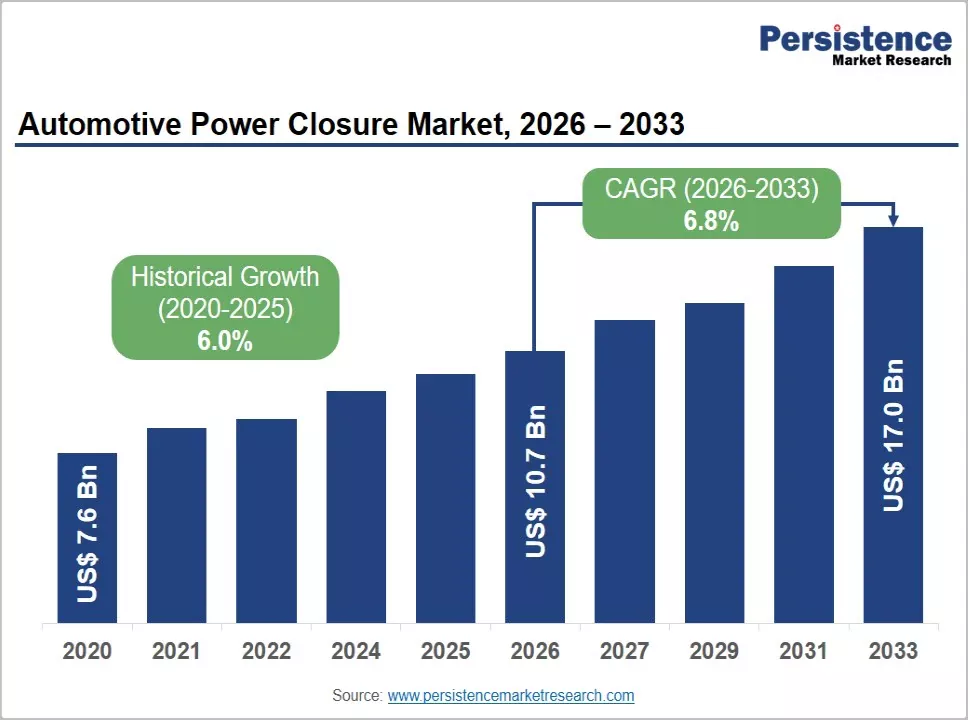
This allows automotive manufacturers to offer their cusThe global automotive power closure market size is likely to be valued at US$10.7 billion in 2026 and is expected to reach US$17.0 billion by 2033, growing at a CAGR of 6.8% during the forecast period from 2026 to 2033, driven by automakers integrating powered doors, windows, tailgates, liftgates, and sunroofs to improve vehicle convenience, accessibility, and safety. The expansion of electric vehicles is also encouraging demand for efficient motors, actuators, sensors, and electronic control systems. In 2025, the International Energy Agency reported that global electric car sales exceeded 17 million in 2024, representing more than 20% of new car sales worldwide.tomers prime vehicle comfort. The automotive power closure uses the control algorithms to work smoothly and harmoniously. The automotive power closure reduces the risk of any injury from closing lift gates or roofs, windows and it also augments the eminence appearance of the car.
Key Industry Highlights:
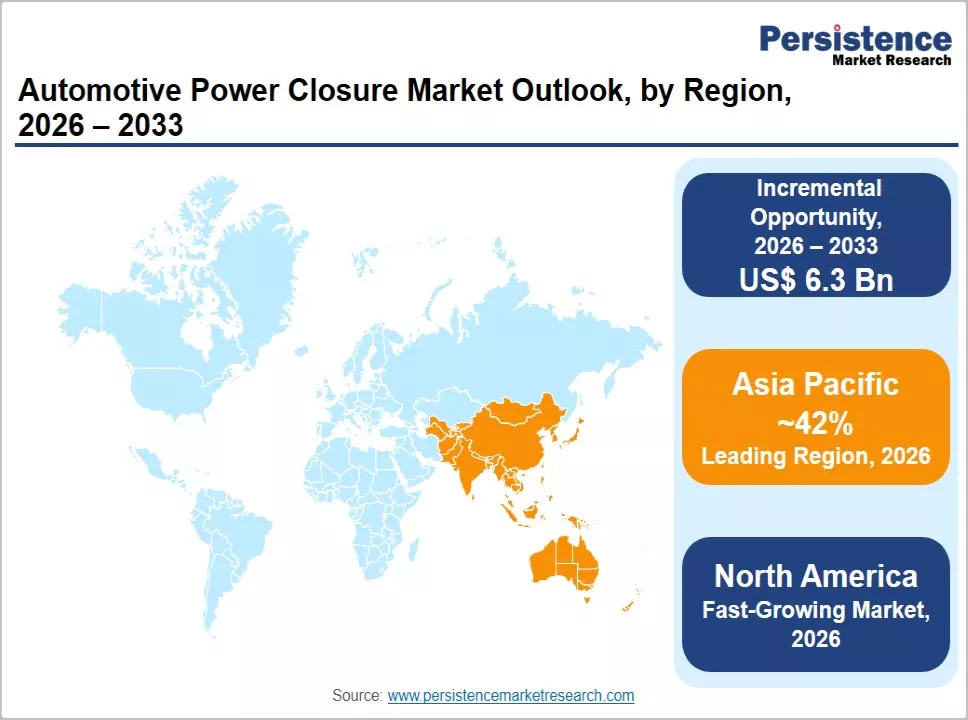
- Leading Region: Asia Pacific is anticipated to be the leading region, accounting for a market share of 42% in 2026, driven by high vehicle production volumes, expanding electric vehicle adoption, and rising demand for powered closures.
- Fastest-growing Region: North America is likely to be the fastest-growing region, supported by strong SUV and pickup truck demand, premium feature adoption, vehicle safety requirements, and advanced automotive manufacturing capabilities.
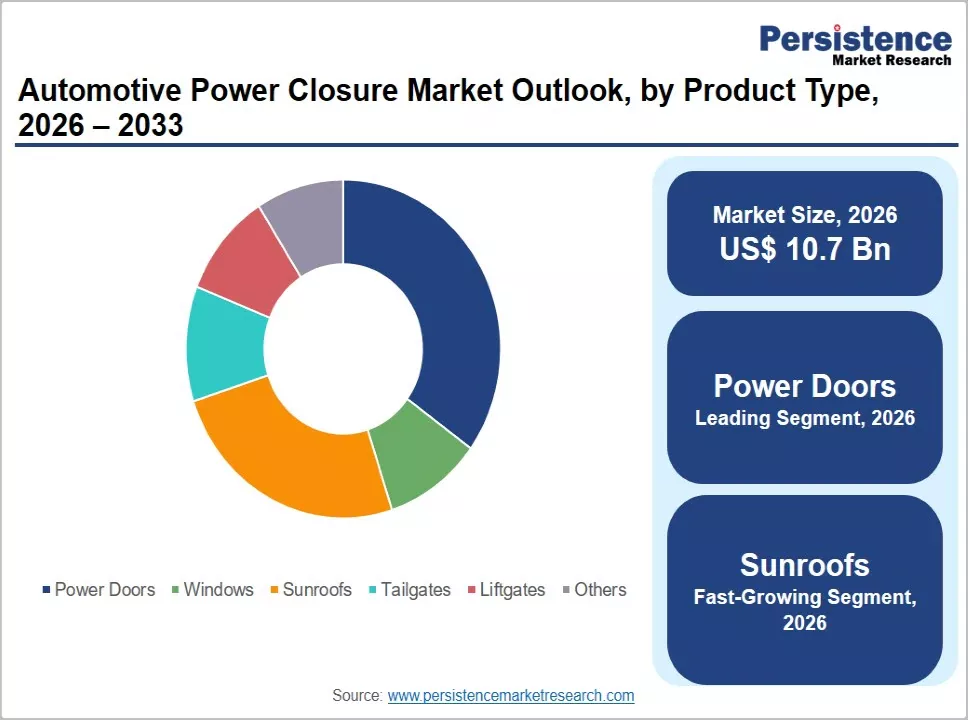
- Leading Product Type: Power doors are projected to represent the leading product type in 2026, accounting for 35% of the revenue share, for widespread integration of powered access systems and electronic latches.
- Leading Technology Type: Electric motors are anticipated to be the leading technology type, accounting for over 50% of the revenue share in 2026, supported by their widespread use in powered doors, windows, liftgates, and sunroofs.
- Key Opportunity: Integration of intelligent power closure systems with software-defined vehicles, electric vehicle platforms, and advanced safety technologies creates opportunities for lightweight, sensor-enabled doors, tailgates, liftgates, and sunroofs that enhance convenience, automation, and vehicle accessibility.
DRO Analysis
Driver - Rising Demand for Premium and Luxury Vehicles with Convenience Features
Automakers are integrating powered doors, windows, tailgates, liftgates, and sunroofs to enhance the overall driving experience. Features such as hands-free tailgate operation, soft-close doors, and automatic window controls are becoming important differentiators across premium vehicle segments. Growing demand for SUVs and crossovers further supports adoption, as these vehicles frequently incorporate powered closure systems to improve accessibility, usability, and perceived vehicle quality for drivers and passengers.
Automotive manufacturers are also expanding convenience features into mid-range vehicles to attract technology-conscious consumers and strengthen product differentiation. Integration of electric motors, actuators, sensors, and electronic control units enables smoother operation and more precise movement of closure components. These systems can improve accessibility while incorporating anti-pinch protection and obstacle detection.
As automakers compete to deliver increasingly sophisticated interiors and user-friendly vehicle experiences, power closure technologies are gaining wider acceptance across vehicle categories. This trend creates opportunities for component suppliers to develop compact, lightweight, reliable, and energy-efficient solutions tailored to evolving automotive design and consumer expectations.
Restraint - Complex System Integration and Validation Requirements
Power closure systems combine electric motors, actuators, electronic latches, sensors, wiring harnesses, and control units that must operate reliably within a vehicle's electrical and mechanical architecture. Integrating these components requires coordination among automakers, software developers, and Tier-1 suppliers. Compatibility issues involving vehicle networks, power consumption, component packaging, and control logic can increase engineering complexity.
Safety validation adds complexity because power closure systems must prevent injuries, detect obstructions, and maintain dependable operation throughout their service life. Anti-pinch mechanisms, electronic locking functions, and emergency manual operation may require extensive testing before vehicle production begins. Software calibration and hardware modifications can extend development timelines and increase validation costs, particularly when systems are customized for different vehicle platforms.
Opportunity - Technological Convergence with Software-Defined Vehicles and Autonomy
The transition toward software-defined vehicles creates new opportunities for the automotive power closure market by enabling closure systems to interact with centralized vehicle computing, connectivity platforms, and intelligent control architectures. Powered doors, liftgates, and windows can increasingly be managed through software-based commands, personalized vehicle settings, and connected access applications.
Integration with digital keys, proximity sensors, and gesture recognition can support convenient entry and exit experiences. Automakers can also introduce software-enabled functions that coordinate locking, opening, and closing operations with vehicle status. These developments encourage suppliers to create adaptable closure modules compatible with evolving electronic architectures and connected mobility requirements.
Advances in automated driving and vehicle autonomy could further expand opportunities for intelligent power closure technologies. As vehicles incorporate more sophisticated assistance and autonomous functions, automated entry, exit, and access management may become increasingly valuable in selected applications. Sensors and control software can help closure systems identify nearby obstacles, respond to user commands, and coordinate movement with surrounding vehicle functions.
Category-wise Analysis
Product Type Insights
Power doors are expected to account for 35% of revenue in 2026, due to increasing integration of powered opening and closing mechanisms in premium vehicles and expanding adoption across mainstream models. These systems improve passenger convenience through electronic latches, powered sliding mechanisms, soft-close functionality, and intelligent access controls. For example, Brose develops powered door systems and mechatronic solutions for automotive manufacturers.
Sunroofs are likely to represent the fastest-growing segment, supported by rising consumer preference for panoramic roof designs, brighter cabins, and enhanced interior experiences. Automakers increasingly incorporate powered opening and closing mechanisms that enable convenient roof operation and integration with vehicle electronics. Advanced systems can include position sensors, anti-pinch protection, and automatic controls that improve operational safety and comfort. For instance, Webasto develops panoramic roofs and powered roof systems for automotive applications.
Technology Type Insights
Electric motors are projected to lead the market, capturing around 50% of the revenue share in 2026, supported by their widespread application in powered doors, windows, tailgates, liftgates, and sunroofs. These motors provide controlled movement, consistent operation, and compatibility with electronic vehicle architectures. Automakers value their compact construction, controllability, and suitability for integration with sensors and control units. Johnson Electric supplies automotive motors and motion subsystems used in vehicle applications.
Actuators are likely to be the fastest-growing technology type due to increasing demand for automated closure mechanisms, soft-close functionality, and intelligent vehicle access. These components convert electrical or other forms of energy into controlled mechanical movement, enabling powered doors, tailgates, liftgates, and sunroofs to operate smoothly. Integration with electronic control units and sensors improves movement precision and supports obstacle detection and anti-pinch functions. Automakers are increasingly seeking compact, lightweight, and reliable actuator solutions that fit evolving vehicle architectures.
Regional Insights
North America Automotive Power Closure Market Trends
North America is likely to be the fastest-growing region, supported by strong demand for SUVs, pickup trucks, premium vehicles, and convenience-oriented automotive technologies. Automakers are increasingly integrating powered doors, windows, liftgates, and sunroofs to improve accessibility, comfort, and vehicle differentiation. Demand for hands-free tailgates, electronic latches, anti-pinch protection, and intelligent access systems is strengthening technology adoption.
U.S. Automotive Power Closure Market Trends
The U.S. is expected to dominate the regional market, accounting for approximately 80% of the market share in 2026, driven by strong demand for SUVs, pickup trucks, and premium vehicles. The Federal Reserve reported substantial light-truck production in 2026, reflecting the importance of these vehicle platforms. Automakers increasingly offer powered tailgates, automatic windows, and hands-free access features. Large vehicle interiors and frequent cargo access create demand for convenient closure mechanisms.
Canada Automotive Power Closure Market Trends
Canada is likely to be a significant market for automotive power closure, holding approximately 20% of the market share in 2026, supported by its vehicle manufacturing base and strong demand for trucks and sport utility vehicles. Statistics Canada reported that trucks accounted for 88% of new vehicle sales in 2025, reinforcing the relevance of powered tailgates and liftgates. The country produced more than a million passenger vehicles in 2025, according to the federal government's automotive strategy.
Europe Automotive Power Closure Market Trends
Europe is likely to be a significant market for automotive power closure in 2026, due to premium vehicle manufacturing, stringent vehicle safety expectations, and the transition toward electric mobility. Automakers are integrating powered doors, windows, liftgates, and panoramic sunroofs to improve convenience and differentiate vehicle interiors. Demand for compact motors, intelligent actuators, electronic latches, and obstacle-detection sensors is increasing as vehicle electronics become more sophisticated.
U.K. Automotive Power Closure Market Trends
The U.K. is likely to be a significant market for automotive power closure, accounting for 15% of Europe market share in 2026. The market's premium vehicle segment supports demand for powered tailgates, windows, and advanced roof systems. Electrification is encouraging manufacturers to develop efficient components compatible with modern vehicle platforms. The automotive supply chain also provides opportunities for specialized actuator and sensor suppliers.
Germany Automotive Power Closure Market Trends
Germany is anticipated to dominate the regional market, accounting for around 37% of the Europe market share in 2026. Electric vehicle manufacturing is particularly relevant to future closure-system development. The German Association of the Automotive Industry reported that electric passenger car production increased in 2025. Premium automakers prioritize powered doors, panoramic roofs, and intelligent tailgate systems.
Asia Pacific Automotive Power Closure Market Trends
The Asia Pacific region is anticipated to be the leading region, accounting for a market share of 42% in 2026, driven by its large-scale vehicle production, expanding consumer demand, and rapid electric vehicle adoption. China, India, Japan, and other regional manufacturing hubs provide opportunities for powered doors, windows, liftgates, and sunroofs across premium and mainstream vehicles. Automakers are increasingly incorporating electronic latches, intelligent actuators, and safety sensors into new vehicle platforms.
China Automotive Power Closure Market Trends
China is projected to dominate the regional market, holding around a 30% share of the market in 2026. Rapid electrification is encouraging the integration of electronically controlled doors, powered tailgates, and intelligent access systems. Domestic automakers are expanding technology-rich vehicle offerings to compete in the market. Demand for panoramic roofs and automated convenience features is also increasing. Large-scale production supports supplier localization and manufacturing efficiency.
India Automotive Power Closure Market Trends
India is expected to emerge as a significant market, accounting for approximately a 22% share in 2026, due to growing passenger vehicle demand, expanding SUV sales, and increasing availability of feature-rich vehicles. Automakers are increasingly introducing powered tailgates, automatic windows, and sunroofs in selected vehicle segments. Rising consumer interest in comfort and convenience is encouraging broader feature adoption.
Competitive Landscape
??????
The global automotive power closure market is moderately fragmented, with established Tier-1 automotive suppliers, specialized actuator manufacturers, and developers of integrated electronic closure systems competing across the industry. Growing demand for powered doors, windows, tailgates, liftgates, and sunroofs is encouraging manufacturers to enhance their mechatronics capabilities and broaden their product offerings.
Key players include Aisin, Bosch, Brose, Continental, Denso, Inteva, Johnson Electric, Magna, and NMB Technologies. Competition is centered on motor technology, electronic latches, sensors, actuators, and integrated closure modules. Manufacturers are focusing on product innovation, system reliability, safety, lightweight design, and long-term partnerships with original equipment manufacturers (OEMs) to strengthen their market positions.
Key Industry Developments:
- In February 2026, Webasto announced plans for a third Indian production facility in the Delhi region to meet rising demand for openable roof systems. The plant is scheduled to begin operations in the fourth quarter of 2026, strengthening local manufacturing of automotive sunroof and roof systems.
Companies Covered in Automotive Power Closure Market
- Aisin
- Bosch
- Brose
- Continental
- Denso
- Infineon
- Inteva
- Johnson Electric
- Magna
- NMB Technologies
Frequently Asked Questions
The global automotive power closure market is projected to reach US$10.7 billion in 2026.
Rising demand for premium vehicles, convenience features, automated access systems, and enhanced vehicle safety drives market growth.
The automotive power closure market is expected to grow at a CAGR of 6.8% from 2026 to 2033.
Integration of intelligent actuators, software-defined vehicle technologies, hands-free access systems, and advanced safety sensors creates key market opportunities.
Aisin, Bosch, Brose, Continental, Denso, Infineon, and Inteva are the leading players.


