


- Executive Summary
- Global Applicant Tracking System Market Snapshot, 2025 and 2032
- Market Opportunity Assessment, 2025 - 2032, US$ Bn
- Key Market Trends
- Future Market Projections
- Premium Market Insights
- Industry Developments and Key Market Events
- PMR Analysis and Recommendations
- Market Overview
- Market Scope and Definition
- Market Dynamics
- Drivers
- Restraints
- Opportunity
- Key Trends
- Macro-economic Factors
- Inflationary Pressures Encourage Companies to Automate Recruitment Processes
- Government Incentives for Digital Transformation Stimulate Investment in ATS
- COVID-19 Impact Analysis
- Forecast Factors - Relevance and Impact
- Value Added Insights
- Deployment Adoption Analysis
- Regulatory Landscape
- Value Chain Analysis
- PESTLE Analysis
- Porter’s Five Force Analysis
- Price Analysis, 2024A
- Key Highlights
- Key Factors Impacting Component Costs
- Pricing Analysis, By Deployment
- Global Applicant Tracking System Market Outlook
- Key Highlights
- Market Volume (Units) Projections
- Market Size (US$ Bn) and Y-o-Y Growth
- Absolute $ Opportunity
- Market Size (US$ Bn) and Volume (Units) Analysis and Forecast
- Historical Market Size (US$ Bn) Analysis, 2019-2024
- Current Market Size (US$ Bn) Analysis and Forecast, 2025 - 2032
- Global Applicant Tracking System Market Outlook: Component
- Introduction / Key Findings
- Historical Market Size (US$ Bn) and Volume (Units) Analysis, By Component, 2019 - 2024
- Current Market Size (US$ Bn) and Volume (Units) Analysis and Forecast, By Component, 2025 - 2032
- Software
- Services
- Training, Support, and Maintenance
- Integration and Implementation
- Consulting
- Market Attractiveness Analysis: Component
- Global Applicant Tracking System Market Outlook: Deployment
- Introduction / Key Findings
- Historical Market Size (US$ Bn) Analysis, By Deployment, 2019 - 2024
- Current Market Size (US$ Bn) Analysis and Forecast, By Deployment, 2025 - 2032
- On-premises
- Cloud
- Market Attractiveness Analysis: Deployment
- Global Applicant Tracking System Market Outlook: Organization Size
- Introduction / Key Findings
- Historical Market Size (US$ Bn) Analysis, By Organization Size, 2019 - 2024
- Current Market Size (US$ Bn) Analysis and Forecast, By Organization Size, 2025 - 2032
- Small and Medium Enterprises
- Large Enterprises
- Market Attractiveness Analysis: Organization Size
- Global Applicant Tracking System Market Outlook: End Use
- Introduction / Key Findings
- Historical Market Size (US$ Bn) Analysis, By End Use, 2019 - 2024
- Current Market Size (US$ Bn) Analysis and Forecast, By End Use, 2025 - 2032
- IT and Telecommunication
- BFSI
- Healthcare and Life Sciences
- Consumer Goods and Retail
- Manufacturing
- Others
- Market Attractiveness Analysis: End Use
- Key Highlights
- Global Applicant Tracking System Market Outlook: Region
- Key Highlights
- Historical Market Size (US$ Bn) and Volume (Units) Analysis, By Region, 2019 - 2024
- Current Market Size (US$ Bn) and Volume (Units) Analysis and Forecast, By Region, 2025 - 2032
- North America
- Europe
- East Asia
- South Asia and Oceania
- Latin America
- Middle East & Africa
- Market Attractiveness Analysis: Region
- North America Applicant Tracking System Market Outlook
- Key Highlights
- Historical Market Size (US$ Bn) Analysis, By Market, 2019 - 2024
- By Country
- By Component
- By Deployment
- By Organization Size
- By End Use
- Current Market Size (US$ Bn) Analysis and Forecast, By Country, 2025 - 2032
- U.S.
- Canada
- Current Market Size (US$ Bn) and Volume (Units) Analysis and Forecast, By Component, 2025 - 2032
-
- Software
- Services
- Training, Support, and Maintenance
- Integration and Implementation
- Consulting
-
- Current Market Size (US$ Bn) Analysis and Forecast, By Deployment, 2025 - 2032
- On-premises
- Cloud
- Current Market Size (US$ Bn) Analysis and Forecast, By Organization Size, 2025 - 2032
- Small and Medium Enterprises
- Large Enterprises
- Current Market Size (US$ Bn) Analysis and Forecast, By End Use, 2025 - 2032
- IT and Telecommunication
- BFSI
- Healthcare and Life Sciences
- Consumer Goods and Retail
- Manufacturing
- Others
- Market Attractiveness Analysis
- Europe Applicant Tracking System Market Outlook
- Key Highlights
- Historical Market Size (US$ Bn) Analysis, By Market, 2019 - 2024
- By Country
- By Component
- By Deployment
- By Organization Size
- By End Use
- Current Market Size (US$ Bn) Analysis and Forecast, By Country, 2025 - 2032
- Germany
- France
- U.K.
- Italy
- Spain
- Russia
- Türkiye
- Rest of Europe
- Current Market Size (US$ Bn) and Volume (Units) Analysis and Forecast, By Component, 2025 - 2032
-
- Software
- Services
- Training, Support, and Maintenance
- Integration and Implementation
- Consulting
-
- Current Market Size (US$ Bn) Analysis and Forecast, By Deployment, 2025 - 2032
- On-premises
- Cloud
- Current Market Size (US$ Bn) Analysis and Forecast, By Organization Size, 2025 - 2032
- Small and Medium Enterprises
- Large Enterprises
- Current Market Size (US$ Bn) Analysis and Forecast, By End Use, 2025 - 2032
- IT and Telecommunication
- BFSI
- Healthcare and Life Sciences
- Consumer Goods and Retail
- Manufacturing
- Others
- Market Attractiveness Analysis
- East Asia Applicant Tracking System Market Outlook
- Key Highlights
- Historical Market Size (US$ Bn) Analysis, By Market, 2019 - 2024
- By Country
- By Component
- By Deployment
- By Organization Size
- By End Use
- Current Market Size (US$ Bn) Analysis and Forecast, By Country, 2025 - 2032
- China
- Japan
- South Korea
- Current Market Size (US$ Bn) and Volume (Units) Analysis and Forecast, By Component, 2025 - 2032
-
- Software
- Services
- Training, Support, and Maintenance
- Integration and Implementation
- Consulting
-
- Current Market Size (US$ Bn) Analysis and Forecast, By Deployment, 2025 - 2032
- On-premises
- Cloud
- Current Market Size (US$ Bn) Analysis and Forecast, By Organization Size, 2025 - 2032
- Small and Medium Enterprises
- Large Enterprises
- Current Market Size (US$ Bn) Analysis and Forecast, By End Use, 2025 - 2032
- IT and Telecommunication
- BFSI
- Healthcare and Life Sciences
- Consumer Goods and Retail
- Manufacturing
- Others
- Market Attractiveness Analysis
- South Asia & Oceania Applicant Tracking System Market Outlook
- Key Highlights
- Historical Market Size (US$ Bn) Analysis, By Market, 2019 - 2024
- By Country
- By Component
- By Deployment
- By Organization Size
- By End Use
- Current Market Size (US$ Bn) Analysis and Forecast, By Country, 2025 - 2032
- India
- Southeast Asia
- ANZ
- Rest of South Asia & Oceania
- Current Market Size (US$ Bn) and Volume (Units) Analysis and Forecast, By Component, 2025 - 2032
-
- Software
- Services
- Training, Support, and Maintenance
- Integration and Implementation
- Consulting
-
- Current Market Size (US$ Bn) Analysis and Forecast, By Deployment, 2025 - 2032
- On-premises
- Cloud
- Current Market Size (US$ Bn) Analysis and Forecast, By Organization Size, 2025 - 2032
- Small and Medium Enterprises
- Large Enterprises
- Current Market Size (US$ Bn) Analysis and Forecast, By End Use, 2025 - 2032
- IT and Telecommunication
- BFSI
- Healthcare and Life Sciences
- Consumer Goods and Retail
- Manufacturing
- Others
- Market Attractiveness Analysis
- Latin America Applicant Tracking System Market Outlook
- Key Highlights
- Historical Market Size (US$ Bn) Analysis, By Market, 2019 - 2024
- By Country
- By Component
- By Deployment
- By Organization Size
- By End Use
- Current Market Size (US$ Bn) Analysis and Forecast, By Country, 2025 - 2032
- Brazil
- Mexico
- Rest of Latin America
- Current Market Size (US$ Bn) and Volume (Units) Analysis and Forecast, By Component, 2025 - 2032
-
- Software
- Services
- Training, Support, and Maintenance
- Integration and Implementation
- Consulting
-
- Current Market Size (US$ Bn) Analysis and Forecast, By Deployment, 2025 - 2032
- On-premises
- Cloud
- Current Market Size (US$ Bn) Analysis and Forecast, By Organization Size, 2025 - 2032
- Small and Medium Enterprises
- Large Enterprises
- Current Market Size (US$ Bn) Analysis and Forecast, By End Use, 2025 - 2032
- IT and Telecommunication
- BFSI
- Healthcare and Life Sciences
- Consumer Goods and Retail
- Manufacturing
- Others
- Market Attractiveness Analysis
- Middle East & Africa Applicant Tracking System Market Outlook
- Key Highlights
- Historical Market Size (US$ Bn) Analysis, By Market, 2019 - 2024
- By Country
- By Component
- By Deployment
- By Organization Size
- By End Use
- Current Market Size (US$ Bn) Analysis and Forecast, By Country, 2025 - 2032
- GCC Countries
- Egypt
- South Africa
- Northern Africa
- Rest of Middle East & Africa
- Current Market Size (US$ Bn) and Volume (Units) Analysis and Forecast, By Component, 2025 - 2032
-
- Software
- Services
- Training, Support, and Maintenance
- Integration and Implementation
- Consulting
-
- Current Market Size (US$ Bn) Analysis and Forecast, By Deployment, 2025 - 2032
- On-premises
- Cloud
- Current Market Size (US$ Bn) Analysis and Forecast, By Organization Size, 2025 - 2032
- Small and Medium Enterprises
- Large Enterprises
- Current Market Size (US$ Bn) Analysis and Forecast, By End Use, 2025 - 2032
- IT and Telecommunication
- BFSI
- Healthcare and Life Sciences
- Consumer Goods and Retail
- Manufacturing
- Others
- Market Attractiveness Analysis
- Competition Landscape
- Market Share Analysis, 2024
- Market Structure
- Competition Intensity Mapping By Market
- Competition Dashboard
- Company Profiles (Details - Overview, Financials, Strategy, Recent Developments)
- International Business Machines Corporation (IBM)
- Overview
- Segments and Components
- Key Financials
- Market Developments
- Market Strategy
- Workday
- iCIMS
- SAP
- Cornerstone OnDemand, Inc.
- PeopleFluent
- ADP, Inc.
- UKG Inc.
- Bullhorn, Inc.
- Oracle
- BAMBOO HR LLC
- ITS Software Systems Ltd. (Eploy)
- JazzHR (Employ Inc.)
- Zoho Corporation Pvt. Ltd.
- Oorwin
- Ceipal Corp.
- Others
- International Business Machines Corporation (IBM)
- Appendix
- Research Methodology
- Research Assumptions
- Acronyms and Abbreviations


- Hardware & Software IT Services
- Applicant Tracking System Market
Applicant Tracking System Market Size, Share, Trends, Growth, and Forecasts for 2025 - 2032
Applicant Tracking System Market by Component (Software, Services), by Deployment (On-premises, Cloud), by Organization Size (Small and Medium Enterprises, Large Enterprises), by End Use (IT and Telecommunication, BFSI), and Regional Analysis for 2025 - 2032
Applicant Tracking System Market Size and Trends
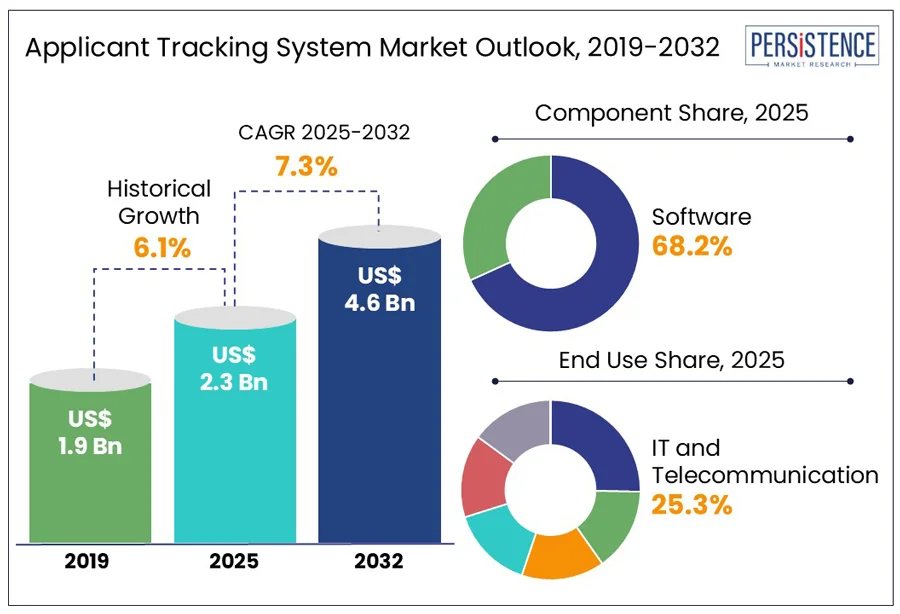
The global applicant tracking system market size is predicted to reach US$ 4.6 Bn in 2032 from US$ 2.3 Bn in 2025. It will likely witness a CAGR of around 7.3% in the forecast period between 2025 and 2032.
In a scenario where a single job posting attracts hundreds of resumes within hours, companies can no longer afford to rely on traditional hiring practices. Applicant Tracking System (ATS) has emerged as a significant tool that goes far beyond resume sorting and is considered the command center of modern recruitment. ATS platforms are likely to change the way companies hire, evaluate, and attract talent. The hunt for specialized skills across borders, increasing regulatory scrutiny, and boom of hybrid work are expected to create opportunities for ATS providers.
Key Industry Highlights
- Software is expected to generate approximately 68.2% share in 2025 amid rising demand for centralized recruitment systems for remote hiring practices.
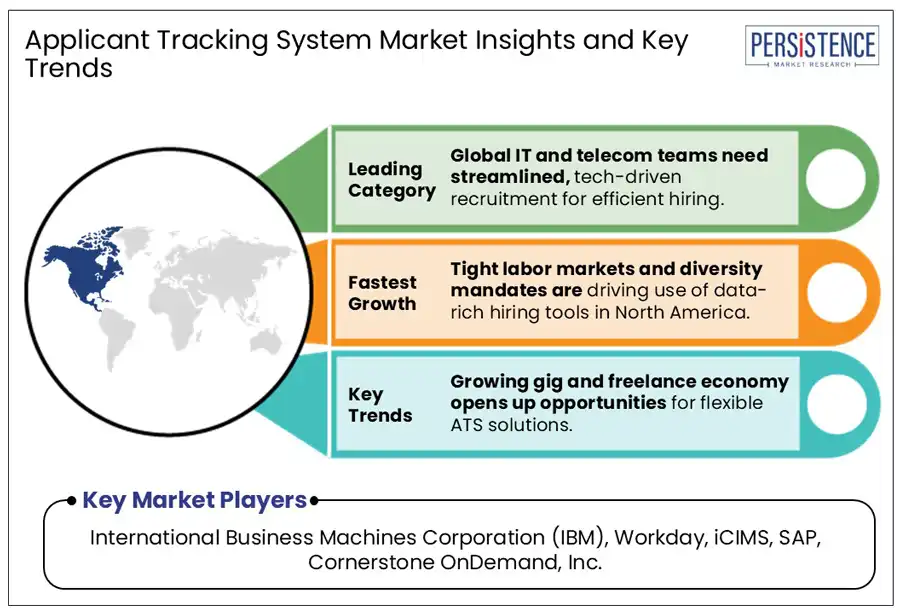
- IT and telecommunication is anticipated to hold nearly 25.3% share in 2025 due to increasing adoption of AI-integrated hiring platforms among digital-native firms.
- North America is predicted to hold around 41.2% share in 2025, backed by investments of start-ups in automation to tackle talent shortages.
- Rising demand for data-driven hiring is encouraging the use of AI-integrated ATS platforms.
- Key players are striving to expand their presence across emerging countries with a surging shift of businesses toward the cloud-based ATS market.
|
Global Market Attribute |
Key Insights |
|
Applicant Tracking System Market Size (2025E) |
US$ 2.3 Bn |
|
Market Value Forecast (2032F) |
US$ 4.6 Bn |
|
Projected Growth (CAGR 2025 to 2032) |
7.3% |
|
Historical Market Growth (CAGR 2019 to 2024) |
6.1% |
Market Dynamics
Driver - Remote hiring spurs integration of ATS with virtual assessment platforms
The rapid shift toward remote and hybrid work models is predicted to propel the applicant tracking system market growth through 2032, finds Persistence Market Research. Vendors are prioritizing global candidate engagement, asynchronous hiring workflows, and remote collaboration to enhance ATS functionalities. A significant example is the surging integration of ATS platforms with virtual assessment solutions and video interviewing tools. Platforms such as Workable now provide native integrations with Codility, Google Meet, and Zoom, allowing for fully remote hiring pipelines.
The shift has also augmented demand for decentralized evaluation and multi-time zone scheduling capabilities. Firms with distributed teams often require ATS solutions that enable hiring managers across regions to contribute to candidate evaluations at different times using shared feedback dashboards and structured scorecards. Recruitee, for instance, has responded by improving collaborative features such as anonymized feedback collection and live commenting on candidate profiles. These are specifically useful for remote teams striving to maintain hiring objectivity without physical meetings.
Restraint - Keyword bias in ATS creates challenges in recruitment strategies
The reliance of ATS on keyword-based filtering has increasingly come under scrutiny. This is because of inadvertently sidelining highly qualified candidates who miss creating their resumes to match specific job description jargon. This issue is specifically evident in industries where transferable skills and experience matter more than precise phrasing. A 2023 Harvard Business School report, for instance, showed that around 88% of employers admitted that their ATS filtered out qualified candidates due to rigid keyword algorithms.
It has raised critical questions about the role of ATS in modern recruitment strategies, mainly when systems fail to recognize the relevance of candidate experience beyond keyword match. This limitation is mainly visible in sectors where candidates come from diverse professional or educational backgrounds. For instance, a skilled software developer listing ‘object-oriented programming’ can be overlooked for a job requiring ‘OOP’ due to the lack of exact keyword match. Companies, including Amazon, have acknowledged similar issues and started developing proprietary internal ATS tools to emphasize contextual understanding over simple keyword scanning.
Opportunity - Mobile-first ATS platforms unlock hiring potential in emerging markets
The development of mobile-friendly ATS is projected to create new avenues by allowing companies to engage with talent more efficiently. In Brazil, Indonesia, and India, where a significant portion of the job-seeking population accesses the internet primarily through smartphones, mobile-optimized ATS platforms are becoming popular. Solutions, including Freshteam and Zoho Recruit, have witnessed rising adoption in these countries due to their real-time communication features, mobile resume parsing, and responsive design.
Mobile-friendly ATS platforms are further integrating features such as click-to-apply functions, WhatsApp communication, and SMS-based updates through social media channels. For example, GrabJobs, a Singapore-based mobile-centric ATS, has capitalized on this trend by providing an instant messaging-based interview scheduling system. It helps in reducing the time-to-hire for frontline roles. Similar platforms are expected to gain traction in customer service, logistics, and hospitality sectors, where simplicity and speed in recruitment determine hiring success.
Category-wise Analysis
Component Insights
In terms of component, the market is bifurcated into software and services. Among these, the applicant tracking software segment is poised to generate nearly 68.2% of share in 2025 due to the rapid adoption of digital hiring practices and the surging complexity of talent acquisition workflows. As companies adopt hybrid or remote work models, HR teams are turning to ATS platforms to optimize and scale their recruitment processes. Multinational companies such as Accenture and Siemens, for example, are leveraging enterprise-grade ATS software solutions to manage multilingual candidate engagement, local compliance, and cross-border hiring.
Services, on the other hand, are likely to exhibit a considerable CAGR from 2025 to 2032, amid the increasing complexity of integrating modern ATS tools into broad HR tech ecosystems. Various mid-sized companies without large in-house IT or HRIS teams are outsourcing this function to ensure smooth integration with existing tools such as background verification and payroll systems. For example, professional service providers, including Allegis Global Solutions and Randstad Sourceright, have reported high client demand for end-to-end ATS service bundles, including recruiter training and analytics configuration.
End Use Insights
Based on end use, the market is segregated into IT and telecommunication, BFSI, healthcare and life sciences, consumer goods and retail, and manufacturing. Out of these, the IT and telecommunication segment is expected to hold around 25.3% of the applicant tracking system market share in 2025 due to the sheer volume and speed of hiring required in this fast-paced industry. Companies in this industry frequently recruit for highly specialized roles and hence require scalable systems to handle the inflow of applications. Tata Consultancy Services and Infosys, for instance, have shifted toward AI-backed ATS tools to manage campus and lateral hiring programs at scale, where thousands of resumes are processed every day.
The BFSI sector is also experiencing high demand for ATS with CRM integration features because of the urgent requirement for compliance-driven, high-volume recruitment in a tightly regulated environment. Financial institutions are under constant pressure to ensure that hiring processes meet rigorous standards of auditability and transparency. Citibank, for instance, has adopted AI-embedded ATS tools to improve hiring for risk and compliance functions across its global offices. These help ensure that candidate screening and regulatory documentation are secure, thereby creating high demand.
Regional Insights
North America Applicant Tracking System Market Trends
North America will likely account for a share of approximately 41.2% in 2025, owing to technological innovations, regulatory demands, and evolving hiring practices. The U.S. applicant tracking system market is expected to outpace Canada due to the increasing integration of ATS platforms with AI-powered tools for candidate ranking, skill matching, and resume screening. Greenhouse, for example, recently improved its structured hiring framework by using generative AI features to reduce bias in the sourcing stage and automate job description creation.
iCIMS also collaborated with Microsoft to integrate ATS workflows into Microsoft Teams. This allowed recruiters to manage candidates without switching platforms, enhancing recruitment in hybrid work environments. Several companies in the U.S. are further including Diversity, Equity, and Inclusion (DEI) features in their ATS tools. For instance, Lever launched built-in analytics to track diversity hiring metrics across the recruitment funnel. It enables employers to take corrective action based on real-time data.
Europe Applicant Tracking System Market Trends
The market in Europe is mainly influenced by stringent data protection norms such as the General Data Protection Regulation (GDPR). These have propelled ATS providers to develop robust data privacy and consent management functionalities. London-based SmartRecruiters, for example, provides GDPR-specific compliance modules, including automated consent tracking and candidate data deletion. These have become important for companies operating across multiple countries in Europe, thereby augmenting vendors to prioritize regulatory adaptability.
The market is also expected to show a strong preference for multilingual and localized solutions. Local companies often demand ATS platforms that support country-specific hiring practices and multiple languages. It has resulted in the rise of regionally dominant vendors, including Talentsoft in France and Softgarden in Germany. These provide compliance with local labor laws and native-language interfaces, as well as cater to enterprise-level and mid-sized businesses that require region-specific customizations.
Asia Pacific Applicant Tracking System Market Trends
In Asia Pacific, increasing hiring activities in sectors, including BFSI, e-commerce, and IT, primarily across Australia and India, is projected to create new opportunities. The rapid growth of tech start-ups and global capability centers in India has led to the rising adoption of scalable and affordable integrated HR tech solutions such as Keka and Zoho Recruit. These platforms are immensely popular among mid-sized enterprises, backed by their integration with local job portals such as Naukri.
Australia and New Zealand represent a more mature segment of Asia Pacific’s market. Here, fair hiring practices and compliance with labor laws play a key role in vendor selection. Platforms, including LiveHire and JobAdder, both based in Australia, provide innovative features such as AI-driven candidate rediscovery and internal mobility tracking. These mainly focus on integration with government job boards such as SEEK and local payroll systems.
Competitive Landscape
The applicant tracking system market houses several well-established firms and emerging cloud-based start-ups. Leading companies are providing deeply integrated HR suites with ATS as a module to cater to large enterprises. Their dominance is, however, challenged by emerging companies delivering user-centric, AI-backed, and flexible platforms. These companies are focusing on attracting mid-sized enterprises by launching SaaS-based and modular solutions to enhance user experience.
Key Industry Developments
- In October 2024, Sapia.ai introduced a significant tool called Live Interview, designed to simplify interview scheduling for hourly hiring. It makes scheduling as intuitive as booking a restaurant, mainly benefiting store managers supervising hourly workers.
- In September 2024, Kula launched an all-in-one hiring platform that uses generative AI to assist recruiters in capturing, scheduling, screening, and sourcing interview feedback with prospective hires. With this launch, the company aims to alleviate all the pain points that recruiters have faced over the decades.
Companies Covered in Applicant Tracking System Market
- International Business Machines Corporation (IBM)
- Workday
- iCIMS
- SAP
- Cornerstone OnDemand, Inc.
- PeopleFluent
- ADP, Inc.
- UKG Inc.
- Bullhorn, Inc.
- Oracle
- BAMBOO HR LLC
- ITS Software Systems Ltd. (Eploy)
- JazzHR (Employ Inc.)
- Zoho Corporation Pvt. Ltd.
- Oorwin
- Ceipal Corp.
- Others
Frequently Asked Questions
The market is projected to reach US$ 2.3 Bn in 2025.
Increasing shift toward hybrid work models and rising integration of automation are the key market drivers.
The market is poised to witness a CAGR of 7.3% from 2025 to 2032.
Development of mobile-friendly ATS and increasing regulatory scrutiny are the key market opportunities.
International Business Machines Corporation (IBM), Workday, and iCIMS are a few key market players.


