




- Sporting Goods & Equipment
- Airsoft Gun Market
Airsoft Gun Market Size, Trends, Share, and Growth Forecast 2026 - 2033
Airsoft Gun Market by Product Type (Handgun, Rifle, Shotgun, Muzzle Loading, Others), Mechanism (Spring Powered, Electric Powered, Gas Powered), Price Range (Low (Below USD 100), Medium (USD 100 to 500), High (Above USD 500)), Distribution Channel (Online Sales, Offline Sales), and Regional Analysis, 2026 - 2033

Airsoft Gun Market Size and Trend Analysis
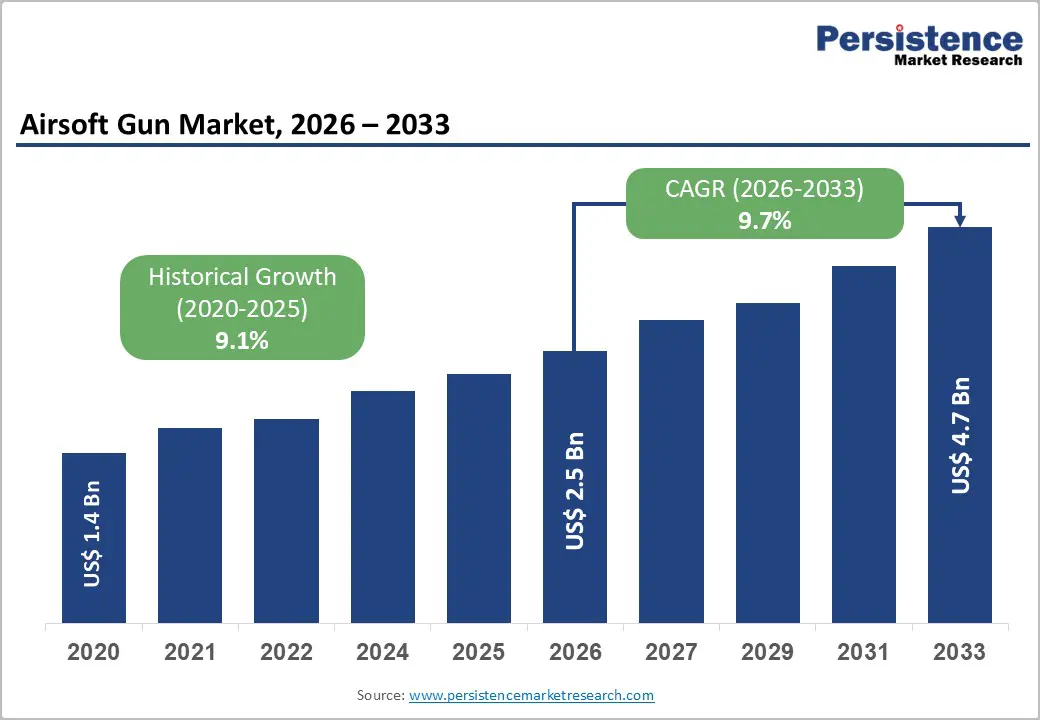
The global airsoft gun market size is likely to be valued at US$ 2.5 billion in 2026 and is expected to reach US$ 4.7 billion by 2033, growing at a CAGR of 9.7% during the forecast period from 2026 to 2033.
Increasing participation in organized shooting sports, rising consumer spending on outdoor recreation, and the proliferation of commercial airsoft arenas are accelerating demand for mid- to high-end replica weapons and accessories.
Key Industry Highlights:
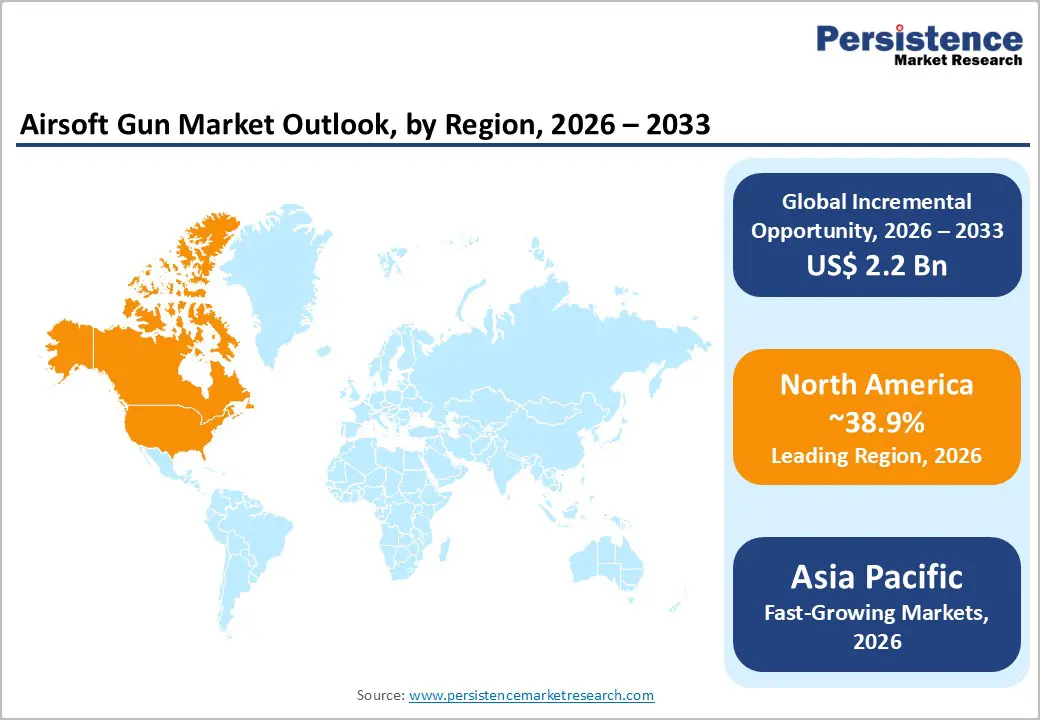
- Leading Region: North America is the leading regional market holding 38.9% share, supported by high participation in shooting and adventure sports, extensive commercial field networks, and strong brand presence from companies.
- Fastest-Growing Region: The Asia Pacific region is among the fastest-growing markets, leveraging its manufacturing base in Japan, Taiwan, and China, rising middle-class leisure spending, and the global influence of brands in premium airsoft segments.
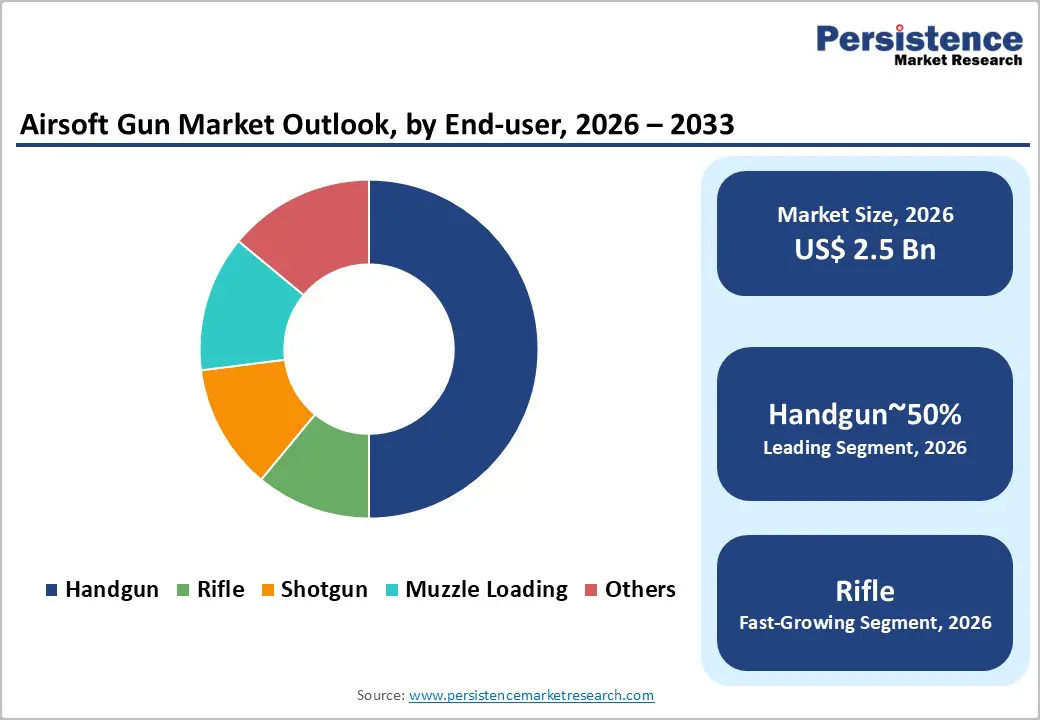
- Leading Segment: Among Product Types, Handgun replicas dominate unit volumes, capturing an estimated around 50% share due to their affordability, ease of use for beginners, and role as secondary sidearms for experienced players across both indoor and outdoor airsoft formats.
- Fastest-Growing Segment: By Mechanism and value, Electric Powered airsoft guns, particularly AEGs, represent the dominant and one of the fastest-growing segments, as players increasingly favor reliable, upgradable platforms that support both casual skirmishes and competitive league play worldwide.
- Key Opportunity lies in the expansion of organized leagues, mil-sim events, and eco-friendly product lines, where companies that combine high-performance replicas with biodegradable BBs, greener propellants, and enhanced safety features can capture premium positioning and recurring event-driven demand.
| Key Insights | Details |
|---|---|
| Airsoft Gun Market Size (2026E) | US$ 2.5 Billion |
| Market Value Forecast (2033F) | US$ 4.7 Billion |
| Projected Growth CAGR (2026 - 2033) | 9.7% |
| Historical Market Growth (2020 - 2025) | 9.1% |
Market Dynamics
Drivers - Growing Participation in Organized Adventure Sports Positions Airsoft as a Mainstream, Safe, and Repeat-Driven Recreational Activity
The increasing popularity of organized recreational activities and adventure sports is a major growth driver for the Airsoft Gun Market. Airsoft has gained traction as a social, skill-based leisure activity that appeals to a wide age group. In 2023, the Sports & Fitness Industry Association (SFIA) reported that a record 242 million people in the U.S. participated in at least one sport or fitness activity, highlighting a large consumer base open to emerging recreational formats such as airsoft skirmishes and military simulation (mil-sim) events.
This trend supports the rapid expansion of commercial airsoft fields and weekend scenario games across North America and Europe. Operators increasingly offer bundled packages that include rental guns, safety gear, and organized events to attract first-time players. As standardized safety rules, mandatory eye protection, and insured field operations become more common, airsoft is gaining recognition as a mainstream and family-friendly shooting sport, driving repeat participation and equipment upgrades.
Rising Use of Cost-Effective Airsoft Platforms for Military, Law-Enforcement, and Security Training Applications Worldwide
Institutional adoption of airsoft platforms for tactical training is another key factor driving market growth. Military units, law-enforcement agencies, and private security firms increasingly use airsoft guns for force-on-force and scenario-based training exercises. Electric and gas-powered airsoft replicas allow trainees to practice room clearing, hostage rescue, and crowd-control drills in realistic environments at a significantly lower cost than live-fire training.
These platforms provide safe yet effective feedback when used with marking BBs and protective equipment. Industry reports suggest that institutional use of airsoft-based training solutions grew by around 10% in 2024, reflecting a broader shift toward cost-efficient, short-range simulation tools. Acceptance by professional users encourages manufacturers to develop more durable, training-grade replicas and accessories. These innovations often extend into the civilian market, reinforcing demand for higher-value products among serious hobbyists and competitive players.
Market Restraints
Persistent Injury Risks and Safety Perceptions Limit Broader Adoption Among Parents, Institutions, and Youth-Focused Organizations
Despite being marketed as non-lethal, airsoft guns present safety concerns that limit broader market adoption. The risk of injury, particularly to the eyes and face, remains a key restraint for new participants. Medical data shows that airsoft and other projectile-based recreational activities contribute to serious eye injuries, including corneal abrasions and retinal damage. Several high-profile incidents involving players or bystanders, often due to inadequate protective gear or unsafe engagement distances, have heightened public concern.
As a result, some schools, municipalities, and insurance providers impose strict rules or discourage airsoft activities altogether. Even when safety risks are manageable through proper equipment and supervision, negative perceptions persist. This discourages parents, educational institutions, and youth organizations from supporting participation. The ongoing association with injury risk limits the expansion of the potential player base in certain regions, particularly where safety awareness and liability concerns are high.
Fragmented Global Regulations and Replica Weapon Laws Increase Compliance Costs and Create Market Access Challenges
Regulatory uncertainty remains a significant challenge for the global Airsoft Gun Market. Laws governing airsoft guns vary widely across countries and, in some cases, classify them similarly to firearms. Nations such as Singapore and Australia enforce strict controls or outright bans on private ownership of realistic airsoft replicas. In the United States, several cities and school districts have imposed restrictions following incidents where airsoft guns were mistaken for real firearms by law enforcement.
In 2024, the European Union introduced stricter import, safety, and marking requirements for airsoft guns, increasing compliance obligations for manufacturers and distributors. These regulatory differences raise operating costs, complicate cross-border e-commerce, and create uncertainty for retailers and field operators. Sudden policy changes can disrupt local markets, limit event operations, and reduce product availability, ultimately constraining market growth despite steady consumer interest.
Market Opportunities
Expansion of Structured Airsoft Leagues and Large-Scale Events Drives Equipment Demand and Experiential Revenue Streams
The professionalization of airsoft through structured leagues, national tournaments, and themed mil-sim events is emerging as a key opportunity for market participants. In Europe, countries such as the United Kingdom, Germany, and France have reported a strong rise in organized airsoft tournaments and weekend events, with major sites hosting hundreds of players and generating ancillary demand for travel, accommodation, and premium rental gear.
Organized communities, supported by national bodies such as the United Kingdom Airsoft Players Union (UKAPU) and specialized clubs, actively promote safety standards and engage with law enforcement to legitimize the hobby. As more international “airsoft festivals” and scenario-driven games are marketed via social media and online communities, vendors can develop event-exclusive product lines, sponsorship packages, and rental fleets, capturing higher margins and recurring revenue tied to the experiential airsoft ecosystem.
Advancements in Electric Airsoft Technology and Sustainable Consumables Create Differentiation Opportunities in Premium Segments
Technological advancement and sustainability-focused innovation represent a major opportunity for airsoft manufacturers. Demand is growing for high-performance Electric Powered airsoft guns, particularly programmable Automatic Electric Guns (AEGs) equipped with MOSFET controllers, adjustable trigger response, and integrated performance tracking. These features appeal to competitive players who prioritize consistency and customization. At the same time, environmental concerns and field-level regulations are accelerating adoption of biodegradable BBs and low-emission gas propellants to reduce plastic waste and environmental impact.
Manufacturers that invest in durable internal components, quick-change spring systems, and recyclable packaging can differentiate themselves in premium segments. Aligning product development with sustainability expectations also helps brands meet evolving regulatory standards. This combination of performance innovation and eco-friendly design is particularly important in mature markets such as Japan and Western Europe, where quality and compliance strongly influence purchasing decisions.
Category-wise Analysis
Product Type Insights
Within the Product Type segment, Handgun airsoft replicas account for an estimated 50% of global unit shipments, making them the most widely sold category. Handguns are especially popular among beginners and casual players due to their lower price points, compact size, and ease of use. They are well suited for indoor close-quarters battle (CQB) arenas where engagement distances are short. Retailers report strong demand for starter kits that bundle a pistol replica with protective eyewear and BBs, highlighting the importance of first-time and impulse purchases.
Experienced players frequently purchase handgun replicas as secondary sidearms, supporting repeat demand. Compared with rifles or shotguns, which are often larger and more expensive one-time investments, handguns benefit from broader accessibility and higher replacement rates. This combination of entry-level appeal and secondary usage reinforces the segment’s leading position.
Mechanism Insights
By Mechanism, electric-powered airsoft guns, particularly Automatic Electric Guns (AEGs), dominate the market, accounting for more than 50% of global revenue. AEGs are favored for their reliability, ease of maintenance, and consistent performance across different weather conditions. They offer flexible firing modes, making them suitable for both casual skirmishes and organized mil-sim events. Standardized gearbox designs have also created a strong aftermarket for upgrades, including motors, gears, and electronic controls.
In contrast, spring powered airsoft guns are mainly positioned as entry-level products or specialized sniper rifles, while gas powered models appeal to enthusiasts seeking realism but involve higher operating costs and temperature sensitivity. The extensive ecosystem surrounding electric platforms, including batteries, chargers, and internal upgrades, encourages ongoing spending beyond the initial purchase, supporting long-term revenue growth.
Price Range Insights
From a price range perspective, the medium segment, priced between USD 100 and 500, represents the largest share of market revenue, accounting for over 50% of total value. This range attracts players who move beyond basic entry-level products and seek better durability, performance, and customization options. Medium-priced airsoft guns typically feature reinforced receivers, metal gearboxes, and compatibility with aftermarket accessories used in competitive play.
While low-priced products under USD 100 drive high sales volumes among beginners, many of these buyers eventually upgrade to mid-range or premium models. High-end replicas priced above USD 500 cater to advanced players seeking superior accuracy and realism. The growing popularity of competitive leagues and mil-sim events continues to position the medium price band as the market’s core segment for both committed newcomers and experienced enthusiasts.
Distribution Channel Insights
By distribution channel, online sales have become the leading and fastest-growing segment, accounting for more than half of retail revenue in many markets. E-commerce platforms and specialized webstores offer wide product selections, competitive pricing, and access to niche brands and upgrade components that are rarely available in physical stores. Detailed product reviews and community feedback further influence online purchasing decisions.
Cross-border online sales are particularly important for enthusiasts in regions with limited domestic availability, although these transactions must comply with complex customs and replica-weapon regulations. Offline Sales remain important for first-time buyers who value hands-on inspection and safety guidance. However, the convenience, transparency, and extensive choice offered by online channels suggest that digital retail will continue to drive structural growth in the Airsoft Gun Market.
Regional Insights
North America Airsoft Gun Market Trends
North America remains the largest regional market, accounting for an estimated 38.9% of global revenue, driven primarily by the United States and Canada. High participation in shooting sports, a strong culture of tactical recreation, and a wide network of commercial airsoft fields support consistent demand. The region hosts numerous mil-sim events and organized weekend games, where clear rules and mandatory safety gear have helped position airsoft as a mainstream recreational activity. However, regulatory complexity persists, with certain states and cities enforcing strict marking requirements, age limits, or local restrictions. These measures often arise from incidents where airsoft guns were mistaken for real firearms. As a result, operators emphasize safety training, visible muzzle markings, and coordination with local authorities. Despite these challenges, strong consumer interest and the presence of established brands continue to anchor market growth.
Europe Airsoft Gun Market Trends
The European Airsoft Gun Market continues to grow as interest in outdoor recreation, scenario gaming, and historical re-enactments increases. Countries such as Germany, the U.K., France, and Spain lead regional demand, supported by well-established airsoft communities and dedicated playing fields. The United Kingdom stands out as a major hub, with large venues hosting weekly games and national events. While EU-level regulatory harmonization has improved, airsoft laws remain governed by national regulations covering muzzle energy, coloration, and ownership.
In the U.K., the Violent Crime Reduction Act (VCRA) allows realistic imitation firearms under specific conditions, supported by organizations such as the United Kingdom Airsoft Players Union (UKAPU). Stricter EU import and safety rules introduced in February 2024 have increased compliance requirements but also improved product quality and traceability, supporting consumer confidence in premium segments.
Asia Pacific Airsoft Gun Market Trends
Asia Pacific represents a fast-growing and strategically important region for the Airsoft Gun Market. The region combines strong manufacturing capabilities with influential enthusiast communities. Japan and Taiwan are home to leading manufacturers such as Tokyo Marui and G&G Armament Taiwan Ltd., whose products set global benchmarks for quality and performance. These companies benefit from advanced supply chains that support continuous innovation.
In China, domestic demand is limited by strict firearms regulations, but the country plays a major role as an export manufacturing hub. Japan’s strict domestic laws on muzzle energy have fostered a market focused on high-quality, compliant replicas. Across ASEAN countries, regulations vary widely, creating both opportunities and challenges. Over time, rising middle-class spending on leisure activities and strong regional brands are expected to drive growth in mid- and high-end segments.
Competitive Landscape
The global airsoft gun market is moderately fragmented, featuring a mix of global manufacturers and regional specialists competing across multiple price tiers and product categories. Key players include VALKEN Sports, Colt’s Manufacturing Company, ICS Airsoft, Crosman Corporation, Lancer Tactical, G&G Armament Taiwan Ltd., Tokyo Marui, Umarex, Vega Force Company, and others. Competition is driven by frequent product launches, licensing agreements for officially branded replicas, and expansion into direct-to-consumer e-commerce channels.
Many companies are also broadening their offerings to include accessories such as optics, tactical gear, and biodegradable ammunition. Emerging business models include subscription-based rental fleets for airsoft fields, customization and upgrade services, and training-focused product lines for law-enforcement and security clients. These strategies help companies differentiate their brands while capturing recurring revenue beyond traditional retail sales.
Key Market Developments:
- In March 2024, Umarex introduced a new range of airsoft replicas and accessories designed to meet updated EU import and safety requirements, featuring compliant markings, documentation, and packaging intended to support European retailers and reassure consumers about product legality and quality.
- In June 2024, Valken Sports, alongside other major North American brands, expanded sponsored league and tournament initiatives to strengthen community engagement, elevate large-scale event participation, and spotlight mid-to high-end gear, enhancing brand visibility and driving premium segment sales.
- In 2023, Tokyo Marui and other leading Japanese and Taiwanese producers rolled out enhanced Automatic Electric Guns with improved electronics, efficiency, and durability, specifically targeting competitive players who demand better performance and endurance during extended airsoft events.
Companies Covered in Airsoft Gun Market
- VALKEN Sports
- Colt’s Manufacturing Company, LLC
- ICS Airsoft, Inc.
- Crosman Corporation
- Lancer Tactical Inc.
- G&G Armament Taiwan Ltd.
- Ballistic Breakthru Gunnery Corporation
- A&K Airsoft
- Action Sport Games
- ARES Airsoft
- Tokyo Marui
- Umarex
- Vega Force Company (VFC)
- HFC
- Systema PTW
- APS Airgun Ltd
- Angry Gun
- Kriss USA
Frequently Asked Questions
The airsoft gun market is projected to reach around US$ 4.7 Billion by 2033, up from US$ 2.5 Billion in 2026, reflecting a forecast CAGR of 9.7% during 2026‑2033.
A key demand driver is the rising popularity of recreational airsoft sports and tactical events, supported by record levels of sports participation and the expansion of organized airsoft fields, leagues, and weekend mil‑sim events worldwide.
Handgun replicas form the leading product segment, accounting for an estimated around 50% of unit sales, driven by their affordability, ease of handling for beginners, and role as sidearms for experienced players.
North America leads the market, with an estimated share near 38.9%, thanks to strong participation in shooting sports, a dense network of fields and retailers, and established brands operating across the U.S. and Canada.
One of the most promising opportunities is the development of high‑performance, eco‑friendly airsoft platforms and biodegradable BBs, combined with organized leagues and large‑scale mil‑sim events that generate recurring demand for premium guns and accessories.
Key players include VALKEN Sports, Colt’s Manufacturing Company, LLC, ICS Airsoft, Inc., Crosman Corporation, Lancer Tactical Inc., G&G Armament Taiwan Ltd., A&K Airsoft, Tokyo Marui, Umarex, Vega Force Company (VFC), and several other specialized regional manufacturers.


