




- Aerospace & Defense
- Aircraft Window Frame Market
Aircraft Window Frame Market Size, Share, and Growth Forecast, 2026 - 2033
Aircraft Window Frame Market by Aircraft Type (Commercial Aircraft, Business Aircraft, Helicopter, Military Aircraft), Material Type (Metal Window Frame, Composite Window Frame), Product Type (Cockpit Windshield Frame, Cabin Window Frame), and Regional Analysis for 2026 - 2033

Aircraft Window Frame Market Share and Trends Analysis
The global aircraft window frame market size is likely to be valued at US$310.2 million in 2026, and is estimated to reach US$445.3 million by 2033, growing at a CAGR of 5.3% during the forecast period 2026 - 2033.
Rising commercial aircraft deliveries, expanding global fleets, and the steady shift toward lightweight, fuel-efficient airframe components are the key growth enablers. The market grew at a moderate pace in the historical period, as the aviation sector recovered from pandemic-led disruptions and supply chain constraints. However, the forecast period anticipates firmer growth as large order backlogs convert into deliveries and airlines invest in fleet modernization, cabin upgrades, and next-generation aircraft programs.
Key Industry Highlights
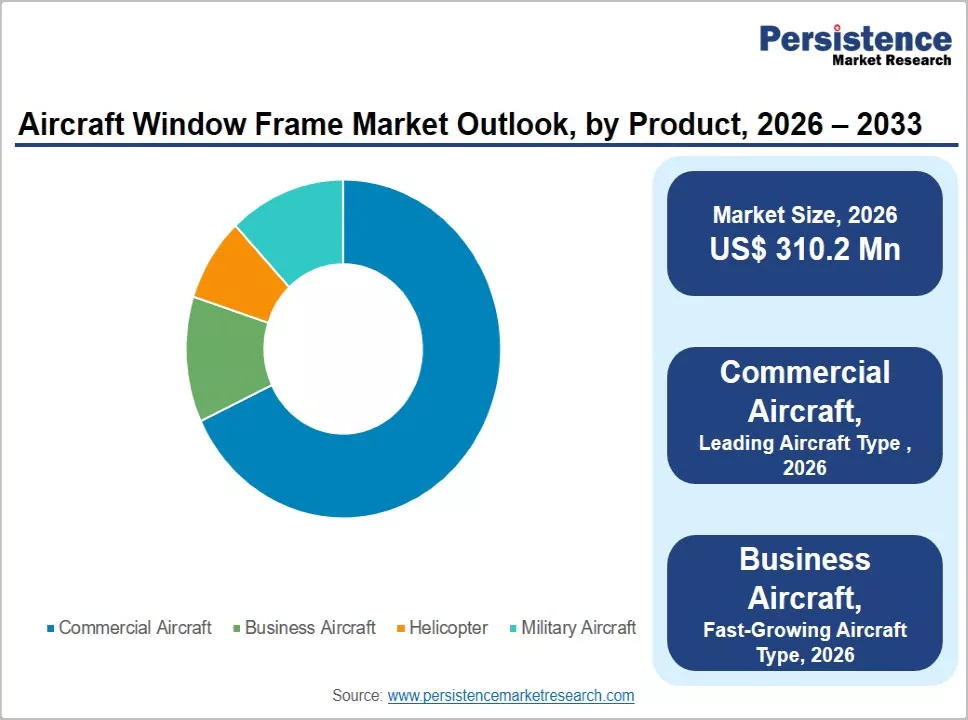
- Dominant Aircraft Type: Commercial aircraft are set to command around 62% of the revenue share in 2026, while business aircraft are likely to grow the fastest at about 6.1% CAGR through 2033, as demand for premium cabin experiences and larger windows rises.
- Leading Material Type: Metal window frames are expected to lead with 71% in 2026, while composite window frames are likely to be the fastest-growing at about 7.4% CAGR during 2026 - 2033, reflecting the industry's push for weight reduction and corrosion resistance.
- Dominant Product Type: Cabin window frames are anticipated to lead with an estimated 68% share in 2026, while cockpit windshield frames are slated to grow steadily at about 4.6% CAGR from 2026 to 2033, supported by new aircraft programs and retrofit activity.
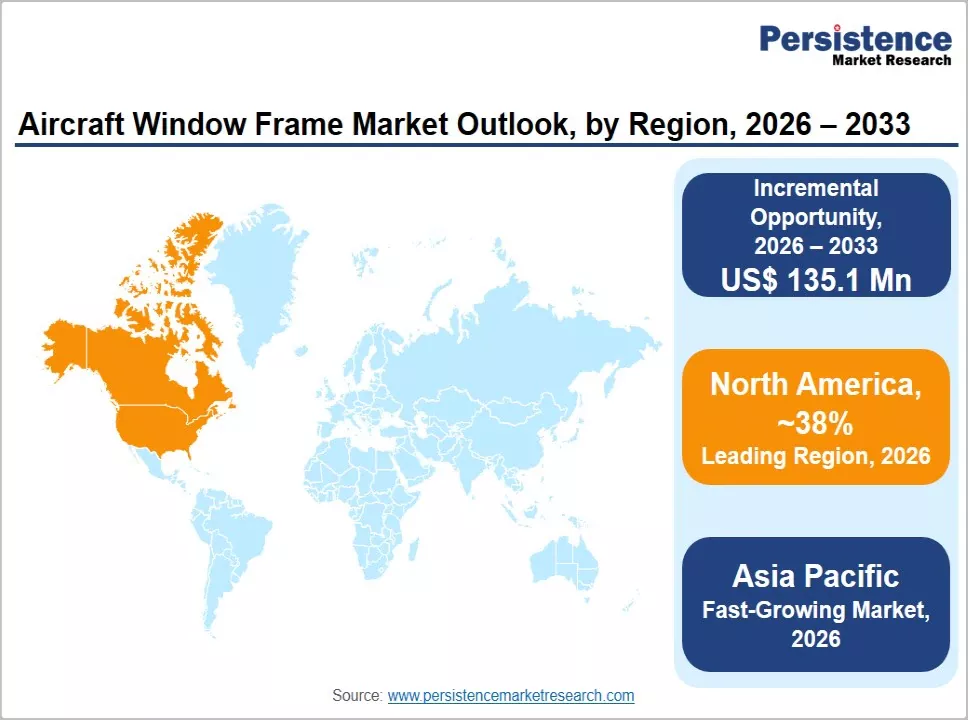
- Regional Leadership: North America is poised to dominate with an estimated 38% share in 2026, whereas Asia Pacific is expected to register the fastest growth at a 6.6% CAGR through 2033, led by fleet expansion in China, India, and Southeast Asian nations.
- Competitive Environment: Competitive dynamics include long-term supply agreements with aircraft manufacturers, investments in lightweight materials, and strategic acquisitions to broaden transparency and cabin interior portfolios.
- March 2026: Vertical Aerospace selected Isoclima as its strategic transparency partner for the Valo aircraft, highlighting growing demand for specialized windshield and window systems in next-generation electric aircraft programs.
DRO Analysis
Driver: Rising Aircraft Deliveries and Fleet Modernization as Primary Growth Catalyst
Growing aircraft production is the leading force driving the aircraft window frame market growth, as airlines and operators place large orders to meet rising passenger traffic and replace aging fleets. Every new aircraft requires a full set of cabin window frames and cockpit windshield frames, which directly links demand to build rates at major aircraft manufacturers. Order backlogs for narrow-body and wide-body programs stretch well into the next decade, providing suppliers with strong long-term visibility and encouraging capacity investments in machining, forming, and assembly lines.
Fleet modernization and cabin retrofit programs add a recurring aftermarket demand layer. Airlines are upgrading cabins to improve passenger comfort, adopting larger windows, and installing electronically dimmable window systems that require compatible frame designs. Business jet manufacturers are also introducing aircraft with expanded windows and premium finishes, further enhancing the value of each frame set. Together with replacement needs from wear, impact damage, and regulatory inspections, these factors ensure sustained growth in the aircraft window frame market in the coming years.
Restraints: Stringent Certification Requirements and Supply Chain Constraints
Aircraft window frames are safety-critical components that must withstand cabin pressurization cycles, bird strikes, temperature extremes, and vibration. Meeting the certification standards set by aviation authorities such as the Federal Aviation Administration and the European Union Aviation Safety Agency requires extensive testing, documentation, and traceability. These processes lengthen development cycles, raise entry barriers, and limit the speed at which new designs and materials can be introduced, particularly for smaller suppliers with limited engineering and testing resources.
Supply chain constraints have also affected the sector, with shortages of aerospace-grade aluminum, titanium, and specialty composites, as well as skilled labor, leading to delivery delays and cost pressures. Dependence on a limited number of qualified sub-tier suppliers increases vulnerability to disruptions, while volatile raw material prices and energy costs squeeze margins under fixed-price, long-term contracts. Aircraft manufacturers' production rate uncertainties can further affect order schedules, making capacity planning challenging for frame manufacturers.
Opportunities: Lightweight Composite Frames and Growth in Next-Generation Aircraft Programs
Composite window frames represent a significant opportunity, as aircraft makers seek to cut weight to improve fuel efficiency and reduce emissions. Carbon-fiber and advanced thermoplastic composites offer high strength-to-weight ratios and excellent fatigue and corrosion resistance, enabling the larger window designs favored in modern wide-body aircraft. As manufacturing processes such as automated layup and compression molding mature, costs are expected to decline, opening broader adoption across narrow-body and regional aircraft platforms and creating differentiation for suppliers with proven composite capabilities.
Emerging aircraft categories, including advanced air mobility vehicles, electric vertical takeoff and landing aircraft, and new supersonic and regional programs, are creating fresh demand for specialized transparencies and frames. Rising defense spending and helicopter fleet renewals in Asia Pacific, the Middle East, and Europe add further opportunities. Partnerships between frame manufacturers, transparency specialists, and electrochromic window technology providers are expected to open integrated, higher-value offerings through 2033.
Category-wise Analysis
Aircraft Type Insights
Commercial aircraft are the leading aircraft type segment, expected to hold about 62% of the aircraft window frame market revenue share in 2026. Large production volumes of single-aisle and twin-aisle aircraft, each requiring numerous passenger windows and a cockpit windshield set, make this segment the primary demand driver. Long-term production programs offer stable, predictable orders, while rising passenger traffic in Asia Pacific and the Middle East keeps delivery schedules full. Airlines' retrofit programs for cabin refreshes provide an additional steady source of replacement frames.
Business aircraft are likely to grow the fastest through 2033, at an approximate 6.1% CAGR. Demand is supported by high-net-worth individuals, corporate fleet expansion, and the introduction of new long-range models with larger, more sophisticated windows. Business jet buyers place high value on cabin ambiance, noise reduction, and views, which encourages advanced frame designs and higher-value materials. Helicopter and military aircraft segments remain stable, supported by fleet renewal, search-and-rescue needs, and defense modernization programs, though growth is paced by procurement cycles and budgets.
Material Type Insights
Metal window frames dominate the material type segment, projected to capture about 71% of the revenue share in 2026. Aluminum and titanium alloys remain widely used because of their proven strength, machinability, repairability, and long history of regulatory acceptance. Metal frames are well-suited to the high-stress environment around cockpit windshields, where structural integrity and bird-strike resistance are critical. Established supply chains and design familiarity make metal frames the default choice on many in-production aircraft programs.
Composite window frames represent the fastest-growing material type segment, anticipated to achieve about 7.4% CAGR during the 2026 - 2033 period. Composites reduce weight, resist corrosion, and permit complex shapes and integrated attachment features, which improve fuel efficiency and reduce maintenance. Newer aircraft platforms increasingly use composite airframes, making composite frames a natural fit for coefficient-of-thermal-expansion compatibility. Although certification and higher tooling costs remain challenges, growing production experience and automation are improving cost competitiveness.
Product Type Insights
Cabin window frames are poised to lead the product type segment with an estimated 68% share in 2026, reflecting the large number of passenger windows installed per aircraft. Cabin frames must balance structural load transfer, sealing, noise insulation, and aesthetics, and increasingly integrate interfaces for dimmable window systems and inner pane assemblies. Airlines' focus on passenger experience, including larger windows and improved sightlines, supports value growth, while retrofit activity helps sustain replacement demand over the life of the aircraft.
Cockpit windshield frames are expected to expand at around 4.6% CAGR through 2033. These frames are highly specialized, engineered to hold multilayer windshields that resist bird strikes, de-icing loads, and pressure differentials. Fewer units per aircraft keep volumes lower than cabin frames, but unit values are considerably higher because of stringent performance requirements and extensive qualification. Growth is anchored in new aircraft deliveries, military platform upgrades, and periodic windshield replacement in service fleets.
Regional Insights
North America Aircraft Window Frame Market Trends
North America is predicted to command an estimated 38% of the aircraft window frame market share in 2026. The U.S. provides the regional growth anchor, supported by the presence of major aircraft manufacturers, a deep tier-one and tier-two supplier network, and a large business aviation and defense sector. High production rates for narrow-body and wide-body programs, along with strong fleet retrofit activity, sustain demand for both cabin and cockpit frames. Federal defense procurement of rotary and fixed-wing aircraft provides additional steady volumes for military applications.
Canada's aerospace sector, centered in Quebec and Ontario, contributes through business jet and regional aircraft production and a competitive supplier base. The North America market is characterized by long-term supply contracts, consolidation among suppliers, and a strong emphasis on lightweight materials and advanced manufacturing.
Europe Aircraft Window Frame Market Trends
Europe is likely to hold 27% of the global market share in 2026. The region benefits from the presence of leading aircraft manufacturers and a strong network of aerostructure and transparency suppliers across France, Germany, the United Kingdom, Italy, and Spain. Policy emphasis on sustainable aviation and emissions reduction encourages the adoption of lightweight materials and advanced composite structures. The region also hosts a vibrant business jet, helicopter, and defense industry that provides diversified demand for window frame solutions.
The Europe market is characterized by strong engineering expertise, close collaboration between aircraft manufacturers and suppliers, and active research programs on next-generation aircraft concepts. Defense spending increases in response to regional security concerns are also supporting helicopter and military aircraft production. Eastern European countries, including Poland and the Czech Republic, are gaining relevance as cost-competitive manufacturing locations for machining and subassembly operations.
Asia Pacific Aircraft Window Frame Market Trends
Asia Pacific is anticipated to be the fastest-growing region in the aircraft window frame market, commanding an estimated 22% in 2026 and projected to achieve a 6.6% CAGR through 2033. China is advancing its domestic commercial aircraft programs and expanding local supply chains for airframe components, while rising passenger traffic is driving large aircraft orders from Chinese carriers. Japan and South Korea contribute through advanced materials expertise and participation in global aerostructure programs.
India is expected to offer particularly dynamic growth opportunities, with rapid airline fleet expansion, large aircraft order commitments, and government efforts to build domestic aerospace manufacturing and maintenance capabilities. Southeast Asia is also experiencing growth as low-cost carriers expand fleets and maintenance, repair, and overhaul facilities develop. The region attracts increasing investments from global suppliers establishing local production and assembly to serve both regional and international programs.
Competitive Landscape
The global aircraft window frame market structure is moderately consolidated, with leading suppliers, including PPG Industries, Gentex Corporation, Saint-Gobain, and GKN Aerospace, controlling a significant portion of the revenue. These established players leverage long-standing relationships with aircraft manufacturers, extensive certification experience, and integrated capabilities across transparencies, frames, and cabin window systems. Heavy investment in materials research and manufacturing automation helps them preserve technological leadership.
Meanwhile, specialized and regional competitors such as Lee Aerospace, Nordam, Sierracin, and Isoclima are focusing on niche aircraft categories, aftermarket supply, and specific geographies. Barriers such as certification requirements, long qualification cycles, and capital-intensive tooling limit new entrants. Market consolidation is expected to increase gradually, as larger suppliers acquire specialist firms to expand product portfolios and secure positions on new aircraft programs, while collaborations on dimmable and smart window technologies continue to grow.
Key Industry Developments:
- In March 2026, Vertical Aerospace selected Isoclima as its strategic transparency partner for the Valo aircraft. The collaboration highlights rising demand for certified windshield and window solutions in electric and advanced air mobility platforms. The selection illustrates how emerging aircraft categories are broadening the customer base for specialized window and windshield suppliers.
Companies Covered in Aircraft Window Frame Market
- PPG Industries, Inc.
- Gentex Corporation
- Saint-Gobain S.A.
- GKN Aerospace (Melrose Industries PLC)
- Lee Aerospace (Llamas Plastics)
- The NORDAM Group LLC
- Sierracin Corporation (TransDigm Group)
- Isoclima S.p.A.
- Collins Aerospace (RTX Corporation)
- Diehl Aviation
- Triumph Group, Inc.
Frequently Asked Questions
The global aircraft window frame market is projected to reach US$310.2 million in 2026.
Rising aircraft deliveries, fleet modernization and cabin retrofit programs, and the shift toward lightweight and corrosion-resistant materials are driving the market.
The market is poised to witness a CAGR of 5.3% from 2026 to 2033.
Adoption of lightweight composite frames, growth of next-generation and advanced air mobility aircraft programs, and increasing defense and helicopter fleet renewals are key market opportunities.
PPG Industries, Inc., Gentex Corporation, Saint-Gobain S.A., GKN Aerospace, and Lee Aerospace are some of the key players in the market.


