




- Aerospace & Defense
- Aircraft Evacuation Systems Market
Aircraft Evacuation Systems Market Size, Share, and Growth Forecast, 2026 - 2033
Aircraft Evacuation Systems Market by Product (Life Vest, Ejection Seat, Escape Slide, Inflatable Flotation, and Evacuation Raft), Distribution Channel (OEM and Aftermarket), and Regional Analysis for 2026 - 2033

Aircraft Evacuation Systems Market Share and Trends Analysis
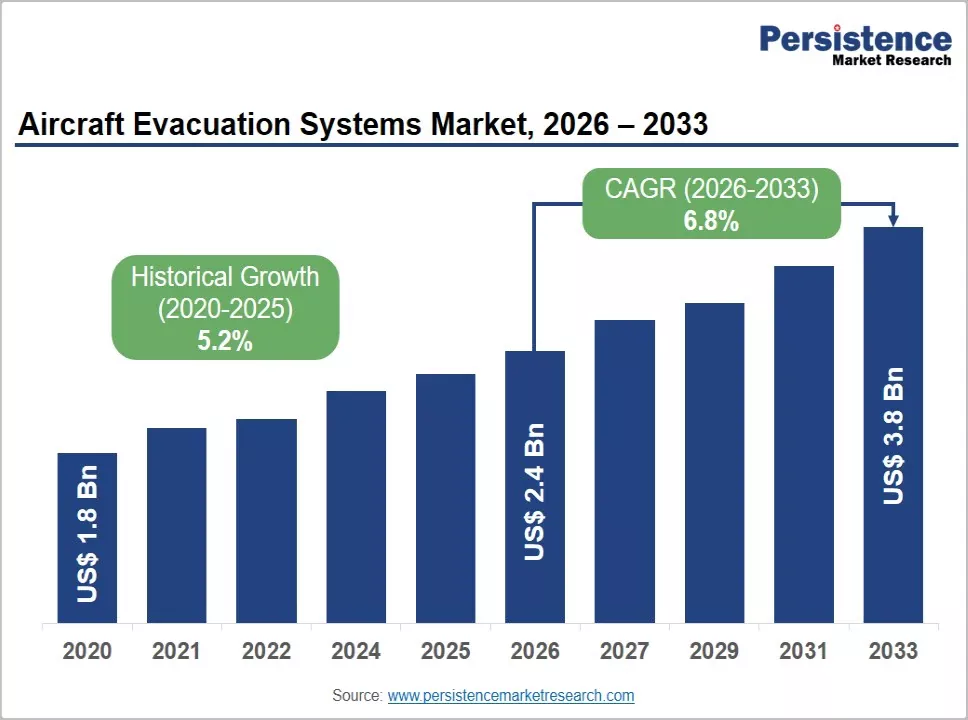
The global aircraft evacuation systems market size is likely to be valued at US$2.4 billion in 2026, and is estimated to reach US$3.8 billion by 2033, growing at a CAGR of 6.8% during the forecast period 2026 - 2033, driven by rising aircraft deliveries, strict passenger and crew safety regulations, expanding military aircraft modernization, and increasing demand for lightweight, reliable emergency equipment are the primary growth enablers.
The market grew at a steady pace in the historical period, supported by the recovery of air travel and fleet renewal programs. However, the forecast period anticipates firmer acceleration as airlines expand fleets, defense budgets rise, and regulators continue to emphasize survivability and certification of evacuation equipment.
Key Industry Highlights
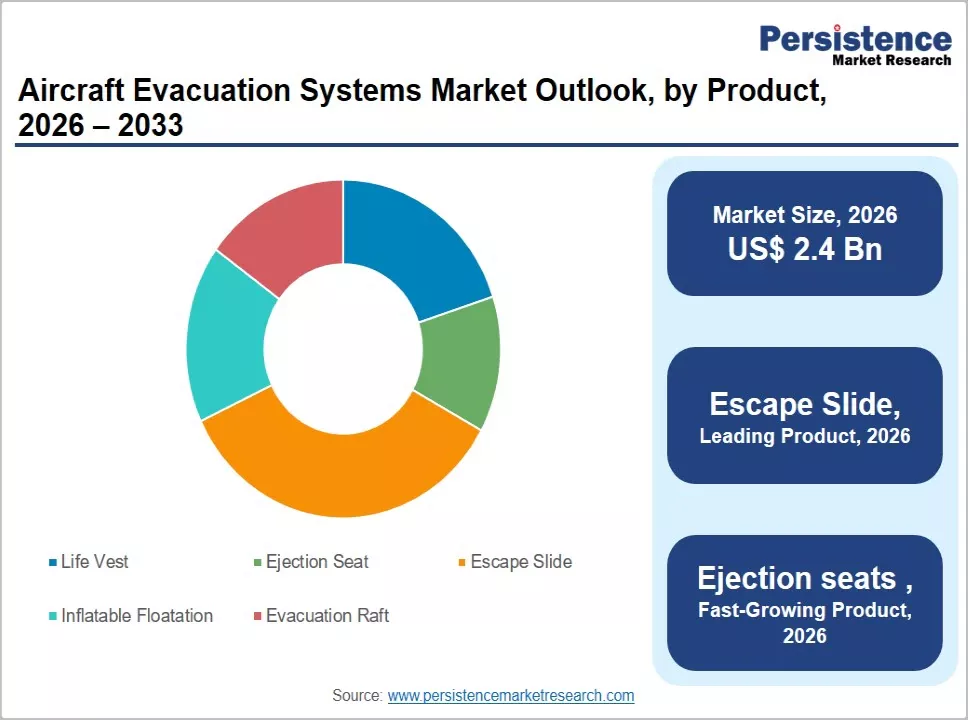
- Dominant Products: Escape slides are set to command around 36% of the revenue share in 2026, while ejection seats are likely to grow the fastest at about 7.9% CAGR through 2033, as combat aircraft and advanced trainer procurement programs expand worldwide.
- Leading Distribution Channel: OEMs are expected to lead with 58% in 2026, while the aftermarket is likely to be the fastest-growing channel at about 7.4% CAGR during 2026 - 2033, reflecting mandatory inspection, repair, and replacement cycles across expanding global fleets.
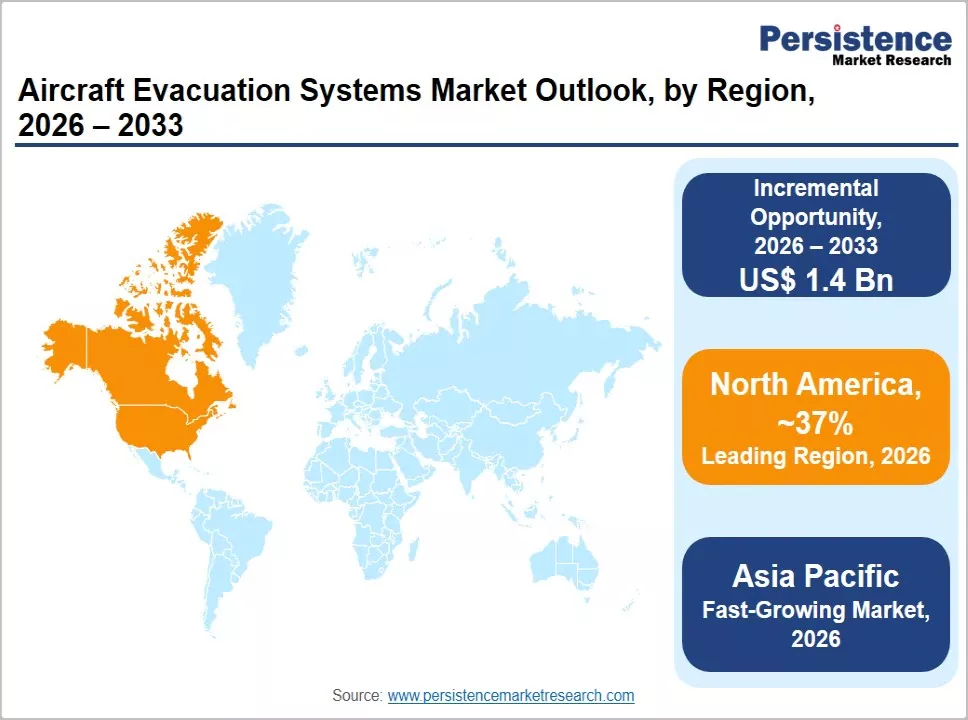
- Regional Leadership: North America is poised to dominate with an estimated 37% share in 2026, while Asia Pacific is expected to register the fastest growth at 8.1% CAGR through 2033, led by fleet expansion in China, India, and Southeast Asian nations.
- Technology Trends: Lightweight fabrics, composite materials, and improved inflation systems are reducing weight and packing volume while improving deployment reliability, in line with airlines' fuel-efficiency goals.
- Competitive Environment: Competitive dynamics include long-term supply contracts with aircraft manufacturers, investments in lightweight evacuation equipment, and strategic expansion of aftermarket service networks.
DRO Analysis
Driver: Rising Aircraft Production and Stringent Safety Regulations as Primary Growth Catalyst
Rising aircraft production is the leading force driving the aircraft evacuation systems market growth, as airlines and lessors place large orders to expand fleets and replace aging aircraft. Every commercial aircraft is required to carry certified emergency equipment, including escape slides at exits, life vests for each occupant, and evacuation rafts for extended overwater operations. Large order backlogs for narrow-body and wide-body aircraft therefore translate directly into steady demand for evacuation systems from original equipment manufacturers, with long-term contracts providing strong visibility for suppliers.
Stringent safety regulations reinforce this demand. Aviation authorities require evacuation of a fully loaded aircraft within ninety seconds under defined conditions, and evacuation equipment must undergo extensive testing, certification, and periodic inspection. Regulators also mandate regular servicing and replacement of components such as inflation bottles, fabrics, and life vests. Growing passenger traffic, higher safety expectations, and increasing scrutiny of accidents and incidents encourage airlines to maintain and upgrade evacuation systems, creating continuous demand for both new equipment and aftermarket support.
Restraints: High Certification Costs and Weight and Maintenance Considerations
High certification and development costs have become a major challenge for the aircraft evacuation systems market. Evacuation slides, rafts, and ejection seats are life-critical products that must meet rigorous standards set by aviation authorities and defense agencies. Testing programs including deployment trials, environmental exposure, and reliability demonstrations require significant time and capital, limiting innovation speed and raising barriers for smaller suppliers. Customization for each aircraft type and exit configuration further adds engineering complexity and cost.
Weight and maintenance considerations also constrain the market. Airlines seek to minimize onboard weight to reduce fuel consumption, putting pressure on suppliers to develop lighter systems without compromising reliability. Evacuation equipment requires periodic inspection, repacking, and replacement of time-limited components, creating operational and cost burdens for airlines and maintenance providers. Supply chain disruptions affecting specialty fabrics, pyrotechnic components, and inflation systems can delay deliveries, while cyclical aircraft production and defense budget uncertainties add demand variability.
Opportunities: Fleet Expansion in Emerging Markets and Defense Aircraft Modernization
Fleet expansion in emerging markets provides a significant opportunity, as airlines in Asia Pacific, the Middle East, and Africa add aircraft to serve rapidly growing passenger demand. New aircraft deliveries and new airline start-ups require full sets of evacuation equipment, while expanding maintenance, repair, and overhaul capabilities in these regions create demand for aftermarket services. Suppliers that establish local service centers and training programs can capture recurring revenue from inspection, repair, and replacement activities, strengthening long-term customer relationships.
Defense aircraft modernization offers additional growth potential. Governments are investing in advanced fighter jets, trainers, and helicopters, each requiring modern ejection seats, life support, and survival equipment. Upgrades to existing fleets, including seat replacements with improved safety performance across a wider range of pilot sizes, also provide demand. Technological advances in lighter materials, smart inflation systems, and condition monitoring are expected to create differentiated, higher-value products and open new opportunities across commercial, business, and military aviation through 2033.
Category-wise Analysis
Product Insights
Escape slides are the leading product segment, expected to hold about 36% of the aircraft evacuation systems market revenue share in 2026. They are mandatory at passenger exits on most commercial aircraft and are often combined with raft capability for overwater operations. Each aircraft requires multiple slides, and periodic servicing and replacement provide sustained aftermarket demand. Suppliers are focusing on lighter fabrics, faster and more reliable inflation, and improved performance in wind and uneven terrain, which supports technology-driven upgrades by airlines.
Ejection seats are likely to grow the fastest through 2033, at an approximate 7.9% CAGR. Demand is driven by procurement of advanced fighter aircraft and trainers, as well as upgrades of existing fleets with modern seats offering wider pilot accommodation and enhanced safety at low altitude and speed. These seats are high-value, technologically complex products with long service lives and extensive support requirements. Life vests, inflatable flotation devices, and evacuation rafts remain important for commercial, business, and military operations, with demand supported by regulatory carriage requirements and regular replacement cycles.
Distribution Channel Insights
The OEM channel dominates the distribution channel segment, projected to capture about 58% of the revenue share in 2026. Evacuation systems are specified and integrated during aircraft design and manufacturing, and suppliers are typically selected through long-term contracts with aircraft manufacturers. Production rates for narrow-body and wide-body programs, as well as business jets and military platforms, drive volumes. Supplier relationships are sticky because of extensive qualification and integration requirements, giving established players a durable position in new aircraft programs.
The aftermarket is the fastest-growing distribution channel, anticipated to achieve about 7.4% CAGR during the 2026 - 2033 period. As global fleets expand and age, demand for inspection, repacking, repair, and replacement of slides, rafts, life vests, and seats rises. Regulatory requirements for periodic overhaul provide predictable, recurring revenue for suppliers and authorized service centers. Airlines and maintenance providers prefer reliable turnaround times and service support, encouraging suppliers to expand regional service networks and offer long-term maintenance agreements.
Technology and Product Innovation Insights
Technological innovation is a key differentiator across all product categories. Manufacturers are using advanced coated fabrics, high-strength lightweight yarns, and improved seam technologies to reduce slide and raft weight and volume while maintaining durability. Inflation systems are being refined to deliver faster, more reliable deployment under varied temperatures, and some suppliers are exploring electronic monitoring to track component status and simplify maintenance. These advances help airlines cut fuel burn and inspection time without compromising safety.
In life vests and inflatable flotation, improvements focus on comfort, fit, and ease of donning, as well as improved lighting and locator devices. Ejection seat developments emphasize broader weight and size accommodation, advanced sequencing and stabilization, and compatibility with modern helmet-mounted displays and protective equipment. Collaboration between aircraft manufacturers, suppliers, and regulators continues to refine standards, and suppliers with strong testing capabilities and certification experience are well placed to introduce new solutions efficiently.
Regional Insights
North America Aircraft Evacuation Systems Market Trends
North America is predicted to command an estimated 37% of the aircraft evacuation systems market share in 2026. The U.S. provides the regional growth anchor, supported by major aircraft manufacturers, a large commercial airline fleet, and the world's largest defense aviation sector. High production rates for commercial and military aircraft, along with robust aftermarket demand from large carriers and maintenance providers, sustain demand for slides, rafts, life vests, and ejection seats. Federal aviation safety requirements and defense procurement programs support continuous investment in modern evacuation equipment.
Canada's aerospace sector contributes through regional aircraft, business jets, and a strong maintenance base. The North America market is characterized by long-term supply contracts, strong technical expertise, close cooperation between suppliers and aircraft manufacturers, and a growing emphasis on lightweight and digitally monitored safety equipment.
Europe Aircraft Evacuation Systems Market Trends
Europe is likely to hold 28% of the global market share in 2026. The region has leading aircraft manufacturers, specialized safety equipment suppliers, and a strong defense aviation industry. France, the United Kingdom, Germany, and Italy host major suppliers of slides, ejection seats, and survival equipment. European aviation safety regulations and strong airline safety culture support consistent demand for high-quality evacuation equipment and regular aftermarket servicing across large commercial and regional fleets.
The Europe market is characterized by technical leadership in ejection seat and escape slide technology, collaborative defense programs, and growth in military aircraft modernization in response to regional security concerns. Increasing defense budgets across several European nations support demand for advanced aircrew survival systems. Eastern European countries, including Poland and Romania, are modernizing their air fleets, creating emerging opportunities for suppliers and maintenance partners.
Asia Pacific Aircraft Evacuation Systems Market Trends
Asia Pacific is anticipated to be the fastest-growing region in the aircraft evacuation systems market, accounting for an estimated 23% in 2026 and projected to achieve an 8.1% CAGR through 2033. China is expanding commercial aircraft deliveries, developing domestic aircraft programs, and modernizing its military aviation fleet, driving demand for slides, rafts, life vests, and ejection seats. Japan and South Korea contribute through established aerospace industries and defense procurement, as well as advanced manufacturing capabilities.
India is expected to offer particularly dynamic growth opportunities, as domestic airlines place record aircraft orders, defense aviation programs expand, and local maintenance, repair, and overhaul capacity grows. Southeast Asian nations are expanding fleets as low-cost carriers grow and air travel demand rises. The region attracts increasing investments from global suppliers establishing local service centers, partnerships, and training facilities to support fast-growing fleets and aftermarket requirements.
Competitive Landscape
The global aircraft evacuation systems market structure is moderately consolidated, with top suppliers, including Safran Aerosystems, Collins Aerospace, Martin-Baker, and Survitec Group, controlling over half of the revenue share. These established players leverage extensive certification experience, long-standing relationships with aircraft manufacturers and air forces, global service networks, and integrated product portfolios. They invest consistently in lightweight materials, reliability improvements, and testing capabilities to maintain technological leadership.
Meanwhile, specialized and regional competitors such as Switlik Parachute Company, Zvezda, and other safety equipment manufacturers are focusing on niche products, specific customer groups, and geographic strongholds. High certification barriers, safety liability, and long qualification cycles limit new entrants. Market consolidation is expected to increase gradually, as larger aerospace groups acquire specialist firms to expand portfolios, strengthen aftermarket capabilities, and secure positions on new commercial and military aircraft programs.
Key Industry Developments:
- In May 2026, EASA issued SIB 2026-07 Revision 2 concerning the replacement of evacuation slide and inflation hose assemblies on Airbus A318, A319, and A320 aircraft. The bulletin became effective on May 11, 2026, supporting continued aftermarket demand for evacuation slides, inflation components, inspection, and replacement services.
- In July 2026, the FAA allowed Boeing to resume issuing airworthiness certificates for new 737 MAX and 787 aircraft from July 20, 2026, following an extended production-quality review. The decision supports normalization of aircraft deliveries and provides a positive demand environment for factory-installed cabin safety equipment, including evacuation slides and related systems.
Companies Covered in Aircraft Evacuation Systems Market
- Safran Aerosystems (Safran S.A.)
- Collins Aerospace (RTX Corporation)
- Martin-Baker Aircraft Company Limited
- Survitec Group Limited
- Switlik Parachute Company, Inc.
- Zvezda JSC
- Aviation Industry Corporation of China (AVIC)
Frequently Asked Questions
The global aircraft evacuation systems market is projected to reach US$ 2.4 billion in 2026.
Rising aircraft production, stringent safety and certification regulations, and growing military aircraft modernization programs are driving the market.
The market is poised to witness a CAGR of 6.8% from 2026 to 2033.
Fleet expansion in emerging markets, defense aircraft modernization, and development of lightweight and digitally monitored evacuation equipment are key market opportunities.
Safran Aerosystems, Collins Aerospace, Martin-Baker Aircraft Company Limited, Survitec Group Limited, and Switlik Parachute Company, Inc. are some of the key players in the market.


