




- Specialty & Fine Chemicals
- 2-Butanol Market
2-Butanol Market Size, Share, and Growth Forecast, 2025 - 2032
2-Butanol market by Grade Type (Industrial Grade, Reagent Grade, Others), Application (Solvents, Fuel Additives, Others), End-user (Chemical Industry, Pharmaceutical Industry, Others), and Regional Analysis for 2025 – 2032

2-Butanol Market Size and Trends Analysis
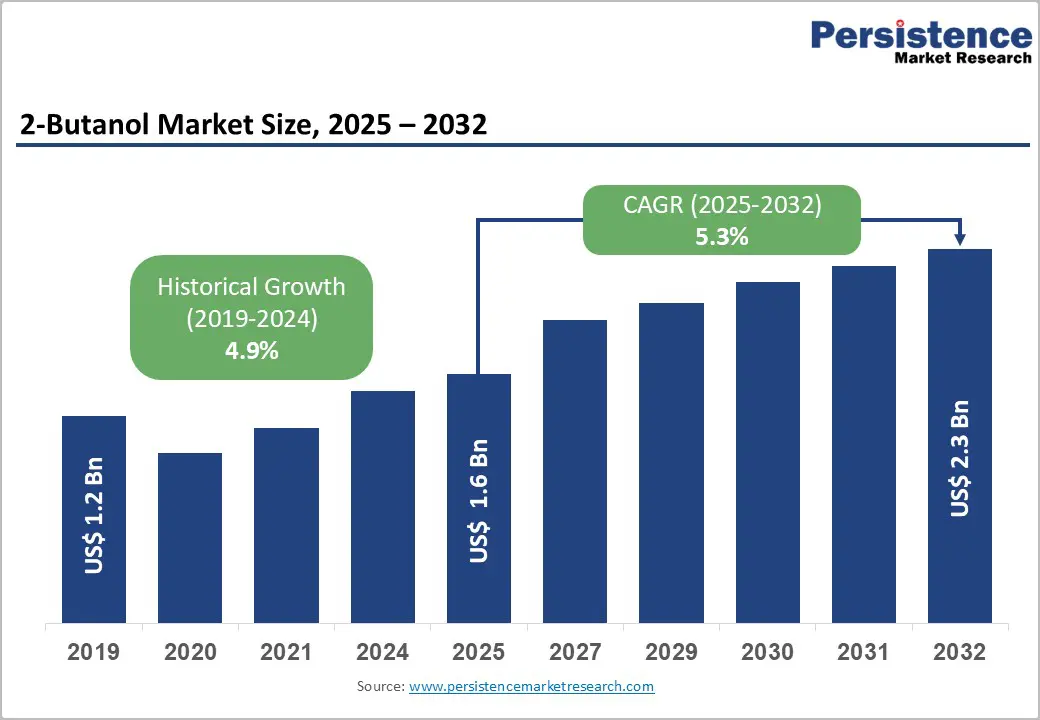
The global 2-butanol market size is likely to be valued at US$1.6 billion in 2025, and is expected to reach US$2.3 billion by 2032, growing at a CAGR of 5.3% during the forecast period from 2025 to 2032, driven by the increasing prevalence of solvent applications in pharmaceuticals, rising demand for fuel additives in automotive, and advancements in chemical synthesis.
The demand for efficient extraction agents and plasticizers, especially in the food and beverage sector, has significantly driven the adoption of 2-butanol across multiple industries. Market growth is further supported by advancements in industrial and pharmaceutical-grade 2-butanol, meeting the increasing need for high-purity and versatile products. The rising use of 2-butanol as a key intermediate in cosmetics, particularly in the Asia Pacific region, is also emerging as a major growth driver for the market.
Key Industry Highlights:
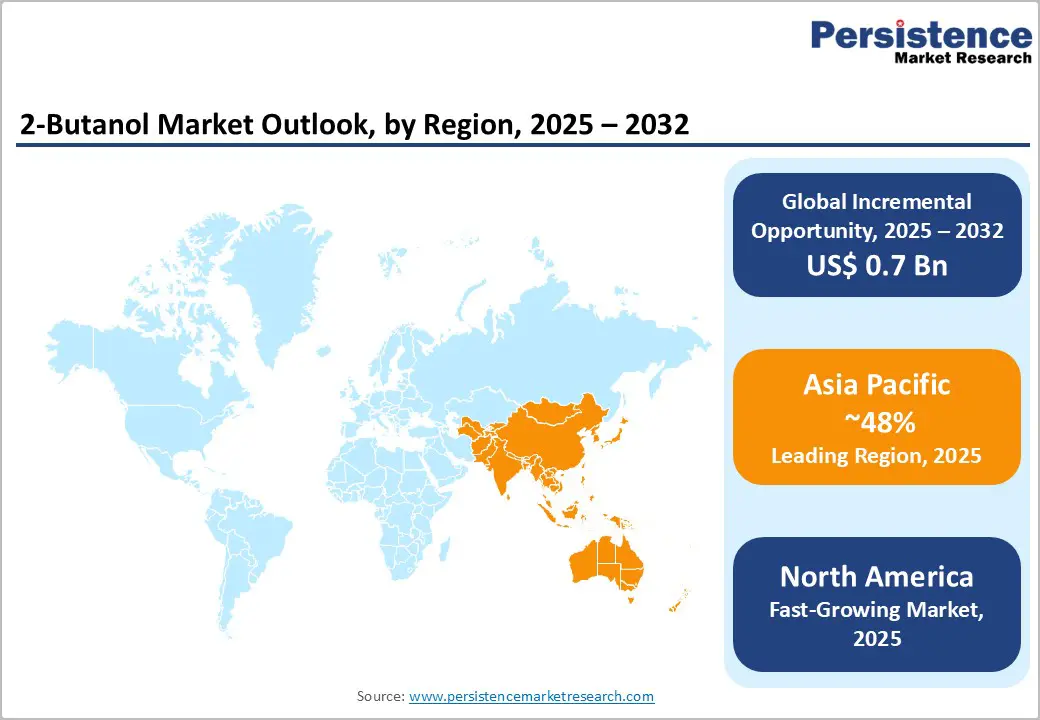
- Leading Region: Asia Pacific, commanding a 48% market share in 2025, driven by massive chemical production, high prevalence of automotive fuels, and strong R&D activities in China.
- Fastest-growing Region: North America, fueled by increasing pharmaceutical innovation, rising awareness of green solvents, and growing investments in food processing in the U.S.
- Dominant Grade Type: Industrial grade, holding approximately 52% of the revenue share, it is widely used in large-scale applications such as coatings, adhesives, and chemical synthesis.
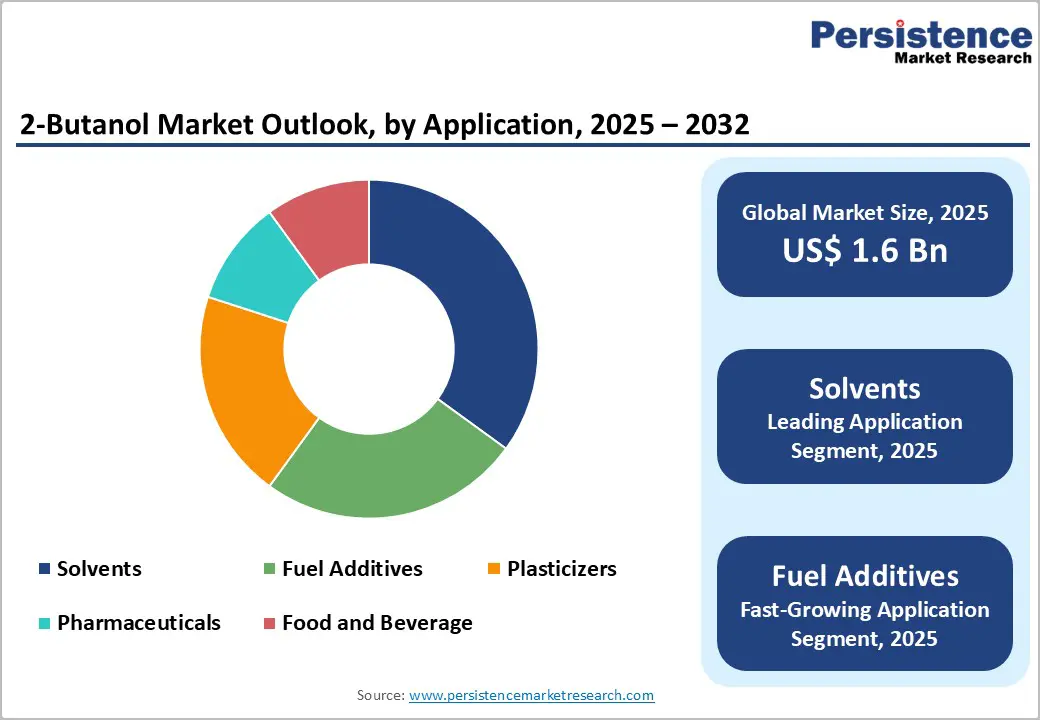
- Leading Application: Solvents, accounting for over 38% of market revenue, due to their extensive use in extraction, purification, and formulation processes across pharmaceuticals, coatings, and chemicals.
- Leading End-user: Chemical industry, contributing nearly 32% of market revenue, due to its extensive use as a solvent and intermediate for producing coatings, plasticizers, and specialty chemicals.
| Key Insights | Details |
|---|---|
| 2-Butanol Market Size (2025E) | US$1.6 Bn |
| Market Value Forecast (2032F) | US$2.3 Bn |
| Projected Growth (CAGR 2025 to 2032) | 5.3% |
| Historical Market Growth (CAGR 2019 to 2024) | 4.9% |
Market Factors – Growth, Barriers, and Opportunity Analysis
Rising Prevalence of Solvent Applications in Pharmaceuticals and Demand for Fuel Additives
The growing use of solvents in the pharmaceutical industry worldwide is a key driver of the 2-butanol market. In pharmaceutical applications, 2-butanol is extensively employed in extraction, purification, and formulation processes, where its high solubility and compatibility with active pharmaceutical ingredients (APIs) facilitate the production of high-purity compounds. Rising investments in drug discovery, the development of complex molecules, and global increases in R&D spending are further driving the demand for 2-butanol in pharmaceuticals.
2-butanol is increasingly used as a fuel additive in gasoline and biofuel formulations. Its properties as an oxygenate and octane enhancer improve combustion efficiency, lower emissions, and help meet cleaner fuel standards. Growing adoption of biofuels, coupled with stricter environmental regulations in regions such as North America and Europe, is further boosting the demand for 2-butanol as a sustainable fuel additive.
High Development and Regulatory Costs
The high costs associated with developing and obtaining regulatory approval for 2-butanol present a significant constraint on market growth. Producing high-purity, industrial-grade 2-butanol requires substantial investment in advanced manufacturing technologies, such as fermentation, distillation, and solvent recovery systems. Companies must also implement strict quality control measures to ensure product consistency, especially for applications in pharmaceuticals, coatings, and specialty chemicals, where impurities can affect performance or safety. These technical demands contribute to higher capital and operational expenditures.
Regulatory compliance further increases financial pressure. Governments in North America, Europe, and Asia impose stringent environmental, health, and safety standards, including limits on VOC emissions, hazardous chemical handling, and storage requirements. Meeting these regulations requires investment in emission-control technologies, safety protocols, waste management systems, and reporting procedures. Non-compliance can result in fines, production interruptions, or reputational damage, making proactive adherence both necessary and costly.
Advancements in Bio-Derived 2-Butanol and Multi-Functional Applications
Advancements in bio-based 2-butanol and its multifunctional applications are creating significant growth opportunities in the market. Bio-derived 2-butanol is typically produced via fermentation using renewable feedstocks such as sugars, starches, and lignocellulosic biomass. This sustainable approach not only reduces reliance on fossil fuels but also lowers greenhouse gas emissions and helps meet increasingly strict environmental regulations. Ongoing research is focused on improving fermentation yields, enhancing separation and purification processes, and optimizing production costs, making bio-based 2-butanol increasingly commercially viable.
The versatility of 2-butanol further drives its adoption across multiple industries. It functions as a solvent, chemical intermediate, fuel additive, and extraction agent, offering broad applicability in coatings, adhesives, pharmaceuticals, and specialty chemicals. Its capacity to dissolve a wide range of resins, enhance blending, and support high-purity formulations makes it suitable for both large-scale and niche applications. Bio-derived 2-butanol is also gaining traction in sustainable fuel formulations, where it serves as an effective oxygenate and octane enhancer.
Category-wise Analysis
Grade Type Insights
The industrial grade segment dominates, accounting for 52% of the market share in 2025. Its leadership is driven by cost-effectiveness, large-scale availability, and suitability for fuel applications, making it the preferred choice in the automotive sector. Industrial-grade 2-butanol, such as that produced by ExxonMobil Chemical, provides bulk solvency and operational efficiency. Its affordability and production scale make it ideal for manufacturers.
ExxonMobil’s 2-butanol is supplied globally and is widely used as a raw material in industrial cleaning formulations, coatings, paint removers, and lubricant additives, all critical for large-scale manufacturing and automotive industrial processes.
The pharmaceutical-grade segment is the fastest-growing, driven by the demand for high-purity compounds and increasing use in excipients. Pharmaceutical-grade 2-butanol meets sterility and quality requirements for active pharmaceutical ingredients (APIs). Growing emphasis on GMP-compliant production and innovative pharmaceutical processes is accelerating adoption in North America and Europe. BASF, one of the world’s largest chemical companies, produces pharmaceutical-grade solvents specifically designed to meet the stringent standards required for API synthesis and excipient manufacturing.
Application Insights
The solvents segment leads, accounting for 38% of the share in 2025, driven by extensive use in extraction and purification processes, particularly within the pharmaceutical and chemical industries. Their wide availability, high solubility, and compatibility with diverse formulations make them essential for producing high-purity compounds. Rising demand for efficient and reliable solvents continues to reinforce their market dominance.
Merck’s high-purity solvents, for example, are specifically formulated for production and purification processes in pharmaceuticals and chemicals, supplied in bulk to meet the needs of high-volume manufacturing environments crucial for API synthesis, target compound extraction, and purification.
The fuel additives segment is the fastest-growing, supported by increasing biofuel adoption and expanding use in gasoline formulations. Its ability to enhance octane levels, improve combustion efficiency, and integrate seamlessly with fuel systems is driving rapid demand. As cleaner fuel regulations tighten, 2-butanol’s role as a versatile and efficient fuel additive continues to expand. Butamax Advanced Biofuels, a joint venture between BP and DuPont, was established to develop biobutanol as a next-generation biofuel capable of blending into gasoline to enhance fuel performance and properties.
End-user Insights
The chemical industry dominates the 2-butanol market, accounting for 32% of revenue in 2025, driven by its widespread use in synthesis and as a chemical intermediate. Its versatility in producing solvents, plasticizers, and specialty chemicals sustains strong demand. The sector’s large-scale manufacturing capabilities, established supply chains, and cost-efficient production processes make it the preferred choice for high-volume 2-butanol applications.
For example, BASF SE produces 2-butanol (an oxo alcohol) for use as a chemical intermediate in the production of downstream products such as butyl acetate, butyl acrylate, esters, plasticizers, and specialty solvents, all of which are key raw materials for paints, coatings, adhesives, plastics, and other industrial chemicals.
The pharmaceutical industry is the fastest-growing segment, driven by increasing applications in drug formulation, where 2-butanol’s excellent solubility enables efficient synthesis and extraction processes. Rising R&D expenditure, demand for high-purity solvents, and increased API production are accelerating adoption. Its reliability, consistency, and compatibility with complex formulations make it an increasingly preferred choice in pharmaceutical applications.
Eastman Chemical Company, for instance, offers a wide range of pharmaceutical-grade solvents and ingredients specifically designed to support critical processes such as drug formulation, extraction, purification, and API synthesis, all of which require high solubility, consistent quality, and adherence to stringent regulatory standards.
Regional Insights
North America 2-Butanol Market Trends
North America is one of the fastest-growing regions, driven by strong industrial activity, well-established chemical production networks, and an increasing focus on regulatory compliance. The U.S. is the primary consumer, supported by large-scale manufacturing in coatings, adhesives, pharmaceuticals, and specialty chemicals, where 2-butanol serves as a key chemical intermediate and solvent. Demand is further reinforced by the region’s automotive, construction, and industrial coatings sectors, which rely on high-performance formulations derived from 2-butanol.
A major trend influencing the market is the region’s stringent environmental and safety regulations, including the Clean Air Act and OSHA standards. These policies are encouraging manufacturers to adopt advanced production technologies, improve process efficiency, and reduce emissions. Chemical producers are investing in cleaner production routes, catalytic process optimization, and solvent-recovery systems to maintain compliance while meeting industrial demand. The growing interest in sustainable and low-impact chemical intermediates is driving research into greener substitutes, renewable feedstocks, and advanced purification technologies.
Europe 2-Butanol Market Trends
Europe is a key player in the 2-butanol market, driven by advanced industrial capabilities, stringent regulatory oversight, and a growing emphasis on sustainable chemical production. The region’s established automotive, construction, and chemical manufacturing sectors continue to support strong demand for 2-butanol, particularly as a precursor to methyl ethyl ketone (MEK) and various specialty solvents used in coatings, adhesives, printing inks, and resin formulations. Countries such as Germany, France, Italy, and the U.K. are the major consumers, reflecting their mature downstream industries.
A defining trend in the region is Europe’s strict environmental and safety regulations, including REACH and VOC directives. These policies are prompting chemical producers to optimize manufacturing processes, reduce emissions, and explore greener alternatives for 2-butanol production. As industries shift toward low-emission coatings and eco-friendly solvents, manufacturers are increasingly investing in cleaner technologies and process efficiency enhancements.
Rising demand from specialty chemicals, pharmaceuticals, and advanced manufacturing applications, where high-purity intermediates are critical, further supports market growth. The increasing adoption of waterborne and high-performance coatings for automotive, infrastructure renovation, and industrial equipment also contributes to steady consumption of 2-butanol across the region.
Asia Pacific 2-Butanol Market Trends
Asia Pacific dominates the 2-butanol market, accounting for 48% of the share in 2025, driven by rapid industrialization, expanding chemical production, and strong demand from downstream sectors such as coatings, adhesives, pharmaceuticals, and specialty chemicals. Key countries, including China, India, South Korea, and Japan, lead regional growth due to their large-scale manufacturing capacities and ongoing investments in petrochemical infrastructure. The region benefits from abundant feedstock availability and cost-efficient production systems, enabling local manufacturers to supply 2-butanol competitively for both domestic consumption and export markets.
A significant trend in the region is the expansion of the paints and coatings industry, particularly in construction and automotive applications. Rapid urbanization and rising vehicle production are driving demand for 2-butanol as a critical intermediate for solvents and plasticizers. Growth in flexible packaging, electronics manufacturing, and pharmaceutical formulations further supports regional consumption.
Increasing environmental awareness is gradually influencing production practices, with several countries implementing stricter emissions and safety regulations. This is prompting manufacturers to adopt cleaner technologies, enhance process efficiency, and explore bio-based or lower-impact production methods.
Competitive Landscape
The global 2-butanol market is highly competitive, characterized by a mix of major chemical producers and regional specialists serving diverse industrial applications, including coatings, solvents, pharmaceuticals, and chemical intermediates. In mature markets such as North America and Europe, companies such as ExxonMobil Chemical maintain strong leadership through advanced R&D capabilities, integrated production systems, and extensive supply-chain networks. These strengths enable them to meet stringent quality standards and sustain long-term partnerships with key end-use industries.
In the Asia Pacific region, rapidly growing chemical hubs are intensifying market competition. Companies such as ZiBo Haizheng Chemical and Xinjiang Dushanzi TianLi High & New Tech leverage proximity to cost-efficient feedstocks, large-scale production facilities, and strong demand from regional downstream sectors. Their ability to provide customized, localized solutions allows them to capture substantial market share. The increasing emphasis on bio-based and sustainable 2-butanol production, driven by environmental regulations and growing demand for greener materials, is also shaping competitive strategies across the region.
Key Industry Developments
- In February 2025, Eastman Chemical Company launched a high-purity 2-butanol grade aimed at enhancing coatings and adhesives applications in the global chemicals market. This product is intended for performance-sensitive uses where solvent quality has a major impact on formulation results.
- In May 2024, SABIC, a leading global chemical producer, acquired Oxea’s alcohols assets, encompassing production and derivative capabilities for oxygenated solvents such as 2-butanol and related oxo-alcohols. The acquisition was described as a strategic effort to expand SABIC’s oxygenates and solvent portfolio and enhance its position in markets that rely on these intermediates.
Companies Covered in 2-Butanol Market
- ExxonMobil Chemical
- ZiBo Haizheng Chemical
- Xinjiang Dushanzi TianLi High & New Tech
- Zhejiang Xinhua CHEMICAL
- INEOS Oxide Ltd
- Perstorp
- Solventis (UK)
- Thermo Fisher Scientific
- BASF
- Mitsubishi Chemical Group Corporation
- Eastman Chemical Company
- OQ Chemicals GmbH
- KH Neochem Co., Ltd.
Frequently Asked Questions
The global 2-butanol market is projected to reach US$1.6 billion in 2025.
The rising prevalence of solvent applications in pharmaceuticals and the demand for fuel additives are key drivers.
The 2-butanol market is poised to witness a CAGR of 5.3% from 2025 to 2032.
Advancements in bio-derived 2-butanol and multi-functional applications are the key opportunities.
ExxonMobil Chemical, ZiBo Haizheng Chemical, Xinjiang Dushanzi TianLi High & New Tech, and Zhejiang Xinhua CHEMICAL are the key players.


