

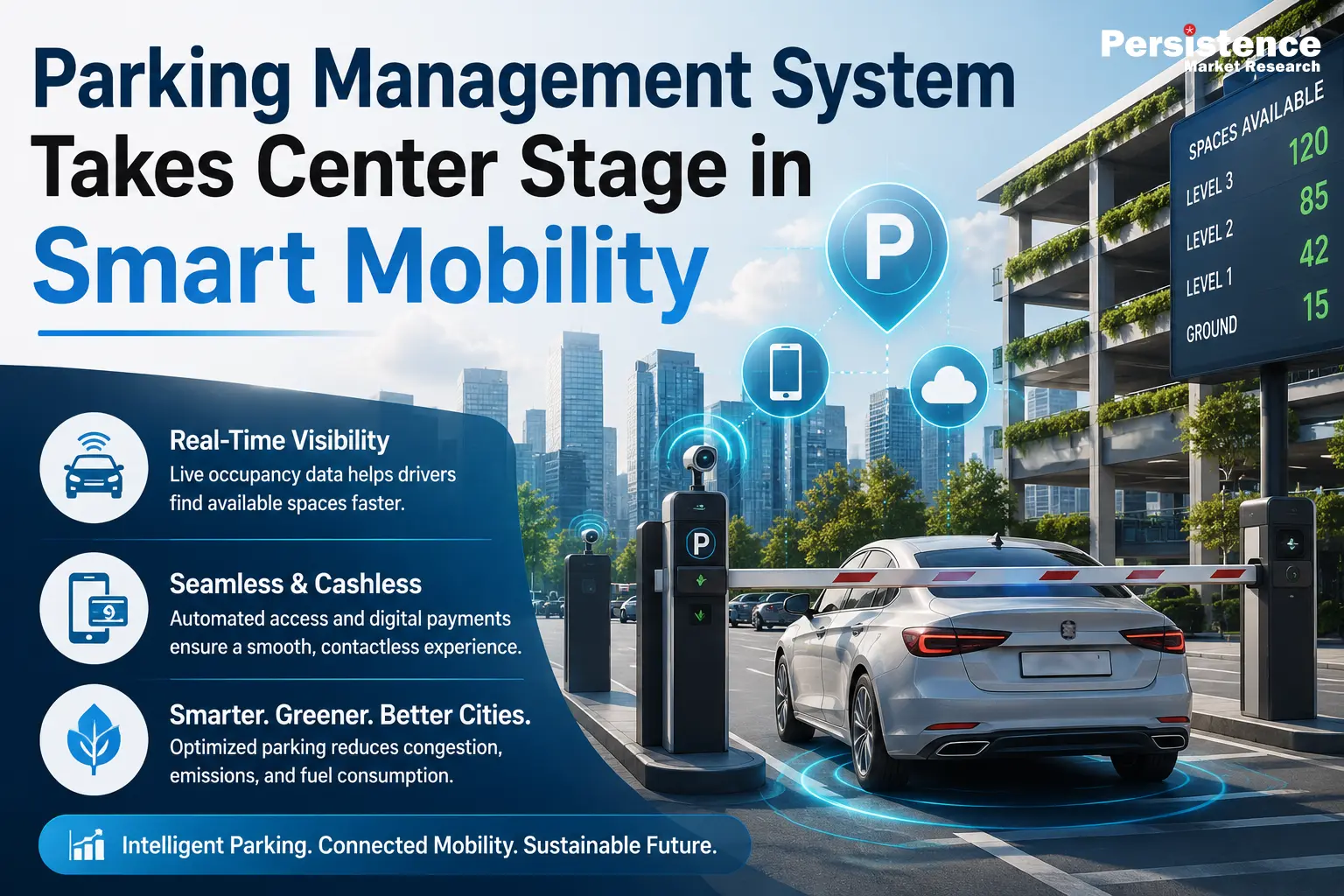
Modern parking platforms now combine intelligent software, IoT-enabled devices, and cloud-based systems to automate access control, optimize space usage, manage payments, and deliver real-time visibility. According to Persistence Market Research, the global parking management system market size is projected to rise from US$7.2 billion in 2026 to US$17.4 billion in 2033, with a CAGR of 13.4% during the forecast period from 2026 to 2033. What was once a manual and fragmented process has evolved into a connected mobility layer that supports both urban efficiency and user convenience.
Parking Becomes a Strategic Urban Asset
Traffic congestion continues to challenge cities around the world, and parking remains a major contributor. The European Commission estimates that congestion costs the European Union nearly €270 billion (approx. US$290 billion) every year, with vehicles searching for parking adding significantly to urban traffic. By directing drivers to available spaces through mobile applications and digital signboards, intelligent parking solutions reduce unnecessary driving, lower fuel consumption, and cut vehicle emissions.
The growing importance of smart parking is also reflected in industry-wide collaborations aimed at improving urban mobility. In February 2025, Parkin partnered with UITP, the world's leading public transport association, to advance intelligent parking solutions globally. The partnership focuses on integrating parking with shared mobility, public transport, and emerging digital technologies to create more sustainable and user-centric urban transportation networks, highlighting the industry's shift from standalone parking facilities to connected mobility ecosystems.
The Digital Engine Behind Smarter Parking
Behind every seamless parking experience is a network of interconnected technologies working in real time. Automatic Number Plate Recognition (ANPR) enables ticketless entry and exit by instantly identifying vehicles, while RFID systems provide frictionless access for registered users such as employees and residents. IoT sensors continuously monitor occupancy and feed live data into mobile applications and digital signage, helping drivers locate available parking without unnecessary circulation.
The impact is significant. The European Commission estimates that up to 30% of urban traffic congestion is caused by drivers searching for parking. By combining AI-powered forecasting with cloud-based platforms, intelligent parking systems reduce this hidden inefficiency, improve space utilization, and enable dynamic pricing based on real-time demand.
Parking is also becoming deeply integrated into the broader mobility ecosystem. Instead of operating as standalone infrastructure, it is increasingly embedded within digital transport platforms that connect payments, EV charging, and real-time mobility services. A clear example of this shift came in 2025, when ParkMobile expanded its integration ecosystem in North America by linking parking reservations, permit management, and EV charging services into a unified app-based platform across thousands of locations. This move reflects a broader industry direction where parking is no longer just about space allocation, but about enabling end-to-end mobility experiences for drivers across urban environments.
Building Blocks of an Intelligent Parking Platform
A modern parking ecosystem brings together multiple capabilities into a unified digital framework. Entry and access control combines ANPR, RFID, QR codes, mobile credentials, and automated barriers to authenticate vehicles within seconds. Automated ticketing and billing systems eliminate manual intervention by calculating parking fees in real time and enabling cashless payments through cards, QR codes, and mobile wallets. Together, these capabilities reduce waiting times, improve security, and enhance revenue accuracy.
The rapid evolution of underlying architecture toward cloud-native, API-driven platforms supported by edge computing and AI-based automation is driving the shift. Instead of operating in silos, modern parking systems now process vehicle recognition, occupancy tracking, and payment validation closer to the source while syncing data instantly with centralized cloud platforms. This improves response time in high-traffic environments and enables seamless integration with external mobility services such as EV charging networks, navigation systems, and digital payment ecosystems.
This convergence is already visible in industry deployments. In 2025, ChargePoint introduced a next-generation cloud platform that integrates EV charging management with commercial and workplace parking operations, using AI-driven optimization and real-time analytics to coordinate usage, predict demand, and manage distributed infrastructure more efficiently. This reflects a broader shift in the industry where parking is no longer a standalone function but part of a unified, software-defined mobility ecosystem.
The Trends Defining the Next Era of Parking
Parking facilities are increasingly being reimagined as mobility hubs rather than static infrastructure. Alongside parking services, they now support EV charging, digital payments, reservation systems, and real-time mobility insights through unified platforms. According to the IEA, public EV charging points surpassed 5 million globally in 2024, following the installation of approximately 1.3 million new chargers in a single year. This rapid expansion is pushing parking operators to integrate charging infrastructure directly into their operational models.
Another major shift is the rise of digital twins, which create virtual replicas of parking assets to simulate traffic flow, predict congestion, and optimize infrastructure planning. Combined with AI and cloud computing, digital twins are enabling a shift from reactive operations to predictive decision-making. At the same time, cloud-based platforms are becoming standard for managing multi-site parking networks, offering centralized control, remote updates, and enhanced cybersecurity.
A Smarter Road Ahead
Parking is no longer a background utility in urban infrastructure. It has become a critical component of connected mobility systems that influence congestion, emissions, energy consumption, and overall city efficiency. As AI, IoT, cloud computing, and predictive analytics continue to mature, parking will operate as an increasingly intelligent layer within the broader transportation ecosystem.
The future of parking is not defined by more space, but by smarter space utilization. Organizations that invest in intelligent parking solutions today are not just modernizing operations but also contributing to the foundation of cleaner, more connected, and more sustainable cities.


