

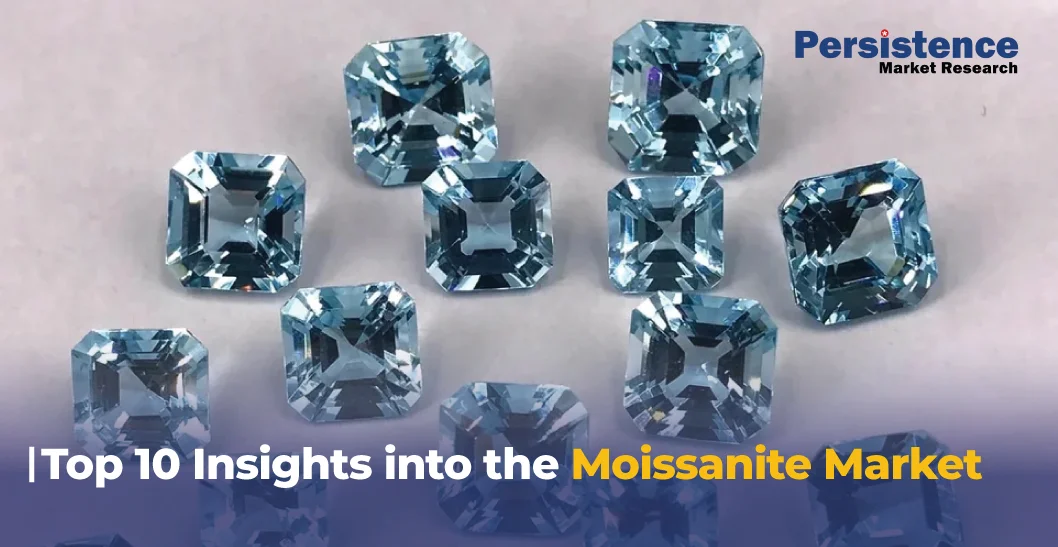
The following insights explore the main forces shaping the moissanite market, including shifts in consumer behavior, production advances, pricing movements, and expectations for future growth.
1. Market growth is steady across major regions
The moissanite market continues to expand as awareness increases among first time buyers and repeat jewelry customers. Market trackers report valuations in the hundreds of millions of dollars, supported by rising online sales and broader product availability. Growth rates vary across regions, but the overall trajectory reflects stable demand for lab grown stones and consistent interest in alternatives to mined gems.
2. Visual value drives strong consumer attraction
Many buyers select moissanite because it offers a larger stone size within a moderate budget. A one carat moissanite ring often costs a fraction of the price of a comparable natural diamond. This value advantage has made moissanite especially popular for engagement rings, anniversary pieces, and statement jewelry where visual impact plays a strong role in the purchase decision.
3. The price differential with diamonds remains a key factor
One of the most influential features of the market is the wide price gap between moissanite and natural diamonds. Even when compared with lab grown diamonds, moissanite typically remains more affordable across most color and clarity grades. This consistent price positioning supports healthy demand and encourages experimentation with larger cuts and unique designs.
4. Ethical preferences influence purchase patterns
Buyers who prioritize sustainability often turn to moissanite because it is produced in controlled laboratory environments without large scale mining. Concerns about the environmental effects of extraction and the desire for transparent sourcing have strengthened interest in lab grown stones. Younger demographics, in particular, view moissanite as an option that aligns with evolving expectations around ethical consumption.
5. Shifts in the diamond market shape alternative choices
Fluctuations in the natural and lab grown diamond markets have highlighted the stability of moissanite pricing. As diamond prices respond to changes in supply, demand, and retail inventories, consumers explore alternatives that offer predictable value. This dynamic places moissanite as a reliable category for shoppers searching for brilliance without uncertainty in long term price movement.
6. Established brands reflect category maturity
The presence of well known moissanite suppliers illustrates the maturity of the market. These brands typically invest in consistent quality, certification, and warranty programs that help buyers feel confident in their purchases. The evolution of these companies, including changes in product lines and distribution models, reflects a category that has moved firmly into mainstream jewelry retail.
7. Technological progress enhances quality and color performance
Advances in silicon carbide crystal growth have improved clarity, reduced color variance, and increased the availability of near colorless grades. Manufacturers now produce stones with higher optical consistency and greater fire, supported by improvements in cutting precision. These developments contribute to rising acceptance among consumers who previously hesitated due to early generation color limitations.
8. Digital channels accelerate awareness and education
Social platforms, review videos, and retailer comparison tools have played a noticeable role in market expansion. Shoppers can easily view side by side comparisons between moissanite and diamonds, learn about durability, and explore design options. Online engagement also encourages peer to peer sharing, which strengthens the credibility of the category and supports faster adoption.
9. The resale market is still developing
The secondary market for moissanite remains at an early stage. While the gemstone delivers clear value at the point of purchase, resale activity is limited compared to natural diamonds, which benefit from long established trading and appraisal systems. As certification practices improve and more buyers enter the market, a more structured resale environment may emerge over time.
10. Future expectations point to wider segmentation and premium positioning
The coming years are likely to bring deeper segmentation within moissanite offerings. One part of the market will continue to focus on affordability and larger stone sizes, while another will move toward premium attributes such as distinctive cuts, branded collections, and top tier color grades. Continued investment in crystal growth and cutting technology is expected to support this diversification, leading to more visible differentiation within moissanite jewelry.
Conclusion
The moissanite market reflects a combination of economic practicality, technological progress, and shifting consumer values. Its appeal spans aesthetic preferences, ethical considerations, and price sensitivity, making it a notable part of the jewelry landscape. As awareness grows and production quality continues to advance, moissanite is expected to maintain its position as a strong alternative to traditional gemstones while evolving into a more broadly segmented global market.


