

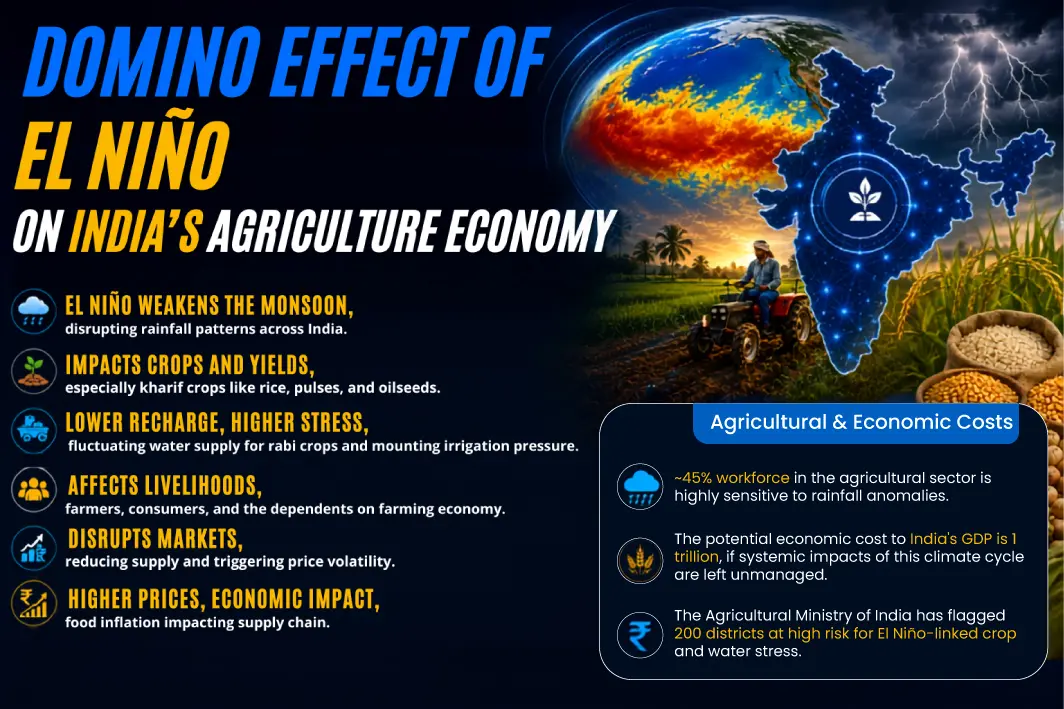
The phenomenon recurs irregularly, but its agricultural consequences follow a recognizable pattern. Since 1950, El Niño events have disrupted Indian rainfall in 9 out of 16 recorded occurrences. That is not a coincidence, but it is a structural relationship between ocean temperatures and the monsoon's strength, one that local farmers have absorbed into their generational memory, even if the scientific vocabulary is relatively recent.
What a Normal Monsoon Season Looks Like Before El Niño Enters
To understand what El Niño disrupts, it helps to first understand what it interrupts. The southwest monsoon runs from June through September. For more than half of India's net sown area, i.e., land with no irrigation, no pipeline, or no alternative water source, those four months are everything. Rain-fed farming accounts for approximately 40% of India's total food production, a share significant enough that any deviation in monsoon behavior sends reverberations through the entire food supply chain.
Under normal conditions, kharif crops, including rice, cotton, soybean, groundnut, and pulses, are sown in June and July. These are timed to receive consistent rainfall through August and September. It is during this period that the reservoirs fill and groundwater recharges. The rabi season that follows inherits that stored moisture, allowing wheat, mustard, and chickpeas to sustain themselves through the dry winter months. El Niño breaks this sequence at its very first link.
Why El Niño Does Not Hit India the Same Way Twice
The historical record on El Niño and Indian rainfall resists simple conclusions. As per sources, including the India Meteorological Department (IMD), in 2002, a moderate El Niño produced a national rainfall deficit of 21%. In 2015, a significantly stronger event resulted in a deficit of only 13%, a counterintuitive outcome explained by the simultaneous presence of a positive Indian Ocean Dipole (IOD). It is a separate oceanic temperature oscillation that can generate independent moisture supply to the subcontinent and partially offset El Niño's suppressive effect.
This variability matters as it prevents El Niño from being read as an automatic catastrophe. Between 1982 and 2002, 6 out of 11 El Niño events negatively affected agricultural gross value added. Since 2004, only 1 out of 7 events caused comparable damage. It was a shift pushed by expanded irrigation networks, minimum support price mechanisms, and crop insurance.
Delayed and Deficient Rainfall Disrupts Kharif Sowing and Reduces Yields
El Niño's moisture-suppressing effects are most entrenched in August and September, the exact months when standing kharif crops need water most. Rice is specifically vulnerable. It requires standing water during tillering and grain formation, and a deficit during those weeks cannot be compensated for later in the season. Historical data shows that superior El Niño phases reduce national rice production by an average of 3.4 million tons.
According to a study published in ISJEM International Journal, in heavily rain-fed states such as Maharashtra, Gujarat, and Karnataka, strong El Niño years have caused foodgrain production declines of 12 to 18%. On the other hand, states with better irrigation coverage, including West Bengal and Odisha, have typically seen smaller losses in the 5 to 8% range. The damage, in other words, concentrates itself on whoever already has the least cushion.
A 2025 study adds a further complication. El Niño does not simply reduce total rainfall, but it also increases the frequency and intensity of heavy daily rainfall events. The rain that does arrive comes in destructive bursts. These are often difficult to capture and are more likely to cause soil erosion as well as crop damage than to replenish soil moisture in any useful way.
Low Monsoon Recharge Constrains Rabi Irrigation and Crop Output
The agricultural consequences of El Niño do not stop when the southwest monsoon retreats. The rabi season, focusing on wheat, mustard, and chickpeas, depends on residual soil moisture, reservoir levels, and groundwater that the kharif season leaves behind. When a below-normal monsoon depletes those reserves, rabi crops inherit the deficit.
The Central Water Commission monitors 166 reservoirs across India, and their October-November levels often determine irrigation capacity for rabi sowing. When those levels fall short, farmers in irrigated zones pump additional groundwater to compensate, boosting extraction from aquifers already under stress. The Central Ground Water Board's 2025 assessment found that of 6,762 groundwater assessment units across the country, 730 are already classified as overexploited, meaning extraction exceeds recharge even in normal monsoon years. An El Niño that reduces recharge pushes this baseline stress further.
Reduced Harvest Volumes Trigger Supply Shortages and Food Price Inflation
The agriculture market's response to El Niño does not arrive immediately. By October and November, when kharif harvests come in short, supply constraints in rice, pulses, oilseeds, and vegetables begin appearing in wholesale markets. Research on India’s drought years has found a correlation of -0.8 between monsoon deficits and food inflation in the following year. This means a bad monsoon in year one almost reliably produces elevated food prices in year two. Drought-driven food price shocks were responsible for more than three-quarters of all instances of double-digit inflation in India between 1956 and 2010.
For the Reserve Bank of India, this creates a policy tension without a clean answer. Raising rates to suppress food inflation conflicts with supporting economic growth in a year when rural incomes are already depressed. As per a latest study by EY, a 2% decline from the rainfall benchmark is estimated to translate into approximately a 0.3 percentage point drop in agricultural Gross Value Added (GVA) growth, a number that ripples through broad economic performance indicators.
Fodder Shortages and Water Stress Hamper Livestock Output and Rural Incomes
The damage from El Niño extends well past yield numbers. Livestock, including cattle, poultry, and dairy animals, depend heavily on fodder availability and water access, both of which contract during drought conditions. Hence, dairy output tends to decline during El Niño years. This is especially significant because milk and eggs often act as an income buffer for rural households, mainly when crop earnings are already under pressure.
A recent industry example highlights this linkage. In June 2026, Parag Milk Foods flagged early signs of stress in the sector. It stated that milk prices had already increased by around 2 to 3% and indicated the possibility of further price hikes if rainfall remains below normal in key milk-producing regions. This exhibits how weather disruptions associated with El Niño can quickly change into cost pressures across the dairy value chain, strengthening the broad inflationary impact on the food system.
Early Forecasting and Policy Intervention Influence India’s 2026 Preparedness
On June 11, 2026, the National Oceanic and Atmospheric Administration (NOAA) officially declared that El Niño is now underway in the tropical Pacific, with a 63% probability of sea surface temperatures exceeding 2°C above average. These conditions might intensify into a super El Niño later in the year. The India Meteorological Department (IMD) had already projected below-normal monsoon rainfall at 90% of the long-period average.
The government's response has been notable in its speed and specificity. Agriculture Minister Shivraj Singh Chouhan, in a high-level review meeting on June 16, 2026, directed district-level contingency planning across 12 states, including Uttar Pradesh, Tamil Nadu, Maharashtra, Karnataka, Gujarat, Rajasthan, Bihar, Madhya Pradesh, Andhra Pradesh, Telangana, Jharkhand, and Odisha, identified as facing relatively severe El Niño impacts. Contingency plans are being prepared for 326 districts across these states, covering alternative crop options, irrigation strategies, and stage-wise interventions associated with August rainfall outcomes.
The Indian Council of Agricultural Research’s (ICAR) Indian Institute of Rice Research has developed climate-resilient paddy varieties specifically designed to withstand El Niño-related stress. This includes DRR Dhan 89 (Super Swarna) and a series up to DRR Dhan 91, with potential yields above 40 quintals per hectare. In October 2025, the International Rice Research Institute (IRRI) and India's National Agricultural Research and Extension System (NARES) jointly released 31 stress-tolerant rice varieties for large-scale cultivation, several of which yield 10 to 30% more than traditional varieties under drought or flood conditions. Varieties such as CR Dhan 808 and Sahbhagi Dhan are now available to farmers in drought-prone regions, with field trials showing a yield advantage of 0.8 to 1.2 tons per hectare over drought-susceptible varieties under water stress.
Temporary Monsoon Shocks to Leave Lasting Imprints on Rural Economies
India's aggregate food production has shown more endurance than raw rainfall numbers would suggest. During the 2023 to 2024 El Niño, the country produced 332.30 million tons of food grain, which was 2.4 million tons above the previous year. By 2024 to 2025, output reached a record 357.73 million tons. Drought-tolerant seed varieties, improved crop management, and price support systems have created an armor between rainfall variability and national output.
But recovery from a significant El Niño event typically takes 18 to 24 months and is conditional on the following monsoon being normal. National records also mask district-level distress, which is precisely why the government's current effort targets 326 specific districts rather than relying on aggregate indicators.
The key question is not whether India can survive El Niño as the evidence shows it can, and continues to. It is what survival costs in terms that do not always appear in annual production figures: rural wages that stay depressed for months after harvests recover, aquifer stress that accumulates across years and undermines future monsoon buffers, and food prices that fall hardest on households already spending the largest share of their income on food. El Niño is a seasonal climate event. The vulnerabilities it exposes are structural ones, and those do not resolve when the rains return.


