




- Non-food Packaging
- Stretch Wrap Machines Market
Stretch Wrap Machines Market Size, Share, and Growth Forecast 2026 - 2033
Stretch Wrap Machines Market by Product Type (Turntable, Rotary Arm, Robotic, Others), Automation Level (Manual, Semiautomatic, Automatic), End-users (Food & Beverage, Pharmaceutical, Consumer, Construction, Chemical, Automotive, Industrial, Others), and Regional Analysis, 2026 - 2033

Stretch Wrap Machines Market Size and Trend Analysis
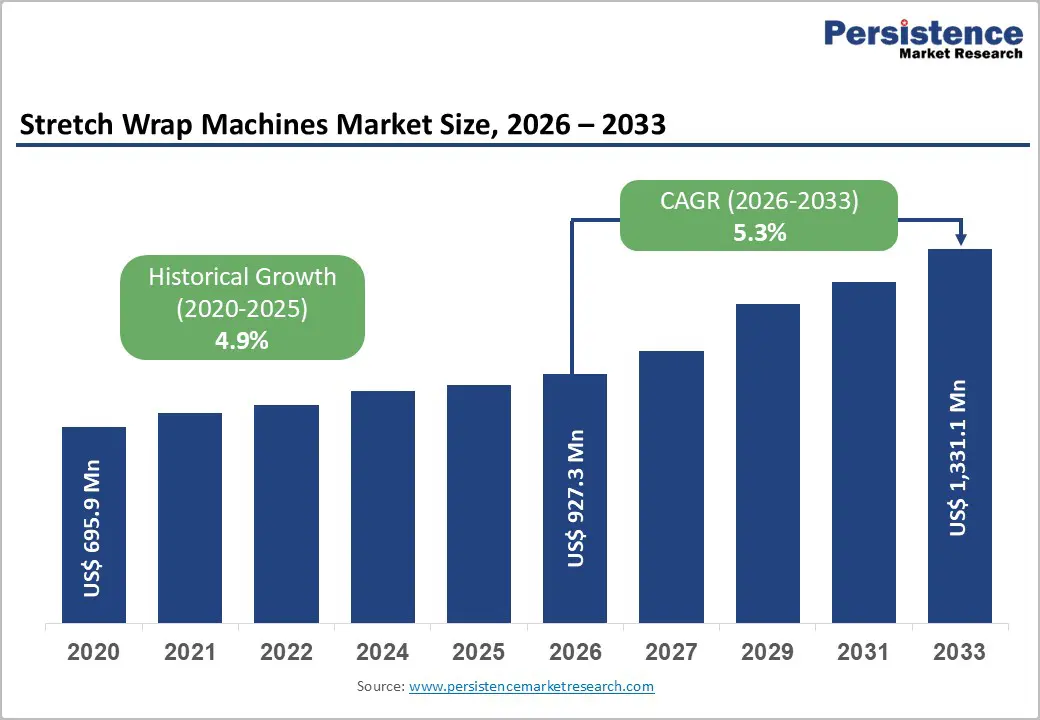
The global stretch wrap machines market size is expected to be valued at US$ 927.3 million in 2026 and projected to reach US$ 1,331.1 million by 2033, growing at a CAGR of 5.3% between 2026 and 2033.
This growth is primarily driven by the rapid expansion of the e-commerce and logistics sectors, where efficient pallet stabilization is critical for safe and cost-effective transportation. Rising demand from the food and beverage industry, characterized by high-volume and fast-paced packaging operations, further supports market expansion. Additionally, ongoing advances in automation technologies are reducing labor dependence, improving operational efficiency, and enhancing overall packaging throughput across industries.
Key Market Highlights
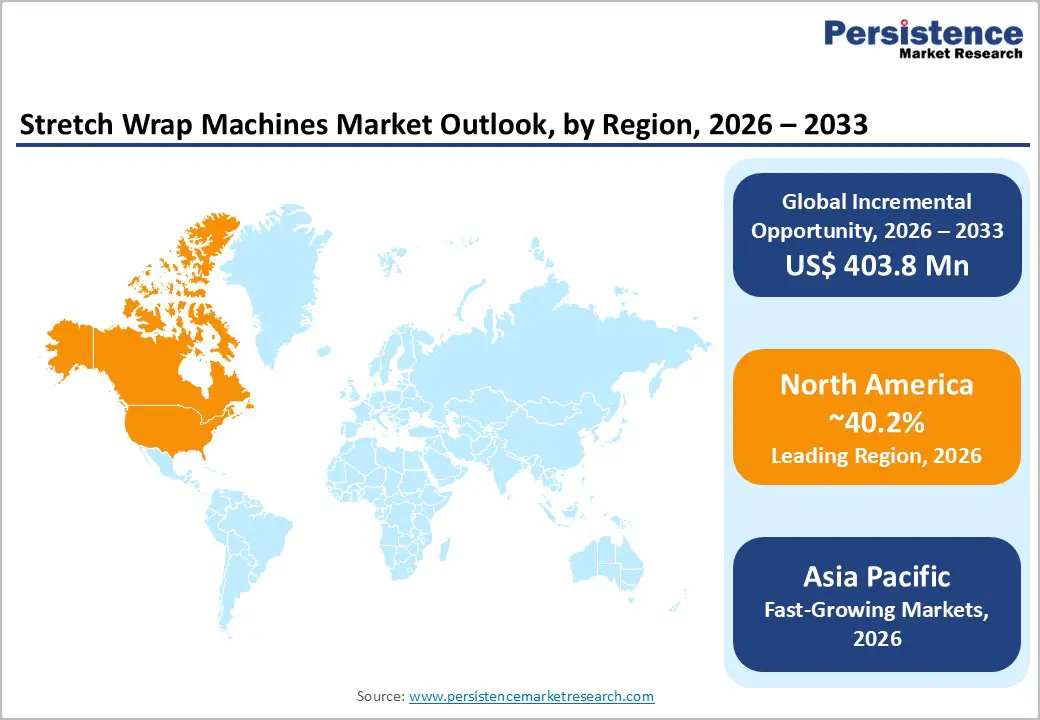
- Leading Region: North America accounts for 40.2% of the market, driven by U.S. automation adoption and a strong logistics infrastructure.
- Fastest-Growing Region: Asia-Pacific is the fastest-growing region, with a 32.4% share, driven by manufacturing expansion in China and India and rising e-commerce demand.
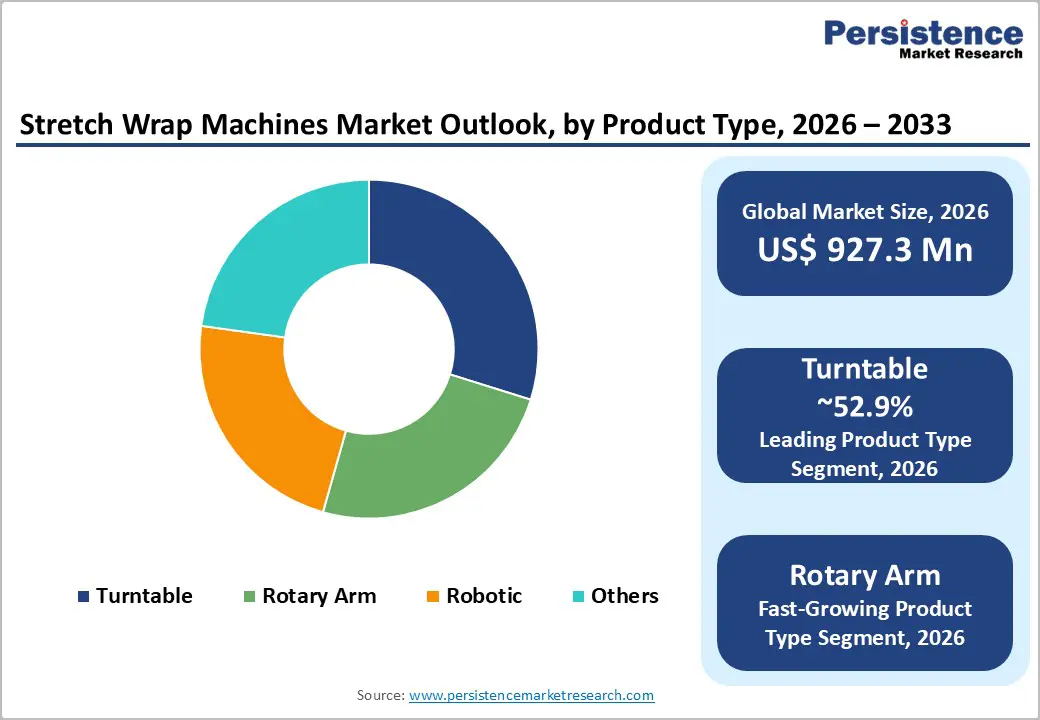
- Leading Product Category: Turntable machines lead the product segment with 52.9% share, preferred for cost-effective and versatile palletizing operations.
- Fastest-Growing Product Category: Robotic and rotary arm machines are the fastest-growing product types, enhancing efficiency in high-volume and complex load handling.
- Key Market Opportunity: The pharmaceutical sector offers growth potential, with robotic and automated solutions reducing transport damage by up to 40%.
| Key Insights | Details |
|---|---|
| Stretch Wrap Machines Size (2026E) | US$ 927.3 million |
| Market Value Forecast (2033F) | US$ 1,331.1 million |
| Projected Growth CAGR (2026 - 2033) | 5.3% |
| Historical Market Growth (2020 - 2025) | 4.9% |
Market Dynamics
Drivers - Surging E-commerce Growth Driving the Need for Logistics Efficiency and Load Security
The rapid expansion of global e-commerce continues to significantly increase demand for stretch wrap machines, as logistics providers prioritize load stability, speed, and damage reduction. With global e-commerce sales reaching US$ 6.3 trillion in 2024, distribution centers are handling higher shipment volumes and tighter delivery timelines. Stretch wrap machines enable consistent palletizing, reduce manual intervention, and support faster order fulfillment across high-throughput warehouses.
Automated stretch wrapping also improves supply chain reliability by minimizing in-transit product damage. Packaging industry benchmarks indicate that automated wrapping systems can reduce shipping damage by up to 30%, lowering returns and replacement costs. These efficiencies are critical for just-in-time delivery models, making stretch wrap machines an essential investment for logistics operators focused on resilience, scalability, and cost optimization.
Growing Food & Beverage Packaging Requirements Supporting Market Expansion
The food and beverage industry remains a key driver for stretch wrap machine adoption due to its reliance on high-volume, time-sensitive packaging operations. Pallet stability is critical for preventing product movement, contamination, and spoilage during transportation. Industry sources indicate that a significant share of food logistics operations depend on pallet wrapping to maintain product integrity across complex distribution networks
Technological advancements further strengthen adoption, with innovations such as metered film delivery and pre-stretch systems reducing film consumption by up to 20%. These improvements support sustainability targets while lowering packaging costs. Additionally, compliance with stringent food safety regulations encourages manufacturers and distributors to adopt automated stretch wrapping solutions, thereby ensuring consistent load containment and regulatory compliance across large-scale food and beverage supply chains.
Restraints - High Initial Capital Investment and Ongoing Maintenance Cost Constraints
High upfront investment requirements remain a key constraint for the stretch wrap machine market, particularly for small and medium-sized enterprises. Equipment costs typically range from US$ 10,000 to US$ 100,000, depending on automation level, which discourages adoption in budget-constrained operations. In addition, annual maintenance expenses averaging around 2% of equipment cost can accumulate over time, especially when machines are poorly maintained.
Operational inefficiencies such as excess film usage and downtime further increase the total cost of ownership. Industry estimates suggest that under-maintained systems can result in substantial annual losses due to waste materials and reduced performance. These financial barriers slow market penetration, particularly in emerging and cost-sensitive regions where capital expenditure decisions are tightly controlled.
Stringent Environmental Regulations Impacting Plastic Film Usage
Increasingly stringent environmental regulations governing plastic waste pose a challenge to the growth of the stretch wrap machine market. Policies such as the EU Packaging Directive, which targets a 50% reduction in single-use plastics by 2030, exert pressure on industries that are heavily reliant on conventional stretch films. Compliance often requires transitioning to recyclable or biodegradable alternatives.
While sustainable films address regulatory concerns, they typically incur higher costs. Industries report an additional 15-20% increase in packaging expenses when adopting eco-friendly materials. These added compliance costs can limit expansion, particularly for manufacturers and logistics providers operating on thin margins or in regions with aggressive sustainability mandates.
Opportunity - Growing Adoption of Robotic and Automated Stretch Wrapping Technologies
The growing adoption of warehouse automation is creating significant opportunities for robotic and automated stretch wrap machines, particularly in high-volume and complex packaging environments. Robotic stretch wrappers are increasingly favored for their ability to handle unstable, oversized, or irregular loads with high precision and repeatability. Their flexibility makes them well-suited for dynamic distribution centers supporting multi-product e-commerce operations.
Integration with IoT and smart monitoring systems further enhances value by enabling real-time performance tracking, predictive maintenance, and reduced unplanned downtime. Industry benchmarks indicate that such connectivity can lower downtime by up to 25%. Food processors and large logistics operators that adopt robotic wrapping solutions also achieve measurable throughput gains, thereby strengthening their operational readiness for sustained e-commerce growth.
Expanding Opportunities from Rising Pharmaceutical Packaging Requirements
The pharmaceutical sector represents a growing opportunity for stretch wrap machine manufacturers due to its strict requirements for hygiene, load security, and damage prevention. Secure palletizing plays a critical role in minimizing product movement and contamination risks during transportation. Industry sources indicate that effective load stabilization can reduce transport-related damage by up to 40%, improving supply chain reliability.
Regulatory developments such as serialization and traceability mandates are accelerating demand for automated and high-precision packaging systems. As pharmaceutical companies invest in modernized distribution infrastructure, demand is increasing for cleanroom-compatible, automated, and robotic stretch-wrapping solutions. These investments support compliance, improve handling efficiency, and position stretch wrap machine suppliers to capitalize on long-term growth within regulated healthcare logistics.
Category-wise Analysis
Product Type Insights
Turntable stretch wrap machines dominate the product type segment, accounting for an estimated 52.9% market share in 2025. Their leadership is driven by cost-effectiveness, compact footprint, and ease of operation, making them well-suited for standard palletized loads in mid-sized manufacturing and distribution facilities. Turntable systems integrate easily into existing packaging lines and efficiently handle uniform loads, supporting their continued dominance through the near term.
Rotary arm and robotic stretch wrap machines represent the fastest-growing product types, driven by demand from facilities handling heavy, unstable, or irregular loads. These machines keep pallets stationary while the wrapping mechanism rotates, improving safety and load integrity. Growth is further supported by increasing automation in logistics hubs, where flexibility, higher speeds, and reduced manual handling are critical operational priorities.
Automation Level Insights
Automatic stretch wrap machines lead the automation segment with an estimated 43.5% market share in 2025, reflecting strong adoption in high-throughput logistics, warehousing, and manufacturing environments. Their ability to significantly reduce operator intervention, ensure consistent wrapping quality, and improve operational efficiency makes them a preferred choice amid rising labor costs and increasing shipment volumes.
Fully integrated and robotic automation systems are emerging as the fastest-growing category, driven by advanced warehouse automation strategies. These systems support seamless integration with conveyors, palletizers, and warehouse management systems. Their capability to adapt to variable load sizes, improve uptime, and deliver higher wrapping precision is accelerating adoption across large distribution centers and e-commerce-driven supply chains.
End-user Insights
The food and beverage industry leads end-user adoption, accounting for approximately 36.9% of the market in 2025. High-volume packaging requirements, combined with the need for load stability and spoilage prevention during transport, support strong demand. Stretch wrap machines play a critical role in maintaining pallet integrity, reducing product loss, and ensuring compliance with food safety and handling standards.
The pharmaceutical sector is emerging as the fastest-growing end-user segment, driven by increasing regulatory requirements and expanding global drug distribution networks. Demand is rising for automated, contamination-controlled, and precision wrapping solutions that protect sensitive products. Investments in modernized pharmaceutical logistics and temperature-controlled supply chains are further supporting the rapid adoption of advanced stretch wrap machines.
Regional Insights
North America Stretch Wrap Machines Market Trends
North America holds a leading position in the global stretch wrap machines market, accounting for around 40.2% market share. This dominance is supported by a mature logistics infrastructure, strong presence of leading manufacturers, and early adoption of automation technologies. The United States remains the core contributor, driven by large-scale distribution centers, advanced packaging standards, and continuous innovation in stretch wrapping solutions.
The rapid expansion of e-commerce and third-party logistics hubs, which increasingly rely on automatic and high-speed stretch wrap machines encourage the demand for stretch wrap machines. Sustainability initiatives and efficiency-focused upgrades are also shaping purchasing decisions, with companies adopting advanced film delivery systems to reduce material consumption, improve load stability, and enhance overall warehouse productivity.
Europe Stretch Wrap Machines Market Trends
Europe represents a significant regional market, characterized by strong industrial activity and well-established packaging regulations. Countries such as Germany, the U.K., France, and Italy drive demand through advanced manufacturing and food processing industries. The region’s growth is supported by harmonized regulatory frameworks that encourage energy-efficient and environmentally compliant packaging equipment.
The European stretch wrap machines market is projected to grow at a steady CAGR of around 5.5% over the forecast period. Demand is increasingly shifting toward automated and eco-efficient systems that help companies meet stringent packaging waste and sustainability targets. Ongoing investments in food, beverage, and export-oriented logistics further support consistent adoption across the region.
Asia Pacific Stretch Wrap Machines Market Trends
Asia Pacific holds a substantial share of the global stretch wrap machines market, accounting for approximately 32.4% market share, supported by large-scale manufacturing and expanding logistics networks. China remains a key contributor due to its strong industrial base, while Japan and South Korea continue to adopt advanced automation technologies in packaging operations.
The region’s growth is driven by rapid e-commerce expansion, particularly in India and Southeast Asia, where demand for semi-automatic and cost-efficient stretch wrap machines is rising. Increasing export activity, infrastructure development, and growing local manufacturing of packaging equipment are improving affordability and accessibility, positioning the Asia Pacific as one of the most dynamic and opportunity-rich markets globally.
Competitive Landscape
The stretch wrap machines market exhibits a moderately consolidated competitive structure, characterized by the presence of numerous global and regional manufacturers offering a wide range of solutions. Competition is primarily driven by technological differentiation, with manufacturers focusing on improving machine efficiency, automation capabilities, and compatibility with diverse load types. Continuous product innovation and customization remain key strategies for addressing diverse end-user requirements.
Market participants are increasingly investing in research and development to integrate smart technologies, including IoT-enabled monitoring, predictive maintenance, and film-optimization systems. Sustainability-focused designs that reduce material use are increasingly important. In parallel, companies are expanding their footprint in emerging markets and shifting toward service-oriented business models, including maintenance contracts and long-term customer support, to strengthen recurring revenue streams and customer retention.
Key Market Developments
- In October 2024, Lantech launched its next-generation Metered Film Delivery system for automatic stretch wrap machines, enhancing film efficiency, reducing breaks, and minimizing machine footprint, thereby improving operational productivity and supporting sustainable packaging initiatives.
- In November 2025, Robopac expanded its robotic stretch wrapper lines across warehouses across the Asia-Pacific region, enabling high-volume, precise pallet handling, increasing automation adoption, and meeting the growing demand from the e-commerce and logistics sectors.
- In September 2025, Signode introduced energy-efficient stretch wrap machines that comply with EU environmental regulations, optimize power consumption, reduce material usage, and support sustainable packaging practices across European industrial and food processing operations.
Companies Covered in Stretch Wrap Machines Market
- Signode Industrial Group LLC
- Lantech LLC
- Robopac S.p.A. (Aetna Group)
- Aetna Group S.p.A.
- Wulftec International Inc.
- Orion Packaging Systems LLC
- ARPAC LLC
- Phoenix Wrappers, Inc.
- FROMM Packaging Systems
- SIAT S.p.A.
- Hangzhou Youngsun Intelligent Equipment Co., Ltd.
- Italdibipack S.p.A.
- Technowrapp S.r.l.
- Berran Industrial Group, Inc.
- Cousins Packaging Inc.
Frequently Asked Questions
The market is expected to reach US$ 927.3 million in 2026, driven by automation and high-volume logistics.
Growth in e-commerce and food & beverage packaging (36.9% share) boosts demand, reducing shipping damage and improving efficiency.
North America leads with 40.2% share, supported by U.S. automation and logistics capabilities.
Robotic technology in pharmaceuticals is a major opportunity, reducing transport damage by up to 40%.
Key players in stretch wrap machines are Signode Industrial Group LLC, Lantech LLC, Robopac S.p.A. (Aetna Group), Aetna Group S.p.A., and Wulftec International Inc.


