
Shipping Containers Market Size, Share and Growth Forecast for 2025 - 2032

Shipping Containers Market by Container Size (Small Containers (20 feet), Large Containers (40 feet), High Cube Containers (40 feet)), Container Type (Dry Storage Containers, Flat Rack Containers, Refrigerated Containers, Special Purpose Containers, Others), and Region for 2025 - 2032

ID: PMRREP6748
Calendar

July 2025

177 Pages

Author : Jitendra Deviputra

Asia Pacific Shipping Containers Market to Grow Substantially

Region

Market Share in 2025

Asia Pacific

47.13%

Asia Pacific shipping containers market leads the sector and is projected to hold a 47.13% market share in 2025 fueled by increasing trade activities. China, as a manufacturing giant manages the highest volumes of containerized cargo followed by countries like Korea, Japan, India, and ASEAN nations adopting sea-faring containers for goods transport.

Affordable labor and resources in Asia attract global manufacturers to establish local production facilities boosting intra-Asia and export trade. Investments in new container terminals and mega ports in China and India further enhance infrastructure supporting regional market growth in shipping containers.

North America Shipping Containers Market to Grow at a 6.1% CAGR till 2032

Region

CAGR in  2025

North America

6.1%

North America market is the rapidly growing industry and is projected to expand at a CAGR of 6.1% from 2025 to 2032. The region's prominent container transportation companies and busy seaports contribute significantly to global container trade.

The U.S. leads the market due to robust trade relationships with leading ports like Los Angeles, Long Beach, New York, and New Jersey globally. Additionally, North America's well-established intermodal infrastructure facilitates efficient container transfers between ships, trucks, and railways, while stable macroeconomic conditions and high consumer demand support healthy container traffic volumes.

Large Containers (40 Feet) Set to Attain a 53.8% Share in 2025

Category      

Market Shares by 2025

Container Size - Large Containers

53.8%

Large containers (40 feet) are projected to capture the high market share of 53.8% in 2025 due to their economies of scale. These containers enable shippers to transport 50% more cargo than smaller 20-foot containers significantly lowering transportation costs per unit.

Versatility of the containers allows for various cargo configurations, while the standardized design facilitates seamless intermodal transfers between ships, trucks, and trains. This ease of multimodal transportation enhances the appeal of large containers among shippers, driving their preference in the logistics industry.

Dry Storage Containers Take the Lead

Category

Market Shares by 2025

Container Type- Dry Storage Containers

64.9%

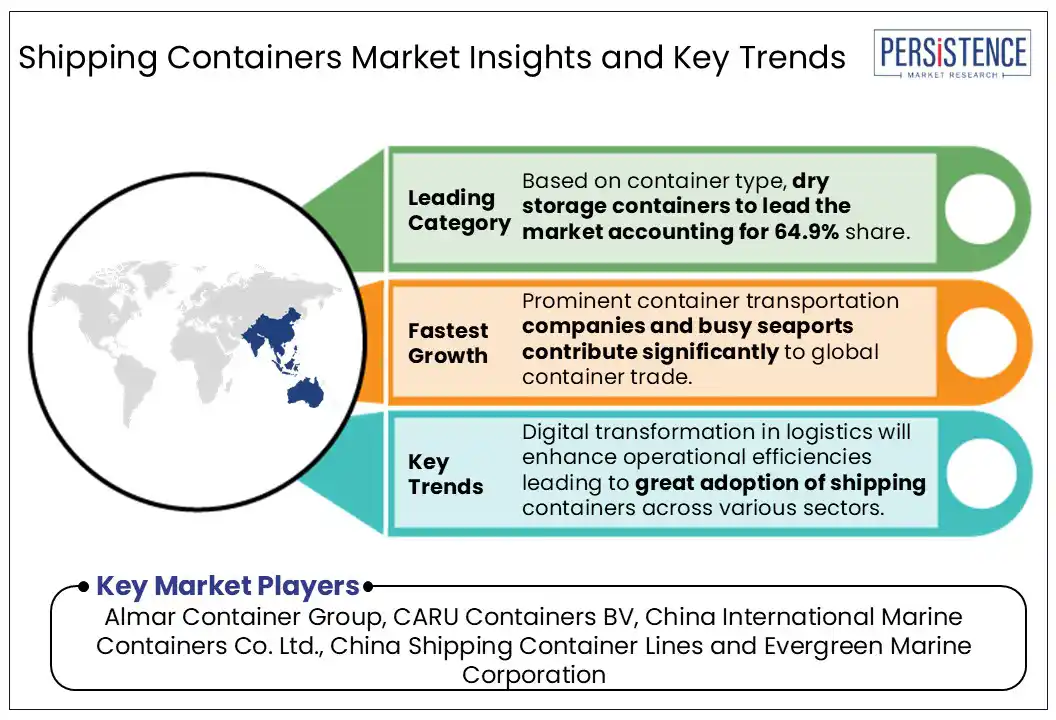
Dry storage containers are projected to dominate the market with 64.9% share in 2025 driven by significant volumes of general cargo transported via sea. These containers efficiently carry a range of bulk commodities and packaged goods including garments, consumer products, machinery, and millwork without refrigeration needs. Their flexibility and low shipping costs make them the preferred choice for non-perishable cargo transport. Additionally, the universal applicability for most non-hazardous dry goods has led to an increasing demand for dry storage containers in the shipping industry.

Shipping Containers Market Introduction and Trend Analysis

The shipping containers market refers to the industry encompassing the design, manufacturing, leasing, and sale of standardized containers used for transporting goods across various modes of transport. These transport modes are ships, trucks, and trains.

Shipping containers are also known as intermodal containers and are typically made from steel and are designed to be durable and weather-resistant, allowing them to protect cargo over long distances and various environmental conditions. These containers work by providing a modular and universally accepted method of transport facilitating the efficient and secure movement of goods across global supply chains.

The industry is currently experiencing transformative trends driven by technological advancements, sustainability initiatives, and evolving consumer demands. One notable trend is the increasing integration of digital technologies such as the Internet of Things (IoT) and blockchain to enhance tracking and monitoring capabilities throughout the supply chain.

Technologies enable real-time visibility of cargo, improving operational efficiency and reducing theft or loss incidents. There is a growing focus on eco-friendly practices prompting manufacturers to explore sustainable materials and designs that minimize environmental impact.

The rise of e-commerce has also contributed to heightened demand for shipping containers as businesses seek to optimize logistics and meet consumer expectations for rapid delivery. The trend of converting shipping containers into adaptable spaces, such as homes and pop-up shops, is gaining momentum, showcasing their potential beyond traditional uses.

Market trends are expected to shape the future landscape of the shipping containers industry driving innovation and redefining operational strategies.
shipping-containers-market-insights-and-key-trends

Historical Growth and Course Ahead

The shipping containers market has indicated steady growth over the past few years. From 2019 to 2024. The market experienced a CAGR of 3.3% driven by the increasing globalization of trade, expanding e-commerce sector, and the need for efficient logistics solutions. This growth period was characterized by robust demand for shipping containers as businesses sought to enhance their supply chain capabilities.

Factors such as infrastructure investments in ports and transportation systems also contributed to this positive trajectory allowing for efficient container movement and handling.

The market is projected to maintain upward growth with an anticipated CAGR of 3.8% from 2025 to 2032. The ongoing digital transformation in logistics will enhance operational efficiencies, leading to great adoption of shipping containers across various sectors. Additionally, the continued rise in global trade particularly in developing economies will drive demand for containerized transport solutions.

Sustainability initiatives will also play a crucial role as stakeholders increasingly prioritize eco-friendly practices potentially leading to the adoption of innovative container designs and materials.

The diversification of container uses including temporary housing and retail spaces is likely to open new market opportunities. The market is set to evolve dynamically balancing traditional freight needs with modern trends and challenges ahead.

Market Growth Drivers

Continuous Expansion of Global Trade

The continuous expansion of global trade is a significant driver for the market growth. As economies become increasingly interconnected, the demand for efficient transportation solutions rises.

Countries are engaging in more trade agreements leading to higher volumes of goods being transported internationally. This trend is particularly evident in emerging markets, where industrialization and urbanization are fueling the need for containerized shipping. The standardization of shipping containers facilitates smoother logistics and reduces costs, making them the preferred choice for transporting goods across borders.

Rapid Growth of E-commerce Boom

The rapid growth of e-commerce has transformed market driving demand for efficient logistics and distribution networks. As consumers increasingly expect fast and reliable delivery of goods, businesses are investing in containerized shipping solutions to meet these demands.

The rise of online shopping has led to a surge in small parcel shipments, which often utilize shipping containers for bulk transport to distribution centers. This trend not only enhances supply chain efficiency but also encourages innovation in container design and usage further propelling market growth.

Technological Innovations

Technological innovations are reshaping the shipping containers market demand by enhancing operational efficiency and safety. The integration of digital technologies such as IoT and blockchain, allows for real-time tracking and monitoring of containers improving visibility throughout the supply chain.

Advancements help reduce losses and optimize logistics processes making container shipping attractive to businesses. Additionally, innovations in container design such as modular and eco-friendly options, are expanding the applications of shipping containers beyond traditional freight driving further growth in the market.

Factors Impeding the Market Growth

Persistent Shortage of Containers

One of the significant challenges impeding the shipping containers market sales is the persistent shortage of containers. This issue has been exacerbated by disruptions caused by COVID-19 pandemic, which led to imbalances in supply and demand.

As global trade rebounded, the demand for containers surged, but production and repositioning lagged behind. This shortage not only drives up shipping costs but also creates delays in the supply chain, affecting businesses that rely on timely deliveries. The inability to secure sufficient containers can hinder operational efficiency and limit market growth.

Port Congestion

Port congestion is another critical factor impeding the market. Increased shipping volumes coupled with labor shortages and logistical inefficiencies have led to significant delays at major ports globally. This congestion results in long turnaround times for vessels, increased shipping costs, and a ripple effect throughout the supply chain.

As containers remain stuck at ports, businesses face challenges in inventory management and fulfillment, which can lead to lost sales and dissatisfied customers. Addressing port congestion is essential for improving the overall efficiency of the market.

Future Opportunities for the Shipping Containers Market Players

Sustainable Container Solutions

As environmental concerns gain prominence, there is a significant opportunity for the shipping containers market expansion and innovation in sustainable container solutions. Manufacturers can focus on developing eco-friendly containers made from recycled materials or utilizing alternative energy sources for production.

The trend toward reducing carbon footprints in logistics presents opportunities for creating containers designed to optimize fuel efficiency during transportation. By addressing sustainability, companies can attract environmentally conscious clients and comply with increasingly stringent regulations.

Modular Container Applications

The versatility of intermodal containers presents several promising opportunity for expanding their use in modular applications. Beyond traditional freight transport, shipping containers can be adapted for various purposes such as temporary housing, mobile retail spaces, or even disaster relief shelters.

As urbanization continues to rise and the demand for affordable housing increases, modular container solutions can offer innovative alternatives. Additionally, businesses seeking flexible, cost-effective workspace solutions may turn to converted containers. This trend not only enhances the market's growth potential but also showcases the adaptability of shipping containers in diverse sectors.

Competitive Landscape for the Shipping Containers Market

The shipping containers market is witnessing swift growth reflecting its dynamic nature. Industry players are launching new products and integrating innovative technologies to create new opportunities in the sector.

Companies are adopting key business strategies to broaden their product ranges, increase market shares in various regions, and enhance supply chains for great market value.

Recent Developments in the Shipping Containers Market

  • September 2024, Loginno, a leading innovator in smart container technology, has launched the first smart container service for domestic shipping in the Philippines. The pilot is part of Loginno's "The Contopia Factor 3" initiative, which aims to revolutionize the global shipping industry by creating a smart container data infrastructure.
  • August 2024, Salgenx has launched a 3,000 KWh zinc chloride saltwater battery for low-cost, large-scale energy storage. The innovative rolled layer design allows the battery to accommodate the natural expansion of zinc during charging, preventing short circuits and extending its operational life. The battery is ideal for grid-scale applications like renewable energy storage, peak shaving, load leveling, and backup power.

Companies Covered in Shipping Containers Market

  • Almar Container Group
  • CARU Containers BV
  • China International Marine Containers Co. Ltd
  • China Shipping Container Lines
  • Evergreen Marine Corporation
  • Ritveyraaj Cargo Shipping Containers
  • Sea Box Inc
  • Singamas Container Holdings Limited
  • Triton International Limited
  • W&K Container Inc.
Frequently Asked Questions

The market is predicted to rise from US$7.5 Bn in 2024 to US$9.8 Bn by 2031.

A few of the leading manufactures are Almar Container Group, CARU Containers BV, and China International Marine Containers Co. Ltd.

Dry storage containers are leading and to dominate the industry with a 64.9% share in 2024.

Asia Pacific region is leading in the market and is expected to reach 47.13% market share in 2024.

Conversion of shipping containers into adaptable spaces is a key trend in the market.

Shipping Containers Market Report Scope

Attributes

Details

Forecast Period

2025 to 2032

Historical Data Available for

2019 to 2024

Market Analysis

US$ Billion for Value

Key Regions Covered

  • North America
  • Asia Pacific
  • Europe

Key Market Segments Covered

  • By Container Size
  • By Container Type
  • By Region

Key Companies Profiled

  • Almar Container Group
  • CARU Containers BV
  • China International Marine Containers Co. Ltd
  • China Shipping Container Lines
  • Evergreen Marine Corporation
  • Ritveyraaj Cargo Shipping Containers
  • Sea Box Inc
  • Singamas Container Holdings Limited
  • Triton International Limited
  • W&K Container Inc.

Report Coverage

  • Market Forecast
  • Company Share Analysis
  • Competition Intelligence
  • DROT Analysis
  • Market Dynamics and Challenges
  • Strategic Growth Initiatives  

Customization & Pricing

Available upon request

Shipping Containers Market Segmentation

By Container Size

  • Small Containers (20 feet)
  • Large Containers (40 feet)
  • High Cube Containers (40 feet)

By Container Type

  • Dry Storage Containers
  • Flat Rack Containers
  • Refrigerated Containers
  • Special Purpose Containers
  • Others

By Region

  • North America
  • Latin America
  • Europe
  • Asia Pacific
  • The Middle East & Africa

Related Reports

1. Executive Summary
    1.1. Global Shipping Containers Market Snapshot, 2025 and 2032
    1.2. Market Opportunity Assessment, 2025 - 2032, US$ Mn
    1.3. Key Market Trends
    1.4. Future Market Projections
    1.5. Premium Market Insights
    1.6. Industry Developments and Key Market Events
    1.7. PMR Analysis and Recommendations
2. Market Overview
    2.1. Market Scope and Definition
    2.2. Market Dynamics
        2.2.1. Drivers
        2.2.2. Restraints
        2.2.3. Opportunity
        2.2.4. Challenges
        2.2.5. Key Trends
    2.3. Macro-Economic Factors
        2.3.1. Global Sectorial Outlook
        2.3.2. Global GDP Growth Outlook
        2.3.3. Other Macro-Economic Factors
    2.4. COVID-19 Impact Analysis
    2.5. Forecast Factors - Relevance and Impact
3. Value Added Insights
    3.1. Container Size Adoption Analysis
    3.2. Technology Assessment
    3.3. Regulatory Landscape
    3.4. Value Chain Analysis
        3.4.1. List of Raw Material Supplier
        3.4.2. List of Manufacturers
    3.5. Key Deals and Mergers
    3.6. PESTLE Analysis
    3.7. Porter’s Five Force Analysis
    3.8. Geopolitical Tensions: Market Impact
4. Price Trend Analysis, 2019 - 2032
    4.1. Key Highlights
    4.2. Key Factors Impacting Container Size Prices
    4.3. Pricing Analysis, By Container Size
    4.4. Regional Prices and Container Size Preferences
5. Global Shipping Containers Market Outlook: Historical (2019 - 2024) and Forecast (2025 - 2032)
    5.1. Market Size (US$ Mn) Analysis and Forecast
        5.1.1. Historical Market Size (US$ Mn) Analysis, 2019-2024
        5.1.2. Current Market Size (US$ Mn) Analysis and Forecast, 2025-2032
    5.2. Global Shipping Containers Market Outlook: Container Size
        5.2.1. Introduction / Key Findings
        5.2.2. Historical Market Size (US$ Mn) Analysis, By Container Size, 2019 - 2024
        5.2.3. Current Market Size (US$ Mn) Forecast, By Container Size, 2025 - 2032
            5.2.3.1. Small Containers
            5.2.3.2. Large Containers
            5.2.3.3. High Cube Containers
    5.3. Market Attractiveness Analysis: Container Size
    5.4. Global Shipping Containers Market Outlook: Container Type
        5.4.1. Introduction / Key Findings
        5.4.2. Historical Market Size (US$ Mn) Analysis, By Container Type, 2019 - 2024
        5.4.3. Current Market Size (US$ Mn) Analysis and Forecast, By Container Type, 2025 - 2032
            5.4.3.1. Dry Storage
            5.4.3.2. Flat Rack
            5.4.3.3. Refrigerated
            5.4.3.4. Special Purpose
            5.4.3.5. Others
    5.5. Market Attractiveness Analysis: Container Type
6. Global Shipping Containers Market Outlook: Region
    6.1. Key Highlights
    6.2. Historical Market Size (US$ Mn) Analysis, By Region, 2019 - 2024
    6.3. Current Market Size (US$ Mn) Forecast, By Region, 2025 - 2032
        6.3.1. North America
        6.3.2. Europe
        6.3.3. East Asia
        6.3.4. South Asia and Oceania
        6.3.5. Latin America
        6.3.6. Middle East & Africa
    6.4. Market Attractiveness Analysis: Region
7. North America Shipping Containers Market Outlook: Historical (2019 - 2024) and Forecast (2025 - 2032)
    7.1. Key Highlights
    7.2. Pricing Analysis
    7.3. Historical Market Size (US$ Mn) Analysis, By Market, 2019 - 2024
        7.3.1. By Country
        7.3.2. By Container Size
        7.3.3. By Container Type
    7.4. Current Market Size (US$ Mn) Analysis and Forecast, By Country, 2025 - 2032
        7.4.1. U.S.
        7.4.2. Canada
    7.5. Current Market Size (US$ Mn) and Volume (Units) Analysis and Forecast, By Container Size, 2025 - 2032
        7.5.1. Small Containers
        7.5.2. Large Containers
        7.5.3. High Cube Containers
    7.6. Current Market Size (US$ Mn) Analysis and Forecast, By Container Type, 2025 - 2032
        7.6.1. Dry Storage
        7.6.2. Flat Rack
        7.6.3. Refrigerated
        7.6.4. Special Purpose
        7.6.5. Others
    7.7. Market Attractiveness Analysis
8. Europe Shipping Containers Market Outlook: Historical (2019 - 2024) and Forecast (2025 - 2032)
    8.1. Key Highlights
    8.2. Pricing Analysis
    8.3. Historical Market Size (US$ Mn) and Volume (Units) Analysis, By Market, 2019 - 2024
        8.3.1. By Country
        8.3.2. By Container Size
        8.3.3. By Container Type
    8.4. Current Market Size (US$ Mn) Analysis and Forecast, By Country, 2025 - 2032
        8.4.1. Germany
        8.4.2. France
            8.4.3. U.K.
            8.4.4. Italy
            8.4.5. Spain
            8.4.6. Russia
            8.4.7. Türkiye
            8.4.8. Rest of Europe
    8.5. Current Market Size (US$ Mn) and Volume (Units) Analysis and Forecast, By Container Size, 2025 - 2032
        8.5.1. Small Containers
        8.5.2. Large Containers
        8.5.3. High Cube Containers
    8.6. Current Market Size (US$ Mn) Analysis and Forecast, By Container Type, 2025 - 2032
        8.6.1. Dry Storage
        8.6.2. Flat Rack
        8.6.3. Refrigerated
        8.6.4. Special Purpose
        8.6.5. Others
    8.7. Market Attractiveness Analysis
9. East Asia Shipping Containers Market Outlook: Historical (2019 - 2024) and Forecast (2025 - 2032)
    9.1. Key Highlights
    9.2. Pricing Analysis
    9.3. Historical Market Size (US$ Mn) and Volume (Units) Analysis, By Market, 2019 - 2024
        9.3.1. By Country
        9.3.2. By Container Size
        9.3.3. By Container Type
    9.4. Current Market Size (US$ Mn) Analysis and Forecast, By Country, 2025 - 2032
        9.4.1. China
        9.4.2. Japan
        9.4.3. South Korea
    9.5. Current Market Size (US$ Mn) and Volume (Units) Analysis and Forecast, By Container Size, 2025 - 2032
        9.5.1. Small Containers
        9.5.2. Large Containers
        9.5.3. High Cube Containers
    9.6. Current Market Size (US$ Mn) Analysis and Forecast, By Container Type, 2025 - 2032
        9.6.1. Dry Storage
        9.6.2. Flat Rack
        9.6.3. Refrigerated
        9.6.4. Special Purpose
        9.6.5. Others
    9.7. Market Attractiveness Analysis
10. South Asia & Oceania Shipping Containers Market Outlook: Historical (2019 - 2024) and Forecast (2025 - 2032)
    10.1. Key Highlights
    10.2. Pricing Analysis
    10.3. Historical Market Size (US$ Mn) and Volume (Units) Analysis, By Market, 2019 - 2024
        10.3.1. By Country
        10.3.2. By Container Size
        10.3.3. By Container Type
    10.4. Current Market Size (US$ Mn) Analysis and Forecast, By Country, 2025 - 2032
        10.4.1. India
        10.4.2. Southeast Asia
        10.4.3. ANZ
        10.4.4. Rest of South Asia & Oceania
    10.5. Current Market Size (US$ Mn) and Volume (Units) Analysis and Forecast, By Container Size, 2025 - 2032
        10.5.1. Small Containers
        10.5.2. Large Containers
        10.5.3. High Cube Containers
    10.6. Current Market Size (US$ Mn) Analysis and Forecast, By Container Type, 2025 - 2032
        10.6.1. Dry Storage
        10.6.2. Flat Rack
        10.6.3. Refrigerated
        10.6.4. Special Purpose
        10.6.5. Others
    10.7. Market Attractiveness Analysis
11. Latin America Shipping Containers Market Outlook: Historical (2019 - 2024) and Forecast (2025 - 2032)
    11.1. Key Highlights
    11.2. Pricing Analysis
    11.3. Historical Market Size (US$ Mn) and Volume (Units) Analysis, By Market, 2019 - 2024
        11.3.1. By Country
        11.3.2. By Container Size
        11.3.3. By Container Type
    11.4. Current Market Size (US$ Mn) Analysis and Forecast, By Country, 2025 - 2032
        11.4.1. Brazil
        11.4.2. Mexico
        11.4.3. Rest of Latin America
    11.5. Current Market Size (US$ Mn) and Volume (Units) Analysis and Forecast, By Container Size, 2025 - 2032
        11.5.1. Small Containers
        11.5.2. Large Containers
        11.5.3. High Cube Containers
    11.6. Current Market Size (US$ Mn) Analysis and Forecast, By Container Type, 2025 - 2032
        11.6.1. Dry Storage
        11.6.2. Flat Rack
        11.6.3. Refrigerated
        11.6.4. Special Purpose
        11.6.5. Others
    11.7. Market Attractiveness Analysis
12. Middle East & Africa Shipping Containers Market Outlook: Historical (2019 - 2024) and Forecast (2025 - 2032)
    12.1. Key Highlights
    12.2. Pricing Analysis
    12.3. Historical Market Size (US$ Mn) and Volume (Units) Analysis, By Market, 2019 - 2024
        12.3.1. By Country
        12.3.2. By Container Size
        12.3.3. By Container Type
    12.4. Current Market Size (US$ Mn) Analysis and Forecast, By Country, 2025 - 2032
        12.4.1. GCC Countries
        12.4.2. Egypt
        12.4.3. South Africa
        12.4.4. Northern Africa
        12.4.5. Rest of Middle East & Africa
    12.5. Current Market Size (US$ Mn) and Volume (Units) Analysis and Forecast, By Container Size, 2025 - 2032
        12.5.1. Small Containers
        12.5.2. Large Containers
        12.5.3. High Cube Containers
    12.6. Current Market Size (US$ Mn) Analysis and Forecast, By Container Type, 2025 - 2032
        12.6.1. Dry Storage
        12.6.2. Flat Rack
        12.6.3. Refrigerated
        12.6.4. Special Purpose
        12.6.5. Others
    12.7. Market Attractiveness Analysis
13. Competition Landscape
    13.1. Market Share Analysis, 2025
    13.2. Market Structure
        13.2.1. Competition Intensity Mapping
        13.2.2. Competition Dashboard
    13.3. Company Profiles (Details - Overview, Financials, Strategy, Recent Developments)
        13.3.1. Almar Container Group
            13.3.1.1. Overview
            13.3.1.2. Segments and Container Sizes
            13.3.1.3. Key Financials
            13.3.1.4. Market Developments
            13.3.1.5. Market Strategy
        13.3.2. CARU Container BV
        13.3.3. China International Marine Containers Ltd.
        13.3.4. China Shipping Container Lines
        13.3.5. Evergreen Marine Corporation
        13.3.6. Sea Box Inc
        13.3.7. Singamas Container Holding Limited
        13.3.8. Triton International Ltd
        13.3.9. W&K Container Ltd.
        13.3.10. Others
14. Appendix
    14.1. Research Methodology
    14.2. Research Assumptions
    14.3. Acronyms and Abbreviations

Research Methodology Framework for Market Research Excellence

At Persistence Market Research, we implement a comprehensive, validated, and multi-dimensional approachto market analysis that delivers actionable insights across complex market landscapes. Our methodology combines the analytical rigor of leading consulting firms with innovative research techniques, ensuring robust market assessments that guide strategic decision-making with confidence.

Core Research Philosophy

Our methodology is built on four foundational pillars:

Research Philosophy Image

At Persistence Market Research, our methodology is designed to transcend conventional market studies by combining analytical rigor, multi-source validation, and future-focused insights.

We integrate advanced research frameworks, robust data collection strategies, cutting-edge analytics, and innovative technologies to deliver a 360-degree view of complex markets.

We integrate advanced research frameworks, robust data collection strategies, cutting-edge analytics, and innovative technologies to deliver a 360-degree view of complex markets.

Each stage spanning from strategic scoping and hypothesis-building to competitive intelligence, quality validation, and actionable recommendations is engineered to provide clients with unmatched clarity, precision, and confidence in decision-making.

By embedding innovation and technology at the core, our approach ensures that insights are not only comprehensive but also predictive, empowering businesses to seize opportunities, mitigate risks, and achieve sustainable growth

Research Philosophy Image

Capturing Key Information and Events

During this phase, key research objectives focus on essential information and data points for assessing the market, including:

Research Philosophy Image

TAM-SAM-SOM Framework Implementation

We employ both top-down and bottom-up approaches to ensure accurate market sizing.

Top-Down Market SizingBottom-Up Market Sizing
Universe Definition: Total global/regional market identificationUnit Economics: Average transaction values, purchase frequencies, customer lifecycle
Segmentation Filters: Geographic, demographic, and behavioral constraintsCustomer Segmentation: Detailed buyer persona development and sizing
Market Share Analysis: Competitive landscape assessment and share allocationPenetration Analysis: Market penetration rates by segment and geography
Growth Rate Application: Historical trends and forward-looking growth assumptionsScaling Methodology: Extrapolation techniques with confidence intervals

Validation & Cross-Verification

  • Triangulation: Comparing top-down and bottom-up results for consistency
  • Sensitivity Analysis: Testing key assumptions and parameter variations
  • Peer Benchmarking: Comparison with analogous markets and industry benchmarks
  • Expert Review: External validation through industry specialist consultation

Research Philosophy Image

Forecasting & Projection Modeling

Our proprietary forecasting models incorporate multiple variables and scenarios.

Forecasting Components

  • Historical Trend Analysis: 10-year historical growth patterns and cyclical variations
  • Driver-Based Modeling: Economic indicators, demographic shifts, technology adoption
  • Scenario Planning: Base case, optimistic, and conservative projections
  • Monte Carlo Simulations: Probability-weighted outcomes and risk assessments

Model Validation

  • Back-Testing: Historical accuracy assessment over 3–5-year periods
  • Cross-Validation: Multiple modeling approaches for result comparison
  • External Benchmarking: Comparison with established market forecasts
  • Continuous Calibration: Quarterly model updates based on new data

Comprehensive Data Collection Strategy

Our secondary research phase establishes a robust knowledge base utilizing diverse, credible sources.

Secondary Data Sourcess

  • Industry Publications & Reports
  • Government & Regulatory Data
  • Financial Intelligence (filings & reports)
  • Academic Research & Digital Intelligence

Quality Assurance Protocol

  • Source credibility assessment and publication date validation
  • Data consistency checks across multiple sources
  • Bias identification and neutralization techniques
  • Information gap tracking for primary research prioritization

Research Philosophy Image

Primary Research Excellence

Our primary research methodology employs best-in-class techniques to capture unique market insights.

Quantitative Research Methods

  • Large-Scale Surveys: Statistically representative samples with 95% confidence intervals
  • Survey Methodology: Multi-channel deployment (online, telephone, in-person)
  • Question Architecture and Response Optimization

Qualitative Research Methods

  • Executive Interviews
  • Focus Groups
  • Expert Consultations

Quality Assurance & Validation Framework

Multi-Stage Validation Process

  • Source Verification and Consistency Testing
  • Outlier Detection and Bias Assessment
  • Peer Review Process and External Validation
  • Sensitivity Analysis and Confidence Intervals

Research Philosophy Image

Methodology Validation & Credibility

Our research methodology has been extensively validated through:

  • Academic Partnerships: Collaborations with top-tier business schools and research institutions
  • Client Success Stories: Documented case studies demonstrating research impact and ROI
  • Continuous Benchmarking: Performance comparison with leading global research firms

This comprehensive methodology framework positions Persistence Market Research at the forefront of market intelligence, combining the analytical sophistication of top-tier consulting firms with innovative research techniques. Our approach ensures that every market assessment delivers precise, actionable, and strategically valuable insights that drive business success in competitive market environments.

Ready to unlock your market potential? Contact our research experts to discuss how our validated methodology can transform your strategic decision-making with data-driven market intelligence.

Copyright © 2026 Persistence Market Research. All Rights Reserved

Connect With Us -