




- Aerospace & Defense
- Commercial Aircraft Market
Commercial Aircraft Market Size, Trends, Share, and Growth Forecast 2026 - 2033
Commercial Aircraft Market by Aircraft Type (Narrow-Body Aircraft, Wide-Body Aircraft, Regional Aircraft, Freighter Aircraft), by Application (Passenger Transport, Cargo Transport, Industrial Construction, Others), and Regional Analysis, 2026 - 2033

Commercial Aircraft Market Size and Trend Analysis
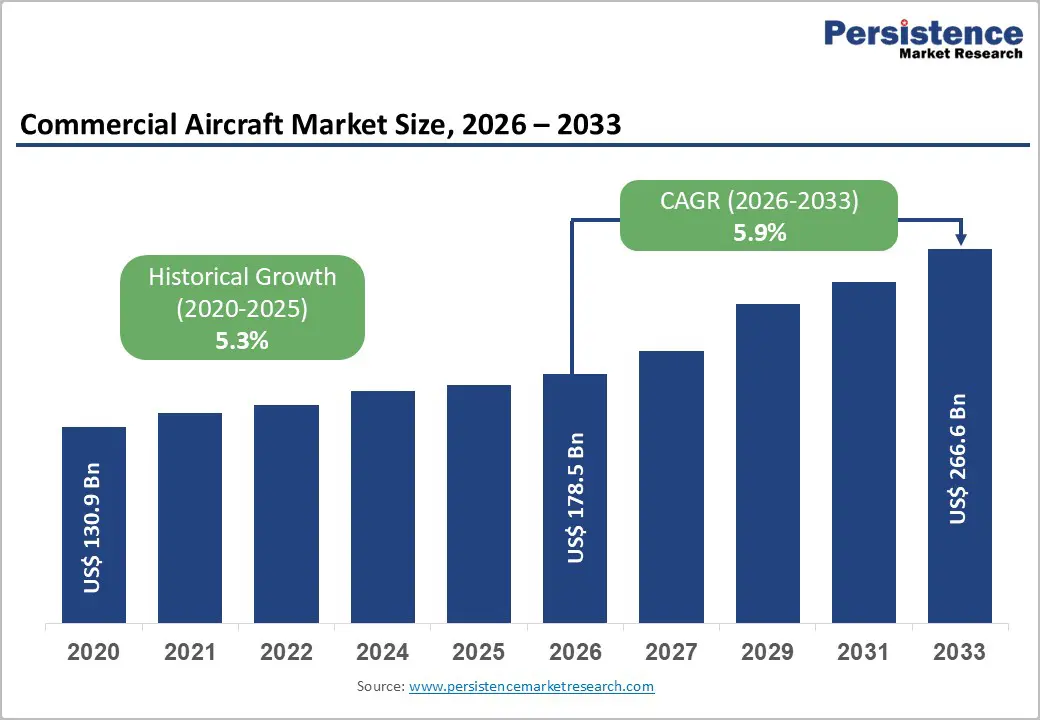
The global commercial aircraft market size is expected to be valued at US$ 178.5 billion in 2026 and projected to reach US$ 266.6 billion by 2033, growing at a CAGR of 5.9% between 2026 and 2033.
This growth is driven by rising global air passenger traffic and expanding air cargo demand, as airlines modernize their fleets to enhance efficiency and fuel efficiency. IATA forecasts nearly 5.2 billion passengers in 2026, a 4.4% increase from 2025, supported by economic recovery in emerging markets and the expansion of low-cost carriers. Simultaneously, the growth of e-commerce is increasing the demand for freighter aircraft.
Key Industry Highlights:
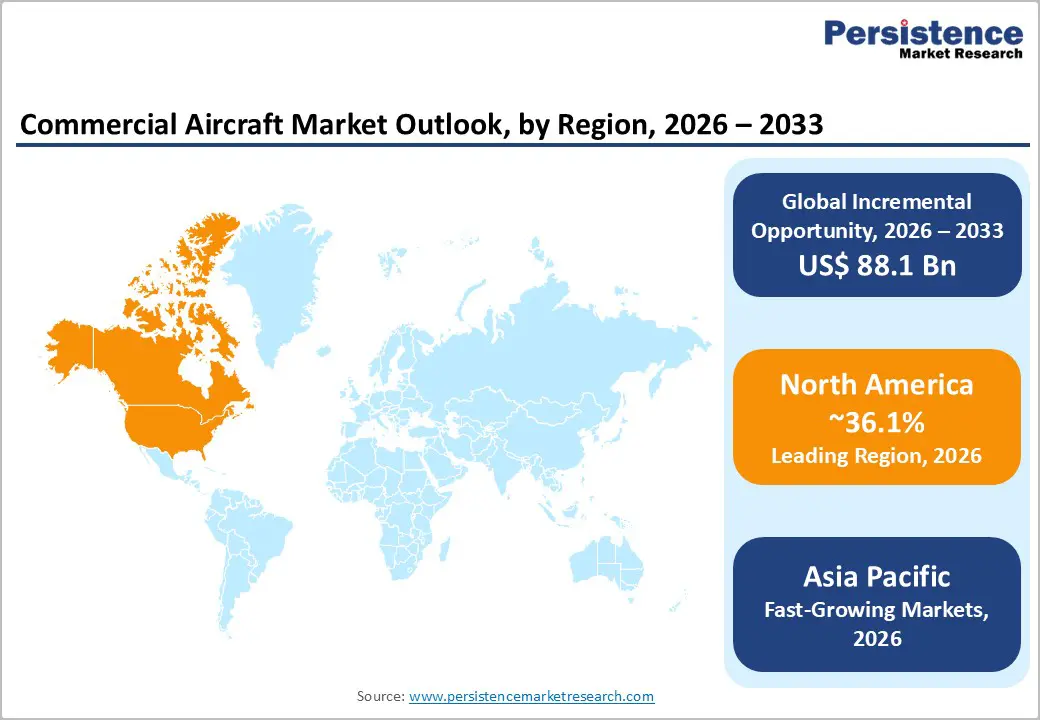
- Leading Region: North America leads the commercial aircraft market with approximately 36.1% share in 2025, driven by major manufacturers, fleet modernization, and low-cost carrier expansion.
- Fastest-Growing Region: Asia Pacific is the fastest-growing region, accounting for approximately 34.4% of the market in 2025, driven by surging air traffic in China, India, and Japan.
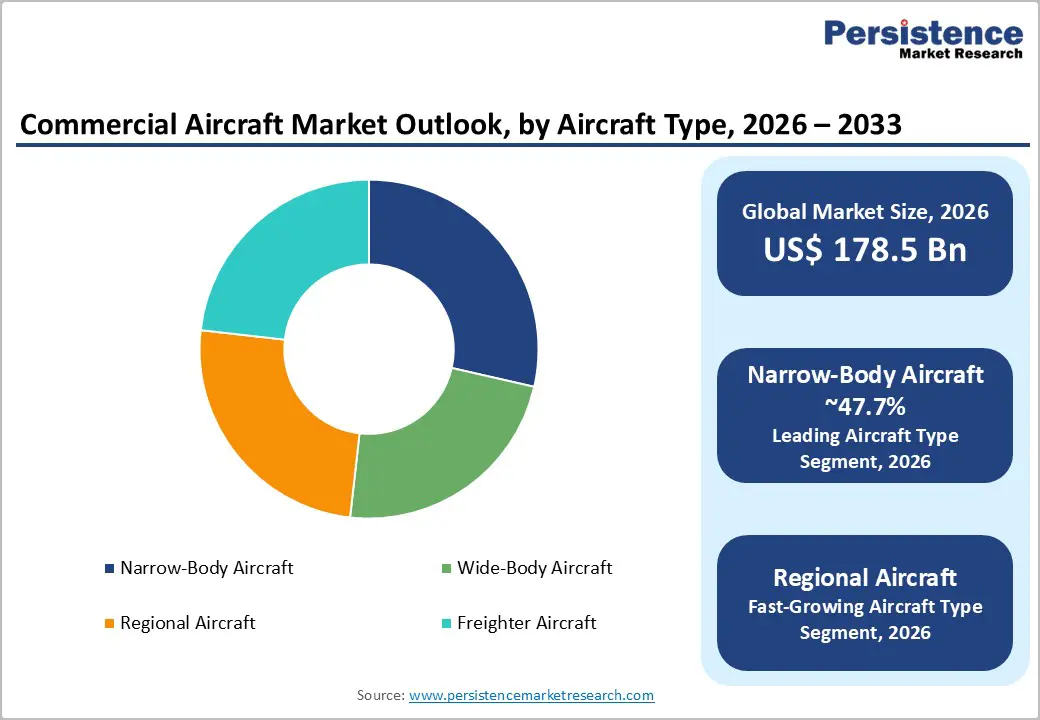
- Leading Aircraft Type: Narrow-body aircraft dominate the market, accounting for roughly 47.7% of the market in 2025, driven by short- to medium-haul efficiency and single-aisle versatility.
- Fastest-Growing Application: Freighter aircraft are the fastest-growing application segment, supported by e-commerce growth, cargo demand, and expanding passenger-to-freighter conversions.
- Key Opportunity: Sustainable Aviation Fuel (SAF) adoption presents a major opportunity, aligning with global net-zero CO2 targets by 2050 and supporting green fleet initiatives.
| Key Insights | Details |
|---|---|
| Commercial Aircraft Size (2026E) | US$ 178.5 billion |
| Market Value Forecast (2033F) | US$ 266.6 billion |
| Projected Growth CAGR (2026 - 2033) | 5.9% |
| Historical Market Growth (2020 - 2025) | 5.3% |
Market Dynamics
Drivers - Rising Global Air Passenger Traffic Fueling Commercial Aircraft Demand
The increasing demand for global air travel is a key driver of the commercial aircraft market. IATA projects nearly 5 billion passengers in 2025, reaching 5.2 billion in 2026 at 4.4% growth, driven by rising middle-class populations in the Asia-Pacific region and the post-pandemic tourism recovery. Low-cost carriers are optimizing short-haul routes using fuel-efficient narrow-body jets, prompting airlines to expand capacity and enhance network connectivity.
Airlines are planning to increase seating capacity to maintain high load factors, necessitating additional aircraft deliveries. This trend particularly increases demand for single-aisle aircraft, supporting fleet growth strategies while ensuring operational efficiency and meeting passenger traffic growth across regional and domestic networks worldwide.
leet Modernization and Efficiency Initiatives Driving Aircraft Replacement
Airlines are increasingly prioritizing fleet modernization to replace older, less efficient aircraft with advanced models offering improved fuel economy and reduced emissions. Forecasts indicate a substantial long-term need for replacement, as newer aircraft deliver significant operational cost savings and comply with stricter environmental regulations.
Next-generation jets from major OEMs are being delivered at accelerated rates, reflecting a focus on narrow-body aircraft to achieve efficiency gains. This replacement cycle not only enhances airline competitiveness but also ensures sustainable operations, operational reliability, and readiness to meet growing passenger and cargo demand, while adhering to evolving global regulatory requirements.
Restraints - Supply Chain Disruptions and Production Bottlenecks Restricting Commercial Aircraft Growth
Persistent disruptions across the aerospace supply chain remain a major constraint for the commercial aircraft market. Labor shortages, component delays, and logistical inefficiencies slow production and delivery schedules, creating a ripple effect that impacts airlines’ fleet expansion plans. Engine maintenance backlogs and geopolitical tensions, such as trade restrictions, further exacerbate these issues, making it challenging for manufacturers to meet growing global demand.
Despite efforts to ramp up deliveries in late 2025, output continues to fall short of airline requirements. Boeing and Airbus face production-volume constraints, highlighting the fragility of their supply chains. These bottlenecks hinder fleet growth, increase the complexity of operational planning for airlines, and create uncertainty about the timely deployment of new aircraft to meet passenger and cargo demand.
High Research, Development, and Certification Costs Limit Market Accessibility
The commercial aircraft market is constrained by the high costs of designing, developing, and certifying new aircraft models. Widebody programs demand multi-billion-dollar investments, while stringent regulatory approvals and safety certifications prolong production timelines. This creates significant barriers to entry for smaller or emerging manufacturers, consolidating the market around established players.
Skilled labor shortages in engine production and specialized aerospace manufacturing further increase development costs, slowing innovation and delaying the introduction of next-generation aircraft. These financial and operational constraints limit competition, consolidate dominance among major OEMs, and constrain the pace at which new, fuel-efficient, and technologically advanced aircraft can enter service to meet evolving airline and environmental requirements.
Opportunities - Growing Adoption of Sustainable Aviation Fuels Driving Market Opportunities
The scaling of Sustainable Aviation Fuels (SAF) presents significant growth opportunities in the commercial aircraft market. SAF adoption is central to global carbon-reduction strategies, including IATA’s net-zero CO2 target by 2050 and the EU’s goal of a 55% emissions reduction by 2030. Airlines are increasingly investing in SAF-ready aircraft, while manufacturers focus on retrofittable fleets compatible with alternative fuels, aligning with policy mandates and sustainability regulations.
Investments in SAF production and distribution infrastructure are stimulating demand for green aircraft technologies and retrofitted systems. OEMs that prioritize SAF compatibility can capture new revenue streams while meeting airline sustainability goals. This trend also drives innovation in engine efficiency, fuel management systems, and lightweight materials, enhancing the commercial aircraft market’s long-term growth potential.
Regional and Freighter Aircraft Expansion: Unlocking New Market Segments
The fastest-growing segments in the commercial aircraft market are regional and freighter aircraft, offering substantial opportunities for manufacturers and operators. Freight demand is driven by surging e-commerce and expanding global trade, with projected cargo volume growth of over 3% annually, particularly in the Asia-Pacific region. Airbus forecasts more than 2,600 freighters will be required in the coming years, including nearly 1,000 new-build units, underscoring the potential for dedicated cargo solutions.
Regional jets serve underserved and short-haul routes, supported by the expansion of airport infrastructure in emerging markets such as India and China. Companies investing in these segments can capture emerging demand, optimize route networks, and strengthen fleet versatility. Targeting regional and freighter aircraft markets allows manufacturers to diversify offerings while responding to evolving airline and cargo needs worldwide.
Category-wise Analysis
Aircraft Type Insights
Narrow-body aircraft lead the commercial aircraft market, accounting for approximately 47.7% of the global share in 2025. Their dominance is driven by low-cost carriers and airlines optimizing short- to medium-haul routes. Airbus delivered 607 A320neo-family units and Boeing 447 737 units in 2025, representing 76% of total deliveries. Single-aisle jets are highly efficient, supporting 86% load factors and enabling airlines to maximize route utilization while reducing operational costs. This versatility cements narrow-body aircraft as the leading segment globally.
Meanwhile, regional aircraft are the fastest-growing category, expanding their presence in emerging and underserved markets. Smaller jets and turboprops efficiently serve short-haul routes with limited infrastructure, supporting connectivity in regions such as India, Southeast Asia, and Africa. Investment in regional airports and feeder routes fuels fleet additions, positioning regional aircraft as a strategic growth segment for OEMs targeting market expansion beyond established hubs.
Application Insights
Passenger transport remains the leading application segment, capturing about 61% of the market in 2025. The recovery of global air traffic to 5 billion passengers is driving strong demand for efficient commercial jets on domestic and international routes. Airlines prioritize high-capacity, fuel-efficient aircraft to meet seasonal peak demand, with bulk orders reflecting sustained expansion. Tourism growth, urban connectivity, and low-cost carrier networks contribute to passenger transport’s continued dominance in the global aircraft market.
At the same time, freighter aircraft are rapidly gaining attention as a high-potential segment. Growth in e-commerce, express logistics, and cargo-focused operations is fueling demand for dedicated freighters and passenger-to-freighter conversions. Companies investing in this segment benefit from increasing global trade volumes and emerging market routes where air cargo connectivity is expanding, making freighters a strategic focus for future market growth.
Regional Insights
North America Commercial Aircraft Market Trends
North America leads the commercial aircraft market, holding approximately 36.1% share in 2025. The region’s dominance is driven by U.S. manufacturing giants such as Boeing and by the presence of Airbus facilities, which support strong production and delivery capabilities. Fleet replacement cycles and low-cost carrier expansion further fuel demand, with airlines such as Delta placing significant orders for the 737 MAX to improve fuel efficiency and reduce operational costs.
Regulatory oversight by the FAA ensures rigorous safety standards and drives the adoption of technology. Certification frameworks accelerate the deployment of next-generation aircraft, supporting both narrow-body and wide-body fleet modernization. Combined with mature infrastructure and high air travel volumes, these factors consolidate North America’s position as the most influential commercial aircraft market globally.
Europe Commercial Aircraft Market Trends
Europe accounts for a substantial portion of the commercial aircraft market, with growth moderated by a 5.9% CAGR during 2026-2033. The region benefits from a mature aviation ecosystem, high passenger volumes, and the presence of major OEMs like Airbus, which provide both production and technological capabilities. Airlines focus on fleet modernization to improve efficiency and comply with stringent emissions regulations.
Strong regulatory oversight, including EASA certifications, ensures safety, sustainability, and the adoption of next-generation aircraft technologies. While growth is slower than Asia Pacific, demand is supported by low-cost carrier expansion, sustainable aviation initiatives, and replacement cycles of aging fleets. Europe remains a strategically important market for both narrow-body and wide-body aircraft segments.
Asia Pacific Commercial Aircraft Market Trends
Asia-Pacific accounts for approximately 34.4% of the market in 2025 and is the fastest-growing region in the commercial aircraft market. Growth is fueled by surging air passenger traffic in China, India, and Japan, coupled with the rapid expansion of regional and low-cost carriers. India alone experienced 16% growth in international traffic in mid-2025, highlighting rising demand for both narrow-body and regional jets.
E-commerce growth and the expansion of manufacturing hubs further increase fleet requirements. Airbus forecasts a demand for nearly 19,560 aircraft in the region over the coming years. Infrastructure development, urban connectivity, and emerging market aviation policies support fleet expansion, positioning the Asia Pacific as a critical growth engine for global commercial aircraft manufacturers.
Competitive Landscape
The commercial aircraft market is highly consolidated, dominated by a few major players controlling most of the large jet production. Smaller manufacturers focus on niche segments, particularly regional and short-haul aircraft. Market leaders maintain growth through substantial order backlogs, continuous research and development in advanced materials and avionics, and adoption of sustainability-focused technologies, including alternative fuels and fuel-efficient designs.
Emerging models emphasize innovation in digital maintenance, repair, and overhaul (MRO) solutions, as well as hybrid propulsion technologies. This competitive environment encourages efficiency, technological differentiation, and rapid adoption of next-generation aircraft to meet evolving airline and regulatory demands globally.
Key Developments:
- In January 2026, Boeing secured 1,175 commercial aircraft orders for 2025, exceeding Airbus’s 1,000 orders. Robust demand for the 787 wide-body and narrow-body jets contributed to the company’s strong backlog, highlighting growth momentum and fleet replacement priorities globally.
- In December 2025, Boeing delivered a total of 600 commercial aircraft, including 447 units of the 737 family, surpassing initial forecasts amid an ongoing production ramp-up and reflecting strong demand for single-aisle jets across domestic and international routes.
- In December 2025, Airbus delivered 793 commercial aircraft, led by 607 units of the A320neo family. Despite ongoing supply chain challenges, the deliveries demonstrate resilience in production, meeting airline requirements for fuel-efficient, short- to medium-haul operations.
Companies Covered in Commercial Aircraft Market
- Airbus SE
- Boeing Commercial Airplanes
- Commercial Aircraft Corporation of China (COMAC)
- Embraer S.A.
- ATR
- Mitsubishi Aircraft Corporation
- Sukhoi Civil Aircraft Company
- Irkut Corporation
- Antonov Company
- De Havilland Aircraft of Canada
- Textron Aviation
- Pilatus Aircraft
- Leonardo S.p.A.
- Harbin Aircraft Industry Group
- United Aircraft Corporation (UAC)
Frequently Asked Questions
The global Commercial Aircraft market is expected to reach US$ 178.5 billion in 2026.
Rising air passenger traffic, with IATA forecasting 5.2 billion passengers in 2026 at 4.4% growth, drives demand.
North America leads with approximately 36.1% share in 2025, supported by manufacturing hubs, fleet modernization, and low-cost carrier growth.
Adoption of Sustainable Aviation Fuels (SAF) offers a major opportunity, aligning with IATA’s net-zero CO2 target by 2050.
Leading players include Airbus SE, Boeing Commercial Airplanes, Commercial Aircraft Corporation of China (COMAC), Embraer S.A., and ATR.


