




- Aerospace & Defense
- Smart Weapons Market
Smart Weapons Market Size, Share, and Growth Forecast 2026 - 2033
Smart Weapons Market by Product Type (Smart Missiles, Guided Projectiles, Munitions, Firearms, Directed Energy Weapons), Technology (Satellite Guidance, Laser Guidance, Radar Guidance, Infrared, Other), Platform (Airborne Systems, Land-based, Naval), and Regional Analysis for 2026 - 2033

Smart Weapons Market Size and Trends Analysis
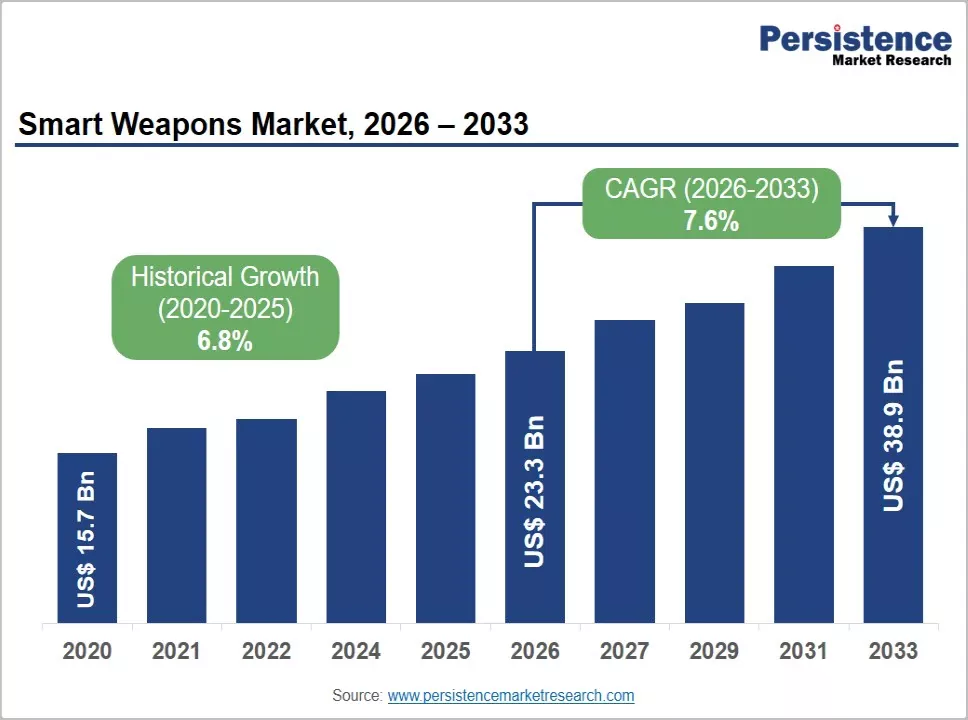
The global smart weapons market is expected to be valued at US$ 23.30 Billion in 2026 and is projected to reach US$ 38.91 Billion by 2033, growing at a CAGR of 7.6% between 2026 and 2033.
Geopolitical tensions, including the Russia-Ukraine conflict and increasing Indo-Pacific security concerns, are reshaping defense procurement priorities and accelerating the shift toward precision-strike and network-enabled smart weapons. These systems support more accurate engagement and improved integration with modern defense networks, increasing their relevance across evolving military requirements.
The growth trajectory reflects rising procurement from NATO member states, many of which committed to increasing defense spending toward two percent of GDP following the 2023 Vilnius Summit, alongside sustained procurement by Indo-Pacific allies responding to People's Liberation Army modernization. The smart weapons industry enters the forecast period with sustained procurement momentum supported by defense modernization programs and inventory replenishment requirements.
Key Market Highlights
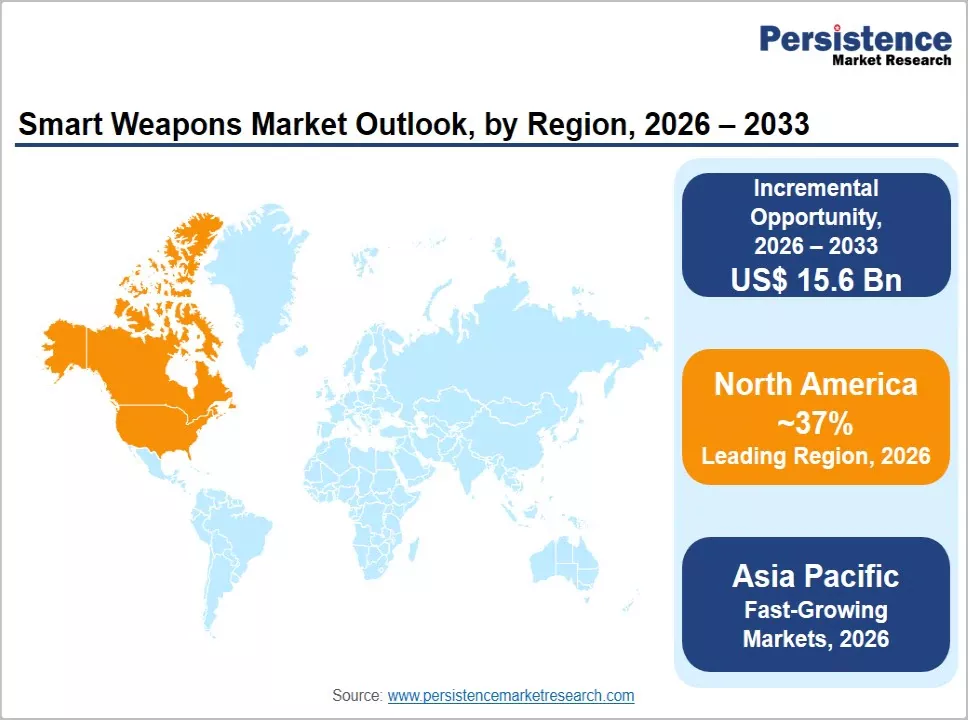
- Leading Region: North America is expected to lead the market, holding around 37.0% share in 2026, supported by the scale of U.S. Department of Defense (DoD) procurement and the world's largest foreign military sales pipeline.
- Fastest-Growing Region: Asia Pacific represents the fastest-growing market, expanding at a 9% CAGR through 2033, driven by rising defense spending, military modernization programs, and growing demand for precision-strike capabilities amid regional security concerns.
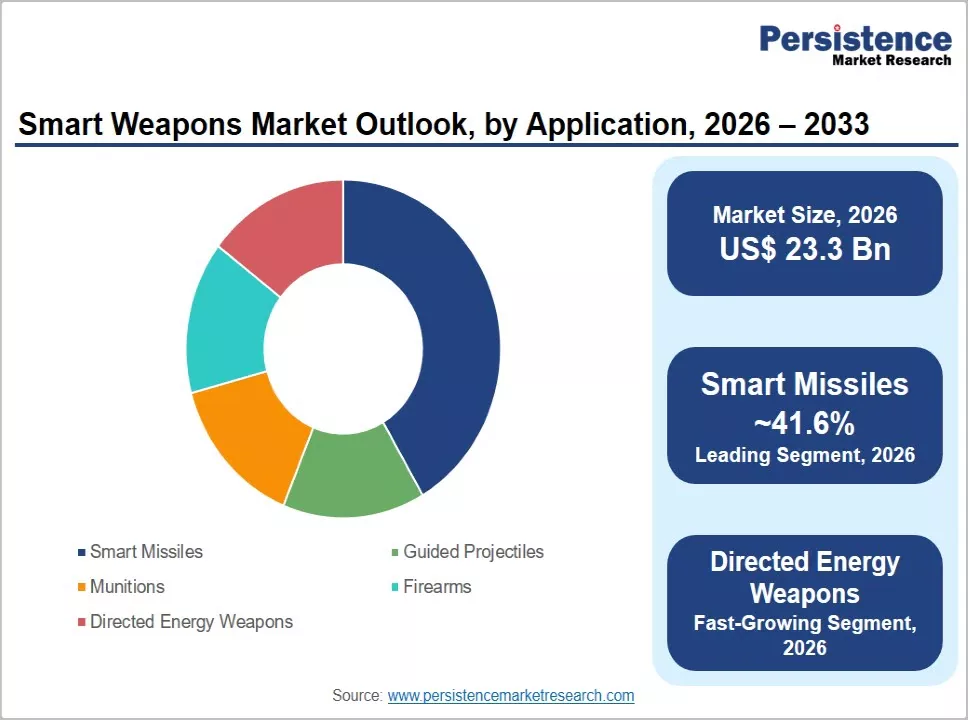
- Leading Segment: Smart missiles represent the leading product type segment, holding around 41.6% market share in 2026, driven by their cross-domain versatility across air, naval, and ground launch platforms. Integration with multi-spectral seekers and data-link capabilities further supports adoption across modern precision-strike applications.
- Fastest-Growing Segment: Directed energy weapons represent the fastest-growing product type segment, driven by increasing development and fielding of high-energy laser and high-power microwave systems for counter-drone, missile defense, and other high-volume threat environments.
Market Dynamics
Drivers - Accelerating NATO and Allied Procurement Cycles
Higher defense spending among NATO members and allied countries is supporting smart weapons procurement. Germany's Bundeswehr activated a EUR 100 billion special defense fund in 2022, with substantial allocations directed toward precision-guided munitions and loitering munition systems.
Poland, now spending over four percent of GDP on defense according to NATO figures, signed contracts in 2024 for additional air-launched smart missile stocks. These programs represent broad military modernization efforts that prioritize GPS/INS-guided systems, man-in-the-loop targeting architectures, and networked fire-control integration over legacy unguided ordnance. Prime contractors across the smart weapons sector are expanding production capacity in response to multi-year framework agreements, supporting revenue visibility through 2030 and beyond.
Operational Proof-of-Concept from Active Theatres
Combat experience in Ukraine has provided substantial operational evidence for precision-guided weapons and related defense systems. HIMARS (High Mobility Artillery Rocket System) precision strikes, the demonstrated effectiveness of Excalibur GPS-guided artillery rounds, and the battlefield use of Javelin anti-tank guided missiles have influenced procurement assessments by the United States Department of Defense (DoD) and allied ministries. The DoD's Fiscal Year 2025 budget request allocated more than US$ 30 billion toward missile programs and precision munitions replenishment. This operational experience is strengthening demand for systems with demonstrated battlefield performance and accelerating inventory replenishment across several markets.
Restraints - Supply Chain Constraints in Critical Microelectronics and Energetics
Precision-guided munitions depend on specialized microelectronics, radiation-hardened processors, MEMS inertial sensors, and application-specific integrated circuits that face persistent sourcing challenges. The U.S. Government Accountability Office (GAO) identified semiconductor supply chain fragility as a systemic risk to munitions production ramp-up in a 2023 report. Energetics supply, particularly propellant and explosive precursors, faces similar constraints because qualified domestic producers are limited and capacity expansion is capital-intensive. These supply limitations can restrict the ability of defense contractors to increase production at the pace required to address rising government procurement and replenishment demand.
Export Control Complexity and Technology Transfer Restrictions
The smart weapons sector operates under layered regulatory frameworks, including the U.S. International Traffic in Arms Regulations (ITAR), the Wassenaar Arrangement, and bilateral end-use monitoring agreements, which can complicate international sales. Allied nations seeking advanced guidance technologies frequently encounter extended approval processes through the Foreign Military Sales (FMS) framework. These controls support technology security and nonproliferation objectives but can also increase transaction complexity, extend procurement timelines, and limit the speed of international market expansion.
Opportunities - Directed Energy Weapons Transition from Development to Fielding
High-energy laser and high-power microwave systems are progressing from development and demonstration programs toward operational fielding, creating an emerging growth segment within the smart weapons market. The U.S. Army awarded Raytheon Technologies a contract for the High Energy Laser, Mobile Demonstrator in 2023, while the U.S. Navy has advanced deployment of the Solid State Laser Weapons System Demonstrator (SSL-TM) aboard surface combatants.
Lower engagement costs compared with some conventional interceptors support the use of directed energy systems against high-volume threats such as drone swarms and rocket barrages. Growing defense investment in counter-drone and missile-defense capabilities is also encouraging vendors with expertise in RF systems, photonics, and advanced power technologies to expand their participation in this emerging segment.
Autonomous and AI-Enabled Targeting Integration
The integration of machine learning into fire-control and target-recognition architectures is emerging as an important capability area within the smart weapons sector. The U.S. Defense Advanced Research Projects Agency (DARPA)'s OFFSET and Collaborative Operations in Denied Environment (CODE) programs have advanced autonomous multi-platform coordination concepts relevant to smart weapons operations.
Allied procurement organizations, including Australia's Department of Defense under the AUKUS trilateral framework, are also increasing focus on AI-enabled defense capabilities. Growing demand for autonomous targeting, coordinated platforms, and faster battlefield decision-making is creating opportunities for non-traditional defense suppliers and technology companies with AI expertise to participate through teaming arrangements, specialized software, and software-defined defense architectures.
Category-wise Analysis
Product Type Insights
Smart missiles represent the leading product type, holding around 41.6% share of the smart weapons market in 2026. Their leadership is supported by versatility across air-to-ground, air-to-air, surface-to-air, and anti-ship mission profiles, providing broad applicability across defense platforms. Air forces procuring the AGM-158 Joint Air-to-Surface Standoff Missile (JASSM) for deep-strike missions and navies acquiring RGM-84 Harpoon anti-ship variants illustrate the cross-domain demand supporting this segment.
Multi-role seekers combining active radar with infrared terminal guidance are increasingly incorporated into new-generation smart missile programs, raising unit value and supporting the segment's revenue share.
Directed energy weapons represent the fastest-growing product type segment, driven by the convergence of solid-state laser maturity and increasing counter-drone requirements. Lockheed Martin Corporation's HELIOS system, delivered to the U.S. Navy in 2022, demonstrates operationally relevant laser power levels exceeding 60 kilowatts. Counter-UAS applications for protecting forward operating bases and critical infrastructure are also expanding the addressable customer base beyond traditional air defense procurement programs.
Technology Insights
Satellite guidance represents the dominant technology segment, accounting for 32.1% of the market share in 2026. GPS/INS hybrid navigation, combining GPS satellite signals with inertial measurement units, provides high accuracy across all-weather, day-night conditions, making it a widely adopted guidance architecture for precision-guided munitions procured by the U.S. Air Force and allied air forces. The Joint Direct Attack Munition (JDAM) guidance kit, used by more than 30 nations, illustrates the factors supporting this segment's share. Its retrofit design converts unguided bombs into precision weapons at relatively modest unit cost, supporting recurring procurement and replacement demand.
Infrared guidance represents the fastest-growing technology segment, propelled by increasing deployment of man-portable anti-armor and short-range air defense systems in conflict theaters. Imaging infrared seekers, which have advanced beyond earlier reticle-based designs, provide all-aspect engagement capabilities and improved target discrimination. Raytheon Technologies' production surge of FIM-92 Stinger infrared-guided missiles under 2023 DoD contracts reflects the increased demand for this technology across allied ground forces.
Platform Insights
Airborne systems are the leading platform, holding about 49.5% market share in 2026. Fighter aircraft and multi-role combat platforms require advanced smart weapons integration, including low-radar-cross-section carriage, high-speed release profiles, and data-linked mid-course guidance updates, supporting higher system complexity and value. F-35 Lightning II integration programs across U.S., U.K., Italian, and Japanese air forces involve procurement of AIM-120 AMRAAM active radar-guided missiles and JSOW glide weapons, supporting continued demand for airborne smart weapons.
Naval systems represent the fastest-growing platform segment, driven by increasing maritime security requirements in regions such as the South China Sea and Eastern Mediterranean. Kongsberg Defence & Aerospace's Naval Strike Missile (NSM) adoption across multiple NATO navies from 2023 onward reflects broader fleet modernization and anti-ship capability upgrades, supporting naval smart weapons procurement into the early 2030s.
Regional Analysis
North America Smart Weapons Market Trends & Insights
North America is expected to lead the global smart weapons market with around 37.0% share in 2026. The region's leadership is supported by the scale of U.S. DoD procurement, an established defense industrial base comprising prime contractors and specialized subsystem suppliers, and the world's largest foreign military sales pipeline. Multi-year production contracts under the DoD's FY2025 budget for advanced missile replenishment are expected to support sustained regional demand through 2033.
U.S. Smart Weapons Market Insights
The U.S. accounts for 90.0% of North American market revenue. Congressional authorization of defense appropriations, including the Fiscal Year 2024 National Defense Authorization Act (NDAA) at US$ 886 billion, supports procurement of precision-strike systems across the military services. Continued allied replenishment through FMS channels is expected to sustain demand for U.S.-produced smart weapons and related systems beyond 2026.
Europe Smart Weapons Market Trends & Insights
Europe is projected to hold about 27.0% share of the global smart weapons market in 2026. NATO defense commitments following Russia's full-scale invasion of Ukraine have accelerated defense procurement across European countries, increasing emphasis on precision-guided munitions and replenishment of existing inventories. The European Defence Fund (EDF), allocating approximately €8 Billion over 2021-2027, is also supporting collaborative smart weapons development and advanced defense technology programs across member states.
Germany Smart Weapons Market Insights
Germany accounts for 22.0% share of the European market in 2026. Rheinmetall AG's domestic production expansion, including a new ammunition plant opened in 2024, is supporting efforts to increase ammunition manufacturing capacity and address Bundeswehr requirements. Continued investment through Germany's special defense fund is expected to support procurement of precision munitions and related systems through the forecast period.
U.K. Smart Weapons Market Insights
The U.K. is projected to hold a significant share of the European market in 2026. The U.K. Ministry of Defence's Defence Equipment Plan prioritizes advanced missile capabilities, including the Future Cruise/Anti-Ship Weapon (FC/ASW) program developed jointly with France. Continued investment under the Integrated Review Refresh 2023 is supporting modernization of precision-strike capabilities and related defense technologies.
France Smart Weapons Market Insights
France is expected to hold a considerable share of the European market in 2026. MBDA, majority French-owned, supports France's domestic smart weapons industry through systems such as the Meteor beyond-visual-range air-to-air missile and the MMP man-portable anti-tank system. France's focus on strategic autonomy supports continued domestic investment in missile systems and precision-guided munitions, contributing to sustained market demand.
Asia Pacific Smart Weapons Market Trends & Insights
Asia Pacific represents the fastest-growing market, expanding at an estimated 9% CAGR through 2033. Military modernization programs across China, India, Japan, and South Korea are increasing procurement of precision-strike systems while supporting the expansion of domestic defense manufacturing capabilities. Japan's 2022 National Security Strategy, which includes increasing defense spending to two percent of GDP by 2027, reflects the broader increase in regional defense investment supporting smart weapons demand.
China Smart Weapons Market Insights
China represents 38.0% of Asia Pacific market revenue. People's Liberation Army modernization programs focused on long-range precision-strike capabilities, including PL-15 active radar air-to-air missiles and YJ-12 anti-ship cruise missiles, support domestic demand for advanced weapon systems. China's 14th Five-Year Plan for Military Modernization has supported procurement and development of smart weapons through 2025, with subsequent modernization programs supporting continued investment.
Japan Smart Weapons Market Insights
Japan is anticipated to hold a notable share of the Asia Pacific market in 2026. The acquisition of Tomahawk cruise missiles under a 2023 agreement with the United States is expanding Japan's long-range precision-strike capabilities. Domestic development of stand-off missiles through Japan's Acquisition, Technology & Logistics Agency (ATLA) is also supporting local development and procurement of advanced missile systems through 2033.
India Smart Weapons Market Insights
India is projected to hold a substantial share of the Asia Pacific market in 2026. India's Defense Research and Development Organization (DRDO) is advancing domestically developed smart missiles, including the Astra beyond-visual-range air-to-air missile, under the government's Aatmanirbhar Bharat (self-reliant India) defense initiative. Expansion of domestic manufacturing, together with continued foreign procurement under the Defense Acquisition Procedure (DAP) 2020, is supporting demand for precision-strike and smart weapon systems.
Competitive Landscape
The global smart weapons market is moderately consolidated, with Lockheed Martin Corporation, RTX Corporation, The Boeing Company, BAE Systems plc, and Northrop Grumman Corporation collectively commanding the majority of Western allied procurement.
Competition is won primarily on platform integration track record, guidance technology proprietary capability, and the depth of long-term government customer relationships, not price. Mid-tier specialists such as MBDA and Israel Aerospace Industries compete effectively on specific guided weapons categories where national industrial policy mandates sovereign capability. Emerging entrants from the technology sector are challenging incumbents specifically in software-defined guidance, AI target recognition, and directed energy, segments where decades of munitions heritage confer less competitive advantage than photonics and machine learning expertise.
Key Industry Developments
- September 2026: Lockheed Martin secured a U.S. Army contract worth up to US$1.2 billion to produce the Precision Strike Missile Increment 2, following successful testing against moving maritime targets and supporting expanded production capacity.
- August 2026: Raytheon secured a seven-year, US$22.9 billion contract to accelerate Tomahawk cruise-missile production, supporting annual output above 1,000 missiles through investments in workforce, technology, facilities, and supply chains.
- March 2026: Boeing secured a US$ 289 million contract with Israel to supply up to 5,000 Small Diameter Bombs, precision-guided air-launched munitions capable of striking targets beyond 40 miles, with deliveries scheduled to begin in 36 months.
Companies Covered in Smart Weapons Market
- Lockheed Martin Corporation
- RTX Corporation
- The Boeing Company
- BAE Systems plc
- Northrop Grumman Corporation
- MBDA
- General Dynamics Corporation
- Thales Group
- Israel Aerospace Industries
- Rafael Advanced Defense Systems
- Rheinmetall AG
- Saab AB
- L3Harris Technologies
- Elbit Systems Ltd.
- Hanwha Corporation
Frequently Asked Questions
The global smart weapons market is expected to be valued at US$ 23.30 billion in 2026 and is projected to reach US$ 38.91 billion by 2033, expanding at a CAGR of 7.6%.
Sustained increases in allied defense budgets, including commitments by NATO members to meet or exceed the two percent of GDP defense spending threshold, are the key driver of smart weapons demand.
Based on product type, the smart missiles segment is expected to hold the largest share of 41.6% in 2026, driven by their unmatched applicability across air-to-ground, air-to-air, anti-ship, and surface-to-air missions.
North America is expected to dominate the market with around 37.0% share in 2026, supported by the U.S. Department of Defense's unparalleled procurement scale and the world's largest foreign military sales pipeline under the FMS program.
The key market opportunity lies in directed energy weapons for counter-drone and integrated air defense applications, where lower per-shot costs compared with conventional interceptors can support deployment against high-volume threats.
Lockheed Martin Corporation, RTX Corporation, The Boeing Company, BAE Systems plc, and Northrop Grumman Corporation are among the leading companies in the market.


