




- Marine
- Marine Infotainment System Market
Marine Infotainment System Market Size, Share, and Growth Forecast, 2026 – 2033
Marine Infotainment System Market by Component Type (Hardware, Software, Services), Vessel Type (Commercial, Defense, Recreational), Application (Navigation, Communication, Entertainment, Others), and Regional Analysis for 2026 – 2033

Marine Infotainment System Market Size and Trends Analysis
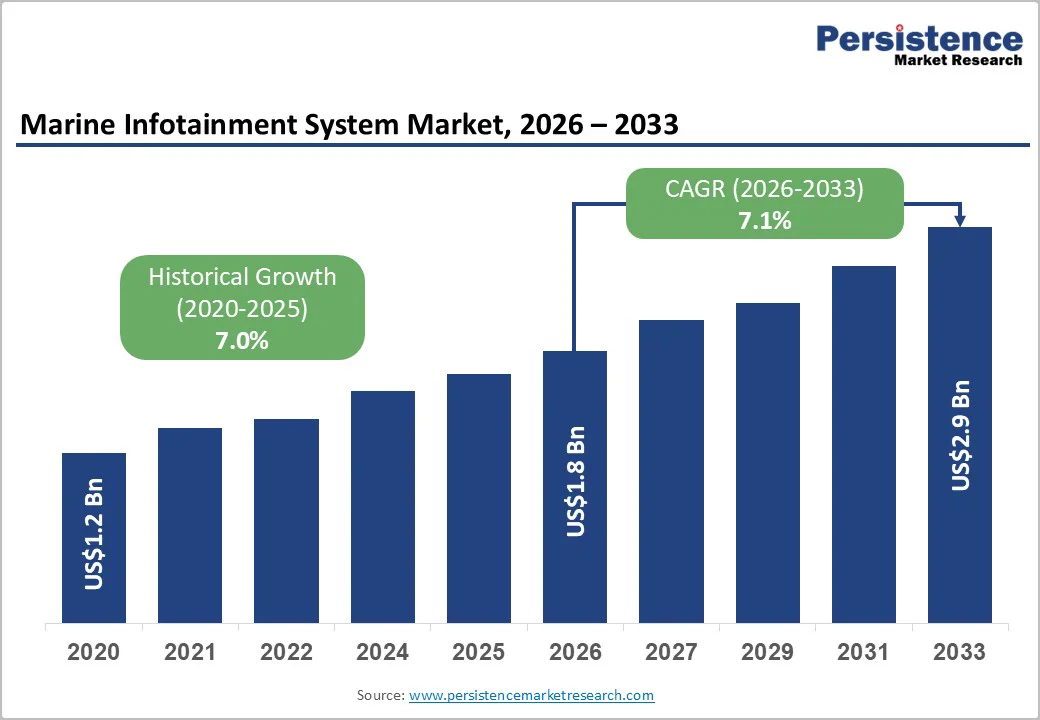
The global marine infotainment system market size is likely to be valued at US$1.8 billion in 2026 and is expected to reach US$2.9 billion by 2033, growing at a CAGR of 7.1% during the forecast period from 2026 to 2033, driven by the rising adoption of digital connectivity and smart marine solutions, including integrated navigation, communication, and entertainment platforms. Increasing demand for enhanced onboard passenger experiences in recreational boats, yachts, cruise ships, and ferries is further accelerating adoption. Advancements in touchscreen interfaces, cloud-based content delivery, satellite communication, and IoT-enabled vessel management systems are improving system performance and reliability.
Key Industry Highlights:
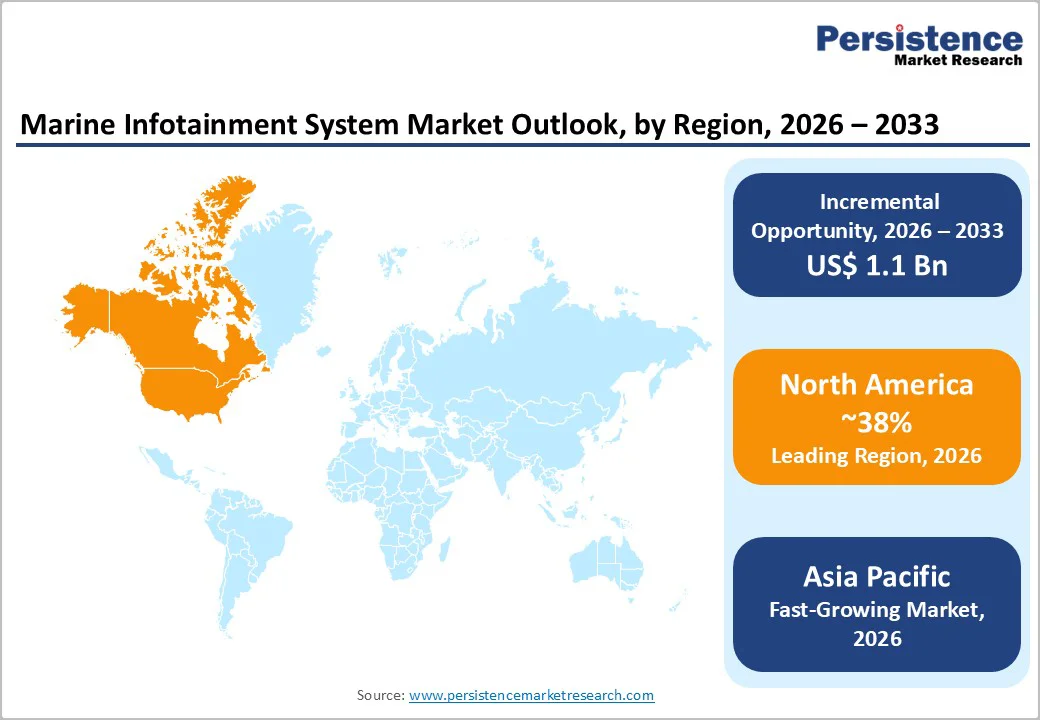
- Leading Region: North America is anticipated to be the leading region, accounting for a market share of 38% in 2026, driven by high adoption of advanced marine technologies and strong recreational boating demand.
- Fastest-growing Region: Asia Pacific is likely to be the fastest-growing region in the marine infotainment system in 2026, driven by rapid shipbuilding activity, expanding maritime trade, rising marine tourism, and increasing adoption of smart navigation and entertainment technologies.
- Leading Component Type: The hardware segment is projected to represent the leading component type in 2026, accounting for 60% of the revenue share, driven by widespread use of displays, audio units, and connectivity devices across vessels.
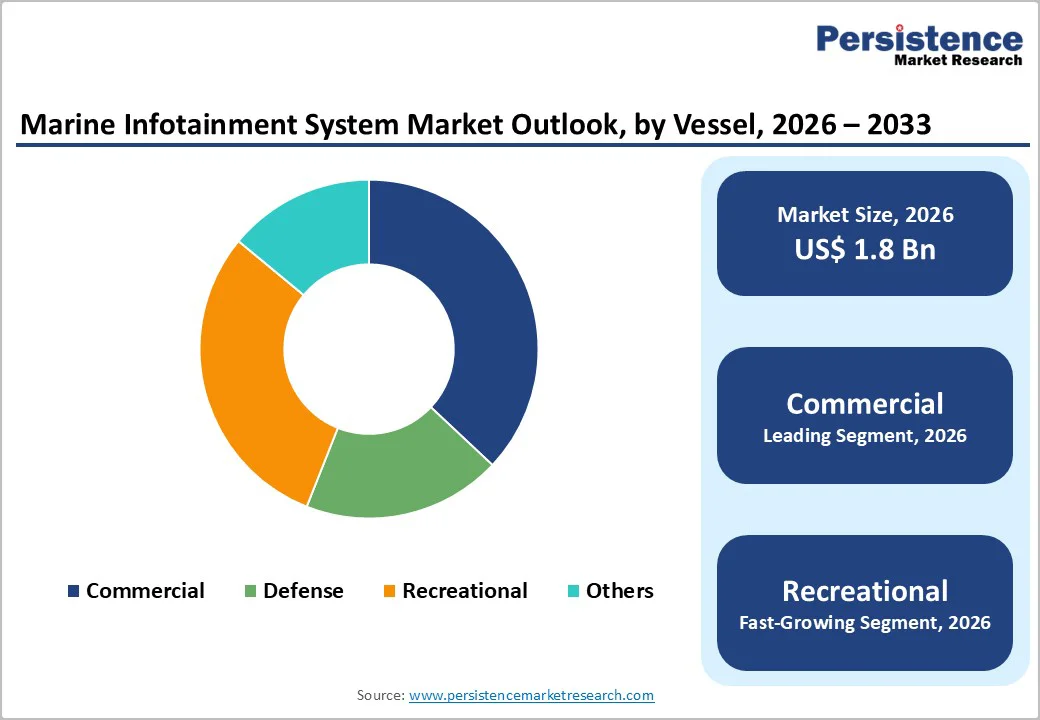
- Leading Vessel Type: Commercial vessels are anticipated to be the leading vessel type, accounting for over 45% of the revenue share in 2026, supported by large fleet sizes and mandatory navigation and communication installations.
- Leading Application Type: Navigation is anticipated to be the leading application type, accounting for over 45% of the revenue share in 2026, owing to its critical role in vessel safety and regulatory compliance.
| Key Insights | Details |
|---|---|
|
Marine Infotainment System Market Size (2026E) |
US$1.8 Bn |
|
Market Value Forecast (2033F) |
US$2.9 Bn |
|
Projected Growth (CAGR 2026 to 2033) |
7.1% |
|
Historical Market Growth (CAGR 2020 to 2025) |
7.0% |
Market Factors – Growth, Barriers, and Opportunity Analysis
Technological Advancements in Connectivity and Integration
Vessels increasingly adopt high-speed satellite communication, broadband maritime networks, and cloud-based platforms. The integration of VSAT, 4G/5G coastal connectivity, and hybrid communication solutions enables seamless access to real-time data, streaming services, and digital applications onboard. These technologies enhance navigation accuracy, weather monitoring, and communication reliability while also supporting advanced entertainment features for passengers and crew. As expectations for always-on connectivity at sea rise, ship-owners are investing in infotainment systems that mirror onshore digital experiences, particularly in recreational boats, cruise ships, and ferries.
The growing integration of infotainment systems with broader vessel management and navigation ecosystems. Modern marine infotainment platforms now combine navigation, communication, safety alerts, and entertainment into unified, touchscreen-based interfaces. Integration with IoT sensors, AI-enabled analytics, and smart bridge systems improves situational awareness, operational efficiency, and user personalization. Software-driven architectures also allow remote updates, diagnostics, and scalability, reducing lifecycle costs. Enhanced connectivity and system integration are transforming marine infotainment from standalone entertainment units into intelligent, multifunctional platforms that support both operational performance and superior onboard experiences.
Supply Chain and Technical Complexity Constraints
Supply chain challenges act as a significant restraint in the marine infotainment system market, particularly due to reliance on specialized electronic components such as marine-grade displays, processors, sensors, and connectivity modules. Disruptions in global semiconductor supply, logistics delays, and dependence on limited suppliers for certified maritime hardware can lead to longer lead times and higher system costs. These issues are especially impactful for shipbuilders and retrofit projects, where delays can affect vessel delivery schedules and overall project economics. Smaller operators often face difficulties in sourcing compatible components, limiting wider adoption across cost-sensitive segments.
The technical complexity associated with integrating infotainment systems into diverse vessel architectures poses another major constraint. Marine infotainment platforms must seamlessly interface with navigation, communication, and safety systems while complying with stringent maritime regulations and certification standards. Variations in vessel design, legacy systems, and operating environments increase installation and customization complexity, raising deployment and maintenance costs. The need for skilled technical personnel for system integration, upgrades, and cybersecurity management further adds to operational challenges.
Integration of AI and IoT for Smart Vessels
The integration of Artificial Intelligence (AI) and Internet of Things (IoT) technologies presents a strong growth opportunity for the marine infotainment system market as the maritime industry shifts toward smart and connected vessels. IoT-enabled sensors embedded across vessels allow infotainment systems to access real-time data related to navigation, weather conditions, fuel consumption, and equipment status. This connectivity enables centralized dashboards where entertainment, communication, and operational insights coexist, enhancing both user experience and situational awareness for crew and passengers.
Elevates marine infotainment by enabling intelligent automation, predictive analytics, and personalization. AI-driven algorithms can provide predictive maintenance alerts, optimize route planning, and offer personalized content recommendations based on passenger preferences and voyage conditions. Voice-controlled interfaces and smart assistants improve usability and reduce crew workload, particularly on complex vessels. As ship-owners increasingly invest in digital transformation to improve efficiency, safety, and passenger satisfaction, AI- and IoT-integrated infotainment systems are emerging as a key differentiator. This convergence creates new revenue opportunities for solution providers through software upgrades, data-driven services, and long-term digital service contracts.
Category-wise Analysis
Component Type Insights
The hardware segment is expected to lead the marine infotainment system market, accounting for approximately 60% of total revenue in 2026, driven by the physical backbone of all onboard infotainment and navigation systems. Core components such as marine-grade displays, audio systems, control panels, antennas, and connectivity modules are essential for both operational and entertainment functions across vessel types. These components are mandatory for safe navigation, communication, and regulatory compliance, particularly in commercial and defense vessels. Hardware demand remains strong due to frequent retrofitting of older fleets and replacement cycles driven by harsh marine operating environments. For example, Furuno Electric supplies integrated marine displays and radar hardware widely adopted in commercial shipping and fishing fleets, reinforcing hardware’s dominant position in the market.
The software segment is likely to represent the fastest-growing segment in 2026, driven by increasing demand for system integration, analytics, personalization, and remote updates. Software platforms enable seamless interaction between navigation, communication, and entertainment systems while supporting real-time data processing and cloud connectivity. As vessels transition toward smart and connected architectures, software-defined infotainment systems allow scalability without major hardware replacement. Subscription-based software services also provide recurring revenue opportunities for vendors. For example, Wärtsilä offers software-centric marine solutions that integrate navigation data, vessel performance analytics, and onboard systems through a unified digital interface.
Vessel Type Insights
Commercial vessels are projected to lead the market, capturing around 45% of the total revenue share in 2026, driven by large fleet volumes and mandatory installation of navigation and communication systems. Cargo ships, tankers, ferries, and cruise vessels require reliable infotainment platforms that integrate safety, operational data, and crew communication. Regulatory requirements from maritime authorities drive consistent demand for certified systems. Continuous fleet modernization and retrofitting projects sustain long-term growth in this segment. For example, Kongsberg Maritime provides integrated bridge and infotainment solutions widely deployed across global commercial shipping fleets.
Recreational vessels are likely to be the fastest-growing application in 2026, driven by rising marine tourism, luxury boating, and high consumer spending on leisure experiences. Yacht and pleasure boat owners increasingly demand premium infotainment systems featuring high-definition displays, advanced audio, voice control, and smartphone integration. The trend toward connected leisure boating mirrors automotive infotainment evolution, accelerating adoption among high-income consumers. Growth is especially strong in North America, Europe, and emerging Asian leisure boating markets. For example, Garmin has seen strong demand for its integrated marine infotainment and navigation systems in recreational boats and luxury yachts.
Application Type Insights
Navigation is projected to lead the market, capturing around 45% of the total revenue share in 2026, as it is critical for vessel safety, operational efficiency, and regulatory compliance. Navigation systems integrated within infotainment platforms provide real-time positioning, route planning, collision avoidance, and weather updates. These systems are indispensable across commercial, defense, and recreational vessels, ensuring consistent demand. Technological advancements such as digital charts, radar overlays, and AI-assisted navigation continue to strengthen this segment’s dominance. For example, Raytheon Anschütz delivers advanced navigation and bridge systems extensively used in commercial and naval vessels worldwide.
Entertainment is likely to be the fastest-growing application in 2026, driven by rising expectations for onboard digital experiences. Passengers and crew increasingly demand high-quality multimedia, streaming services, gaming, and personalized content, particularly on cruise ships, ferries, and recreational vessels. Improved satellite connectivity and cloud-based content delivery have made advanced entertainment systems feasible even on long voyages. This segment benefits directly from growth in marine tourism and luxury travel. For example, Navico Group provides integrated audio and entertainment solutions widely used in recreational boats and passenger vessels, supporting rapid growth in this application segment.
Regional Insights
North America Marine Infotainment System Market Trends
North America is anticipated to be the leading region, accounting for a market share of 38% in 2026, driven largely by a mature recreational boating ecosystem and steady commercial vessel upgrades. High disposable incomes, especially in the U.S. and Canada, support demand for premium infotainment features such as touchscreen multifunction displays, integrated navigation, advanced audio systems, and seamless smartphone connectivity. Regulatory emphasis on safety and navigation compliance from authorities such as the U.S. Coast Guard further accelerates the installation of modern infotainment and communication systems across commercial and passenger vessels.
North America is the growing convergence of infotainment with smart vessels and digital bridge solutions. Vessel owners increasingly prefer integrated platforms that combine navigation, communication, monitoring, and entertainment into unified user interfaces, reducing complexity and improving operational efficiency. Software-driven upgrades, cloud-based updates, and AI-enabled features are gaining traction, particularly in recreational and luxury marine segments. For example, Garmin Ltd. plays a significant role in the region, with its advanced marine displays and integrated infotainment systems widely adopted across recreational boats and yachts, reinforcing North America’s leadership in innovation and adoption.
Europe Marine Infotainment System Market Trends
Europe is likely to be a significant market for marine infotainment systems in 2026, due to a strong focus on integration, safety, and enhanced passenger experiences across commercial, recreational, and defense vessels. Regulatory emphasis on maritime safety and environmental compliance encourages operators to adopt advanced infotainment platforms that combine navigation, communication, and monitoring systems. Large cruise and ferry operations demand high-quality connectivity and onboard entertainment to meet passenger expectations. Europe’s well-established recreational boating culture, especially in countries such as Norway, Italy, France, and the U.K., is driving increased investments in premium marine infotainment solutions that deliver seamless connectivity, advanced touchscreen interfaces, and integrated GPS and safety features.
The growing shift toward smart, software-centric systems is enabling remote updates, predictive analytics, and greater customization across marine applications. Vessel owners are increasingly favoring flexible and scalable platforms over standalone hardware, with cloud-enabled entertainment systems, AI-assisted navigation tools, and IoT integration gaining momentum in both new builds and retrofit projects. Innovation-driven partnerships between technology providers and shipyards are hence becoming more prevalent to deliver customized solutions. For instance, Becker Marine Systems GmbH offers integrated navigation and infotainment solutions for commercial vessels and luxury yachts in Europe, reflecting the region’s strong push toward multifunctional, connected maritime platforms.
Asia Pacific Marine Infotainment System Market Trends
The Asia Pacific region is likely to be the fastest-growing region in 2026, driven by expanding shipbuilding activities, rising maritime trade, and increased marine tourism across key countries such as China, India, and ASEAN nations. Rapid industrialization and infrastructure investments in ports and coastal connectivity are enabling improved onboard digital experiences, including high?speed internet access and cloud?based entertainment and navigation services. Recreational boating is gaining popularity in markets such as Australia and Southeast Asia, prompting demand for advanced infotainment solutions that combine multimedia, navigation, and communication functions.
There is a growing adoption of smart, connected vessel technologies that utilize IoT and software-driven platforms to improve system performance and enhance the user experience. Operators are increasingly implementing unified infotainment architectures that enable remote diagnostics, real-time data integration, and predictive maintenance, helping to lower operational costs and boost reliability. Manufacturers are also collaborating with local technology companies and shipbuilders to tailor solutions to regional needs and climatic conditions. For example, Jason Electronics Pte. Ltd. delivers integrated navigation, communication, and infotainment systems for commercial and recreational vessels across the Asia Pacific, underscoring the region’s rapid embrace of connected, multifunctional marine platforms.
Competitive Landscape
The global marine infotainment system market exhibits a moderately fragmented structure, driven by the presence of both established multinational corporations and specialized marine technology providers competing for market share through innovation, partnerships, and geographic expansion. The industry comprises firms with broad portfolios spanning navigation, communication, safety, and entertainment systems, which are increasingly integrated into unified infotainment solutions. Companies are investing heavily in research and development to introduce advanced features such as cloud connectivity, real?time data analytics, and enhanced user interfaces that meet the evolving demands of commercial, defense, and recreational vessels.
The competitive landscape features a combination of major hardware and software incumbents alongside specialized technology innovators, with key players including Wärtsilä Corporation, Transas Marine Limited, Cobham PLC, and Alphatron Marine. These players compete through continuous product innovation, strategic collaborations with shipbuilders and system integrators, and expansion into emerging regional markets. Competition in the rapidly digitalizing maritime market is increasingly driven by a focus on comprehensive after?sales support, modular platform solutions, and strict compliance with maritime standards, as companies strive to differentiate their infotainment ecosystems.
Key Industry Developments:
- In November 2025, JL Marine Systems, in collaboration with MediaTek and NEXA, launched the world’s first Google-certified marine infotainment system, Power-Pole® VISION. The next-generation system features purpose-built 7" and 12" IP67-rated touchscreens designed for rugged marine environments, sunlight readability, and seamless integration with Power-Pole devices. As the first Android-certified marine device, VISION provides access to the Google Play Store and Google Mobile Services, enabling app-based navigation, entertainment, and future expandability.
- In November 2025, Next Yacht Group, owner of AB Yachts and Maiora, unveiled the Next AI-Integrated System, the world’s first offline artificial intelligence platform for yachts. Presented aboard the AB 110 during the Fort Lauderdale International Boat Show (FLIBS), the system functions as an intelligent onboard assistant, providing operational data such as fuel and water levels, energy usage, alarms, and maintenance schedules. Owners and crew can manage lighting, climate, entertainment, and other yacht systems through the proprietary My AB and My Maiora apps.
Companies Covered in Marine Infotainment System Market
- Kongsberg Maritime
- Furuno Electric Co., Ltd.
- Raytheon Anschütz
- Wärtsilä Corporation
- Transas Marine Limited
- Northrop Grumman Corporation
- Garmin Ltd.
- Navico Group
- Becker Marine Systems GmbH
- Imtech Marine
- L3 Technologies
- Mitsubishi Electric Corporation
- Tokyo Keiki Inc.
Frequently Asked Questions
The global marine infotainment system market is projected to reach US$1.8 billion in 2026.
The rising demand for connected, integrated navigation, communication, and entertainment solutions across recreational, commercial, and defense vessels.
The marine infotainment system market is expected to grow at a CAGR of 7.1% from 2026 to 2033.
Opportunities include the integration of AI and IoT for smart vessels, the adoption of cloud-based and software-driven platforms, and the growing demand for premium onboard entertainment systems in recreational and luxury yachts.
Kongsberg Maritime, Furuno Electric Co., Ltd., Raytheon Anschütz, Wärtsilä Corporation, and Transas Marine Limited are the leading players.


