


- Executive Summary
- Global Automated Parking System Market Snapshot 2024 and 2032
- Market Opportunity Assessment, 2024-2032, US$ Mn
- Key Market Trends
- Industry Developments and Key Market Events
- Demand Side and Supply-Side Analysis
- PMR Analysis and Recommendations
- Market Overview
- Market Scope and Definitions
- Value Chain Analysis
- Macro-Economic Factors
- Global GDP Outlook
- Global Automotive Sales by Region
- Global Automotive Vehicle Parc
- Global Automotive Sales by Vehicle Type
- Global EV Sales Overview
- Forecast Factors - Relevance and Impact
- COVID-19 Impact Assessment
- PESTLE Analysis
- Porter's Five Forces Analysis
- Geopolitical Tensions: Market Impact
- Regulatory and Technology Landscape
- Market Dynamics
- Drivers
- Restraints
- Opportunities
- Trends
- Price Trend Analysis, 2019 - 2032
- Region-wise Price Analysis
- Price by Segments
- Price Impact Factors
- Global Automated Parking System Market Outlook:
- Key Highlights
- Global Automated Parking System Market Outlook: Structure Type
- Introduction/Key Findings
- Historical Market Size (US$ Mn) and Volume (Units) Analysis by Structure Type, 2019-2023
- Current Market Size (US$ Mn) and Volume (Units) Analysis and Forecast, by Structure Type, 2024-2032
- Silo System
- AGV System
- Puzzle System
- Tower System
- Shuttle System
- Rail Guided Cart System
- Semi-Automated
- Double/Triple Stacker
- Misc.
- Market Attractiveness Analysis: Structure Type
- Global Automated Parking System Market Outlook: Platform Type
- Introduction/Key Findings
- Historical Market Size (US$ Mn) and Volume (Units) Analysis by Platform Type, 2019-2023
- Current Market Size (US$ Mn) and Volume (Units) Analysis and Forecast, by Platform Type, 2024-2032
- Palleted
- Non-Palleted
- Market Attractiveness Analysis: Platform Type
- Global Automated Parking System Market Outlook: End-User
- Introduction/Key Findings
- Historical Market Size (US$ Mn) and Volume (Units) Analysis by End-User, 2019-2023
- Current Market Size (US$ Mn) and Volume (Units) Analysis and Forecast, by End-User, 2024-2032
- Residential
- Commercial
- Mixed Use
- Market Attractiveness Analysis: End-User
- Global Automated Parking System Market Outlook: Region
- Key Highlights
- Historical Market Size (US$ Mn) and Volume (Units) Analysis by Region, 2019-2023
- Current Market Size (US$ Mn) and Volume (Units) Analysis and Forecast, by Region, 2024-2032
- North America
- Europe
- East Asia
- South Asia & Oceania
- Latin America
- Middle East & Africa
- Market Attractiveness Analysis: Region
- North America Automated Parking System Market Outlook:
- Key Highlights
- Pricing Analysis
- North America Market Size (US$ Mn) and Volume (Units) Analysis and Forecast, by Country, 2024-2032
- U.S.
- Canada
- North America Market Size (US$ Mn) and Volume (Units) Analysis and Forecast, by Structure Type, 2024-2032
- Silo System
- AGV System
- Puzzle System
- Tower System
- Shuttle System
- Rail Guided Cart System
- Semi-Automated
- Double/Triple Stacker
- Misc.
- North America Market Size (US$ Mn) and Volume (Units) Analysis and Forecast, by Platform Type, 2024-2032
- Palleted
- Non-Palleted
- North America Market Size (US$ Mn) and Volume (Units) Analysis and Forecast, by End-User, 2024-2032
- Residential
- Commercial
- Mixed Use
- Europe Automated Parking System Market Outlook:
- Key Highlights
- Pricing Analysis
- Europe Market Size (US$ Mn) and Volume (Units) Analysis and Forecast, by Country, 2024-2032
- Germany
- Italy
- France
- U.K.
- Spain
- Russia
- Rest of Europe
- Europe Market Size (US$ Mn) and Volume (Units) Analysis and Forecast, by Structure Type, 2024-2032
- Silo System
- AGV System
- Puzzle System
- Tower System
- Shuttle System
- Rail Guided Cart System
- Semi-Automated
- Double/Triple Stacker
- Misc.
- Europe Market Size (US$ Mn) and Volume (Units) Analysis and Forecast, by Platform Type, 2024-2032
- Palleted
- Non-Palleted
- Europe Market Size (US$ Mn) and Volume (Units) Analysis and Forecast, by End-User, 2024-2032
- Residential
- Commercial
- Mixed Use
- East Asia Automated Parking System Market Outlook:
- Key Highlights
- Pricing Analysis
- East Asia Market Size (US$ Mn) and Volume (Units) Analysis and Forecast, by Country, 2024-2032
- China
- Japan
- South Korea
- East Asia Market Size (US$ Mn) and Volume (Units) Analysis and Forecast, by Structure Type, 2024-2032
- Silo System
- AGV System
- Puzzle System
- Tower System
- Shuttle System
- Rail Guided Cart System
- Semi-Automated
- Double/Triple Stacker
- Misc.
- East Asia Market Size (US$ Mn) and Volume (Units) Analysis and Forecast, by Platform Type, 2024-2032
- Palleted
- Non-Palleted
- East Asia Market Size (US$ Mn) and Volume (Units) Analysis and Forecast, by End-User, 2024-2032
- Residential
- Commercial
- Mixed Use
- South Asia & Oceania Automated Parking System Market Outlook:
- Key Highlights
- Pricing Analysis
- South Asia & Oceania Market Size (US$ Mn) and Volume (Units) Analysis and Forecast, by Country, 2024-2032
- India
- Southeast Asia
- ANZ
- Rest of SAO
- South Asia & Oceania Market Size (US$ Mn) and Volume (Units) Analysis and Forecast, by Structure Type, 2024-2032
- Silo System
- AGV System
- Puzzle System
- Tower System
- Shuttle System
- Rail Guided Cart System
- Semi-Automated
- Double/Triple Stacker
- Misc.
- South Asia & Oceania Market Size (US$ Mn) and Volume (Units) Analysis and Forecast, by Platform Type, 2024-2032
- Palleted
- Non-Palleted
- South Asia & Oceania Market Size (US$ Mn) and Volume (Units) Analysis and Forecast, by End-User, 2024-2032
- Residential
- Commercial
- Mixed Use
- Latin America Automated Parking System Market Outlook:
- Key Highlights
- Pricing Analysis
- Latin America Market Size (US$ Mn) and Volume (Units) Analysis and Forecast, by Country, 2024-2032
- Brazil
- Mexico
- Rest of LATAM
- Latin America Market Size (US$ Mn) and Volume (Units) Analysis and Forecast, by Structure Type, 2024-2032
- Silo System
- AGV System
- Puzzle System
- Tower System
- Shuttle System
- Rail Guided Cart System
- Semi-Automated
- Double/Triple Stacker
- Misc.
- Latin America Market Size (US$ Mn) and Volume (Units) Analysis and Forecast, by Platform Type, 2024-2032
- Palleted
- Non-Palleted
- Latin America Market Size (US$ Mn) and Volume (Units) Analysis and Forecast, by End-User, 2024-2032
- Residential
- Commercial
- Mixed Use
- Middle East & Africa Automated Parking System Market Outlook:
- Key Highlights
- Pricing Analysis
- Middle East & Africa Market Size (US$ Mn) and Volume (Units) Analysis and Forecast, by Country, 2024-2032
- GCC Countries
- South Africa
- Northern Africa
- Rest of MEA
- Middle East & Africa Market Size (US$ Mn) and Volume (Units) Analysis and Forecast, by Structure Type, 2024-2032
- Silo System
- AGV System
- Puzzle System
- Tower System
- Shuttle System
- Rail Guided Cart System
- Semi-Automated
- Double/Triple Stacker
- Misc.
- Middle East & Africa Market Size (US$ Mn) and Volume (Units) Analysis and Forecast, by Platform Type, 2024-2032
- Palleted
- Non-Palleted
- Middle East & Africa Market Size (US$ Mn) and Volume (Units) Analysis and Forecast, by End-User, 2024-2032
- Residential
- Commercial
- Mixed Use
- Competition Landscape
- Market Share Analysis, 2024
- Market Structure
- Competition Intensity Mapping
- Competition Dashboard
- Company Profiles
- Klaus Multiparking Systems
- Company Overview
- Product Portfolio/Offerings
- Key Financials
- SWOT Analysis
- Company Strategy and Key Developments
- Westfalia Parking
- ParkPlus Inc.
- U-tron
- Lödige Industries
- SOTEFIN SA
- Tedra Automotive Solutions Pvt. Ltd.
- RR Parkon
- Robotic Parking Systems, Inc
- Wipro PARI
- ShinMaywa Industries, Ltd.
- Wohr Parking Systems
- CITYLIFT
- Mutrade Industrial Corp
- Shenzhen Yee Fung Automation Technology Co., Ltd.
- Klaus Multiparking Systems
- Appendix
- Research Methodology
- Research Assumptions
- Acronyms and Abbreviations


- Automotive Components & Materials
- Automated Parking System Market
Automated Parking System Market Size, Share, and Growth Forecast for 2025 - 2032
Automated Parking System Market By Structure Type (Silo System, AGV System, Puzzle System, Tower System, Shuttle System, Rail Guided Cart System, Semi-Automated), Platform Type (Palleted, Non-Palleted), End-user (Residential, Commercial, Mixed Use), and Regional Analysis for 2025 - 2032
Automated Parking System Market Size and Trends
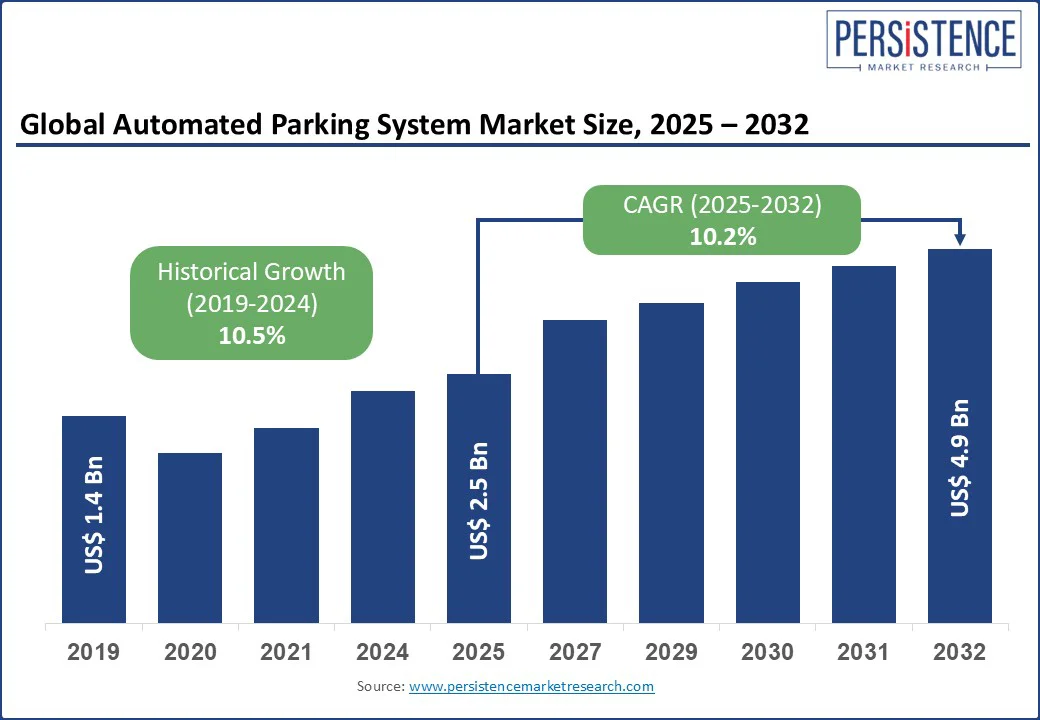
The global automated parking system market size is likely to be valued at US$ 2.5 Bn in 2025 and is expected to reach US$ 4.9 Bn by 2032, growing at a CAGR of 10.2% during the forecast period from 2025 to 2032. The global automated parking system market is witnessing strong growth driven by increasing urban vehicle density and shrinking parking spaces. Innovations in robotics, AI-based slot management, and non-palleted platforms are enhancing operational efficiency and system integration. Additionally, sustainability initiatives are promoting energy-efficient, space-saving vertical parking solutions in smart cities.
Key Industry Highlights:
- Rising urban congestion and limited parking space are accelerating the deployment of automated systems in metro cities.
- Integration of AI and IoT technologies is advancing system efficiency, real-time monitoring, and user convenience.
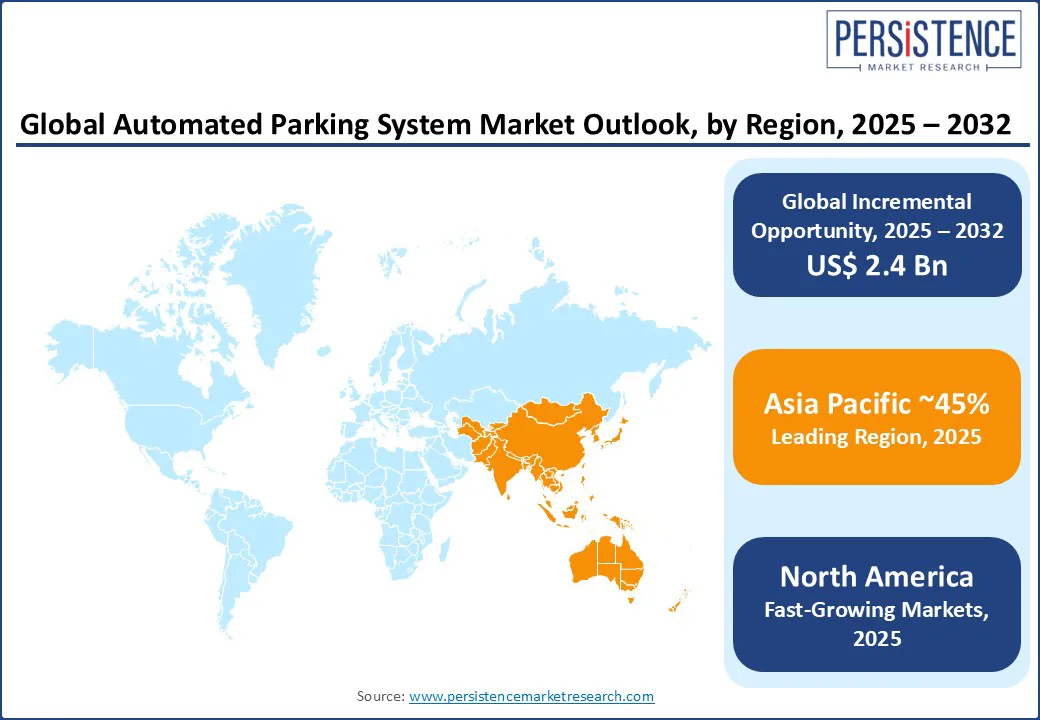
- Asia Pacific dominates the global industry by around 45%, led by China and Japan’s rapid urbanization and smart infrastructure initiatives.
- North America is picking up pace with a significant CAGR of 10.4%, driven by growing investments in mobility infrastructure and premium real estate.
- Non-palleted platforms are gaining preference due to faster vehicle retrieval and reduced mechanical complexity.
- Integrating automated parking with transportation networks is a rising trend supporting multi-modal urban mobility systems.
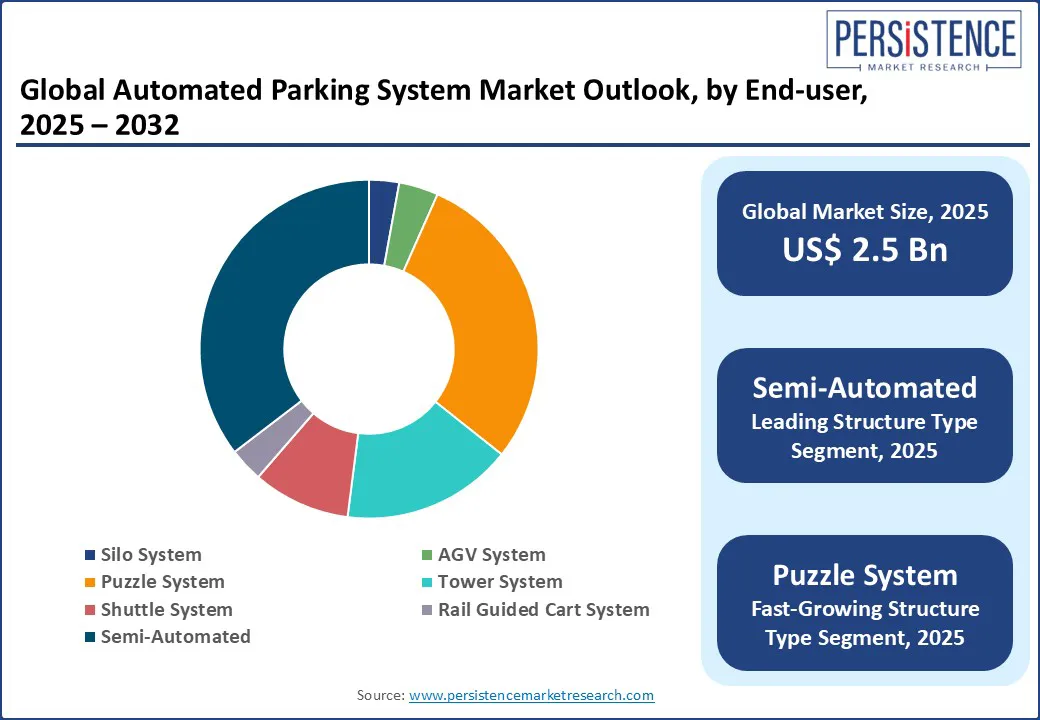
- Semi-automated systems hold the dominant share of around 36% due to their affordability and scalability in residential and mid-rise developments.
- The mixed-use segment is witnessing a prominent growth rate, fueled by the need for space-optimized solutions in commercial-residential hybrid projects.
| Global Market Attribute | Key Insights |
| Automated Parking System Market Size (2025E) | US$ 2.5 Bn |
| Market Value Forecast (2032F) | US$ 4.9 Bn |
| Projected Growth (CAGR 2025 to 2032) | 10.2% |
| Historical Market Growth (CAGR 2019 to 2024) | 10.5% |
Market Dynamics
Driver - Automated Parking Systems Emerge as Strategic Enablers for Real Estate Value Optimization in Urban Markets
Automated parking systems (APS) are revolutionizing real estate development in urban areas with limited space. By replacing traditional parking with vertical stacking, APS can reduce parking footprints by up to 70%, allowing for more commercial, residential, or green units. This is crucial in cities like Singapore, Hong Kong, and New York, where maximizing buildable area boosts ROI. APS eliminates the need for ramps and wide turning radii, enhancing architectural flexibility and enabling more leasable space. Consequently, mixed-use buildings, premium offices, and luxury towers are increasingly adopting APS as a premium amenity that appeals to modern buyers seeking secure, tech-driven convenience and sustainable design.
Several municipalities are using urban planning incentives and zoning relaxations to promote the adoption of APS. Real estate developers are partnering with APS providers early in the design phase to co-develop efficient, space-optimized layouts. In an environment where space monetization is paramount, APS has evolved from a utility function to a strategic asset, enabling developers to elevate both asset performance and project marketability.
Restraint - Technical Complexity and Reliability Concerns Restrict Broader Automate Parking System Market Penetration
Technical complexity remains a significant restraint in the growth of the global automated parking system (APS) market, beyond cost factors. These systems demand seamless integration of electromechanical lifts, sensors, software, and user interfaces. Even minor malfunctions can trigger complete shutdowns, causing delays in vehicle retrieval and reducing customer satisfaction. In high-traffic locations like malls or transit hubs, such delays can stretch to 12-15 minutes during peak hours, leading to crowding, frustration, and reputational loss for operators. Over 35% of APS-related complaints in urban areas stem from retrieval delays or mechanical faults, highlighting the operational fragility of such systems.
The shortage of skilled technicians and complex maintenance routines increases operational burdens, particularly in emerging markets with limited local support. This can lead to prolonged downtimes due to scarce parts and service teams. Additionally, rising cybersecurity threats in connected APS raise data safety concerns, causing skepticism among developers and users, which may limit deployment to tech-savvy urban areas.
Opportunity- Supporting Sustainable Urban Development and Electric Vehicle Integration
Automated Parking Systems (APS) are becoming essential for promoting sustainable urban mobility. They align with global initiatives aimed at reducing emissions, optimizing land use, and incorporating electric vehicle (EV) infrastructure. As cities face challenges like congestion and environmental concerns, APS provides a compact and technology-driven solution that minimizes space requirements while reducing energy consumption and traffic flow. By eliminating the need for wide driveways, ventilation systems, and continuous lighting, APS also helps to lower operational emissions and supports the creation of greener buildings.
The growth in EV adoption has created a growing need for parking solutions that include EV charging. APS can feature tiered charging stations, renewable energy sources, and smart energy storage. Initiatives like Germany’s Green Garage and Amsterdam’s Zuidas district are integrating solar and EV readiness to reduce carbon footprints. Globally, programs such as the EU’s Horizon 2020 are funding such infrastructure. As sustainability regulations increase, APS providers that adopt EV integration and clean energy will drive the next wave of eco-friendly mobility solutions.
Automated Parking System Market Insights
Component Type Insights
Semi-automated parking systems represent the largest share in the global automated parking system market, accounting for approximately 36% of total market volume. This dominance is primarily attributed to their cost-efficiency, flexible design architecture, and ease of deployment across medium-density urban environments. Unlike fully automated systems, semi-automated solutions such as double stackers, triple stackers require partial human interaction but significantly reduce space usage compared to traditional parking. Their simplified mechanics and lower upfront and maintenance costs make them a favored option in emerging economies and smaller-scale developments where budget constraints and retrofitting are concerns.
These systems are ideal for residential buildings, small commercial lots, and shared community spaces, providing sufficient automation without the complexities of fully integrated robotics. The growing preference among developers to install scalable parking infrastructure, especially in the Asia Pacific and Latin America, further accelerates their adoption. Semi-automated systems serve as a practical, transitional solution that bridges conventional and fully automated technologies.
End-user Insights
The mixed-use end-user segment is experiencing significant growth at approximately 10.6% during the forecast period. The growth is primarily driven by the increase in multi-functional real estate developments that combine commercial, residential, and retail components. These integrated urban environments create complex traffic and parking demands that traditional systems struggle to manage.
Automated parking offers an ideal solution by enabling space optimization, higher vehicle throughput, and enhanced user convenience, especially in locations with limited land availability. As cities transition toward vertical construction and smart infrastructure, developers of mixed-use properties are investing in advanced, intelligent parking solutions that align with sustainability, efficiency, and premium user experience goals.
In regions such as Europe and North America, regulatory incentives and rising consumer expectations are reinforcing the trend. Automated parking also adds tangible value by reducing time spent parking, lowering carbon emissions, and enabling design flexibility for architects. These benefits make mixed-use developments a fertile segment for automated parking innovation and long-term market growth.
Regional Insights
Asia Pacific Automated Parking System Market
Asia Pacific accounts for the largest share of around 45% driven by dense urban population, rapid infrastructure development, and increasing vehicle ownership. The region’s dominance is largely fueled by space constraints in metropolitan cities, encouraging the adoption of compact, high-capacity parking solutions such as puzzle and tower systems. Countries such as China, Japan, and South Korea have made considerable investments in smart city projects, where automated parking is integrated as part of intelligent urban mobility ecosystems. The Puzzle System, in particular, is gaining widespread use in Chinese Tier I and II cities due to its ability to accommodate a high volume of cars with minimal horizontal space.
China is a leading region with policies that support intelligent parking through public-private partnerships and innovation funding. Japan, with its legacy of vertical parking towers and advanced mechatronics, remains a technological pioneer in the segment. South Korea’s government-led urban redevelopment and adoption of smart infrastructure further strengthen regional growth. India is emerging as a high-growth market, with rising adoption of semi-automated and tower-based systems in metro cities such as Mumbai, Delhi, and Bengaluru, driven by space constraints and increasing urban middle-class demand. Overall, East Asia and South Asia & Oceania together contribute a considerable share reinforcing Asia Pacific’s leadership in adoption and innovation.
North America Automated Parking System Market Trends
North America is emerging as one of the fastest-growing regions in the automated parking system market, backed by increasing demand for smart, sustainable, and space-efficient parking in urban redevelopment projects. The regional growth is significantly supported by the growth in commercial and mixed-use buildings, especially in densely populated cities like New York, Los Angeles, Toronto, and Chicago. Developers are increasingly shifting toward non-palleted, fully automated systems for high-rise properties, aligning with ESG goals and offering value-added amenities. The commercial end-user category continues to dominate installations, particularly in the U.S., as businesses seek to optimize parking costs and land usage.
In the United States, several state and city-level policies incentivize green construction and LEED-certified developments, encouraging the integration of robotic parking. Moreover, the region's growing adoption of electric vehicles (EVs) is also prompting the inclusion of EV-compatible automated systems with charging docks. Canada, with its rapidly urbanizing metropolitan centers like Vancouver and Toronto, is witnessing similar demand trends, particularly in premium residential and hotel developments.
Europe Automated Parking System Market Trends
Europe holds a prominent share of approximately 29.4% in the global automated parking system market, making it one of the most mature and innovation-driven regions. The continent's stringent environmental regulations, combined with high urban population density, have fueled widespread deployment of automated and sustainable parking solutions. Fully automated systems are particularly favored in major European cities due to their ability to maximize land usage, reduce CO2 emissions, and enhance vehicle flow efficiency. European Union initiatives around smart city development, such as Horizon Europe and Green Deal policies, provide funding and regulatory frameworks that support the implementation of robotic parking infrastructure in public and private developments.
Germany stands out as a technological leader with high adoption in cities such as Berlin, Munich, and Frankfurt, where parking automation is integrated into commercial buildings and public transit hubs. France and the Netherlands have also advanced in integrating shuttle and tower systems within residential and mixed-use projects. In Scandinavia, especially Sweden and Norway, demand for electric-vehicle-compatible APS systems is driven by environmental consciousness and space efficiency. Europe's advanced urban planning and strong public-private collaboration established it as a prominent region in automated parking innovation and sustainable urban mobility solutions.
Competitive Landscape
The global automated parking system market features a robust competitive landscape, with around 60% to 65% of the total install base (~2.4 million spaces by 2025) held by top key players such as Wohr Parking Systems, Klaus Multiparking, Robotic Parking Systems, Lodige Industries, Shenzhen Yee Fung Automation, and others. These firms are aggressively expanding through strategic partnerships, regional collaborations, and R&D investments in AI-based slot navigation, non-palleted systems, and EV-compatible modules. The competition remains healthy as mid-tier manufacturers, particularly from Asia, are entering price-sensitive markets with modular and retrofittable solutions, pushing innovation and cost optimization. This evolving ecosystem fosters technological advancement and market accessibility, fueling faster adoption in urban infrastructure projects.
Manufacturers are collaborating with architectural consultants, real estate developers, and transport authorities to strengthen supply chains. Many have set up regional warehouses and service partnerships to improve delivery efficiency and after-sales support. This integrated approach enables localized customization, timely deployment, and fosters long-term growth in the global industry.
Key Industry Developments:
- In January 2025, KLAUS Multiparking America Inc. launched its kVario 8000 Series semi-automatic puzzle parking system, a scalable, eco-friendly solution for mixed-use and multifamily developments in the U.S.
- In early 2024, Wohr Parking Systems secured the world’s first Environmental Product Declaration (EPD) for its Parklift 450 mechanical parking lift, marking a milestone in lifecycle-verified sustainable parking solutions.
Companies Covered in Automated Parking System Market
- Klaus Multiparking Systems
- Westfalia Parking
- ParkPlus Inc.
- U-tron
- Lödige Industries
- SOTEFIN SA
- Tedra Automotive Solutions Pvt. Ltd.
- RR Parkon
- Robotic Parking Systems, Inc
- Wipro PARI
- ShinMaywa Industries, Ltd.
- Wohr Parking Systems
- CITYLIFT
- Mutrade Industrial Corp
- Shenzhen Yee Fung Automation Technology Co., Ltd.
Frequently Asked Questions
The automated parking system market size is set to reach US$ 2.5 Bn in 2025.
Automated parking systems are driven by rising urban land constraints, demand for real estate value optimization, integration with smart mobility, and sustainability-focused infrastructure development.
The automated parking system market growth is projected at a CAGR of 10.2% from 2025 to 2032.
Key market opportunities lie in integrating automated parking with smart city infrastructure, electric vehicle charging, and mixed-use urban developments.
The major players dominating the global Automated Parking System Market are Wohr Parking Systems, Klaus Multiparking, and Shenzhen Yee Fung Automation Technology Co., Ltd., and SOTEFIN SA.


