

Through the use of innovative technologies, ambitious emission reduction goals, and sustainable operational practices, several organizations are setting notable examples in carbon footprint management. Here is an overview of ten such companies making significant efforts while showcasing the importance and impact of sustainability.
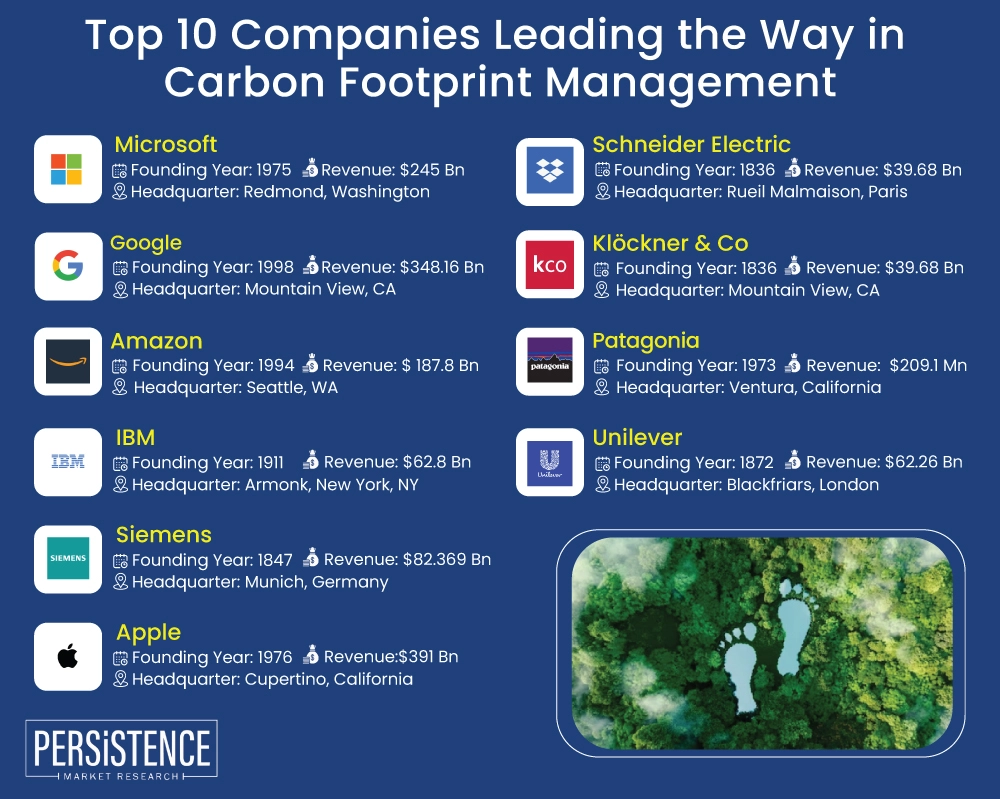
Top 10 Companies Fostering Growth in Carbon Footprint Management Market
1. Microsoft
Microsoft is a leader in the fight against climate change, aiming to be carbon negative by 2030. This means the company plans to remove more carbon from the atmosphere than it emits. Microsoft has pledged to eliminate all the carbon it has ever emitted since its founding in 1975 by 2050. To achieve this, Microsoft uses cutting-edge technology like the Microsoft Cloud for Sustainability, which helps companies track and decrease their emissions. They are also making heavy investments in renewable energy projects and are encouraging suppliers to adopt green practices?.
2. Schneider Electric
Schneider Electric is known for being one of the most sustainable corporations in the world. The company specializes in energy management and automation, helping industries decrease their energy consumption and carbon emissions. Schneider uses digital tools to track and manage emissions and works closely with its suppliers to help them meet sustainability goals. Their initiatives show that collaboration across supply chains is critical for reducing global emissions?.
3. Google
Google is at the forefront of using technology to fight climate change. The company has achieved carbon neutrality back in 2007 and is now working toward operating entirely on carbon-free energy by 2030. Google also uses Artificial Intelligence (AI) to optimize energy use in its data centers, thereby making them the most energy-efficient across the world. Additionally, Google’s tools, such as the Environmental Insights Explorer, help cities and organizations understand their emissions and find ways to reduce them?.
4. Klöckner & Co
Klöckner & Co, a key player in the metal and steel distribution industry, stands out for its focus on transparency and sustainability. The company developed the Nexigen PCF Algorithm, which calculates the carbon footprint of over 200,000 products. By providing detailed Product Carbon Footprints (PCF), they empower their customers to choose more sustainable options. This approach assists other businesses to decrease their emissions while supporting global decarbonization?.
5. Amazon
Amazon is making significant strides in sustainability with its Climate Pledge, committing to achieving net-zero carbon emissions by 2040, ten years ahead of the Paris Agreement. Amazon is electrifying its delivery fleet, with plans to deploy over 100,000 electric delivery vehicles by 2030. Additionally, the company invests in renewable energy projects worldwide and has developed programs to encourage suppliers to decrease their carbon footprints?.
6. Patagonia
Patagonia has long been a champion of environmental sustainability. The company designs durable, repairable, and recyclable products to minimize waste and reduce emissions. Patagonia also supports several environmental initiatives and uses its platform to advocate for climate-friendly policies. By aligning its business with environmental values, Patagonia proves that sustainability and profitability can go hand in hand?.
7. IBM
IBM has committed to achieving net-zero emissions by 2030. The company uses unique technologies like blockchain for supply chain transparency and AI tools to monitor and reduce emissions. IBM also provides sustainability solutions to other businesses, helping them decrease their carbon footprints while improving their energy efficiency?.
8. Unilever
Unilever is working toward becoming carbon neutral across its value chain by 2039. The company focuses on sustainable product innovation, including reformulating household and personal care products to lower their environmental impact. Unilever also partners with suppliers to meet ambitious carbon reduction targets and ensures that sustainability remains at the core of its business strategy?.
9. Siemens
Siemens leverages digital technology to help industries and cities decrease emissions. Their innovations include smart grid solutions and energy-efficient building solutions. Siemens is also committed to reducing its operational carbon footprint and enabling its customers to do the same by leveraging sustainable technologies?.
10. Apple
Apple has achieved carbon neutrality for its corporate operations since 2020 and aims to extend this achievement to its entire supply chain and product lifecycle by 2030. The company prioritizes renewable energy and sustainable materials in its products and works closely with suppliers to meet stringent environmental standards. Apple's efforts highlight how the tech industry can lead in carbon footprint management?.
A Few Factors Driving Need for Carbon Footprint Management Solutions
The push for carbon footprint management is driven by several key factors:
- Technology: Companies are adopting unique technologies like AI, IoT, and digital platforms to track and decrease emissions in real time.
- Supply Chain Collaboration: Several organizations are working with suppliers to set ambitious emission-reduction targets.
- Regulations: Governments worldwide are introducing mandatory reporting requirements, forcing companies to disclose their emission statistics and improve transparency.
- Consumer Demand: Customers increasingly prefer brands that align with their values, driving companies to prioritize sustainability?.
Key Players to Focus on Setting Benchmarks on Carbon Footprint Management
Companies listed above are proof that sustainability is not just about decreasing emissions but also about innovation, collaboration, and long-term growth. These organizations are setting benchmarks in carbon footprint management, showcasing that businesses can thrive while being environmentally responsible. By adopting similar strategies, companies of all sizes can contribute to a more sustainable future.


