




- Specialty & Fine Chemicals
- Iodate Market
Iodate Market Size, Share, and Growth Forecast 2026 - 2033
Iodate Market by Product Type (Potassium Iodate, Calcium Iodate, Sodium Iodate), Grade (Pharmaceutical Grade, Food Grade, Industrial Grade), Application (Pharmaceuticals, Food and Beverages, Animal Feed), and Regional Analysis, 2026 - 2033

Iodate Market Size and Trend Analysis
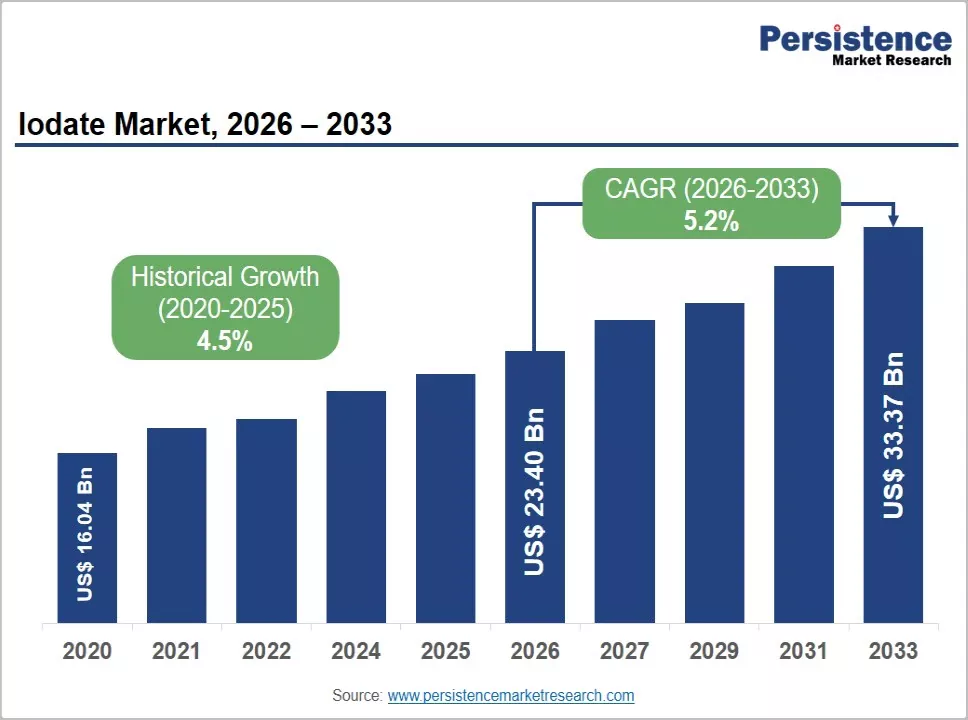
The global iodate market size is expected to be valued at US$ 23.40 billion in 2026 and is projected to reach US$ 33.37 billion by 2033, growing at a CAGR of 5.2% between 2026 and 2033. Iodine deficiency disorders remain a persistent global public health challenge, and iodate compounds sit at the operational center of the global response.
Mandatory salt iodization programs across more than 120 countries, reinforced by World Health Organization (WHO) and UNICEF advocacy, have converted potassium iodate and related compounds from specialty chemicals into regulated nutritional infrastructure.
This trajectory reflects not simply population-driven volume growth, but structural demand diversification - pharmaceutical manufacturers, animal nutrition formulators, and water treatment operators are each expanding their draw on iodate supply chains. The International Council for the Control of Iodine Deficiency Disorders (ICCIDD Global Network) continues to press governments to tighten iodization standards, reinforcing a regulatory tailwind that institutional investors and procurement strategists should not underestimate.
Key Industry Highlights
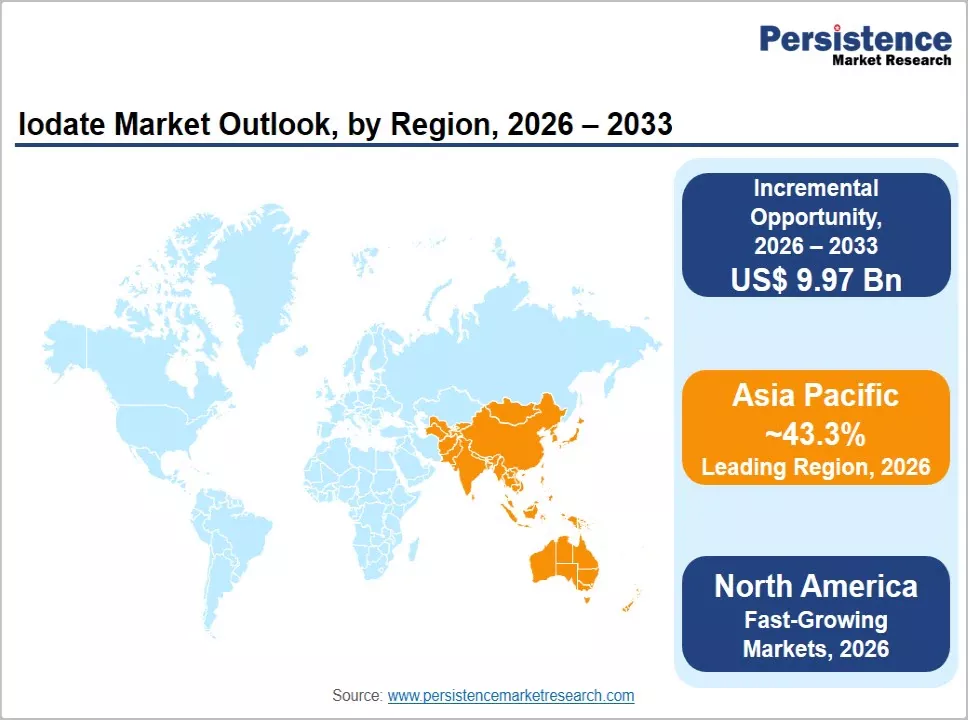
- Dominant Region: Asia Pacific holds 43.3% of global iodate demand in 2026, anchored by China's brine-extraction iodine supply base and India's legally mandated salt iodization infrastructure. By 2033, the region's absolute volume lead will widen as Southeast Asian governments progressively formalize their own iodization legislation and pharmaceutical manufacturing scales across the subcontinent.
- Fastest-growing Region: Growing at 7.8% CAGR through 2033, North America is the iodate industry's fastest-expanding regional market, propelled by federal nuclear preparedness procurement and water infrastructure investment under the US Infrastructure Investment and Jobs Act. Investors tracking specialty chemical growth vectors should weight North American iodate demand as a beneficiary of both health security spending and environmental regulation tightening.
- Leading Grade: Pharmaceutical grade commands 66.4% of global iodate volumes, a position entrenched by pharmacopoeial certification barriers and non-discretionary procurement logic across thyroid therapeutics and emergency stockpile programs. This dominance is structurally durable - price competition cannot penetrate a segment where FDA and EMA compliance documentation determines supplier eligibility.
- Dominant Product Type: Calcium iodate is emerging as the iodate sector's most commercially dynamic sub-segment, capturing market share in compound animal feed formulations across European and Asian poultry and cattle operations. EFSA's 2022 feed additive guidelines have elevated calcium iodate's regulatory standing relative to alternative iodine sources, creating a certification-driven moat for qualified producers.
- Key Market Opportunity: The global iodate market's US$ 9.97 billion incremental opportunity between 2026 and 2033 will not distribute evenly. The highest-margin pockets will concentrate in pharmaceutical-grade supply for nuclear emergency preparedness and in GMP-certified animal nutrition - both segments where supply certification, not price, determines contract awards. Producers investing now in dual-grade manufacturing capability and pharmacopoeial audit readiness are best positioned to capture disproportionate value.
DRO Analysis
Driver- Mandatory Salt Iodization Mandates Sustaining Baseline Demand
Potassium iodate demand is structurally anchored by legally enforced salt iodization programs across South Asia, Sub-Saharan Africa, and Southeast Asia. India's Food Safety and Standards Authority of India (FSSAI) mandates a minimum of 15 parts per million (ppm) of iodine at the retail level, binding the country's entire organized salt industry to consistent iodate procurement.
These mandates create procurement floors that persist regardless of commodity price cycles, providing the iodate sector with a degree of demand predictability absent in most specialty chemical markets. As African governments progressively enforce their own iodization legislation — accelerated by WHO's 2022–2030 micronutrient action framework — the addressable volume base widens materially.
Rising Pharmaceutical-Grade Iodate Consumption in Thyroid Therapeutics and Radiation Emergency Preparedness
The pharmaceutical application of potassium iodate extends well beyond antiseptics. National governments and health agencies are stockpiling iodate-based thyroid-blocking tablets for nuclear emergency preparedness. Following renewed attention to nuclear facility risk management post-Fukushima and intensified by European Union directives requiring Member States to maintain civilian iodine tablet stockpiles, procurement cycles accelerated meaningfully between 2022 and 2024. The French Nuclear Safety Authority (ASN) distributed updated potassium iodate tablets to populations living within 20 kilometers of nuclear installations in 2023, exemplifying the government-mandated demand that pharmaceutical manufacturers cannot substitute away from.
Restraint- Iodine Supply Concentration and Price Volatility
The iodate industry's upstream vulnerability lies in iodine itself. Chile and Japan together account for approximately 90% of global iodine production, per data from the U.S. Geological Survey (USGS). This extreme geographic concentration exposes iodate manufacturers to supply disruption risk from seismic events, export policy shifts, or currency-driven cost escalation. Procurement teams at pharmaceutical manufacturers have reported contract renegotiation pressures when iodine spot prices spike, compressing downstream margins and creating reluctance to commit to long-term iodate supply agreements at fixed pricing.
Opportunity- Expanding Animal Nutrition Applications in Industrialized Livestock Markets
Calcium iodate's role as a bioavailable iodine source in compound animal feed is gaining traction as intensive livestock producers in China, Brazil, and the European Union respond to tightening regulations around thyroid function and reproductive health in cattle and poultry. The European Food Safety Authority (EFSA) published updated maximum iodine content guidelines for feed additives in 2022, indirectly validating calcium iodate's preferred regulatory status over organic iodine alternatives for certain livestock categories. Feed additive manufacturers positioned to offer GMP-certified calcium iodate with consistent bioavailability data are well-placed to displace less-documented iodine sources in premium livestock markets through 2033.
Water Treatment Infrastructure Investment Creating New Industrial Demand
Sodium iodate and iodine-based disinfection compounds are gaining evaluation as alternatives or supplements to chlorine in municipal and industrial water treatment, particularly where trihalomethane formation from chlorination raises regulatory compliance risks. The U.S. Environmental Protection Agency (EPA) continues to tighten disinfection by-product rules under the Safe Drinking Water Act, encouraging water utilities to assess alternative disinfectants. Infrastructure investment under the US Infrastructure Investment and Jobs Act (2021), which allocated US$ 55 billion to water infrastructure modernization, positions municipal procurement officers as a meaningful emerging buyer segment in the broad iodate landscape through the forecast period.
Category-wise Analysis
Product Type Insights
Why Does Potassium Iodate Command the Largest Share of the Global Market?
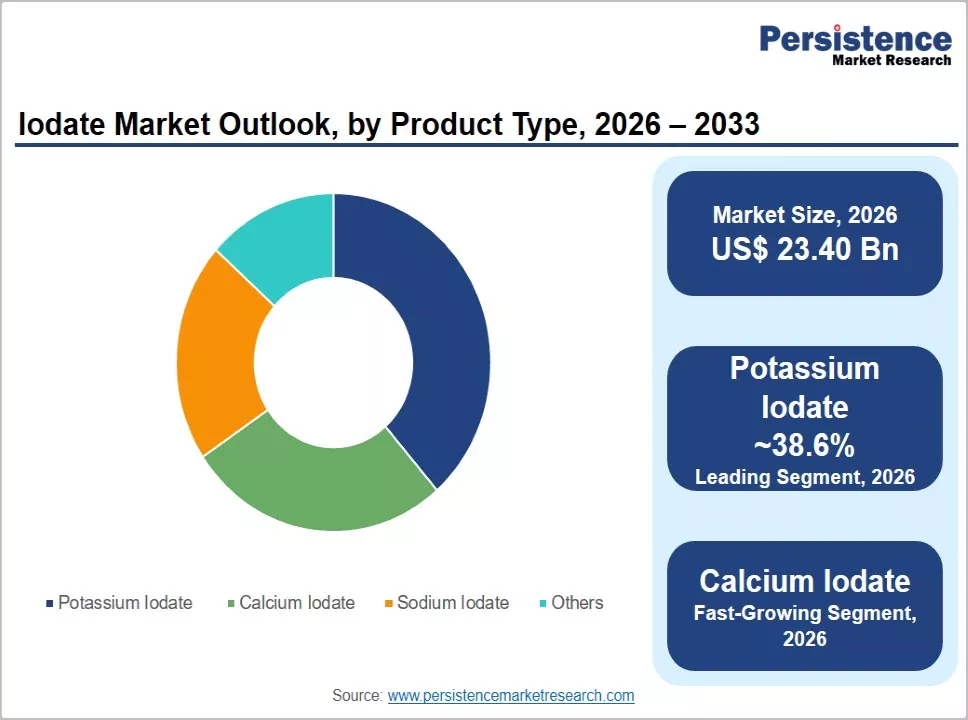
Potassium iodate accounts for 38.6% of the global market in 2026, equivalent to US$ 9.03 billion, because it functions as the universal standard for food-grade salt iodization and pharmaceutical thyroid-blocking applications simultaneously. Its chemical stability under tropical storage conditions — superior to potassium iodide in humid environments — makes it the preferred compound for governments procuring iodization agents for use across coastal and equatorial supply chains. Salt producers from Tata Chemicals in India to large-scale North African processors specify potassium iodate as the default iodization agent in bulk purchasing contracts.
Calcium iodate is the fastest-growing segment, propelled by expanding use in compound animal feed. DSM-Firmenich, following its 2023 merger, has integrated iodine-fortified premix products into its animal nutrition portfolio, amplifying commercial demand for feed-grade calcium iodate at scale across European and Asian poultry operations.
Grade Insights
What is Driving Pharmaceutical Grade Dominance in the Market?
Pharmaceutical grade accounts for 66.4% of the global market in 2026, equivalent to US$ 15.54 billion, reflecting the inescapable dependency of thyroid disorder therapeutics, contrast media formulation, and nuclear emergency preparedness stockpiling on rigorously certified iodate supply. Manufacturers including Merck KGaA supply pharmaceutical-grade potassium iodate to hospital pharmacies and national health stockpile programs, where any deviation from BP (British Pharmacopoeia) or USP (U.S. Pharmacopeia) monograph specifications renders material unusable. This certification barrier insulates pharmaceutical-grade suppliers from price-only competition.
Food grade is the fastest-growing sub-segment. Mandatory fortification rollouts in lower-middle-income economies, reinforced by UNICEF's Universal Salt Iodization acceleration agenda active through 2025, are pulling food-grade iodate volumes upward in markets where pharmaceutical-grade specifications are neither required nor economically viable.
Application Insights
Pharmaceuticals account for 45.3% of the global market in 2026, equivalent to US$ 10.60 billion, anchored by two structurally durable demand channels: thyroid condition management and nuclear preparedness. Endocrinologists prescribe potassium iodate formulations in thyroid storm suppression protocols, while national health agencies — including the UK Health Security Agency (UKHSA) — procure potassium iodate tablets for emergency distribution to populations near nuclear sites. Both channels operate under non-discretionary procurement logic, insulating pharmaceutical iodate demand from consumer sentiment cycles.
Food and beverages is the fastest-growing application. The Scaling Up Nutrition (SUN) Movement, which gained renewed government commitments from Ethiopia, Tanzania, and Bangladesh between 2022 and 2024, is accelerating national iodized salt programs that directly expand the iodate volumes consumed within the food processing supply chain.
Regional Insights
North America Iodate Market Trends
North America accounts for 23.1% of the global market in 2026, representing US$ 5.41 billion. The region's market is shaped by pharmaceutical procurement discipline, federally mandated water quality standards, and a mature processed food sector that relies on consistent iodized salt supply. North America carries the fastest-growing CAGR among all regions at 7.8% through 2033, driven by accelerating nuclear preparedness spending and water infrastructure modernization. Renewed US Department of Health and Human Services (HHS) guidance on radiation emergency preparedness, issued in revised form in 2023, is directly translating into expanded potassium iodate procurement contracts.
U.S. Iodate Market Trends
The U.S. represents 65.4% of North America market in 2026, equivalent to US$ 3.54 billion. Demand is led by pharmaceutical manufacturers and federally contracted emergency preparedness agencies maintaining potassium iodate stockpiles under Federal Emergency Management Agency (FEMA) protocols. As nuclear energy capacity expands through new reactor licensing under the Nuclear Regulatory Commission (NRC), surrounding population iodization planning will sustain procurement growth through 2033.
Europe Iodate Market Trends
Europe accounts for 11.2% of the global market in 2026, representing US$ 2.62 billion. The region's demand profile is shaped by EU Regulation 2017/625 on official controls for food and feed safety, which mandates iodine content verification across the processed food supply chain. Nuclear proximity preparedness is a prominent driver following post-Ukraine conflict reassessment of civilian emergency protocols, with several Member States revisiting potassium iodate stockpile adequacy. Pharmaceutical demand remains the volume anchor.
Germany Iodate Market Size
Germany represents 36.5% of the Europe market in 2026, equivalent to US$ 0.96 billion. Germany's pharmaceutical manufacturing base - anchored by companies including Merck KGaA and a dense network of contract manufacturers regulated under German Medicines Act (AMG) standards — drives sustained pharmaceutical-grade iodate procurement. As Germany accelerates chemical industry decarbonization under its National Hydrogen Strategy, iodate's role in chemical synthesis processes is under incremental review for potential process integration.
France Iodate Market Trends
France represents 18.3% of the Europe market in 2026, equivalent to US$ 0.48 billion. France's outsized nuclear energy infrastructure - operating 56 reactors managed by Électricité de France (EDF) - creates a structurally elevated baseline demand for potassium iodate through the national civilian emergency stockpile system. As EDF pursues its new reactor construction program under the French Energy Sovereignty Act (2023), potassium iodate procurement obligations for surrounding communities will expand commensurately.
Asia Pacific Iodate Market Trends
Asia Pacific accounts for 43.3% of the global market in 2026, representing US$ 10.13 billion, making it the clear regional anchor of global iodate demand. The region concentrates the world's largest iodine-deficient populations, the most active salt iodization programs, and the fastest-growing pharmaceutical manufacturing base. China's upstream iodine extraction capacity and India's mandated iodization infrastructure together determine global supply-demand balancing dynamics. Regional demand will intensify as animal nutrition standards tighten across Southeast Asian livestock markets.
China Iodate Market Trends
China represents 40.3% of the Asia Pacific market in 2026, equivalent to US$ 4.08 billion. China is simultaneously the region's dominant iodate consumer and a significant producer, with iodine extracted as a by-product of natural gas and oil well brine operations in Sichuan Province. As China's National Development and Reform Commission (NDRC) continues to enforce universal salt iodization under the Salt Industry Reform Plan, domestic iodate demand will remain structurally protected through the forecast period.
India Iodate Market Trends
India represents 21.6% of the Asia Pacific market in 2026, equivalent to US$ 2.19 billion. India's iodized salt mandate - enforced across the entire organized salt industry under FSSAI regulation - makes potassium iodate a non-discretionary procurement input for processors including Tata Chemicals and Nirma Limited. As India's National Program for Prevention and Control of Non-Communicable Diseases integrates micronutrient sufficiency targets, iodization coverage requirements are expected to tighten further, expanding commercial iodate volumes through 2033.
Competitive Landscape
The global iodate market is moderately concentrated at the pharmaceutical-grade tier and fragmented across food and industrial grades. Merck KGaA and Thermo Fisher Scientific Inc. anchor the high-specification pharmaceutical supply channel, competing on GMP certification depth, pharmacopoeial compliance documentation, and supply continuity guarantees rather than price alone. Mid-market producers - including Iofina plc, which extracts iodine from Oklahoma brine streams, Ajay-SQM Group, and Jubilant Ingrevia Limited - compete across both food and pharmaceutical grades, leveraging vertical integration into iodine production as a margin buffer against spot price volatility.
Regional specialists such as Godo Shigen Co., Ltd. and Nippoh Chemicals Co., Ltd. in Japan, and Mekong Chemicals in Southeast Asia, hold strong positions in local pharmaceutical and food-grade procurement channels. Competitive differentiation increasingly turns on supply chain transparency, traceability documentation for regulatory audits, and the ability to deliver consistent elemental iodine content across production batches. Additional participants including American Elements, Calibre Chemicals Pvt. Ltd., Samrat Pharmachem Limited, Vishal Laboratories, Deepwater Chemicals, Tokyo Chemical Industry Co., Ltd., and Spectrum Chemical Manufacturing Corp. serve specialty research, industrial, and regional food-grade segments.
Key Industry Developments
- In September 2026, the U.S. Food and Drug Administration's food-substance database continued to recognize potassium iodate under its established regulatory provisions for food applications. Under 21 CFR 184.1635, potassium iodate is permitted as a dough-strengthening agent in bread manufacturing, subject to specified usage limits. Its recognized applications also include flour treatment and nutrient supplementation. This regulatory framework remains relevant for manufacturers using potassium iodate in food processing and iodine fortification.
- In June 2025, the European Food Safety Authority (EFSA) published a scientific assessment on the renewal of authorizations for potassium iodide and anhydrous calcium iodate as nutritional feed additives for all animal species. Following an application from AJAY EUROPE SARL, EFSA concluded that both substances remained safe for target animals and the environment under their existing authorized conditions of use. However, the authority could not reach a conclusion on consumer safety because adequate data on iodine deposition in animal-derived food products were unavailable. The assessment reinforced the importance of safety evaluation and quality control for iodine-based compounds used in animal nutrition.
- In 2025, Germany's Federal Institute for Risk Assessment (BfR) reiterated its assessment that potassium iodate and sodium iodate can be used as iodine sources in iodized table salt without presenting a nutritional, technological, or toxicological disadvantage compared with iodide compounds. The assessment addressed the question of whether consumers need to know which iodine compound is used in fortified salt and supported the continued use of iodate-based fortification in food applications.
Companies Covered in Iodate Market
- Merck KGaA
- Thermo Fisher Scientific Inc.
- American Elements
- Calibre Chemicals Pvt. Ltd.
- Ajay-SQM Group
- Samrat Pharmachem Limited
- Vishal Laboratories
- Godo Shigen Co., Ltd.
- Nippoh Chemicals Co., Ltd.
- Mekong Chemicals
- Jubilant Ingrevia Limited
- Deepwater Chemicals
- Tokyo Chemical Industry Co., Ltd.
- Spectrum Chemical Manufacturing Corp.
- Iofina plc
- Others
Frequently Asked Questions
The global iodate market is valued at US$ 23.40 billion in 2026 and is projected to reach US$ 33.37 billion by 2033, expanding at a CAGR of 5.2%.
Government-mandated universal salt iodization enforced by bodies including India's FSSAI and WHO's micronutrient action framework, and expanding pharmaceutical procurement for nuclear preparedness.
Pharmaceutical grade holds the largest share of the global market, accounting for 66.4% of total volume, owing to the certification-intensive nature of thyroid therapeutics and emergency preparedness procurement.
Asia Pacific dominates the global market with a 43.3% share, driven by China's vertically integrated iodine extraction industry and India's legally mandated salt iodization infrastructure enforced under FSSAI regulation.
The highest-value opportunity in the market lies in GMP-certified calcium iodate supply for animal nutrition, where EFSA's 2022 feed additive guidelines have created a certification-driven advantage for qualified producers serving European and Asian livestock markets.
The global market's leading companies include Merck KGaA, Thermo Fisher Scientific Inc., Iofina plc, Jubilant Ingrevia Limited, and Ajay-SQM Group, competing across pharmaceutical, food, and industrial grades.


