




- Industrial Machinery
- Emulsifying Machines Market
Emulsifying Machines Market Size, Share, and Growth Forecast, 2026 – 2033
Emulsifying Machines Market by Product Type (Vacuum Emulsifying Machine, Ultrasonic Emulsifying Machine, Others), Application (Food & Beverage, Personal Care & Cosmetics, Others), Capacity, and Regional Analysis for 2026 - 2033

Emulsifying Machines Market Size and Trends Analysis
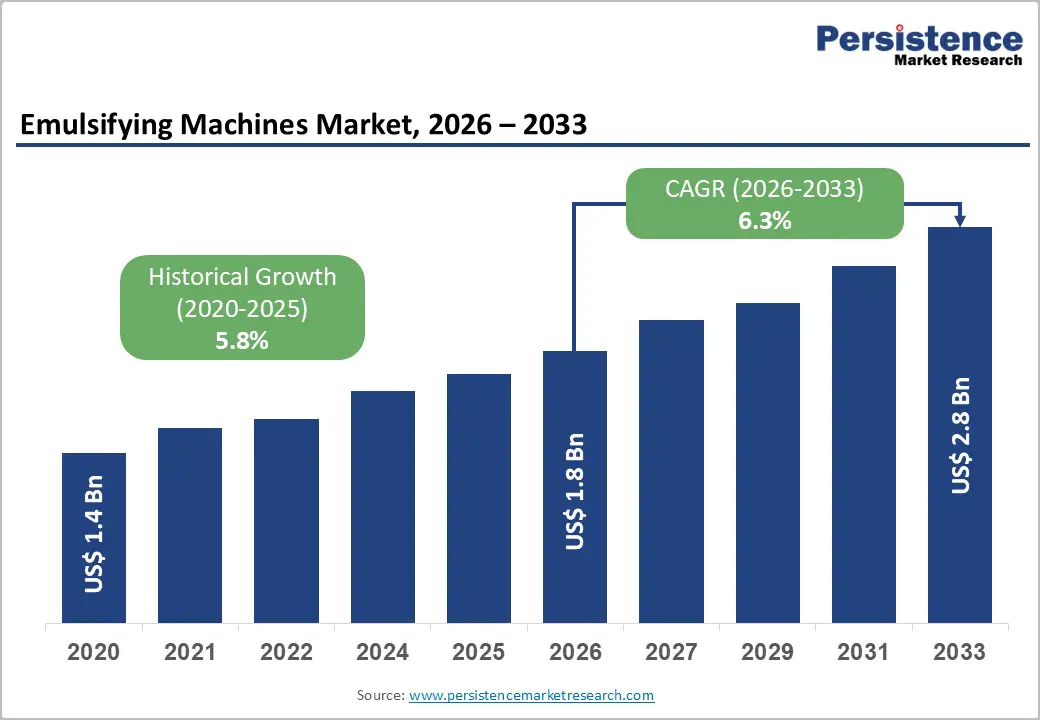
The global emulsifying machines market size is likely to be valued at US$ 1.8 billion in 2026 and is expected to reach US$ 2.8 billion by 2033, growing at a CAGR of 6.3% between 2026 and 2033, driven by increasing demand across food processing, personal care, pharmaceutical, and chemical manufacturing industries.
Growth is supported by rising adoption of hygienic processing equipment, stricter product quality standards, and increasing investments in automated manufacturing systems. Continuous advancements in emulsification technologies and growing demand for high-performance formulations are further encouraging equipment modernization across industrial facilities worldwide.
Key Industry Highlights:
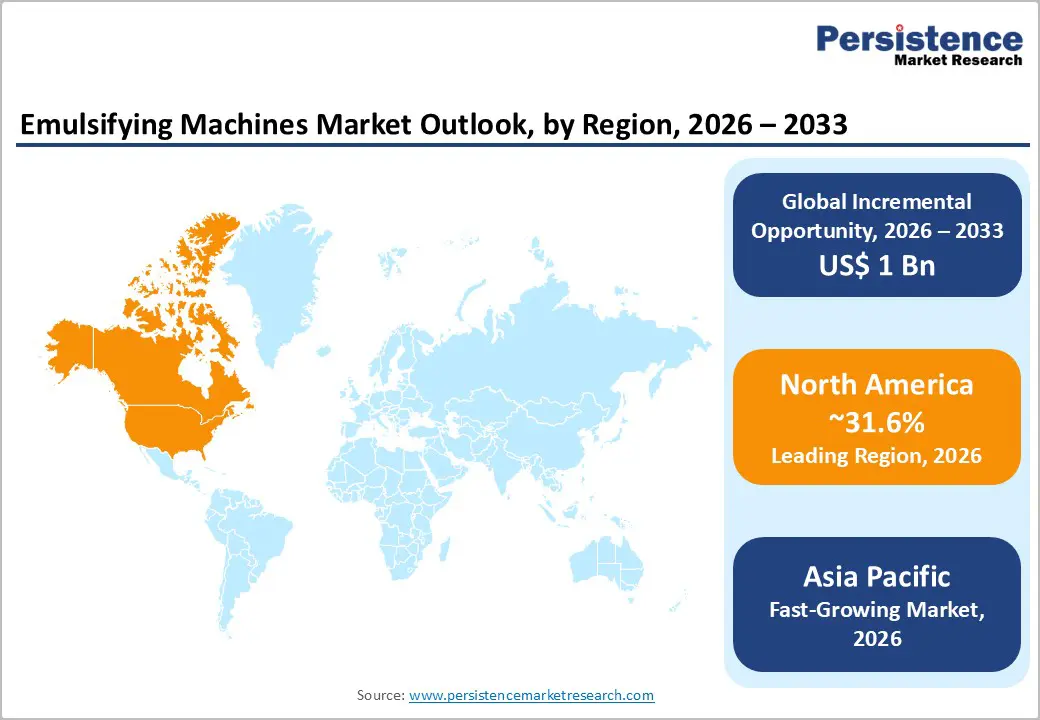
- Leading Region: North America is anticipated to account for approximately 31.6% of market share in 2026, supported by strong food processing, pharmaceutical manufacturing, and personal care industries.
- Fastest-growing Region: Asia Pacific is expected to register the highest growth rate through 2033, driven by expanding manufacturing capacity and rising demand across food, cosmetics, and pharmaceutical sectors.
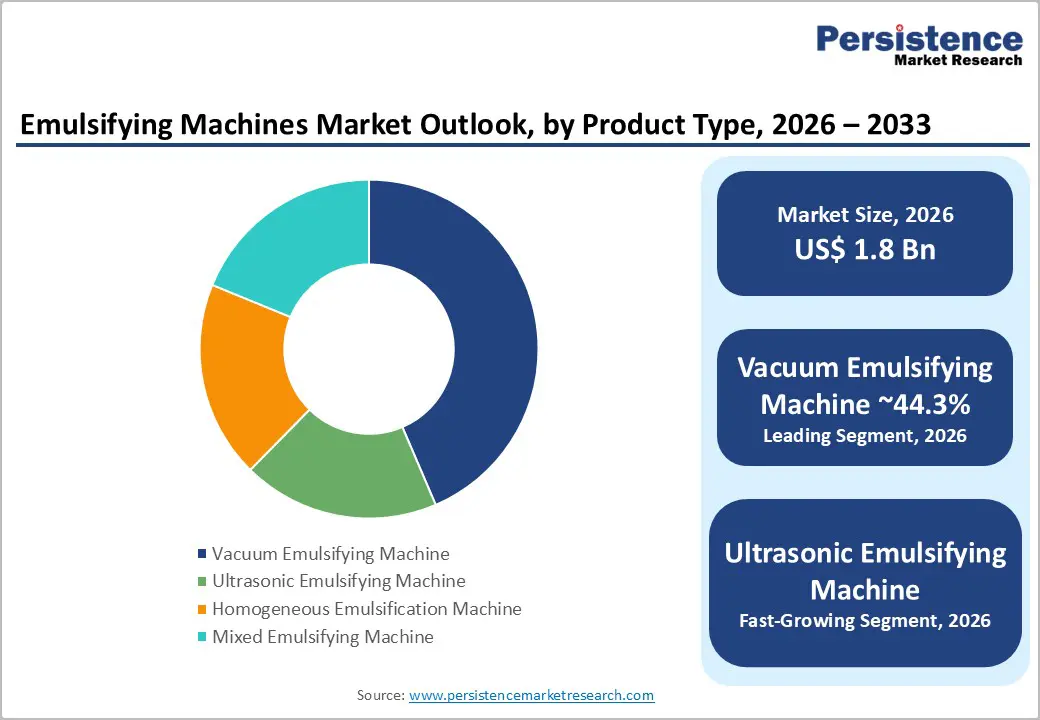
- Dominant Product Type: Vacuum emulsifying machines are anticipated to hold approximately 44.3% market share, driven by widespread adoption in food, cosmetics, and pharmaceutical applications requiring superior product stability and consistency.
- Leading Application: The food & beverage segment is anticipated to account for approximately 51.6% of market revenue in 2026, supported by growing demand for processed foods, dairy products, sauces, beverages, bakery fillings, and plant-based formulations.
DRO Analysis
Driver - Expanding Food Processing Industry and Demand for Hygienic Manufacturing
The food and beverage industry remains the largest consumer of emulsifying machines, accounting for a significant share of global installations. Emulsification plays a critical role in the production of sauces, dressings, dairy products, bakery fillings, beverages, spreads, and plant-based food alternatives. As processed food consumption continues to rise globally, manufacturers are investing in advanced equipment capable of delivering consistent texture, product stability, and production efficiency.
The increasing adoption of food safety standards and hygienic manufacturing practices has accelerated demand for vacuum and high-shear emulsification systems. Food manufacturers are prioritizing equipment that supports clean-in-place (CIP) operations, minimizes contamination risks, and improves operational efficiency. Large-scale food processing facilities increasingly require automated emulsifying solutions capable of handling high production volumes while maintaining product consistency. These factors continue to drive replacement demand and new equipment investments, particularly in North America, Europe, and rapidly industrializing Asian economies.
Regulatory Compliance and Premium Product Manufacturing in Cosmetics and Pharmaceuticals
The cosmetics and pharmaceutical industries are increasingly adopting advanced emulsification technologies to meet stringent quality standards and regulatory requirements. Modern skincare products, creams, lotions, ointments, suspensions, and topical drug formulations require highly controlled emulsification processes to achieve product stability and effectiveness.
Manufacturers are investing in automated vacuum emulsifying machines that provide precise control over particle size distribution, temperature, and mixing conditions. Regulatory emphasis on Good Manufacturing Practices (GMP), product traceability, and quality assurance is encouraging equipment upgrades across production facilities. The growing popularity of premium personal care products and advanced drug delivery formulations further supports demand for sophisticated emulsification systems. As manufacturers focus on reducing batch variability and improving process validation, demand for technologically advanced emulsifying equipment continues to strengthen across both developed and emerging markets.
Restraint - High Capital Investment and Long Procurement Cycles
Despite favorable growth prospects, the market faces challenges associated with high capital expenditure requirements. Industrial emulsifying machines often involve substantial upfront investment due to advanced engineering, automation capabilities, hygienic design requirements, and specialized documentation for regulated industries.
Pharmaceutical and cosmetics manufacturers frequently require extensive validation procedures, installation qualification, performance testing, and regulatory documentation before equipment deployment. These requirements increase project complexity and extend procurement timelines. Small and medium-sized enterprises often face budget constraints that limit adoption of premium emulsification systems. Furthermore, maintenance costs, operator training requirements, and facility integration expenses contribute to higher total ownership costs. As a result, many smaller manufacturers postpone equipment upgrades until production volumes justify investment, creating longer purchasing cycles within the market.
Opportunity - Manufacturing Expansion across Asia Pacific
Asia Pacific represents one of the most attractive growth opportunities for emulsifying machine manufacturers. Rapid industrialization, urbanization, and rising consumer spending are supporting expansion across food processing, cosmetics, pharmaceutical, and specialty chemical industries. China, India, Japan, and Southeast Asian countries continue to witness increasing investments in manufacturing facilities aimed at serving both domestic and export markets.
Growing demand for processed foods, skincare products, nutritional supplements, and pharmaceutical formulations is creating significant opportunities for advanced processing equipment suppliers. Regional manufacturers are increasingly upgrading production capabilities to meet international quality standards, driving demand for modern emulsification technologies. Equipment suppliers that establish local service networks, technical support centers, and application laboratories are likely to gain competitive advantages by reducing implementation risks and improving customer confidence.
Adoption of Continuous Processing and Smart Manufacturing Technologies
Industrial manufacturers are increasingly transitioning from traditional batch processing toward continuous and semi-continuous production systems. This shift is creating opportunities for suppliers offering advanced emulsification solutions integrated with automation, digital monitoring, and process optimization capabilities.
Modern facilities seek equipment that supports real-time process control, predictive maintenance, and improved production efficiency. Digital technologies such as advanced sensors, automated control systems, and process simulation tools enable manufacturers to reduce waste, shorten development cycles, and enhance product consistency. The growing focus on Industry 4.0 initiatives across food, pharmaceutical, and cosmetics industries is expected to increase demand for intelligent emulsification systems. Suppliers capable of combining equipment, software, technical services, and process expertise will be well positioned to capitalize on this evolving market landscape.
Category-wise Analysis
Product Type Insights
Vacuum emulsifying machines are anticipated to account for approximately 44.3% of the market share in 2026. Their dominance is driven by extensive use in food processing, cosmetics, and pharmaceutical manufacturing, where product stability and uniformity are critical. These systems remove trapped air during processing, improving texture, appearance, and shelf life. Common applications include skincare creams, lotions, mayonnaise, sauces, ointments, and other high-viscosity formulations. Their ability to deliver consistent product quality and support large-scale production continues to drive adoption among major manufacturers.
Ultrasonic emulsifying machines are expected to be the fastest-growing segment. Growth is supported by increasing demand for nanoemulsions and fine-particle formulations used in advanced cosmetics, drug delivery systems, nutraceuticals, and specialty chemicals. The technology enables superior droplet-size control while reducing processing time and energy consumption. Meanwhile, Homogeneous Emulsification Machines maintain strong demand for high-shear applications such as dairy products and industrial emulsions, while Mixed Emulsifying Machines remain popular among small and mid-sized manufacturers seeking versatile and cost-effective processing solutions.
Application Insights
The food & beverage segment is anticipated to hold approximately 51.6% of the market share in 2026. Emulsifying machines are widely used in the production of sauces, salad dressings, dairy products, beverages, confectionery fillings, bakery creams, and plant-based foods. Rising demand for convenience foods, premium formulations, and consistent product quality is encouraging food manufacturers to invest in automated emulsification systems. Large-scale processors particularly favor advanced equipment that enhances throughput while meeting stringent food safety and hygiene standards.
The personal care & cosmetics segment is projected to be the fastest-growing application segment. Growth is fueled by increasing demand for skincare creams, anti-aging products, sunscreens, serums, and premium cosmetic formulations that require precise emulsification. The Pharmaceutical segment continues to expand steadily, supported by growing production of topical creams, gels, ointments, and drug-delivery formulations. Meanwhile, the Chemical segment maintains stable demand across paints, coatings, adhesives, inks, and specialty industrial emulsions, where uniform dispersion and product stability are essential.
Regional Insights
North America Emulsifying Machines Market Trends
North America is anticipated to account for approximately 31.6% of the market share in 2026, making it one of the most established regional markets. Demand is supported by a mature food processing industry, advanced pharmaceutical manufacturing capabilities, and a strong personal care products sector. The region continues to invest in automation, hygienic processing technologies, and smart manufacturing solutions, creating sustained demand for advanced emulsification systems.
U.S. Emulsifying Machines Market Trends
The U.S. accounts for approximately 77% of North America's market share, making it the regional leader. The country's extensive food and beverage manufacturing sector, large pharmaceutical industry, and growing cosmetics market support strong equipment demand. Manufacturers are increasingly adopting automated vacuum and high-shear emulsifying systems to improve production efficiency, maintain regulatory compliance, and support clean-label product development. Investments in digital manufacturing and process optimization continue to drive equipment upgrades across production facilities.
Canada Emulsifying Machines Market Trends
Canada represents approximately 13% of regional demand, supported by growing investments in food processing, nutraceutical production, and specialty consumer products. Demand is particularly strong for medium-capacity and hygienic processing systems used in dairy products, beverages, and personal care formulations. Government support for food manufacturing modernization and industrial automation is expected to support steady market growth throughout the forecast period.
Europe Emulsifying Machines Market Trends
Europe remains a technologically advanced market characterized by strict manufacturing standards, strong engineering expertise, and widespread adoption of premium processing equipment. Demand is driven by the region's leadership in pharmaceuticals, cosmetics, specialty chemicals, and food manufacturing. Sustainability initiatives and energy-efficiency requirements are encouraging manufacturers to upgrade processing infrastructure and adopt modern emulsification technologies.
Germany Emulsifying Machines Market Trends
Germany is the largest market in Europe, supported by its strong industrial manufacturing base and leadership in pharmaceutical, food, and chemical production. The country is also home to several leading process equipment manufacturers, creating a highly developed ecosystem for advanced mixing and emulsification technologies. Demand remains strong for automated, energy-efficient, and high-capacity processing systems.
U.K. Emulsifying Machines Market Trends
The U.K. is a significant market driven by pharmaceutical innovation, premium personal care product manufacturing, and processed food production. Companies increasingly invest in advanced emulsification equipment to support product innovation, quality assurance, and production flexibility. Demand is particularly strong for systems used in cosmetics, healthcare products, and specialty food formulations.
France Emulsifying Machines Market Trends
France benefits from a globally recognized cosmetics and personal care industry, making it an important market for vacuum emulsifying and homogenization equipment. The country's pharmaceutical and food processing sectors also contribute significantly to demand. Manufacturers continue to invest in premium processing technologies to support high-quality formulations and export-oriented production.
Spain Emulsifying Machines Market Trends
Spain remains an important contributor to regional growth due to its expanding food processing industry and increasing investments in cosmetics manufacturing. Demand for emulsifying machines is supported by the growing production of dairy products, sauces, personal care products, and specialty formulations. Modernization of manufacturing facilities is expected to create additional opportunities for equipment suppliers.
Asia Pacific Emulsifying Machines Market Trends
Asia Pacific is anticipated to be the fastest-growing regional market during the forecast period, supported by rapid industrialization, expanding manufacturing capacity, and rising consumer demand. The region benefits from strong growth in food processing, pharmaceuticals, personal care products, and specialty chemicals. Increasing investments in production infrastructure and local manufacturing capabilities continue to strengthen market opportunities.
China Emulsifying Machines Market Trends
China is expected to account for approximately 59% of the Asia Pacific market in 2026, making it the dominant country within the region. Its extensive manufacturing ecosystem, large consumer base, and rapidly expanding food, pharmaceutical, and cosmetics industries support substantial demand for emulsifying machines. Investments in automation and advanced processing technologies are accelerating adoption of high-performance emulsification systems across multiple industries.
Japan Emulsifying Machines Market Trends
Japan remains a major market due to its focus on precision manufacturing, product quality, and technological innovation. The country's pharmaceutical, cosmetics, and food industries require advanced emulsification systems capable of delivering highly consistent product performance. Demand is particularly strong for high-shear, ultrasonic, and automated processing solutions.
India Emulsifying Machines Market Trends
India is emerging as one of the fastest-growing country markets, driven by increasing disposable incomes, rapid expansion of food processing facilities, pharmaceutical manufacturing growth, and rising demand for personal care products. Government initiatives supporting domestic manufacturing and industrial modernization are encouraging investments in advanced processing equipment. Demand is particularly strong among medium-capacity and scalable production facilities.
Competitive Landscape
The global emulsifying machines market remains moderately fragmented, with competition occurring across global industrial equipment manufacturers, specialized mixing technology providers, and regional processing equipment suppliers. Large manufacturers maintain advantages through broad product portfolios and global service networks, while specialized companies compete through application-specific expertise and customized engineering solutions.
Leading companies are focusing on product innovation, process automation, digital integration, and geographic expansion. Manufacturers increasingly combine equipment sales with technical consulting, pilot testing, validation support, and lifecycle services. Strategic priorities include improving energy efficiency, supporting continuous processing applications, and enhancing customer productivity through intelligent manufacturing solutions.
Key Industry Developments:
- In January 2025, SPX FLOW announced a collaboration with Siemens to develop digital twin and AI-enabled product design capabilities for fluid processing systems, including automated mixing and emulsification applications.
- In July 2025, SPX FLOW and SIG expanded their collaboration through an upgrade of the Dubai Innovation Center, adding advanced APV processing technologies and pilot-scale mixing capabilities.
Companies Covered in Emulsifying Machines Market
- GEA Group
- SPX FLOW
- Alfa Laval
- Silverson Machines
- IKA-Werke GmbH & Co. KG
- Charles Ross & Son Company
- EKATO Group
- NETZSCH Group
- INOXPA S.A.U.
- Admix Inc.
- Kinematica AG
- Romaco FrymaKoruma
- Ytron Process Technology GmbH
- Bematek Systems Inc.
- Lee Industries, Inc.
- Greerco Corporation (NOV Inc.)
Frequently Asked Questions
The global emulsifying machines market is anticipated to be valued at US$1.8 billion in 2026.
The emulsifying machines market is expected to reach approximately US$2.8 billion by 2033.
The emulsifying machines market is projected to grow at a CAGR of 6.3% between 2026 and 2033.
Key trends include growing adoption of vacuum emulsifying systems for superior product consistency and stability, and increasing demand for ultrasonic emulsification technology in nanoemulsions and advanced formulations.
Vacuum emulsifying machines are the leading product type segment, accounting for approximately 44.3% of the market share.
Major companies include GEA Group, SPX FLOW, Alfa Laval, IKA, and Silverson Machines.


