




- Biotechnology
- Salmonella Testing Market
Salmonella Testing Market Size, Share, and Growth Forecast, 2026 - 2033
Salmonella Testing Market by Test Type (Conventional Culture Methods, Immunoassay, PCR-based, Isothermal, Next-Generation Sequencing), Offering (Instruments & Automation Platforms, Test Kits & Reagents, Services), and Regional Analysis for 2026 - 2033

Salmonella Testing Market Size and Trends Analysis
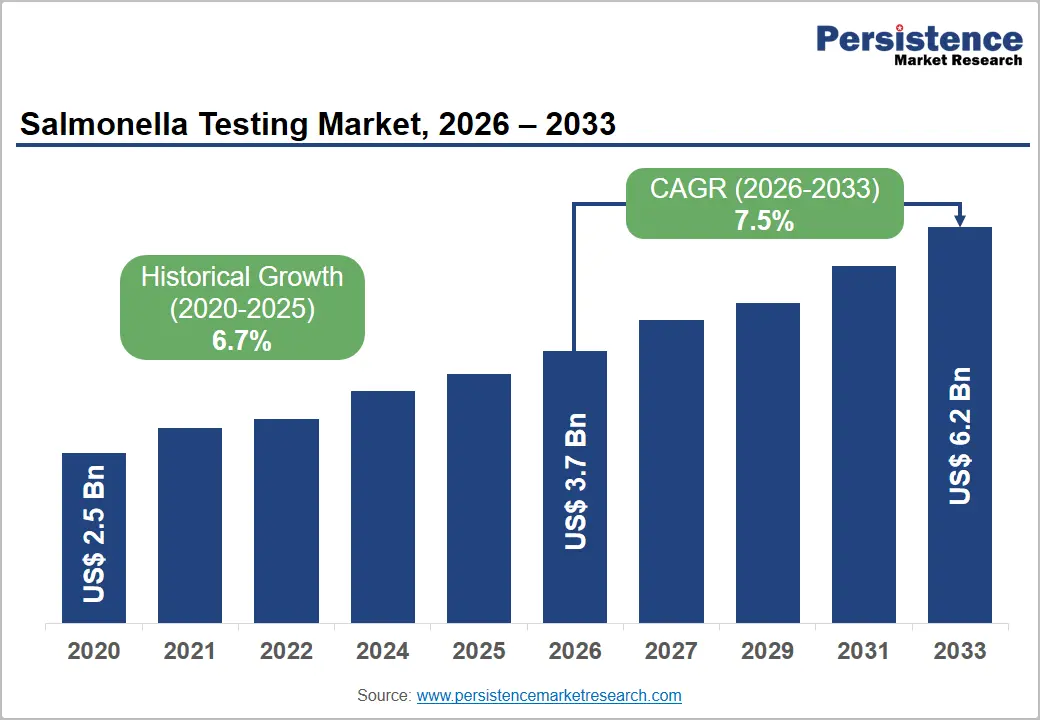
The global salmonella testing market size is likely to be valued at US$3.7 billion in 2026 and is expected to reach US$6.2 billion by 2033, growing at a CAGR of 7.5% during the forecast period from 2026 to 2033, driven by rising food safety concerns, increasing regulatory scrutiny, and the need for rapid pathogen detection across food production and processing facilities.
According to the U.S. Centers for Disease Control and Prevention (CDC), Salmonella causes an estimated 1.35 million infections annually in the U.S., making it one of the leading causes of foodborne illness. The World Health Organization (WHO) reported in 2024 that 600 million people globally fall ill from contaminated food each year, reinforcing the importance of robust food safety testing programs. These trends are accelerating the adoption of PCR-based, immunoassay, and automated testing technologies across the global food supply chain.
Key Industry Highlights:
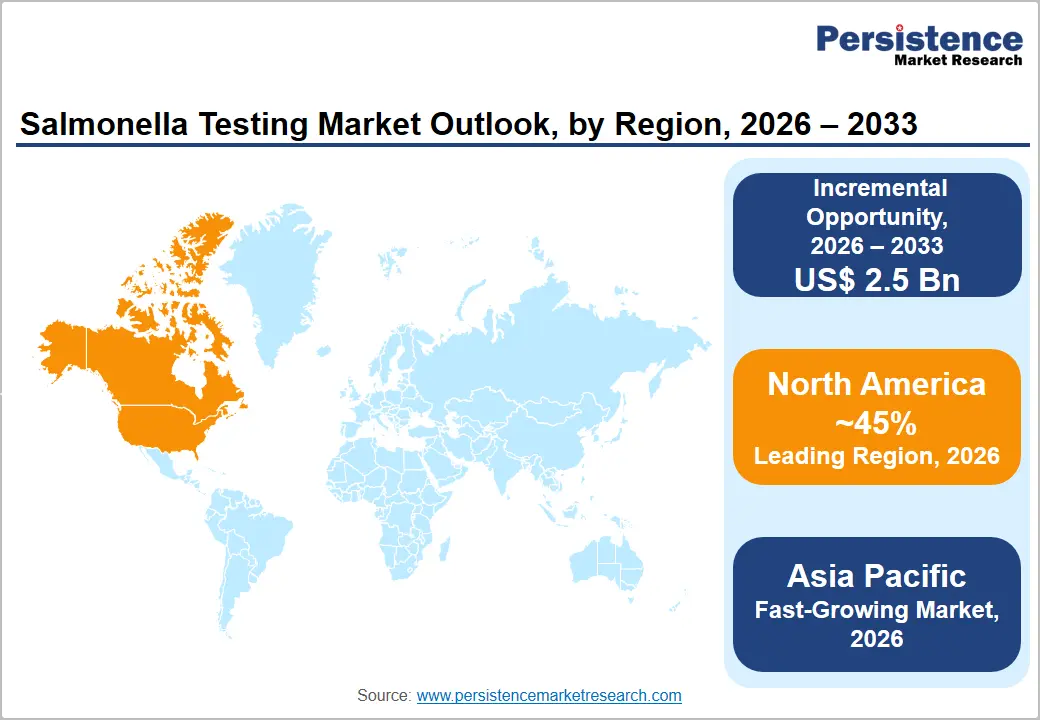
- Leading Region: North America is anticipated to be the leading region, accounting for a market share of 45% in 2026, driven by stringent food safety regulations and a widespread adoption of advanced testing technologies.
- Fastest-growing Region: Asia Pacific is likely to be the fastest-growing region, supported by expanding food processing industries, increasing food exports, and strengthening food safety regulations.
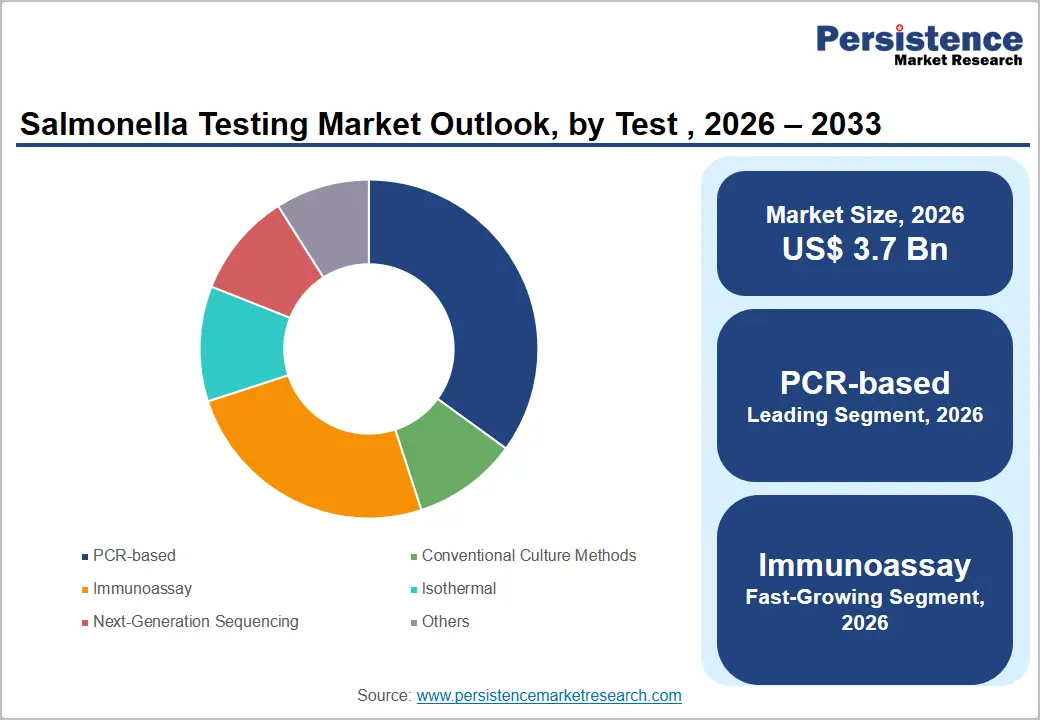
- Leading Test Type: PCR-based testing is projected to be the leading test type in 2026, accounting for 37% of the revenue share, owing to its high sensitivity, specificity, and rapid turnaround time.
- Leading Offering: Test kits & reagents are anticipated to be the leading offering, accounting for over 64% of the revenue share in 2026, supported by recurring demand for routine screening and quality assurance testing.
- Key Opportunity: The expanding adoption of rapid, automated, and molecular-based pathogen detection technologies across food production, processing, and supply chain networks is creating substantial growth opportunities in the Salmonella testing market.
DRO Analysis
Driver - Increasing Incidence of Salmonella Outbreaks and Foodborne Illnesses
Foodborne contamination remains a persistent concern across poultry, meat, eggs, dairy products, fresh produce, and processed foods. Regulatory agencies and food manufacturers are under increasing pressure to identify contamination before products reach consumers. High-profile recalls associated with Salmonella contamination can result in financial losses, reputational damage, and supply chain disruptions.
Food processors are investing in routine screening programs and advanced pathogen detection technologies. This heightened focus on prevention has significantly increased the adoption of reliable and rapid Salmonella testing methods. According to the U.S. Centers for Disease Control and Prevention, Salmonella remains one of the leading causes of foodborne illnesses.
Increasing consumer awareness regarding food safety and product quality is encouraging manufacturers to implement stricter testing protocols throughout production and distribution processes. Export-oriented food producers are also required to comply with international safety standards, increasing testing volumes. Expanding food trade has heightened concerns about pathogen transmission across borders, making accurate Salmonella detection an essential component of modern food safety management systems.
Restraint - Structural Limitations of Traditional Methods and Infrastructure Gaps
Traditional culture-based testing methods remain widely used because of their regulatory acceptance and proven accuracy. These methods often require lengthy incubation periods and multiple confirmation steps before results can be obtained. Delayed detection can affect inventory management, product release schedules, and supply chain efficiency. Small and medium-sized food producers may face difficulties implementing advanced testing technologies due to budget limitations and laboratory constraints.
Infrastructure disparities across developing regions also create barriers to widespread Salmonella testing implementation. Many laboratories lack advanced diagnostic equipment, automation capabilities, and skilled personnel required for high-throughput testing operations. Limited access to accredited testing facilities can increase turnaround times and testing costs. In rural and emerging food production regions, inconsistent laboratory standards and insufficient quality assurance systems reduce testing effectiveness.
Opportunity - Technological Convergence and Rapid/Point-of-Use Solutions
Modern testing technologies, including PCR-based assays, isothermal amplification methods, biosensors, and automated detection platforms, enable faster identification of contamination compared with conventional techniques. Food manufacturers increasingly seek testing systems that deliver accurate results within hours rather than days.
Rapid detection helps reduce production delays, minimize recall risks, and improve operational efficiency. The integration of automation and digital data management enhances laboratory productivity, making advanced testing platforms attractive for large-scale food processing facilities and quality control laboratories. Growing demand for decentralized testing is expected to accelerate adoption of portable and user-friendly diagnostic tools.
Point-of-use solutions allow food producers, processors, and inspectors to conduct testing closer to production sites, reducing dependence on centralized laboratories. Advances in artificial intelligence, genomic analysis, and connected monitoring systems are improving detection accuracy and traceability. These innovations support faster decision-making and strengthen food safety programs across the supply chain.
Category-wise Analysis
Test Type Insights
The PCR-based test type is expected to lead, accounting for 37% of the revenue share in 2026, due to its ability to deliver highly sensitive and specific results within a significantly shorter timeframe than traditional culture-based approaches. Food manufacturers, contract testing laboratories, and regulatory agencies increasingly rely on PCR technologies to support routine screening, outbreak investigations, and compliance activities. A notable example includes the widespread adoption of the BAX System Real-Time PCR platform by Hygiena, which is used by food processors and laboratories for rapid Salmonella detection and regulatory compliance programs.
Isothermal testing is likely to represent the fastest-growing segment, supported by the ability to provide rapid results without requiring sophisticated thermal cycling equipment. These technologies are gaining attention among food producers and field-testing operators seeking cost-effective and portable diagnostic solutions. For example, Loop-Mediated Isothermal Amplification (LAMP)-based Salmonella detection systems are increasingly utilized for rapid on-site food safety screening applications.
Offering Insights
Test kits & reagents are projected to lead the market, capturing around 64% of the revenue share in 2026, supported by recurring demand from food manufacturers, diagnostic laboratories, inspection agencies, and contract testing providers that perform routine pathogen screening. Since every testing procedure requires consumables, reagents generate continuous purchasing cycles and stable revenue streams. For example, bioMérieux’s VIDAS Salmonella testing kits are extensively used in food safety laboratories for rapid screening and confirmation of Salmonella contamination.
Services are likely to be the fastest-growing offering. Many manufacturers prefer external service providers as they offer advanced analytical capabilities, regulatory expertise, and accredited testing infrastructure without requiring significant in-house investments. For instance, Eurofins Scientific’s food testing services provide comprehensive Salmonella detection, validation, and compliance testing solutions for food producers worldwide.
Regional Insights
North America Salmonella Testing Market Trends
North America is anticipated to be the leading region, accounting for a market share of 45% in 2026, supported by strict food safety regulations, advanced laboratory infrastructure, and widespread adoption of molecular diagnostics. The region continues to witness strong demand for rapid pathogen detection technologies across poultry, meat, dairy, and processed food sectors. A notable industry development occurred in 2025 when Neogen Corporation launched its Molecular Detection Assay 2 Quantitative Salmonella solution for poultry applications.
U.S. Salmonella Testing Market Trends
The U.S. is expected to dominate the regional market, accounting for approximately 87% of the market share in 2026. This leadership is supported by stringent regulatory oversight from the USDA and FDA, which promotes routine testing across food production facilities. The poultry industry remains a key end user due to persistent concerns over Salmonella contamination and outbreak prevention. Additionally, food manufacturers are increasingly adopting PCR-based and automated detection technologies to enhance testing efficiency and reduce turnaround times. The presence of advanced laboratory networks and accredited testing facilities further supports the country's high testing volumes.
Canada Salmonella Testing Market Trends
Canada is likely to account for approximately 13% of the North America market share in 2026, driven by the increasing emphasis on preventive testing programs among food processors to ensure product quality and comply with export requirements. Strong collaboration among regulatory authorities, laboratories, and food manufacturers further supports market development. Investments in food safety modernization and laboratory capacity expansion are enhancing testing capabilities, while Canadian food exporters are increasingly adopting rapid testing methods to meet international trade standards and regulatory expectations.
Europe Salmonella Testing Market Trends
Europe is likely to be a significant market for Salmonella testing due to strict food safety legislation and strong laboratory infrastructure. Demand for pathogen testing is supported by extensive food production activities, export requirements, and public health monitoring programs. For example, the continued expansion of testing capabilities by bioMérieux across European food safety laboratories supports faster pathogen detection and traceability initiatives.
U.K. Salmonella Testing Market Trends
The U.K. is likely to be a significant market for Salmonella testing, holding 14% of the Europe market share in 2026, supported by food safety compliance requirements and quality assurance programs. Food manufacturers increasingly rely on accredited laboratories for microbiological testing and certification services. The country's strong retail food sector places substantial emphasis on contamination prevention and supply chain monitoring. The adoption of rapid pathogen detection technologies is increasing among food processors seeking faster release of products.
Germany Salmonella Testing Market Trends
Germany is anticipated to dominate the regional market, accounting for around 39% of the Europe market share in 2026, due to its extensive food processing industry and advanced laboratory ecosystem. The country places significant emphasis on microbiological quality control and food safety compliance. Food manufacturers continue investing in automated testing platforms to improve operational efficiency and regulatory adherence.
Asia Pacific Salmonella Testing Market Trends
The Asia Pacific region is likely to be the fastest-growing region in Salmonella testing, driven by its expanding food processing industries, rising food exports, and strengthening food safety regulations. Growing urbanization and increasing demand for packaged foods are also contributing to higher testing volumes. For instance, the expansion of food safety testing solutions by QIAGEN across Asia-Pacific laboratories supports advanced molecular testing applications.
China Salmonella Testing Market Trends
China is projected to dominate the regional market, holding around a 35% share in 2026, due to its massive food production and export industries. Food safety remains a national priority, encouraging manufacturers to strengthen pathogen monitoring practices. Regulatory authorities continue to enhance food quality standards and inspection requirements. The adoption of rapid molecular testing technologies is increasing across food processing facilities and testing laboratories.
India Salmonella Testing Market Trends
India is expected to account for approximately 20% of the Asia Pacific market share in 2026, due to the expanding food processing activities and stronger food safety enforcement. The Food Safety and Standards Authority of India (FSSAI) continues to promote improved testing and compliance practices across the food industry. Rising consumer awareness regarding food quality and safety is encouraging manufacturers to implement routine pathogen screening.
Competitive Landscape
The global Salmonella testing market exhibits a moderately fragmented structure, driven by the presence of multinational diagnostic companies, food safety testing specialists, laboratory service providers, and regional technology developers. Market participants are focusing on improving testing speed, sensitivity, and workflow efficiency to meet increasingly stringent food safety requirements across the food production and processing industries.
With key leaders, including bioMérieux, Bio-Rad Laboratories, Neogen Corporation, Hygiena, Merck KGaA, QIAGEN, Eurofins Scientific, and Intertek Group, the competitive environment remains innovation-focused. These players compete through product launches, expansion of molecular testing portfolios, laboratory automation capabilities, strategic partnerships, accreditation enhancements, and geographic expansion initiatives.
Key Industry Developments:
- In January 2026, PathogenDx launched its Unified Salmonella Testing System at IPPE 2026, introducing a comprehensive suite of solutions for Salmonella detection, quantitation, serotyping, and vaccine identification in poultry processing environments. The platform is designed to provide faster, more accurate, and cost-effective Salmonella monitoring.
- In March 2025, Bio-Rad Laboratories launched its XP-Design Assay Salmonella Serotyping Solution, enabling rapid and accurate identification of Salmonella serotypes for food safety testing. The solution helps food testing laboratories improve outbreak investigations, strengthen traceability, and accelerate pathogen characterization, supporting more effective food safety monitoring and regulatory compliance.
Companies Covered in Salmonella Testing Market
- Agilent Technologies
- ALS Limited
- BioControl Systems (Meridian)
- bioMérieux
- Bio-Rad Laboratories
- Bureau Veritas
- Danaher
- Eurofins Scientific
- Hygiena
- IDEXX Laboratories
- Intertek Group
- Merck KGaA
- Mérieux NutriSciences
- Neogen Corporation
- QIAGEN
- Romer Labs
- SDIX LLC
Frequently Asked Questions
The Salmonella testing market is projected to reach US$3.7 billion in 2026.
Rising incidences of foodborne illnesses and increasingly stringent food safety regulations are driving demand for rapid and accurate Salmonella testing solutions worldwide.
The Salmonella testing market is expected to grow at a CAGR of 7.5% from 2026 to 2033.
The growing adoption of rapid molecular diagnostics, portable testing technologies, and automated food safety testing platforms presents significant opportunities in the Salmonella testing market.
Agilent Technologies, ALS Limited, Meridian Bioscience (BioControl Systems), bioMérieux, Bio-Rad Laboratories, Bureau Veritas, and Danaher Corporation are the leading players.


