


- Executive Summary
- Global Reishi Mushroom Extract Market Snapshot, 2026 and 2033
- Market Opportunity Assessment, 2026 – 2033, US$ Bn
- Key Market Trends
- Future Market Projections
- Premium Market Insights
- Industry Developments and Key Market Events
- PMR Analysis and Recommendations
- Market Overview
- Market Scope and Definition
- Market Dynamics
- Drivers
- Restraints
- Opportunity
- Key Trends
- Macro-economic Factors
- Global Sectoral Outlook
- Global GDP Growth Outlook
- COVID-19 Impact Analysis
- Forecast Factors – Relevance and Impact
- Value Added Insights
- Tool Adoption Analysis
- Regulatory Landscape
- Value Chain Analysis
- PESTLE Analysis
- Porter’s Five Force Analysis
- Price Analysis, 2025A
- Key Highlights
- Key Factors Impacting Deployment Costs
- Pricing Analysis, By Application
- Global Reishi Mushroom Extract Market Outlook
- Key Highlights
- Market Volume (Units) Projections
- Market Size (US$ Bn) and Y-o-Y Growth
- Absolute $ Opportunity
- Market Size (US$ Bn) and Volume (Units) Analysis and Forecast
- Historical Market Size (US$ Bn) Analysis, 2020-2025
- Current Market Size (US$ Bn) Analysis and Forecast, 2026 – 2033
- Global Reishi Mushroom Extract Market Outlook: Form
- Introduction / Key Findings
- Historical Market Size (US$ Bn) and Volume (Units) Analysis, By Form, 2020 – 2025
- Current Market Size (US$ Bn) and Volume (Units) Analysis and Forecast, By Form, 2026 – 2033
- Powder
- Liquid
- Market Attractiveness Analysis: Form
- Global Reishi Mushroom Extract Market Outlook: Application
- Introduction / Key Findings
- Historical Market Size (US$ Bn) Analysis, By Application, 2020 – 2025
- Current Market Size (US$ Bn) Analysis and Forecast, By Application, 2026 – 2033
- Dietary Supplements
- Functional Food
- Beverages
- Pharmaceutical
- Market Attractiveness Analysis: Application
- Global Reishi Mushroom Extract Market Outlook: Distribution Channel
- Introduction / Key Findings
- Historical Market Size (US$ Bn) Analysis, By Distribution Channel, 2020 – 2025
- Current Market Size (US$ Bn) Analysis and Forecast, By Distribution Channel, 2026 – 2033
- Online Stores
- Offline Stores
- Market Attractiveness Analysis: Distribution Channel
- Key Highlights
- Global Reishi Mushroom Extract Market Outlook: Region
- Key Highlights
- Historical Market Size (US$ Bn) and Volume (Units) Analysis, By Region, 2020 – 2025
- Current Market Size (US$ Bn) and Volume (Units) Analysis and Forecast, By Region, 2026 – 2033
- North America
- Europe
- East Asia
- South Asia and Oceania
- Latin America
- Middle East & Africa
- Market Attractiveness Analysis: Region
- North America Reishi Mushroom Extract Market Outlook
- Key Highlights
- Historical Market Size (US$ Bn) Analysis, By Market, 2020 – 2025
- By Country
- By Form
- By Application
- By Distribution Channel
- Current Market Size (US$ Bn) Analysis and Forecast, By Country, 2026 – 2033
- U.S.
- Canada
- Current Market Size (US$ Bn) and Volume (Units) Analysis and Forecast, By Form, 2026 – 2033
- Powder
- Liquid
- Current Market Size (US$ Bn) Analysis and Forecast, By Application, 2026 – 2033
- Dietary Supplements
- Functional Food
- Beverages
- Pharmaceutical
- Current Market Size (US$ Bn) Analysis and Forecast, By Distribution Channel, 2026-2033
- Online Stores
- Offline Stores
- Market Attractiveness Analysis
- Europe Reishi Mushroom Extract Market Outlook
- Key Highlights
- Historical Market Size (US$ Bn) Analysis, By Market, 2020 – 2025
- By Country
- By Form
- By Application
- Distribution Channel
- Current Market Size (US$ Bn) Analysis and Forecast, By Country, 2026 – 2033
- Germany
- France
- U.K.
- Italy
- Spain
- Russia
- Türkiye
- Rest of Europe
- Current Market Size (US$ Bn) and Volume (Units) Analysis and Forecast, By Form, 2026 – 2033
- Powder
- Liquid
- Current Market Size (US$ Bn) Analysis and Forecast, By Application, 2026 – 2033
- Dietary Supplements
- Functional Food
- Beverages
- Pharmaceutical
- Current Market Size (US$ Bn) Analysis and Forecast, By Distribution Channel, 2026-2033
- Online Stores
- Offline Stores
- Market Attractiveness Analysis
- East Asia Reishi Mushroom Extract Market Outlook
- Key Highlights
- Historical Market Size (US$ Bn) Analysis, By Market, 2020 – 2025
- By Country
- By Form
- By Application
- By Distribution Channel
- Current Market Size (US$ Bn) Analysis and Forecast, By Country, 2026 – 2033
- China
- Japan
- South Korea
- Current Market Size (US$ Bn) and Volume (Units) Analysis and Forecast, By Form, 2026 – 2033
- Powder
- Liquid
- Current Market Size (US$ Bn) Analysis and Forecast, By Application, 2026 – 2033
- Dietary Supplements
- Functional Food
- Beverages
- Pharmaceutical
- Current Market Size (US$ Bn) Analysis and Forecast, By Distribution Channel, 2026-2033
- Online Stores
- Offline Stores
- Market Attractiveness Analysis
- South Asia & Oceania Reishi Mushroom Extract Market Outlook
- Key Highlights
- Historical Market Size (US$ Bn) Analysis, By Market, 2020 – 2025
- By Country
- By Form
- By Application
- By Distribution Channel
- Current Market Size (US$ Bn) Analysis and Forecast, By Country, 2026 – 2033
- India
- Southeast Asia
- ANZ
- Rest of South Asia & Oceania
- Current Market Size (US$ Bn) and Volume (Units) Analysis and Forecast, By Form, 2026 – 2033
- Powder
- Liquid
- Current Market Size (US$ Bn) Analysis and Forecast, By Application, 2026 – 2033
- Dietary Supplements
- Functional Food
- Beverages
- Pharmaceutical
- Current Market Size (US$ Bn) Analysis and Forecast, By Distribution Channel, 2026-2033
- Online Stores
- Offline Stores
- Market Attractiveness Analysis
- Latin America Reishi Mushroom Extract Market Outlook
- Key Highlights
- Historical Market Size (US$ Bn) Analysis, By Market, 2020 – 2025
- By Country
- By Form
- By Application
- By Distribution Channel
- Current Market Size (US$ Bn) Analysis and Forecast, By Country, 2026 – 2033
- Brazil
- Mexico
- Rest of Latin America
- Current Market Size (US$ Bn) and Volume (Units) Analysis and Forecast, By Form, 2026 – 2033
- Powder
- Liquid
- Current Market Size (US$ Bn) Analysis and Forecast, By Application, 2026 – 2033
- Dietary Supplements
- Functional Food
- Beverages
- Pharmaceutical
- Current Market Size (US$ Bn) Analysis and Forecast, By Distribution Channel, 2026-2033
- Online Stores
- Offline Stores
- Market Attractiveness Analysis
- Middle East & Africa Reishi Mushroom Extract Market Outlook
- Key Highlights
- Historical Market Size (US$ Bn) Analysis, By Market, 2020 – 2025
- By Country
- By Form
- By Application
- By Distribution Channel
- Current Market Size (US$ Bn) Analysis and Forecast, By Country, 2026 – 2033
- GCC Countries
- Egypt
- South Africa
- Northern Africa
- Rest of Middle East & Africa
- Current Market Size (US$ Bn) and Volume (Units) Analysis and Forecast, By Form, 2026 – 2033
- Powder
- Liquid
- Current Market Size (US$ Bn) Analysis and Forecast, By Application, 2026 – 2033
- Dietary Supplements
- Functional Food
- Beverages
- Pharmaceutical
- Current Market Size (US$ Bn) Analysis and Forecast, By Distribution Channel, 2026-2033
- Online Stores
- Offline Stores
- Market Attractiveness Analysis
- Competition Landscape
- Market Share Analysis, 2025
- Market Structure
- Competition Intensity Mapping By Market
- Competition Dashboard
- Company Profiles (Details – Overview, Financials, Strategy, Recent Developments)
- Nammex
- Overview
- Segments and Deployments
- Key Financials
- Market Developments
- Market Strategy
- Host Defense Mushrooms
- Four Sigmatic
- Om Mushroom Superfood
- Aloha Medicinals Inc.
- Real Mushrooms
- Swanson Health Products
- Nature's Way
- Mushroom Wisdom
- Vita Green Health Products Co., Ltd.
- Hokkaido-Reishi Co., Ltd.
- Qingdao Dacon Trading Co., Ltd.
- Xi'an Greena Biotech Co., Ltd.
- Hunan Nutramax Inc.
- Naturalin Bio-Resources Co., Ltd.
- Nammex
- Appendix
- Research Methodology
- Research Assumptions
- Acronyms and Abbreviations


- Nutraceuticals & Functional Foods
- Reishi Mushroom Extract Market
Reishi Mushroom Extract Market Size, Share, and Growth Forecast, 2026 - 2033
Reishi Mushroom Extract Market by Form (Powder, Liquid), Application (Dietary Supplements, Functional Food, Beverages, Pharmaceutical), Distribution Channel (Online Stores, Offline Stores), and Regional Analysis for 2026-2033.
Key Industry Highlights
- Dominant Region: North America is set to command roughly 35% market share in 2026, boosted by strong per-capita consumption and deep penetration of premium products.
- Fastest-growing Market: The Asia Pacific market is likely to be the fastest-growing through 2033, fueled by a soaring demand for premium wellness products among expanding middle classes.
- Dominant Form: Powder is slated to dominate by capturing around 61% revenue share in 2026, driven by its versatility in diverse applications including dietary supplements and functional beverages.
- Fastest-growing Material: Liquids are likely to be the fastest-growing segment over the 2026-2033 forecast period, aided by their superior bioavailability and faster absorption.
| Key Insights | Details |
|---|---|
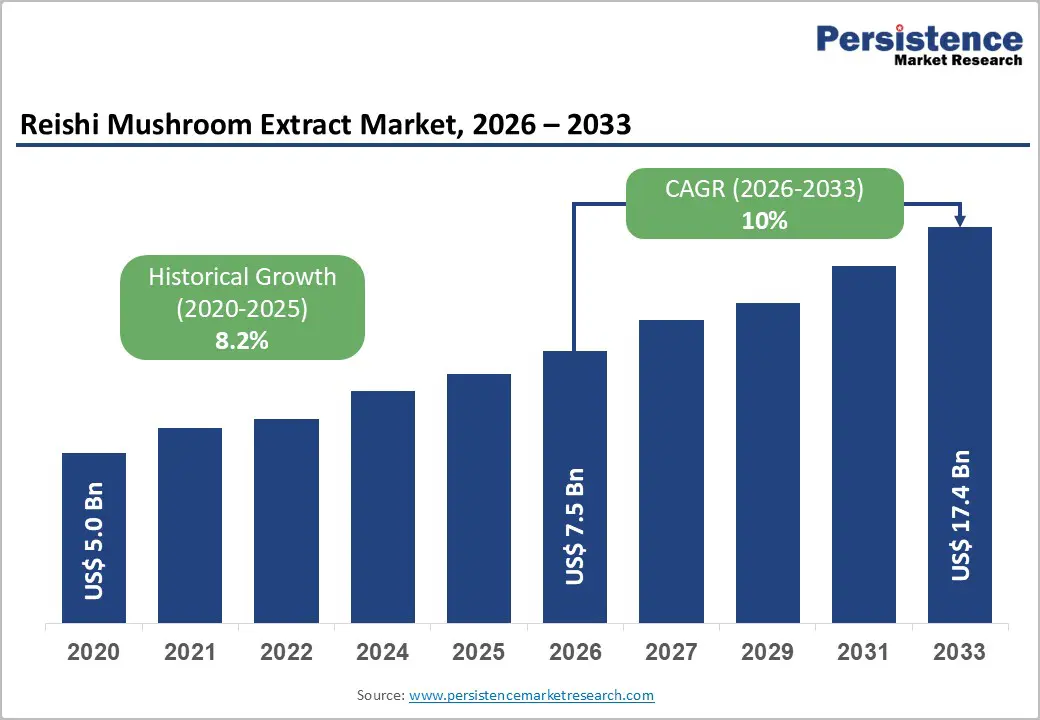
| Reishi Mushroom Extract Market Size (2026E) | US$ 7.5 Bn |
| Market Value Forecast (2033F) | US$ 17.4 Bn |
| Projected Growth (CAGR 2026 to 2033) | 10% |
| Historical Market Growth (CAGR 2020 to 2025) | 8.2% |
Market Factors – Growth, Barriers, and Opportunity Analysis
Growing Health-Conscious Consumer Base and Preventive Healthcare Trends
The global shift toward preventive healthcare and natural wellness solutions serves as a core market driver for reishi mushroom extract. Consumers increasingly prioritize products that support long-term health through plant-based options. Herbal medicines play a central role in primary healthcare for vast populations worldwide. Organizations such as the World Health Organization (WHO) highlight this reliance. In parallel, dietary supplements gain traction, particularly in regions with strong wellness cultures. Functional mushrooms, including reishi extract, stand out due to their adaptogenic properties. This preference stems from a broader desire for solutions that enhance immunity and vitality without synthetic additives.
Post-pandemic behaviors have solidified these patterns, with sustained interest in immunity-focused products. Younger demographics, such as millennials and Generation Z (Gen Z), lead this charge. They favor natural ingredients and actively incorporate them into daily routines. Businesses can capitalize on this momentum by emphasizing transparency in sourcing and efficacy through clinical backing. Strategic positioning in this space requires alignment with consumer values, such as sustainability and personalization. Market leaders who adapt to these shifts will secure stronger footholds, while laggards risk erosion in competitive landscapes.
Expanding Applications in Functional Foods and Beverage Innovation
Product innovation fuels market growth through diversification into functional foods and beverages. Companies integrate reishi mushroom extract into diverse formats such as coffee substitutes, energy drinks, wellness shots, and adaptogenic beverages. Leading corporations actively launch or acquire these mushroom-infused lines, which signals strong commercial potential. This approach broadens appeal beyond core supplement users to everyday wellness seekers. Firms achieve seamless incorporation by leveraging advances in extraction techniques, flavor stabilization, and nutrient absorption improvements.
Strategic diversification into areas such as functional chocolates and confections unlocks premium pricing opportunities. These innovations target consumers who value indulgent yet health-supportive options. Businesses can gain a competitive edge when they prioritize sensory appeal alongside bioactive retention. Executives should assess supply partnerships to ensure consistent quality across product lines, with strategies involving consumer testing for taste preferences, which enhances adoption rates.
Product Authenticity Crisis and Mycelium-Fruiting Body Adulteration
Quality concerns plague the reishi mushroom extract market growth due to widespread substitution of genuine fruiting bodies with mycelium grown on grain. Manufacturers favor mycelium because it grows faster and costs less to produce. This practice results in lower levels of key bioactives, such as beta-glucans, and introduces unwanted grain starch. Consumers often encounter misleading labels and packaging images that depict fruiting bodies, even though the contents lack them. Such tactics erode trust and harm legitimate producers.
Regulatory gaps exacerbate this issue, as agencies such as the U.S. Food and Drug Administration (FDA) sometimes blur distinctions between mycelium and mushrooms in their guidelines. Businesses face unfair competition from low-quality alternatives that undercut prices. Forward-thinking companies should invest in third-party testing and transparent sourcing to rebuild credibility. Industry leaders who prioritize authenticity will differentiate themselves and foster long-term loyalty. Stakeholders must advocate for stricter global standards to safeguard market integrity and support sustainable growth.
Regulatory Heterogeneity and Compliance Complexity
Divergent regulatory frameworks across key markets impose heavy compliance demands and hinder entry for reishi mushroom extract producers. Authorities classify the extract in varied ways. The United States treats it as a dietary supplement under U.S. FDA oversight. China views it as traditional medicine through the National Medical Products Administration (NMPA). The European Union (EU) deems it a novel food under the European Food Safety Authority (EFSA). Australia lists it among therapeutic goods via the Therapeutic Goods Administration (TGA). Each category demands unique approval processes, paperwork, and label requirements. Companies must navigate these differences to launch products successfully.
This patchwork of rules raises operational costs and delays market access, especially for firms with global ambitions. Businesses often need to develop region-specific versions of their offerings to meet local standards. Executives should build dedicated regulatory teams or partner with local experts to streamline approvals. Prioritize structure-function claims, such as immune support, over disease-treatment statements where restrictions apply. Leaders must lay down holistic compliance roadmaps early to cut risks and speed expansion by conducting gap analyses between jurisdictions and allocate budgets for dossier preparation.
Personalized Nutrition and Digital Health Integration
The convergence of digital health technologies, microbiome research, and personalized wellness opens doors for innovative product development and marketing in the reishi mushroom extract sector. Companies blend genetic testing, biomarker analysis, and microbiome sequencing to craft tailored dosing and combination formulas. These tools match individual health profiles with precise bioactive delivery. Digital platforms integrate with wearable devices to track real-time outcomes and boost user engagement. Such features justify premium pricing for customized offerings. Businesses can tap into direct-to-consumer (D2C) channels through these advancements.
Telehealth growth further expands distribution via practitioner-guided protocols. Executives gain strategic leverage by prioritizing data-driven personalization. They should forge alliances with tech firms to embed reishi extracts into app-based wellness plans. Consumer education on microbiome benefits enhances adoption. Leaders pilot subscription models tied to ongoing biomarker feedback. This approach deepens loyalty and positions brands as pioneers in proactive health. Firms that seize this intersection will outpace rivals and capture high-value segments with sustained demand.
Beauty and Cosmeceutical Applications Expansion
Reishi mushroom extract offers strong potential in premium skincare and cosmeceutical products. This shift creates high-margin opportunities for market expansion. Key compounds such as polysaccharides and triterpenes deliver benefits for anti-aging, skin brightening, and inflammation reduction. They stimulate collagen production, regulate melanin levels, and combat oxidative damage. Leading beauty brands actively introduce reishi-infused lines in serums and creams. These formulations appeal to consumers who seek natural active ingredients. Companies diversify beyond supplements into this growing sector with ease.
Executives can leverage this trend to strengthen brand prestige and revenue streams. They should partner with dermatological research firms to validate efficacy claims. Focus on clean beauty certifications to attract discerning buyers. Supply chain integration ensures consistent bioactive potency across batches. Pioneering firms target affluent demographics through luxury retail channels and influencer collaborations. This strategy not only elevates market presence but also builds resilience against supplement market volatility.
Category-wise Analysis
Form Insights
Powder is poised to dominate, capturing approximately 61% of the reishi mushroom extract market revenue share in 2026. The versatility of the powered variety in diverse applications including dietary supplements, functional beverages, food ingredients, and cosmetic formulations is driving the growth of this segment. Powder extracts provide manufacturers with optimal cost-efficiency, extended shelf stability, simplified logistics, and flexible dosing options. This format supports seamless integration into capsules, tablets, and beverage mixes while preserving bioactive compounds such as polysaccharides and triterpenes. End-users appreciate precise portion control for daily routines. Firms can leverage powders to accelerate market entry and meet diverse consumer preferences in supplements and functional foods.
Liquid are likely to be the fastest-growing segment over the 2026-2033 forecast period. Liquid extracts are gaining traction due to their superior bioavailability and faster absorption compared to powder forms. Consumers favor these ready-to-use options for tinctures, wellness shots, and functional beverages. Immediate dissolution ensures quick effects, which gives them a clear edge in fast-paced lifestyles. Advances in taste-masking techniques make them more palatable, while concentrated extraction methods boost potency. This positions liquids as premium choices that command higher prices. D2C e-commerce channels amplify their appeal, as users place a high value on convenience and show stronger loyalty. Producers can tap into this trend by offering versatile formats that fit modern routines and drive repeat purchases.
Application Insights
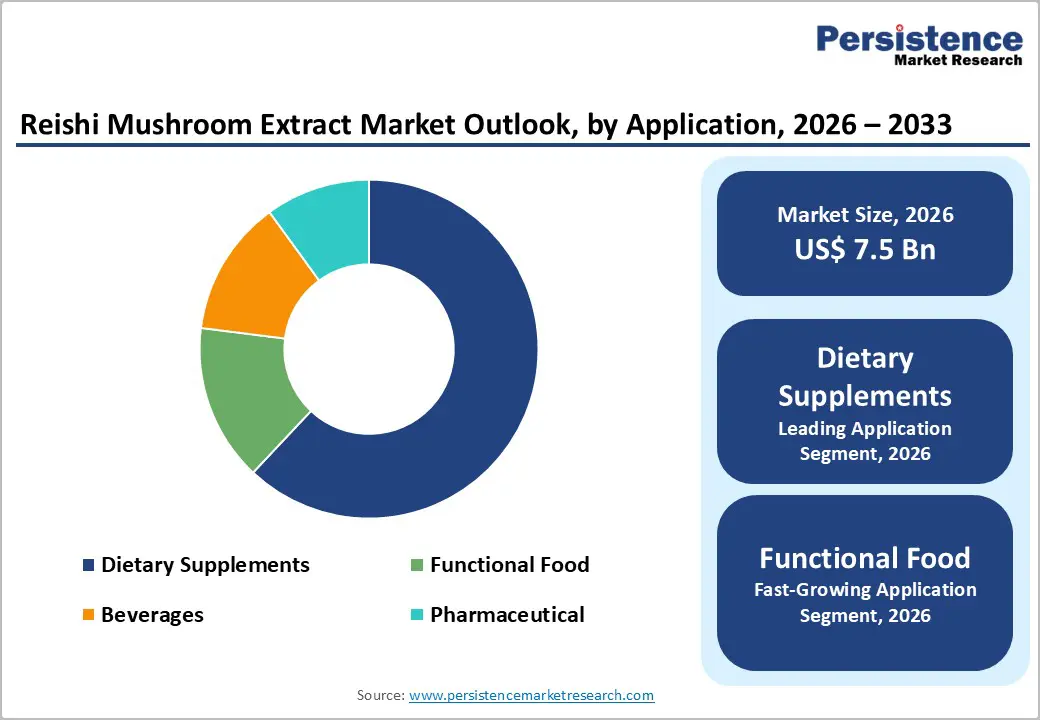
Dietary supplements are anticipated to hold an estimated 62% of the reishi mushroom extract market share in 2026. This category encompasses capsules, tablets, soft gels, and powder supplements marketed for immune support, stress management, sleep optimization, and general wellness. The segment benefits from established distribution infrastructure, consumer familiarity, and regulatory clarity in major markets. Combination formulations featuring reishi alongside complementary mushrooms, such as cordyceps, lion's mane, and chaga, and adaptogens demonstrate particularly strong growth, commanding premium pricing through synergistic positioning.
Functional food are estimated to be the fastest-growing segment between 2026 and 2033. This vibrant segment features mushroom coffee blends, adaptogenic teas, protein powders, energy bars, and wellness beverages. Accelerating growth stems from widespread acceptance among mainstream consumers who move beyond traditional supplement routines. Brands position these items as everyday lifestyle drinks rather than niche health aids. Celebrity backing, social media campaigns, and eye-catching packaging attract younger audiences effectively. Impulse purchases and habitual use mirror patterns in standard beverage markets, which foster steady revenue streams. Innovations such as ready-to-drink (RTD) cans, instant mixes, and functional snacks broaden reach into convenience stores and beyond.
Regional Insights
North America Reishi Mushroom Extract Market Trends
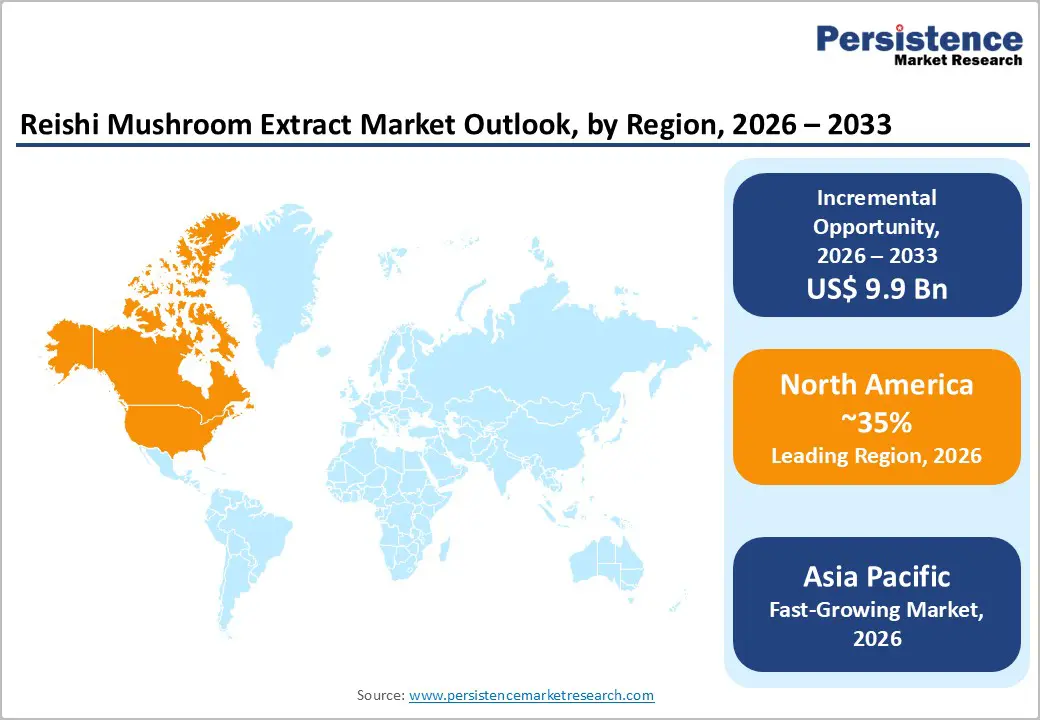
North America is set to command a significant portion of the reishi mushroom extract market share at approximately 35% in 2026. The regional market benefits from strong per-capita consumption and deep penetration of premium products. An innovative ecosystem fuels ongoing advancements. The United States drives most regional activity through its robust dietary supplement sector. Consumers embrace functional mushrooms within everyday wellness practices. Brands thrive by blending reishi into diverse formats such as beverages and snacks. Regulatory support from the Dietary Supplement Health and Education Act (DSHEA) allows structure-function claims backed by science. This framework encourages market entry and product diversity.
Executives tap into concentrated retail networks, including major chains and online platforms such as Amazon. Direct-to-consumer leaders like Four Stigmatic, Host Defense, and Om Mushrooms excel with targeted branding. Venture capital flows into startups focused on novel applications in beauty and personalization. Businesses should prioritize digital health integrations for tailored offerings. They gain edges through influencer partnerships and clean-label certifications. Forward-thinking firms explore functional food expansions to capture impulse purchases. Leaders who align with these dynamics secure sustained growth and competitive dominance across wellness channels.
Europe Reishi Mushroom Extract Market Trends
Europe holds a strong position in the global market for reishi mushroom extracts. Consumers show deep affinity for natural products and prioritize preventive healthcare. Harmonized regulations support steady expansion across the region. Germany leads with its tradition of blending phytotherapy into mainstream medicine. Health insurance often covers complementary treatments, which boosts accessibility. The United Kingdom gains ground through innovative functional beverages and growing wellness retail networks. France excels in beauty and cosmeceutical uses, while Spain contributes via diverse applications. The EFSA enforces strict quality rules. These standards build trust but challenge lower-quality entrants. Novel Food Regulation demands rigorous safety checks and uniform product specs.
Executives navigate this landscape by partnering with established herbal firms such as Schwabe, Bionorica, and Martin Bauer Group. Emerging functional food brands add fresh competition. Investments target organic certifications, sustainable farming ties, and clinical studies for health claims. Businesses should expand into pharmacies and secure practitioner endorsements. Sports nutrition offers untapped potential through targeted formulations. Leaders prioritize clean-label strategies and EU-wide distribution to maximize reach. Firms that align with these trends gain loyalty and outpace rivals in premium segments.
Asia Pacific Reishi Mushroom Extract Market Trends
Asia Pacific is anticipated to emerge as the fastest-growing market for reishi mushroom extracts through 20333. China leads with its rich heritage in traditional Chinese medicine (TCM), cost-effective cultivation, and vast consumer base. Urbanization fuels demand for premium wellness products among expanding middle classes. Japan appeals to discerning buyers through standardized extracts and cutting-edge processing methods. India accelerates via heightened health consciousness, rising incomes, and Ayurvedic integrations. ASEAN economies, led by Thailand, Malaysia, and Singapore, advance through modernized herbal practices and health tourism. Key forces include a preventive care focus, hybrid medical approaches, and supportive government policies.
Executives can capitalize on manufacturing strengths, abundant raw materials, and export potential. Investments that target scaled production, organic standards, and urban premium lines can attract high returns. Businesses should forge local partnerships to navigate regulations and tap domestic channels. They should prioritize value-added processing for higher margins. Market leaders need to explore e-commerce and influencer strategies to reach affluent city dwellers, balancing tradition with innovation to secure export pipelines and domestic loyalty. This region offers scalable growth for those who invest wisely in supply chains and consumer trends.
Competitive Landscape
The global reishi mushroom extract market structure is moderately fragmented, with Nammex, Host Defense Mushrooms, Four Sigmatic, Om Mushroom Superfood, and Aloha Medicinals collectively controlling nearly 40% of total market share. The competitive landscape includes multinational dietary supplement manufacturers, specialized functional mushroom brands, and vertically integrated enterprises that manage cultivation, extraction, and product formulation within unified operations. Market leaders are leveraging strong brand recognition, established distribution networks, research expertise, and quality certifications to maintain competitive advantages. Positioning strategies vary across distribution channels, as premium niche brands are focusing on D2C models and specialty wellness markets, while larger corporations are dominating mass retail distribution through scale efficiencies and broader product portfolios.
Competitive dynamics are further shaped by the presence of Chinese manufacturers that benefit from cost-efficient cultivation systems and large-scale production capacity, which enables competitive pricing across global markets. Western companies are differentiating through standardized extraction processes, organic certification, clinical research support, and transparent sourcing practices to appeal to quality-conscious consumers. Partnerships, acquisitions, and product innovation initiatives are playing important roles in expanding market reach and strengthening brand positioning.
Key Industry Developments
- In May 2025, Laird Superfood launched six new organic mushroom powders, including blends for Calm & Relaxation and Focus & Memory, plus single varieties such as Organic Reishi, Lion's Mane, Turkey Tail, and Oyster, to meet the rising demand for adaptogens.
- In March 2025, Host Defense’s parent company, Fungi Perfecti, launched a new MycoBenefits™ line of mushroom mycelium-based supplements that combine mushroom mycelium with herbs, vitamins, and minerals into four targeted formulas for focus, mood, sleep, and beauty support.
Companies Covered in Reishi Mushroom Extract Market
- Nammex
- Host Defense Mushrooms
- Four Sigmatic
- Om Mushroom Superfood
- Aloha Medicinals Inc.
- Real Mushrooms
- Swanson Health Products
- Nature's Way
- Mushroom Wisdom
- Vita Green Health Products Co., Ltd.
- Hokkaido-Reishi Co., Ltd.
- Qingdao Dacon Trading Co., Ltd.
- Xi'an Greena Biotech Co., Ltd.
- Hunan Nutramax Inc.
- Naturalin Bio-Resources Co., Ltd.
Frequently Asked Questions
The global reishi mushroom extract market is projected to reach US$ 7.5 billion in 2026.
Rising demand for natural immune support, functional foods, and preventive wellness amid preventive healthcare shifts is driving the market.
The market is poised to witness a CAGR of 10% from 2026 to 2033.
Personalized nutrition via digital tech, premium cosmeceuticals, and expansion into e-commerce plus emerging Asia Pacific urban markets are prime market opportunities.
Nammex, Host Defense Mushrooms, Four Sigmatic, Om Mushroom Superfood, and Aloha Medicinals Inc. are some of the key players in the market.


