




- Bulk Chemicals
- Epichlorohydrin Market
Epichlorohydrin Market Size, Share, and Growth Forecast, 2026 – 2033
Epichlorohydrin Market by Product Type (Oil-based Epichlorohydrin, Others), Application (Epoxy Resins, Synthetic Glycerin, Others), End-User (Construction, Automotive, Paints and Coatings, Adhesives, Electrical and Electronics, Textile, Water Treatment, Others), and Regional Analysis for 2026 - 2033

Epichlorohydrin Market Share and Trends Analysis
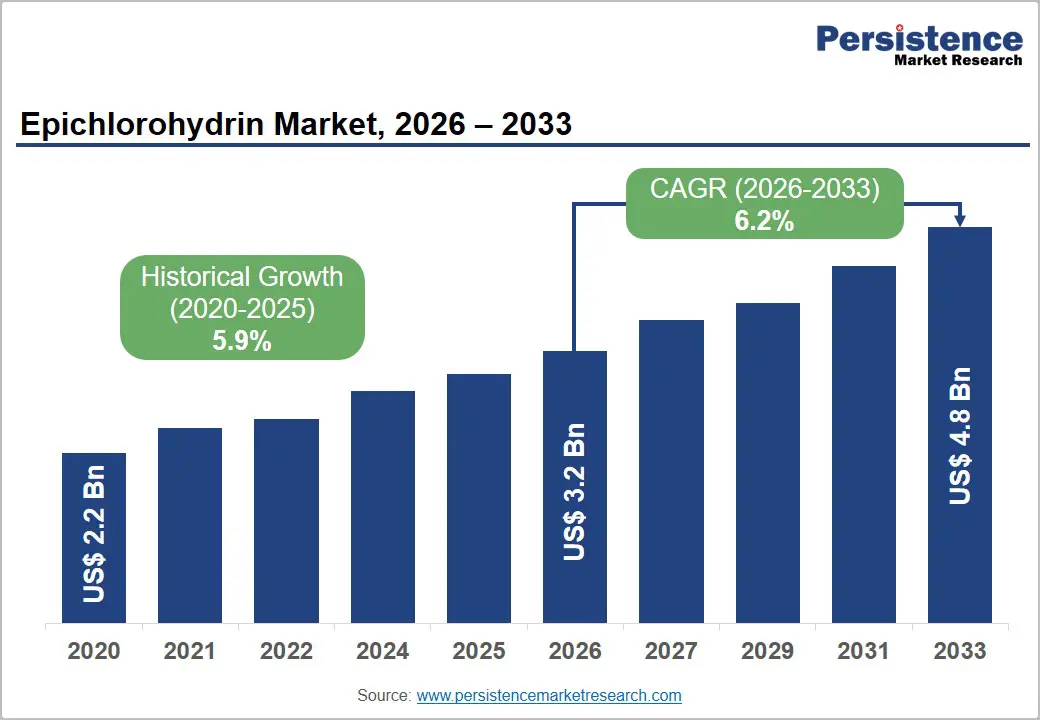
The global epichlorohydrin market size is likely to be valued at US$3.2 billion in 2026 and is estimated to reach US$4.8 billion by 2033, growing at a CAGR of 6.2% during the forecast period from 2026 to 2033, driven by infrastructure expansion and increasing demand for epoxy resins. Technological shifts toward glycerol-based feedstocks enhance sustainability, while stringent safety regulations foster infrastructure innovation. Rising industrial hygiene standards and green chemistry mandates accelerate the adoption of high-purity derivatives in water treatment, ensuring a robust trajectory for the global chemical market through 2033.
Key Industry Highlights:
- Leading Product Type: Glycerin-based epichlorohydrin is set to hold around 42% revenue share in 2026, driven by the industrial transition toward sustainable, bio-based feedstock alternatives.
- Fastest-Growing Product Type: Propylene-based epichlorohydrin is projected as the fastest-growing segment, driven by its essential utility in high-volume industrial manufacturing processes.
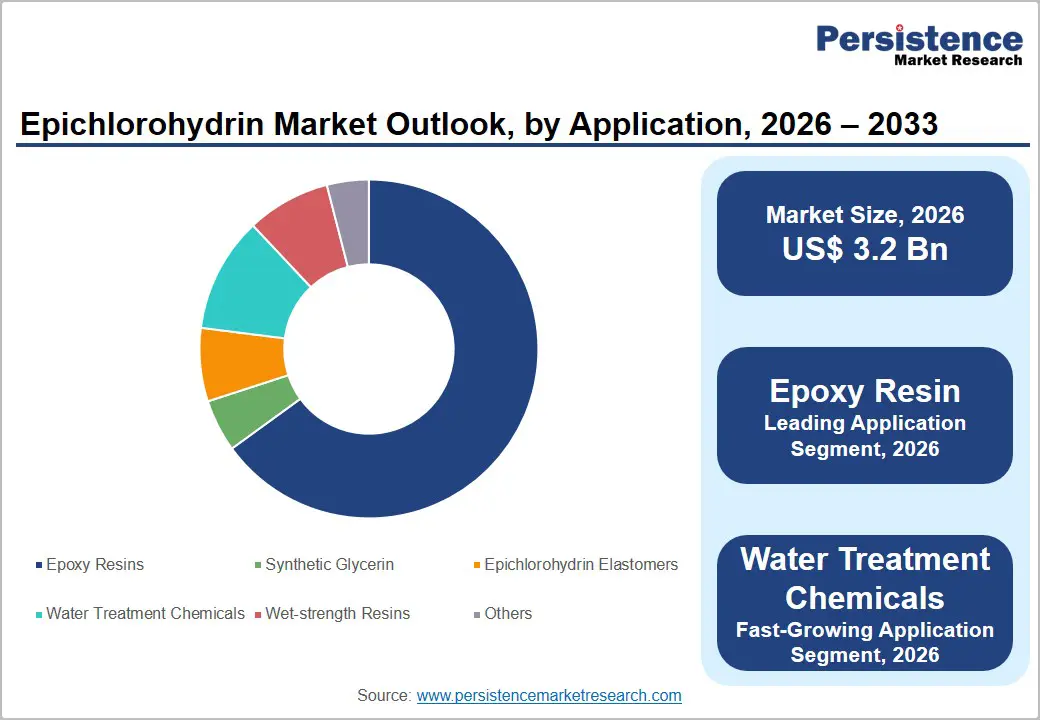
- Leading Application: Epoxy resins are estimated to hold roughly a 65% revenue share in 2026, driven by their status as the dominant derivative for the global construction and protective coatings sectors.
- Fastest-Growing Application: Water treatment chemicals are forecasted to record the fastest growth, driven by increasingly strict government regulatory mandates for industrial clean water purification.
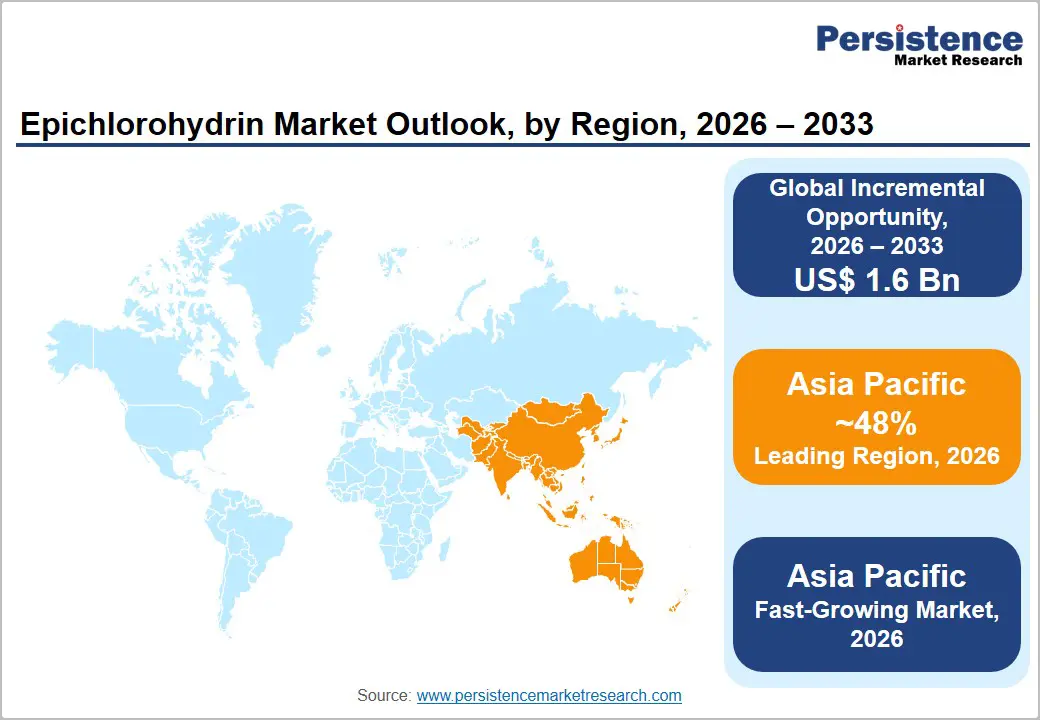
- Regional Leadership: Asia Pacific is projected to capture roughly 48% of the market share by 2026, while also remaining the fastest-growing regional market through 2033 due to robust industrial output and infrastructure development.
- Competitive Environment: The market reflects a highly competitive structure, with key players such as Solvay S.A. and Olin Corporation shifting toward bio-based integration and regionalized production to improve supply chain resilience.
DRO Analysis
Driver - Expansion of Epoxy Resin Applications in Infrastructure and Construction
Global infrastructure development creates constant demand for advanced chemical composites. Epichlorohydrin serves as an essential precursor for synthetic resins utilized in structural bonding and protective coatings. Rising urbanization necessitates durable materials for bridges, pipelines, and industrial flooring. These resins provide critical resistance against environmental wear, extending asset lifespans significantly. Investment in large-scale projects dictates the consistent procurement of these chemical building blocks for high-performance building solutions.
Material science advancements drive the integration of these polymers into modern engineering designs. According to the U.S. Census Bureau’s official monthly report for February 2025, total construction spending was estimated at a seasonally adjusted annual rate of $2,195.8 billion. Structural adhesives replace traditional mechanical fasteners in many assembly processes. This shift maximizes operational efficiency for builders. Lower maintenance requirements for coated structures justify higher upfront costs, cementing long-term adoption cycles for these essential industrial polymers.
Restraint - Stringent Regulatory Frameworks and Toxicological Concerns
Rigid safety mandates and health risks create significant operational barriers for global producers. Regulatory bodies classify epichlorohydrin as a hazardous substance, requiring expensive containment systems and specialized worker protections. These requirements increase overhead costs for manufacturing facilities. Firms face potential penalties for non-compliance with strict emission standards. Such financial pressures discourage small-scale production and entry by new market participants. Constant monitoring of toxicological profiles limits rapid expansion in environmentally sensitive regions.
Legal restrictions on hazardous chemical transport further constrain supply chain agility. Specialized logistics protocols raise distribution expenses for these volatile precursors. According to the United States Environmental Protection Agency, the finalized 2024 Rule on Synthetic Organic Chemical Manufacturing enforces stricter hazardous air pollutant standards. This regulation necessitates substantial capital investment for facility upgrades. Compliance costs erode profit margins for legacy plants. Stringent oversight dictates production volumes and restricts the overall commercial scale of industrial applications.
Opportunity - Emergence of High-Performance Electronics and Advanced Manufacturing
High-performance electronics demand superior epichlorohydrin purity for semiconductor packaging and specialized circuit boards. This chemical component offers essential thermal stability and insulation properties for miniaturized components. Engineers utilize these resin attributes to facilitate efficient heat dissipation in power-dense devices. The structural integrity required for 5G telecommunications infrastructure relies on these advanced materials. Manufacturers gain operational advantages through precise chemical synthesis pathways enabled by this precursor. The demand for advanced electronics creates substantial growth potential.
Advanced manufacturing sectors prioritize reliable chemical inputs for high-output production. According to the U.S. Bureau of Economic Analysis, real value added for private goods-producing industries decreased by 1.8% in the fourth quarter of 2025. This fluctuation highlights the necessity for high-margin specialty resins to stabilize industrial revenue. Firms invest in new capacities to meet this quality shift. Innovation in electronic-grade materials allows companies to capture significant value. High performance standards define this lucrative commercial opportunity.
Category-wise Analysis
Product Type Insights
Glycerin-based epichlorohydrin is anticipated to secure around 42% of the epichlorohydrin market share in 2026, reflecting the rapid industry shift toward sustainable feedstocks and alignment with environmental, social, and governance (ESG) criteria. Companies such as Solvay utilize this pathway to reduce carbon footprints. This method leverages crude glycerol from biodiesel production, offering a renewable alternative to traditional petrochemical routes.
Propylene-based epichlorohydrin is expected to be the fastest-growing segment, propelled by the urgent demand for high-volume production in large-scale industrial manufacturing and the continued optimization of traditional refining processes that ensure cost efficiency for bulk applications. Olin Corporation maintains significant capacity in this segment. Enhanced chlor-alkali integration optimizes yield for massive infrastructure and automotive needs.
Application Insights
Epoxy resin extracts are poised to dominate with a forecasted market share of over 65% in 2026, powered by the extensive use of these resins in critical structural adhesives, high-performance coatings, and composite materials within the automotive and construction sectors. Hexion Inc. provides advanced resin systems for lightweight aerospace components. These applications ensure structural durability while meeting rigorous safety standards.
Water treatment chemicals are estimated to be the fastest-growing segment, fueled by the rising global requirement for municipal and industrial water purification, increased regulatory emphasis on clean water access, and the expansion of advanced effluent treatment facilities. SNF Group utilizes epichlorohydrin-based polymers for effective flocculation. These chemicals remain vital for desalination plants and urban sanitation infrastructure projects.
End-user Insights
The construction segment is likely to be the leading segment with a projected 38% of the epichlorohydrin market share in 2026 due to the sustained demand for infrastructure development, repair, and the integration of protective epoxy coatings in residential and commercial projects. Major firms such as Sika AG utilize these derivatives for high-performance flooring and structural adhesives. These products ensure long-term asset durability in urban environments.
The automotive segment is anticipated to be the fastest-growing segment, fueled by the adoption of lightweight composite materials to improve vehicle efficiency, the expansion of electric vehicle manufacturing, and the integration of advanced electronics in modern automotive design. Manufacturers such as Tesla rely on epoxy composites for battery enclosures. These materials reduce vehicle weight, thereby extending range and improving energy efficiency.
Regional Insights
North America Epichlorohydrin Market Trends
North America captures approximately 20% of the epichlorohydrin market share in 2026. Mature industrial bases drive stable demand for high-purity chemical grades in aerospace, electronics, and infrastructure sectors. Recent strategic shifts prioritize sustainable, bio-based synthesis pathways to satisfy stringent regulatory environmental standards. Capital investment supports facility modernization and digital process automation, enhancing efficiency while reducing long-term operational risks within the domestic chemical sector.
U.S Epichlorohydrin Market Insights
The U.S. commands approximately 85% of the North America epichlorohydrin market in 2026, driven by robust demand in infrastructure, automotive, and electronics sectors. Westlake Corporation recently expanded resin-grade production capacity to meet high-performance coating needs within the region. This strategic investment ensures a consistent supply for domestic manufacturing while supporting the nationwide transition toward high-purity chemical standards and advanced composite applications.
Canada Epichlorohydrin Market Insights
Canada is forecast to hold nearly 15% of the North America market in 2026, driven by investments in transportation infrastructure, water treatment facilities, and energy projects. Rising adoption of durable protective coatings across industrial applications is supporting product demand. The development of renewable energy assets is increasing the use of epoxy composites.
Europe Epichlorohydrin Market Trends
Europe is expected to account for approximately 18% of the epichlorohydrin market share in 2026. The regional market emphasizes sustainable bio-based production pathways to meet strict REACH regulatory standards. Key industry players focus on carbon-neutral manufacturing and advanced water treatment solutions. Innovation in green chemistry remains the primary strategic driver, positioning the continent as a leader in high-value, environmentally compliant chemical synthesis and specialized resin development.
Germany Epichlorohydrin Market Insights
Germany is expected to command roughly 24% of the Europe regional epichlorohydrin market in 2026, driven by robust industrial manufacturing. The sector prioritizes high-performance resins for automotive and aerospace applications. Recently, industry leaders have accelerated investments in circular economy technologies, specifically targeting bio-based production processes and advanced recycling capabilities for epoxy materials to align with strict European environmental mandates and optimize material efficiency across complex supply chains.
France Epichlorohydrin Market Insights
France is likely to represent close to 16% of the Europe market share in 2026, driven by expansion in sustainable construction materials and industrial coatings applications. Government-backed environmental initiatives are encouraging adoption of lower-carbon chemical products. Growth in renewable energy infrastructure is increasing demand for epoxy resin systems.
Asia Pacific Epichlorohydrin Market Trends
Asia Pacific is projected to be the leading and fastest-growing region, securing a 48% regional market share in 2026. Industrial clustering drives success. China and India facilitate mass epoxy production for massive construction needs. Japan and South Korea prioritize high-purity chemical manufacturing for advanced electronics. Strategic vertical supply chains optimize production costs for global trade while supporting consistent chemical output levels throughout the forecast period.
China Epichlorohydrin Market Insights
China is expected to command approximately 48% of the regional market share in 2026. Industrial focus centers on capacity expansion for bio-based production to meet carbon neutrality targets. Major chemical producers commissioned new glycerin-to-epichlorohydrin facilities during 2025 to optimize feedstock costs. These investments enhance output efficiency while aligning with environmental regulations. Local manufacturing landscapes prioritize vertical integration for epoxy resin applications throughout the current fiscal year.
India Epichlorohydrin Market Insights
India is estimated to capture approximately 15% of the regional epichlorohydrin market share in 2026. Domestic growth centers on robust infrastructure projects and rising epoxy resin demand in the construction and water treatment sectors. Regarding recent developments, Epigral Limited initiated plans to double epichlorohydrin production capacity at its Dahej facility, aiming to support the surge in local industrial consumption and reduce reliance on imported chemical feedstocks.
Competitive Landscape
The global epichlorohydrin market exhibits high consolidation, with dominant global players controlling significant production capacity. Leaders such as Solvay S.A., Olin Corporation, and Aditya Birla Chemicals leverage proprietary bio-based technologies and integrated supply chains. These corporations capitalize on economies of scale to maintain market dominance, effectively shaping global supply dynamics through extensive investments.
Mid-tier participants such as Sumitomo Chemical Co., Ltd., LOTTE Fine Chemical Co., Ltd., and Nama Chemicals Company target specialized segments and regional demand. Competitive positioning centers on feedstock integration and navigating complex regulatory landscapes. These firms emphasize cost leadership and localized production to effectively satisfy diverse industrial requirements across emerging markets.
Key Industry Developments:
- In April 2026, DCM Shriram Ltd. commissioned the second phase of its epichlorohydrin facility in Gujarat, increasing total production capacity to 52,000 TPA and strengthening supply availability for epoxy resin and specialty chemical applications.
- In October 2025, DCM Shriram advanced its epichlorohydrin business in Gujarat by commissioning a new Jhagadia plant using eco-friendly glycerine-based technology, strengthening its integration with the chlor-alkali and epoxy resin value chain.
- In August 2025, Grasim Industries announced plans to commission its Epichlorohydrin (ECH) facility along with CPVC capacity at Vilayat by March 2026, strengthening its position in the integrated chlorine derivatives and specialty chemicals value chain.
Companies Covered in Epichlorohydrin Market
- Solvay S.A.
- Olin Corporation
- Aditya Birla Chemicals
- Sumitomo Chemical Co., Ltd.
- LOTTE Fine Chemical Co., Ltd.
- Nama Chemicals Company
- Meghmani Finechem Ltd.
- Formosa Plastics Corporation
- Jiangsu Yangnong Chemical Co., Ltd.
- Momentive Performance Materials
- Dow Inc.
- The Chemours Company
Frequently Asked Questions
The global epichlorohydrin market is projected to reach US$3.2 billion in 2026.
The epichlorohydrin market is primarily driven by robust global demand for epoxy resins in the construction, electronics, and automotive sectors, coupled with an industry-wide transition toward cost-efficient, sustainable bio-based production processes.
The epichlorohydrin market is poised to witness a CAGR of 6.2% from 2026 to 2033.
Key market opportunities include expanding bio-based production capacities, increasing penetration in high-growth emerging industrial economies, and developing high-purity chemical grades for the advanced electronics and aerospace sectors.
Some of the key market players include Solvay S.A., Olin Corporation, Aditya Birla Chemicals, Sumitomo Chemical Co., Ltd., LOTTE Fine Chemical Co., Ltd., and Nama Chemicals Company.


