
Smoke Detectors Market Size, Share, Trends, Growth, and Forecasts for 2025 - 2032

Smoke Detectors Market by Sensor Type (Photoelectric, Dual Sensors, Ionization, Other (ASD)), Product Type (Hardwired Smoke Detectors, Battery Powered Smoke Detectors), End-Use (Residential, Commercial, Industrial), and Regional Analysis for 2025 - 2032.

ID: PMRREP3281
Calendar

August 2025

180 Pages

Author : Sayali Mali

Smoke Detectors Market Size and Forecast

Market Overview

The Global Smoke Detectors Market Size is likely to be valued at US$ 3.1 billion in 2025, and is projected to expand to US$ 4.5 billion by 2032, registering a compound annual growth rate (CAGR) of 5.5% from 2025 to 2032. Rising awareness of fire incident prevention, stringent government mandates, and the integration of smart home devices in residential, commercial, and industrial applications fuel this growth.

The smoke detector market has grown robustly, driven by increasing fire safety regulations, urbanization, and technological advancements. North America leads the market, followed by Europe, with Asia Pacific emerging as the fastest-growing region due to rapid urbanization, rising disposable incomes, and government initiatives promoting fire safety.
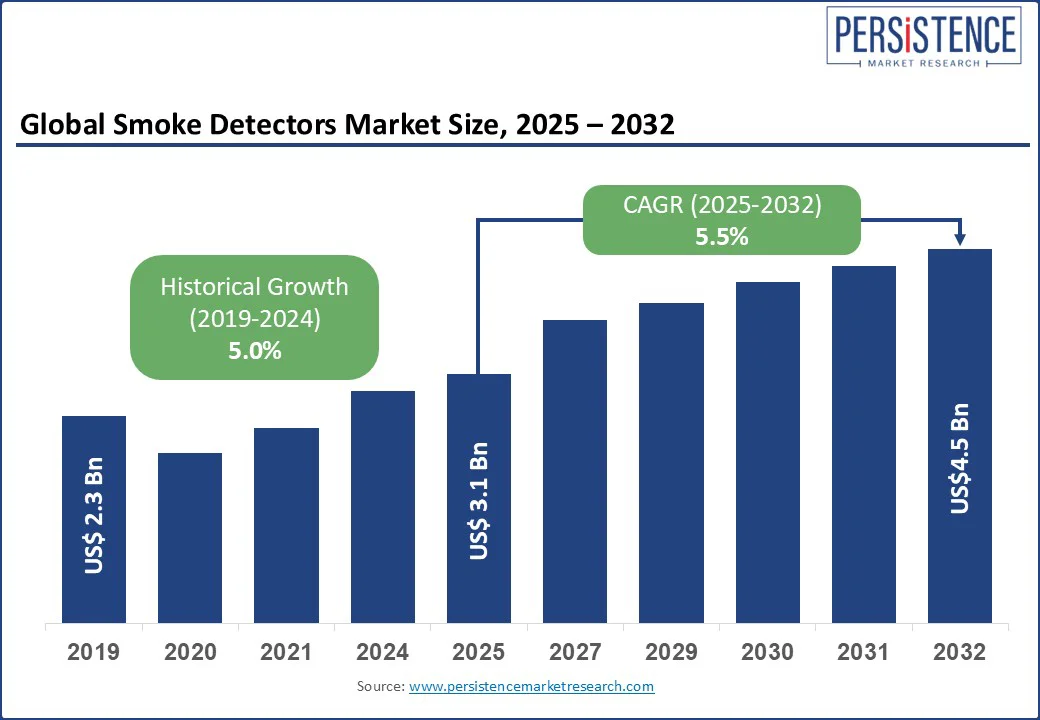
Smoke Detector Market Size 2025 - 2032

Market Dynamics

Drivers

  • Rising Urbanization and Construction as a Driver for the Smoke Detectors Market: Rapid urbanization, especially in developing nations, is a key driver for the smoke detectors market, fueled by increased construction of residential and commercial buildings. The United Nations estimates that 68% of the global population will reside in urban areas by 2050, significantly boosting demand for fire alarms, heat detectors, and other safety sensors.

As urban centers expand, new high-rise apartments, office complexes, and public facilities require advanced fire detection systems to comply with strict construction safety standards. For instance, Honeywell offers smart smoke detectors for home automation that can integrate with building management platforms to improve safety in modern infrastructure.

Government mandates, such as the U.S. Fire Administration’s fire code requirements, emphasize smoke alarm installation in all new buildings, further propelling market growth. In developing nations such as India and China, rapid urban development and rising disposable incomes increase investment in fire safety, with fire sensors becoming standard in new homes. This ongoing construction boom, coupled with growing awareness, supports the long-term growth of the global smoke detector market.

  • Rise in Fire Incidents Spurs Smoke Detector Market Growth: The rising number of fire-related accidents has amplified the need for early warning systems. According to the National Fire Protection Association (NFPA), U.S. fire departments responded to 1.3 million fires in 2023, highlighting the critical role of fire alarms in property and life protection.

The NFPA also states that “three out of five fire-related deaths occur in homes without working smoke alarms.” Conversely, homes equipped with active fire sensors and smoke alarms can reduce fire-related fatalities by half. This has prompted governments and building code authorities to enforce mandatory deployment of photoelectric smoke detectors for commercial use, dual-sensor alarms, and smart detectors in residential and commercial buildings.

Restraints

  • High Initial Costs: High initial costs of advanced smoke detectors, such as smart and dual-sensor models, restrict adoption in cost-sensitive developing nations. For instance, Siemens’ Cerberus FIT, priced above US$ 1,000, is unaffordable in regions such as Sub-Saharan Africa. A 2023 UN report notes that only 20% of households in low-income countries have smoke detectors, highlighting cost barriers that limit market penetration and fire safety improvements.

Opportunities

  • Smart Smoke Detectors: The emergence of smart home devices opens up opportunities for IoT-enabled smart detectors with capabilities such as voice alerts, real-time mobile notifications, and seamless integration with home ecosystems. For instance, Google Nest Protect (2023) offers app-based alerts and interconnectivity, enhancing user safety. These detectors enhance user convenience and safety by providing remote monitoring and instant alerts, appealing to tech-savvy consumers
  • Integration of Digital Health Solutions: AI-driven platforms and digital analytics boost smoke detector performance by up to 30%, enhancing reliability and reducing false alarms. For instance, Siemens’ Cerberus FIT, launched in 2021, uses AI to optimize detection in commercial settings, while Honeywell’s 2022 Morley MAx integrates cloud analytics for real-time monitoring. U.S. government data from NIST shows AI detectors cut response times by 25%, improving safety outcomes.

Category-wise Insights

Sensor Type Insights

  • Photoelectric smoke detectors for commercial use dominate the market with approximately 52% revenue share in 2025, favored for their reliability in detecting smoldering fires and minimizing false alarms. Their light-based detection technology ensures early warning, reducing false alarms by 20% compared to ionization detectors. Regulatory preferences, such as NFPA 72’s endorsement, and advancements such as Hochiki’s SOC-E3N (launched in 2022) reinforce their dominance.
  • Dual-sensor smoke detectors, combining photoelectric and ionization technologies, are the fastest-growing segment due to their ability to detect both fast-flaming and smoldering fires, enhancing fire safety. The segment’s growth is driven by increasing demand for versatile solutions in industrial and commercial applications

Product Type Insights

  • Hardwired smoke detectors with battery backup, offering continuous protection, are the leading segment due to compliance with construction safety standards. Their use in commercial and large residential projects, supported by regulations such as NFPA 72, ensures continuous operation with battery backups. Interconnectivity features, enabling synchronized alarms, further drive their adoption in multi-room buildings.
  • Battery-powered smoke detectors for residential buildings are growing rapidly due to ease of installation and effectiveness in retrofitting older properties. Their portability and smart features, such as Wi-Fi connectivity in Nest’s Protect, appeal to residential users. Rising smart home adoption and flexibility in older buildings without wiring infrastructure fuel their rapid growth.

End-Use Insights

  • The commercial segment leads with 44% of market revenue, driven by fire code mandates across public buildings, offices, and retail spaces. Advanced systems such as ABB’s Alarm-Stick integrate with building management systems, ensuring compliance and safety. Commercial real estate growth further supports this segment’s dominance.
  • The residential segment is expanding quickly, fueled by increasing homeownership and adoption of smart home devices that include fire sensors, heat detectors, and smart detectors. According to NFPA, 96% of U.S. homes were equipped with smoke detectors in 2023, and rising adoption of smart detectors such as Honeywell’s Morley MAx, residential demand is surging, particularly in urbanizing regions.

Regional Insights

North America Smoke Detectors Market Trends

North America remains the largest regional market with 30% global revenue share. Key drivers include:

  • Strict Regulations: Compliance with NFPA codes mandating fire detection systems in all structures.
  • Public Awareness: U.S. Fire Administration reports that 96% of American homes are equipped with at least one smoke alarm.
  • Technological Innovation: Strong R&D ecosystem led by Honeywell and Johnson Controls fosters growth in smart detectors and fire alarms.

Europe Smoke Detectors Market Trends

Europe contributes 28% to global revenue, with Germany, the U.K., and France leading due to:

  • U.K.: The U.K.’s Fire Safety Act 2021 increases adoption of photoelectric and dual-sensor detectors in commercial and residential sectors.
  • Germany: Germany’s DIN 14676 standard mandates smoke detectors in residential buildings, driving market growth. German innovation in eco-friendly and low-energy smart detectors.
  • France: France’s growing urban landscape increases demand for photoelectric smoke detectors for commercial use and heat detectors.

Asia Pacific Smoke Detectors Market Trends

Asia Pacific holds a significant market share, with momentum from China, India, and Japan:

  • China: China’s urban population is expected to hit 70% by 2030, increasing demand for fire detection systems in all sectors.
  • India: India’s Smart Cities Mission boosts infrastructure for fire alarms and safety sensors.
  • Japan: Japan’s high adoption of smart home devices accelerates growth in smart smoke detectors for home automation.

Competitive Landscape

The global Smoke Detectors Market is highly competitive. Heavy investments in R&D for sustainable, IoT-integrated fire alarms and heat detectors. Strategic tie-ups with builders and insurers to expand reach. Targeting high-growth regions such as India and China to meet rising urban demand.

Key Developments

  • Honeywell’s 2024 launch of app-integrated smart detectors with improved sensitivity.
  • Johnson Controls’ 2025 collaboration with real estate firms to embed smart smoke detectors during construction.
  • Nest’s 2023 introduction of a new dual-sensor model with enhanced fire safety features.

Companies Covered in Smoke Detectors Market

  • Johnson Controls
  • Honeywell International
  • Robert Bosch
  • Schneider Electric
  • Huawei
  • ABB
  • United Technologies
  • Hochiki Corp.
  • Nest
  • Others.
Frequently Asked Questions

The Smoke Detectors market is valued at US$ 3.1 billion in 2025.

Rapid urbanization, rising fire incidents, and growth in construction safety standards.

Integration of smart home devices and collaboration with builders to offer pre-installed fire sensors and smoke alarms.

Johnson Controls, Honeywell International, Robert Bosch, Schneider Electric, Huawei, ABB, United Technologies, Hochiki Corp., Nest. And others.

Global Smoke Detectors Market Report Scope

Report Attribute

Details

Historical Data/Actuals

2019 - 2024

Forecast Period

2025 - 2032

Market Analysis Units

Value: US$ Bn/Mn, Volume: As Applicable

2025 (E)

US$ 3.1 Billion

2032 (F)

US$ 4.5 Billion

Historical CAGR

5.0%

Projected CAGR

5.5%

Geographical Coverage

  • North America
  • Europe
  • East Asia
  • South Asia and Oceania
  • Latin America
  • Middle East and Africa

Segmental Coverage

  • Sensor Type
  • Product Type
  • End-Use
  • Region

Competitive Analysis

  • Johnson Controls
  • Honeywell International
  • Robert Bosch
  • Schneider Electric
  • Huawei
  • ABB
  • United Technologies
  • Hochiki Corp.
  • Nest
  • Others.

Report Highlights

  • Market Forecast and Trends
  • Competitive Intelligence and Share Analysis
  • Growth Factors and Challenges
  • Strategic Growth Initiatives
  • Pricing Analysis
  • Future Opportunities and Revenue Pockets
  • Market Analysis Tools

Customization and Pricing

Available upon request

Market Segmentation

By Sensor Type

  • Photoelectric
  • Dual Sensors
  • Ionization
  • Other (ASD)

By Product Type

  • Hardwired Smoke Detectors
  • Battery Powered Smoke Detectors

By End-Use

  • Residential
  • Commercial
  • Industrial

By Region

  • North America
  • Europe
  • East Asia
  • South Asia and Oceania
  • Latin America
  • Middle East and Africa

Related Reports

  1. Executive Summary
    1. Global Smoke Detectors Market Snapshot, 2025 and 2032
    2. Market Opportunity Assessment, 2025 - 2032, US$ Bn
    3. Key Market Trends
    4. Future Market Projections
    5. Premium Market Insights
    6. Industry Developments and Key Market Events
    7. PMR Analysis and Recommendations
  2. Market Overview
    1. Market Scope and Definition
    2. Market Dynamics
      1. Drivers
      2. Restraints
      3. Opportunity
      4. Challenges
      5. Key Trends
    3. COVID-19 Impact Analysis
    4. Forecast Factors - Relevance and Impact
  3. Value Added Insights
    1. Value Chain Analysis
    2. Key Market Players
    3. Regulatory Landscape
    4. PESTLE Analysis
    5. Porter’s Five Forces Analysis
    6. Consumer Behavior Analysis
  4. Price Trend Analysis, 2019 - 2032
    1. Key Factors Impacting Product Prices
    2. Pricing Analysis, By Sensor Type
    3. Regional Prices and Product Preferences
  5. Global Smoke Detectors Market Outlook
    1. Market Size (US$ Bn) Analysis and Forecast
      1. Historical Market Size (US$ Bn) Analysis, 2019-2024
      2. Market Size (US$ Bn) Analysis and Forecast, 2025-2032
    2. Global Smoke Detectors Market Outlook: By Sensor Type
      1. Historical Market Size (US$ Bn) Analysis, By Sensor Type, 2019-2024
      2. Market Size (US$ Bn) Analysis and Forecast, By Sensor Type, 2025-2032
        1. Photoelectric
        2. Dual Sensor
        3. Ionization
        4. Other(ASD)
      3. Market Attractiveness Analysis: Sensor Type
    3. Global Smoke Detectors Market Outlook: Product
      1. Historical Market Size (US$ Bn) Analysis, By Product, 2019-2024
      2. Market Size (US$ Bn) Analysis and Forecast, By Product, 2025-2032
        1. Hardwired Smoke Detectors
        2. Battery Powered Smoke Detectors
      3. Market Attractiveness Analysis: Product
    4. Global Smoke Detectors Market Outlook: End User
      1. Historical Market Size (US$ Bn) Analysis, By End User, 2019-2024
      2. Market Size (US$ Bn) Analysis and Forecast, By End User, 2025-2032
        1. Residential
        2. Commercial
        3. Industrial
      3. Market Attractiveness Analysis: End User
  6. Global Smoke Detectors Market Outlook: Region
    1. Historical Market Size (US$ Bn) Analysis, By Region, 2019-2024
    2. Market Size (US$ Bn) Analysis and Forecast, By Region, 2025-2032
      1. North America
      2. Latin America
      3. Europe
      4. East Asia
      5. South Asia and Oceania
      6. Middle East & Africa
    3. Market Attractiveness Analysis: Region
  7. North America Smoke Detectors Market Outlook
    1. Historical Market Size (US$ Bn) Analysis, By Market, 2019-2024
      1. By Country
      2. By Sensor Type
      3. By Product
      4. By End User
    2. Market Size (US$ Bn) Analysis and Forecast, By Country, 2025-2032
      1. U.S.
      2. Canada
    3. Market Size (US$ Bn) Analysis and Forecast, By Sensor Type, 2025-2032
      1. Photoelectric
      2. Dual Sensors
      3. Ionization
      4. Other(ASD)
    4. Market Size (US$ Bn) Analysis and Forecast, By Product, 2025-2032
      1. Hardwired Smoke Detectors
      2. Battery Powered Smoke Detectors
    5. Market Size (US$ Bn) Analysis and Forecast, By End User, 2025-2032
      1. Residential
      2. Commercial
      3. Industrial
    6. Market Attractiveness Analysis
  8. Europe Smoke Detectors Market Outlook
    1. Historical Market Size (US$ Bn) Analysis, By Market, 2019-2024
      1. By Country
      2. By Sensor Type
      3. By Product
      4. By End User
    2. Market Size (US$ Bn) Analysis and Forecast, By Country, 2025-2032
      1. Germany
      2. France
      3. U.K.
      4. Italy
      5. Spain
      6. Russia
      7. Rest of Europe
    3. Market Size (US$ Bn) Analysis and Forecast, By Sensor Type, 2025-2032
      1. Photoelectric
      2. Dual Sensors
      3. Ionization
      4. Others(ASD)
    4. Market Size (US$ Bn) Analysis and Forecast, By Product, 2025-2032
      1. Hardwired Smoke Detectors
      2. Battery Powered Smoke Detectors
    5. Market Size (US$ Bn) Analysis and Forecast, By End User, 2025-2032
      1. Residential
      2. Commercial
      3. Industrial
    6. Market Attractiveness Analysis
  9. East Asia Smoke Detectors Market Outlook
    1. Historical Market Size (US$ Bn) Analysis, By Market, 2019-2024
      1. By Country
      2. By Sensor Type
      3. By Product
      4. By End User
    2. Market Size (US$ Bn) Analysis and Forecast, By Country, 2025-2032
      1. China
      2. Japan
      3. South Korea
    3. Market Size (US$ Bn) Analysis and Forecast, By Sensor Type, 2025-2032
      1. Photoelectric
      2. Dual Sensors
      3. Ionization
      4. Others(ASD)
    4. Market Size (US$ Bn) Analysis and Forecast, By Product, 2025-2032
      1. Hardwired Smoke Detectors
      2. Battery Powered Smoke Detectors
    5. Market Size (US$ Bn) Analysis and Forecast, By End User, 2025-2032
      1. Residential
      2. Commercial
      3. Industrial
    6. Market Attractiveness Analysis
  10. South Asia & Oceania Smoke Detectors Market Outlook
    1. Historical Market Size (US$ Bn) Analysis, By Market, 2019-2024
      1. By Country
      2. By Sensor Type
      3. By Product
      4. By End User
    2. Market Size (US$ Bn) Analysis and Forecast, By Country, 2025-2032
      1. India
      2. Indonesia
      3. Thailand
      4. Singapore
      5. ANZ
      6. Rest of South Asia & Oceania
    3. Market Size (US$ Bn) Analysis and Forecast, By Sensor Type, 2025-2032
      1. Photoelectric
      2. Dual Sensors
      3. Ionization
      4. Other(ASD)
    4. Market Size (US$ Bn) Analysis and Forecast, By Product, 2025-2032
      1. Hardwired Smoke Detectors
      2. Battery Powered Smoke Detectors
    5. Market Size (US$ Bn) Analysis and Forecast, By End User, 2025-2032
      1. Residential
      2. Commercial
      3. Industrial
    6. Market Attractiveness Analysis
  11. Latin America Smoke Detectors Market Outlook
    1. Historical Market Size (US$ Bn) Analysis, By Market, 2019-2024
      1. By Country
      2. By Sensor Type
      3. By Product
      4. By End User
    2. Market Size (US$ Bn) Analysis and Forecast, By Country, 2025-2032
      1. Brazil
      2. Mexico
      3. Rest of Latin America
    3. Market Size (US$ Bn) Analysis and Forecast, By Sensor Type, 2025-2032
      1. Photoelectric
      2. Dual Sensors
      3. Ionization
      4. Other(ASD)
    4. Market Size (US$ Bn) Analysis and Forecast, By Product, 2025-2032
      1. Hardwired Smoke Detectors
      2. Battery Powered Smoke Detectors
    5. Market Size (US$ Bn) Analysis and Forecast, By End User, 2025-2032
      1. Residential
      2. Commercial
      3. Industrial
    6. Market Attractiveness Analysis
  12. Middle East & Africa Smoke Detectors Market Outlook
    1. Historical Market Size (US$ Bn) Analysis, By Market, 2019-2024
      1. By Country
      2. By Sensor Type
      3. By Product
      4. By End User
    2. Market Size (US$ Bn) Analysis and Forecast, By Country, 2025-2032
      1. GCC Countries
      2. Egypt
      3. South Africa
      4. Northern Africa
      5. Rest of Middle East & Africa
    3. Market Size (US$ Bn) Analysis and Forecast, By Sensor Type, 2025-2032
      1. Photoelectric
      2. Dual Sensors
      3. Ionization
      4. Other(ASD)
    4. Market Size (US$ Bn) Analysis and Forecast, By Product, 2025-2032
      1. Hardwired Smoke Detectors
      2. Battery-Powered Smoke Detectors
    5. Market Size (US$ Bn) Analysis and Forecast, By End User, 2025-2032
      1. Residential
      2. Commercial
      3. Industrial
    6. Market Attractiveness Analysis
  13. Competition Landscape
    1. Market Share Analysis, 2024
    2. Market Structure
      1. Competition Intensity Mapping By Market
      2. Competition Dashboard
    3. Company Profiles (Details - Overview, Financials, Strategy, Recent Developments)
      1. Johnson Controls
        1. Overview
        2. Segments and Product Type
        3. Key Financials
        4. Market Developments
        5. Market Strategy
      2. Honeywell International Inc.
      3. Siemens
      4. Robert Bosch
      5. Schneider Electric
      6. Huawei
      7. ABB
      8. United Technologies Corporation
      9. Hochiki Corp.
      10. Nest
      11. Others
  14. Appendix
    1. Research Methodology
    2. Research Assumptions
    3. Acronyms and Abbreviations

Research Methodology Framework for Market Research Excellence

At Persistence Market Research, we implement a comprehensive, validated, and multi-dimensional approachto market analysis that delivers actionable insights across complex market landscapes. Our methodology combines the analytical rigor of leading consulting firms with innovative research techniques, ensuring robust market assessments that guide strategic decision-making with confidence.

Core Research Philosophy

Our methodology is built on four foundational pillars:

Research Philosophy Image

At Persistence Market Research, our methodology is designed to transcend conventional market studies by combining analytical rigor, multi-source validation, and future-focused insights.

We integrate advanced research frameworks, robust data collection strategies, cutting-edge analytics, and innovative technologies to deliver a 360-degree view of complex markets.

We integrate advanced research frameworks, robust data collection strategies, cutting-edge analytics, and innovative technologies to deliver a 360-degree view of complex markets.

Each stage spanning from strategic scoping and hypothesis-building to competitive intelligence, quality validation, and actionable recommendations is engineered to provide clients with unmatched clarity, precision, and confidence in decision-making.

By embedding innovation and technology at the core, our approach ensures that insights are not only comprehensive but also predictive, empowering businesses to seize opportunities, mitigate risks, and achieve sustainable growth

Research Philosophy Image

Capturing Key Information and Events

During this phase, key research objectives focus on essential information and data points for assessing the market, including:

Research Philosophy Image

TAM-SAM-SOM Framework Implementation

We employ both top-down and bottom-up approaches to ensure accurate market sizing.

Top-Down Market SizingBottom-Up Market Sizing
Universe Definition: Total global/regional market identificationUnit Economics: Average transaction values, purchase frequencies, customer lifecycle
Segmentation Filters: Geographic, demographic, and behavioral constraintsCustomer Segmentation: Detailed buyer persona development and sizing
Market Share Analysis: Competitive landscape assessment and share allocationPenetration Analysis: Market penetration rates by segment and geography
Growth Rate Application: Historical trends and forward-looking growth assumptionsScaling Methodology: Extrapolation techniques with confidence intervals

Validation & Cross-Verification

  • Triangulation: Comparing top-down and bottom-up results for consistency
  • Sensitivity Analysis: Testing key assumptions and parameter variations
  • Peer Benchmarking: Comparison with analogous markets and industry benchmarks
  • Expert Review: External validation through industry specialist consultation

Research Philosophy Image

Forecasting & Projection Modeling

Our proprietary forecasting models incorporate multiple variables and scenarios.

Forecasting Components

  • Historical Trend Analysis: 10-year historical growth patterns and cyclical variations
  • Driver-Based Modeling: Economic indicators, demographic shifts, technology adoption
  • Scenario Planning: Base case, optimistic, and conservative projections
  • Monte Carlo Simulations: Probability-weighted outcomes and risk assessments

Model Validation

  • Back-Testing: Historical accuracy assessment over 3–5-year periods
  • Cross-Validation: Multiple modeling approaches for result comparison
  • External Benchmarking: Comparison with established market forecasts
  • Continuous Calibration: Quarterly model updates based on new data

Comprehensive Data Collection Strategy

Our secondary research phase establishes a robust knowledge base utilizing diverse, credible sources.

Secondary Data Sourcess

  • Industry Publications & Reports
  • Government & Regulatory Data
  • Financial Intelligence (filings & reports)
  • Academic Research & Digital Intelligence

Quality Assurance Protocol

  • Source credibility assessment and publication date validation
  • Data consistency checks across multiple sources
  • Bias identification and neutralization techniques
  • Information gap tracking for primary research prioritization

Research Philosophy Image

Primary Research Excellence

Our primary research methodology employs best-in-class techniques to capture unique market insights.

Quantitative Research Methods

  • Large-Scale Surveys: Statistically representative samples with 95% confidence intervals
  • Survey Methodology: Multi-channel deployment (online, telephone, in-person)
  • Question Architecture and Response Optimization

Qualitative Research Methods

  • Executive Interviews
  • Focus Groups
  • Expert Consultations

Quality Assurance & Validation Framework

Multi-Stage Validation Process

  • Source Verification and Consistency Testing
  • Outlier Detection and Bias Assessment
  • Peer Review Process and External Validation
  • Sensitivity Analysis and Confidence Intervals

Research Philosophy Image

Methodology Validation & Credibility

Our research methodology has been extensively validated through:

  • Academic Partnerships: Collaborations with top-tier business schools and research institutions
  • Client Success Stories: Documented case studies demonstrating research impact and ROI
  • Continuous Benchmarking: Performance comparison with leading global research firms

This comprehensive methodology framework positions Persistence Market Research at the forefront of market intelligence, combining the analytical sophistication of top-tier consulting firms with innovative research techniques. Our approach ensures that every market assessment delivers precise, actionable, and strategically valuable insights that drive business success in competitive market environments.

Ready to unlock your market potential? Contact our research experts to discuss how our validated methodology can transform your strategic decision-making with data-driven market intelligence.

Copyright © 2026 Persistence Market Research. All Rights Reserved

Connect With Us -
Smoke Detectors Market Size, Share & Forecast Analysis, 2032